
Pune has developed into one of India’s most important centres for technology, engineering, automotive, manufacturing, education, financial technology and global business services. Many organisations operating from the city serve customers and partners across India and overseas, making Internet-connected systems an essential part of everyday operations.
For a technology company, this may mean protecting cloud applications and APIs. For an automotive manufacturer, it could involve connected production systems and supplier networks. A financial technology company may depend on secure digital transactions, while an outsourcing organisation may handle confidential information belonging to international clients.
In each case, cybersecurity extends beyond the organisation’s internal network.
ISO 27032 Certification in Pune is a commonly used term for implementing and assessing the cybersecurity and Internet-security guidance associated with ISO/IEC 27032. Global Quality Services (GQS) helps organisations understand this guidance, identify weaknesses in their Internet-facing environment and develop practical security measures suited to their operations.
The current standard is ISO/IEC 27032:2023 – Cybersecurity — Guidelines for Internet security. ISO explains that it addresses the relationship among Internet security, web security, network security, and cybersecurity, while also identifying relevant stakeholders and providing high-level guidance on common Internet security issues.
Why ISO 27032 Matters in Pune’s Digital Economy
Pune’s technology and industrial sectors increasingly depend on systems that communicate with external networks.
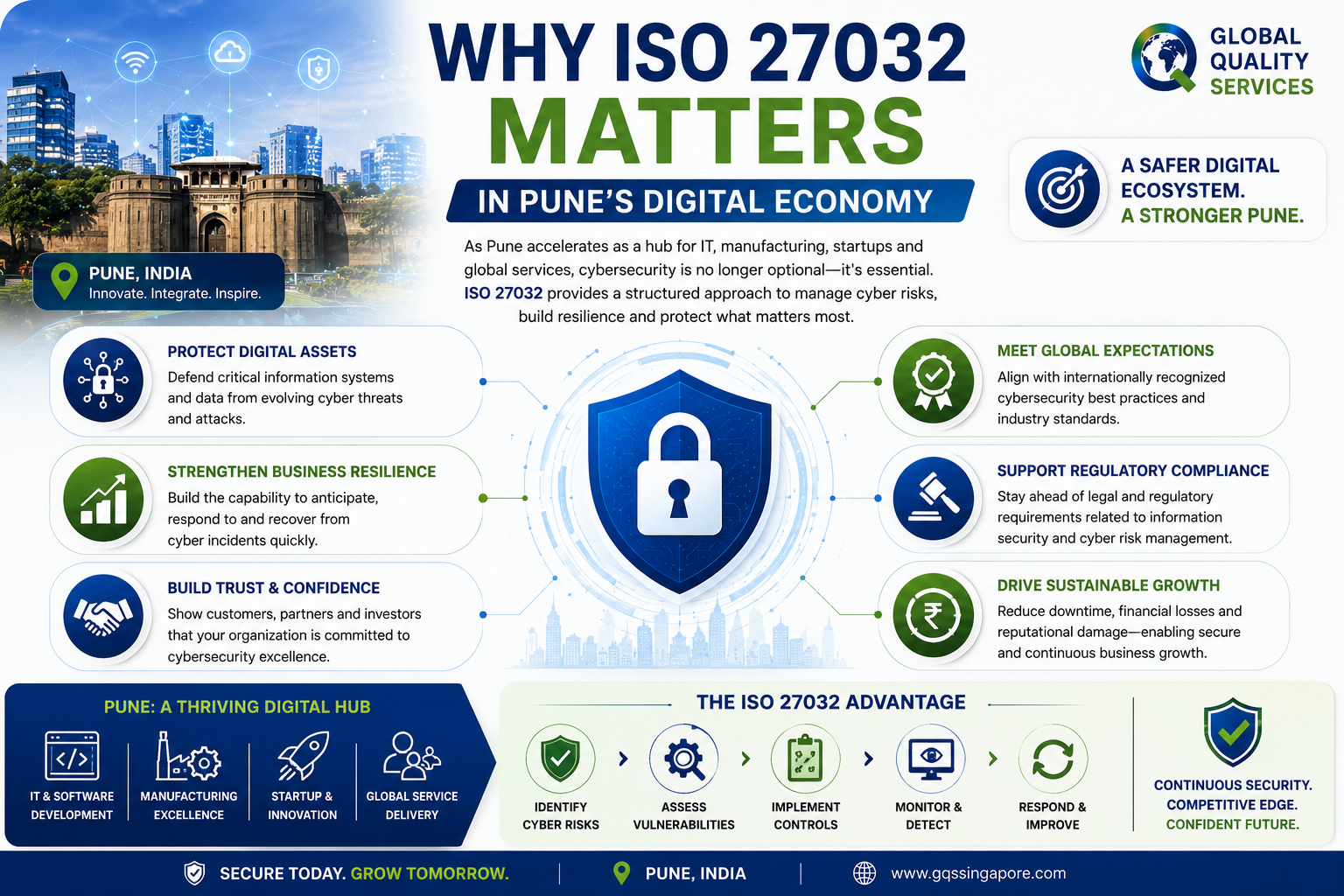
A software company may host applications in the cloud. A manufacturer may connect production environments with enterprise software. A fintech platform may exchange information through APIs. A global service provider may grant employees remote access to clients’ systems in other countries.
Each connection introduces potential cybersecurity considerations. A weakness does not necessarily remain confined to the system where it originates. Stolen credentials could be used against a cloud service. An insecure application could expose information. A compromised vendor account could create access to another environment.
This is why Internet security needs to be viewed as a connected business issue rather than solely as an IT function. ISO/IEC 27032 provides guidance to help organisations understand these relationships and consider Internet security alongside web security, network security, and broader cybersecurity.
What Does ISO/IEC 27032:2023 Actually Address?
ISO/IEC 27032:2023 is intended for organisations that use the Internet. Its official scope includes an overview of Internet security, an explanation of how Internet security relates to other security domains, identification of relevant interested parties, and high-level guidance on common Internet security issues. For a Pune organisation, this can translate into several practical areas.
Internet-Facing Systems
The organisation needs visibility of the systems that are accessible through the Internet. These may include websites, web applications, APIs, cloud platforms, remote-access services, customer portals, email infrastructure and other externally accessible services. Knowing what is exposed is an essential first step. An organisation cannot properly manage an Internet-security risk if it does not know that a particular service exists or who is responsible for it.
Web and Application Security
Modern businesses often rely on applications to communicate with customers, employees and suppliers. Security therefore needs to be considered throughout the application lifecycle. Authentication, access permissions, software vulnerabilities, configurations, development practices and maintenance can all affect the security of an Internet-facing application.
The Guidelines for Indian Government Websites and Apps published by the Government of India include security guidance covering areas such as authentication, encryption, access control, secure coding, logging and patch management. These guidelines apply to government websites and applications, but they can also provide useful reference points when businesses review the security of their own online platforms.
Network Security
Applications cannot be separated completely from the networks on which they operate. Pune organisations may have offices, cloud environments, production facilities, remote workers and third-party connections spread across different locations. Network architecture, segmentation, access restrictions, monitoring and secure configurations can therefore form important parts of an organisation’s wider cybersecurity approach.
Stakeholder Coordination
Cybersecurity responsibilities may extend beyond the organisation. Cloud providers, software vendors, managed service providers, Internet service providers, customers, and business partners can all be part of a connected digital environment. ISO 27032 recognises the importance of understanding the roles of different interested parties and coordinating Internet-security activities accordingly.
ISO 27032 and ISO 27001: Which One Does Your Business Need?
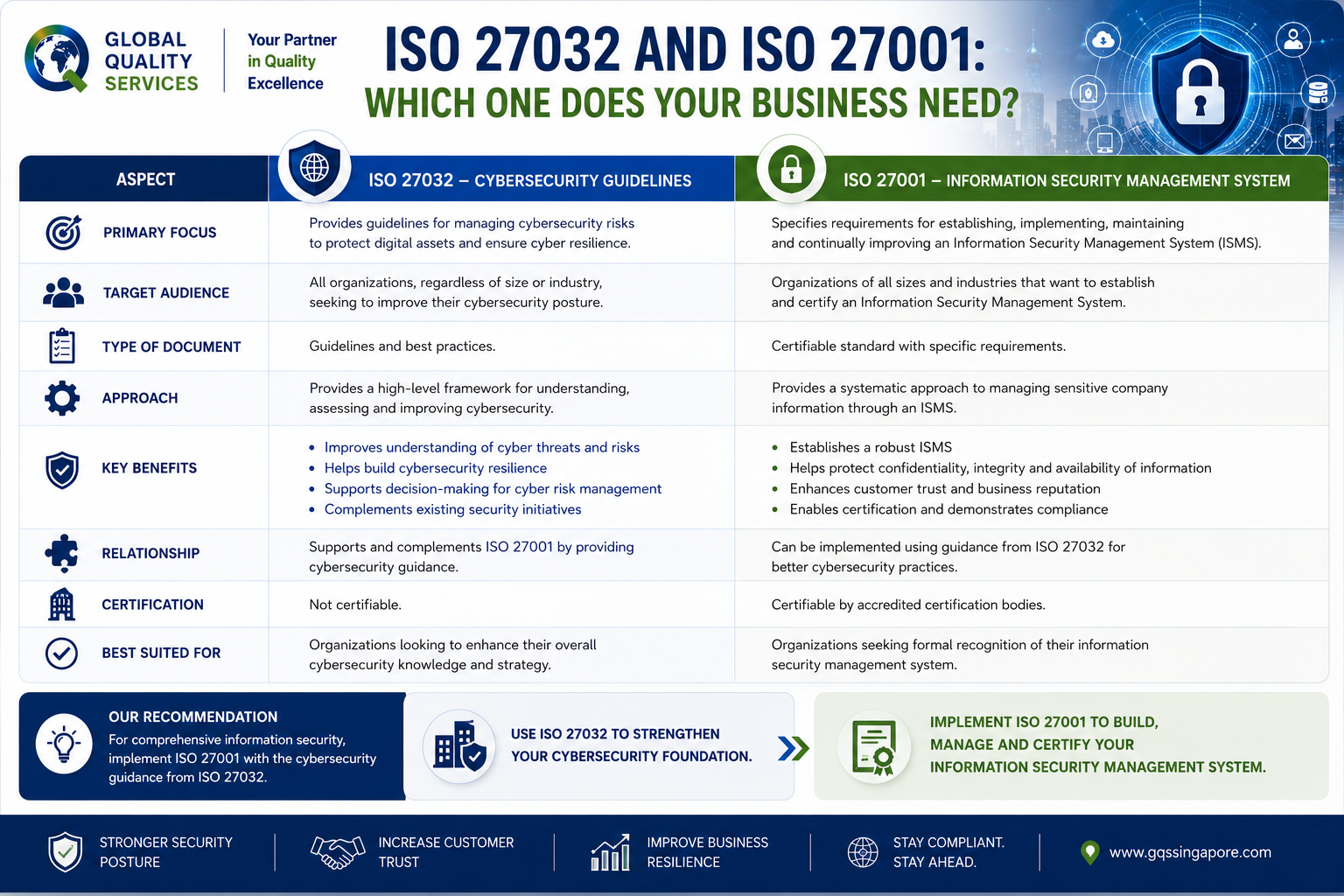
ISO 27032 is sometimes confused with ISO 27001 because both address information and cybersecurity. They are not interchangeable.
ISO 27001 Certification provides requirements for an Information Security Management System. It gives organisations a formal management framework for identifying risks, selecting appropriate controls, monitoring performance and continually improving information security. ISO/IEC 27032:2023, in comparison, provides guidance specifically around Internet security.
For example, a Pune SaaS provider could establish an ISMS in accordance with ISO 27001, using ISO 27032 guidance to take a closer look at its cloud applications, APIs, online services, and external connections. This combination can be useful when an organisation needs both organisation-wide information-security governance and a stronger focus on Internet-facing risks.
ISO 27032 Consultancy Process in Pune
A useful cybersecurity programme should produce more than a collection of policies. The organisation should understand its risks, know who is responsible for managing them and have controls that work in everyday operations.
1. Digital Environment Review
The first stage is to understand how the organisation uses the Internet. GQS reviews the systems, applications, services and external connections that form part of the organisation’s digital environment. For a SaaS business, the focus may be cloud infrastructure and APIs. For an engineering company, attention may be given to remote connectivity and supplier access. For a manufacturing business, connected operational environments may require consideration.
2. Scope and Responsibility Mapping
The organisation then determines which systems, departments, locations and external parties are relevant to the cybersecurity programme. Responsibilities are clarified so that security tasks do not fall between different teams. This is particularly important in environments where IT operations, application development, information security and external technology providers share responsibilities.
3. Cybersecurity Gap Assessment
Existing security practices are reviewed against the relevant ISO 27032 guidance. The assessment may reveal gaps in areas such as:
- User access
- Authentication
- Internet-facing applications
- Network protection
- Security monitoring
- Incident handling
- Third-party relationships
- Cybersecurity awareness
The purpose is not simply to produce a list of weaknesses. Findings should be connected to business risks and prioritised accordingly.
4. Risk Evaluation and Prioritisation
Different vulnerabilities create different levels of exposure. An issue affecting a public-facing customer application may require faster attention than a low-impact internal system.
GQS can assist the organisation in evaluating risks based on the importance of the asset, possible threats, vulnerabilities and consequences of compromise. This helps management decide where to direct cybersecurity resources.
5. Security Improvement Planning
Once priorities are established, the organisation can develop an improvement roadmap. Depending on the findings, this may involve strengthening authentication, reviewing access privileges, improving network segmentation, securing applications, updating systems, improving monitoring or formalising incident-response procedures. The measures should be proportionate to the organisation’s actual risk profile.
6. Policies and Operational Procedures
Cybersecurity controls need supporting processes. Policies and procedures can establish expectations for areas such as access management, incident reporting, secure development, third-party security and acceptable system use. The documentation should reflect actual operations. A policy that employees cannot realistically follow will not provide meaningful protection.
7. Employee Awareness
Employees remain an important part of cybersecurity. Awareness programmes can address phishing, suspicious links, password security, authentication, information handling, remote working and incident reporting. The aim is to help employees recognise how everyday decisions can affect the organisation’s security.
8. Internal Review and Corrective Action
After controls and procedures have been introduced, an internal review can determine whether they are working as intended. Any identified gaps can be documented and corrective actions assigned to appropriate personnel. For organisations pursuing ISO 27001 at the same time, this review can also contribute to broader ISMS readiness.
9. External Assessment Route
The final route depends on what the organisation actually wants to achieve. If the objective is to adopt ISO 27032 guidance, the organisation can assess its practices against the applicable guidance.
If formal ISO certification is required, the organisation should identify the appropriate certifiable standard. ISO 27001 is generally the relevant management-system certification framework for information security. This distinction is important because ISO/IEC 27032:2023 is published by ISO as an International Standard providing guidelines for Internet security, not as an ISO management-system certification standard.
Cybersecurity Compliance Requirements for Pune Businesses
ISO 27032 should complement, rather than replace, applicable Indian legal and regulatory requirements. Businesses need to determine which obligations apply based on their industry, systems, information and services.
The CERT-In Cyber Security Directions issued under Section 70B of the Information Technology Act, 2000 address information security practices, prevention, response, and reporting of cyber incidents. CERT-In is the Indian Computer Emergency Response Team under the Ministry of Electronics and Information Technology.
Organisations handling digital personal data should also monitor India’s privacy framework. The Ministry of Electronics and Information Technology published the Digital Personal Data Protection Rules, 2025 on 14 November 2025, alongside information on the enforcement timeline and Data Protection Board of India.
The rules specify different commencement timelines for different provisions. For example, Rules 1, 2 and 17 to 21 came into force upon publication, while Rule 4 is scheduled to come into force one year after publication and Rules 3, 5 to 16, 22 and 23 eighteen months after publication. This is why businesses should not assume that implementing an ISO standard by itself establishes statutory compliance.
Industries in Pune That Can Benefit
IT and Software Development
Pune’s technology businesses frequently build and manage applications that communicate with customers, employees and other systems. ISO 27032 guidance can help such organisations consider security across their Internet-facing environment.
SaaS and Cloud Businesses
Cloud-based businesses may have customers accessing applications from multiple locations. Protecting authentication, APIs, application infrastructure and external integrations becomes particularly important. GQS also provides SOC 2 services in Pune for organisations seeking assurance around security and other applicable trust-service criteria.
Automotive and Engineering
Pune’s automotive and engineering ecosystem increasingly uses connected technologies, digital supply chains and remote services. Cybersecurity therefore needs to account for connections between business systems, suppliers and technology platforms.
Manufacturing
Manufacturers increasingly use connected production environments, enterprise applications and remote monitoring. Internet-security considerations can become relevant wherever operational environments interact with external networks or digital services.
Financial Technology
Fintech businesses operate highly connected digital platforms and often depend on APIs, online authentication and external service providers. A structured cybersecurity approach can help identify risks across these interconnected services.
Global Capability and Outsourcing Centres
Organisations serving international customers may need to demonstrate mature security practices before entering or retaining client relationships. A structured cybersecurity programme can support customer assurance and complement contractual security requirements.
Benefits of ISO 27032 for Pune Organisations
Let us know the benefits of ISO 27032 Certification in Pune:
Greater Visibility Across the Digital Environment
Organisations can develop a clearer understanding of what systems are exposed, how they connect and who is responsible for protecting them.
Better Prioritisation of Cyber Risks
Rather than treating every vulnerability equally, businesses can focus attention on weaknesses that could create the greatest operational or information-security impact.
Stronger Application and Network Security
Considering web applications, networks and Internet services together can reveal weaknesses that may not be obvious when each area is reviewed independently.
Clearer Security Responsibilities
Defining the roles of internal departments and external service providers can reduce confusion during normal operations and security incidents.
Improved Incident Preparedness
A documented approach to identifying, reporting and responding to incidents can help an organisation react more consistently when a cybersecurity event occurs.
Better Management of External Dependencies
Cloud platforms, software vendors and other service providers can introduce risks that sit outside an organisation’s immediate infrastructure. Reviewing these relationships can improve overall cybersecurity visibility.
Stronger Client Confidence
For Pune organisations serving international customers, demonstrating a structured cybersecurity approach can support due diligence and vendor-security discussions.
A Stronger Foundation for Other Security Frameworks
ISO 27032 can complement broader programmes such as ISO 27001, privacy management and independent security assessments. For example, GQS provides PCI DSS certification services in Pune for organisations whose operations involve payment-card data.
Why Choose GQS for ISO 27032 in Pune?
Global Quality Services has more than 26 years of experience in ISO certification and compliance consulting, according to its current website. Its services cover information security, privacy, cybersecurity, and a range of other management system standards.
GQS can help Pune organisations approach ISO 27032 in line with their specific technology environment rather than relying on a generic cybersecurity checklist. GQS takes a practical approach to cybersecurity consultancy. Instead of starting with documents alone, the organisation’s technology environment and business operations need to be understood first. The assessment can consider:
- Internet-facing applications
- Websites and customer portals
- Cloud services
- APIs and system integrations
- Remote access
- Network architecture
- Third-party technology providers
- User access
- Existing cybersecurity procedures
- Incident-management arrangements
Once the environment is understood, gaps can be prioritised according to risk and business impact. GQS also supports organisations with ISO 27001 certification and consultancy where a formal information-security management system is required. For businesses that handle substantial amounts of personal information, ISO/IEC 27701:2025 certification may also be relevant because it extends information-security management into privacy management.
The approach can be adapted according to organisational size, industry, technology architecture and business objectives.
Frequently Asked Questions
What is ISO 27032 Certification in Pune?
ISO 27032 Certification in Pune generally refers to consultancy, implementation and assessment based on ISO/IEC 27032. The current ISO/IEC 27032:2023 standard provides guidelines for Internet security. It is important to distinguish implementation or assessment against this guidance from formal certification to a certifiable standard such as ISO 27001.
Is ISO 27032 mandatory for businesses in Pune?
No. ISO/IEC 27032:2023 is not a mandatory certification requirement for businesses in Pune. Organisations may adopt its guidance to strengthen cybersecurity, satisfy customer expectations or complement an existing information-security programme.
Can ISO 27032 be implemented with ISO 27001?
Yes. ISO 27001 can provide an organisation-wide framework for information security management, while ISO 27032 can provide additional guidance on Internet security. Using the two together can be particularly useful for organisations with extensive Internet-facing systems.
Is ISO 27032 useful for manufacturing companies?
Yes. Manufacturing businesses increasingly depend on connected technologies, enterprise applications, remote access and digitally connected suppliers. Where these environments interact with Internet-connected systems, ISO 27032 guidance can help organisations consider the associated security risks.
Does ISO 27032 provide CERT-In compliance?
No. Implementing ISO 27032 does not automatically make an organisation compliant with CERT-In requirements. Applicable businesses need to separately assess the CERT-In Cyber Security Directions and other requirements relevant to their operations.