
Bengaluru’s tech hubs are scaling fast, but so are global cyber risks. Securing internal networks is no longer enough when cloud integrations, APIs, and public endpoints expose your platform to external threats. ISO 27032 Certification provides the exact framework needed to safeguard your cyberspace operations, combat phishing, and prevent critical supply-chain breaches.
According to NCRB data reported by The News Minute, Bengaluru recorded 17,561 cybercrime cases the highest among Indian metros. Partnering with an experienced ISO 27032 consultant speeds up implementation, cuts audit friction, and seals complex security gaps fast.
What is ISO/IEC 27032
ISO 27032 certification provides specific guidelines for improving cybersecurity, network security, internet security, and Critical Information Infrastructure Protection (CIIP).
Many teams confuse it with ISO 27001. Here is how they differ:
- ISO 27001: Builds an Information Security Management System (ISMS) within your organizational boundaries. It focuses on access controls, physical security, asset management, and internal policies.
- ISO 27032: Addresses risks originating outside your direct control. It sets a framework for dealing with cross-border threats, web application risks, social engineering attacks, and vulnerability sharing between external partners.
Why Bengaluru Tech Hubs Are Adopting ISO 27032
- Vendor Due Diligence for Global Clients: US and EU enterprise clients expect vendors to prove they can withstand supply-chain attacks, API breaches, and cloud vulnerabilities.
- Defending High-Target Vector Areas: FinTech platforms in Koramangala and HealthTech platforms in Indiranagar handle sensitive transactional data that travels through third-party payment gateways and public endpoints.
- Closing Gaps in ISO 27001: An ISO 27001 audit confirms internal policies are documented. ISO 27032 verifies active defense mechanisms against real-world attack vectors like phishing, advanced persistent threats (APTs), and zero-day exploits.
The Core Focus Areas of ISO 27032 Implementation
Achieving readiness for ISO 27032 requires engineering and security operations teams to focus on four primary domains:
| Pillar | Focus Area | Real-World Execution |
| Information Security | Data integrity in transit | End-to-end payload encryption, strict secrets management, API token expiration protocols |
| Network Security | Infrastructure defense | DDoS mitigation, intrusion prevention systems (IPS), micro-segmentation in cloud VPCs |
| Internet Security | Public-facing applications | OWASP Top 10 mitigation, web application firewalls (WAF), secure CI/CD build pipelines |
| CIIP | High-availability resilience | Multi-region cloud failover, automated backup verification, dependency risk tracking |
5 Steps to Getting ISO 27032 Certified in Bengaluru
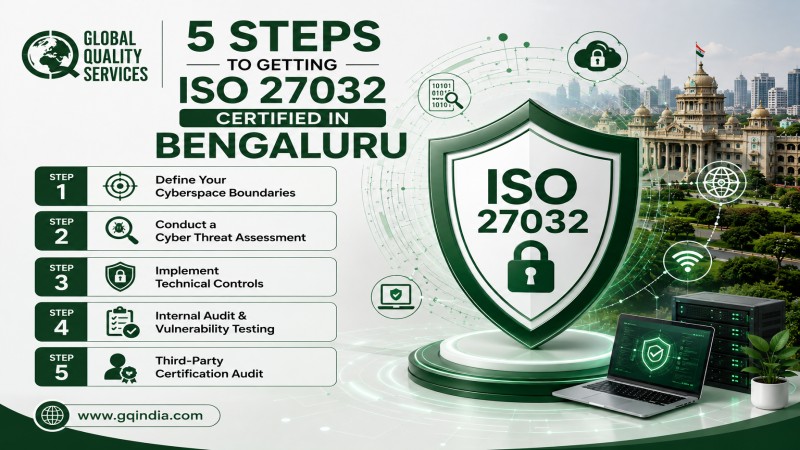
Step 1: Define Your Cyberspace Boundaries
Map every point where your software systems touch external networks. This includes third-party SaaS integrations, cloud storage buckets, remote employee endpoints, and customer-facing mobile apps.
Step 2: Conduct a Cyber Threat Assessment
Move beyond standard internal risk registers. Run technical threat modeling exercises targeting:
- Phishing and credential stuffing on public forms.
- Man-in-the-middle (MitM) attacks on API endpoints.
- Dependency risks in open-source software libraries.
Step 3: Implement Technical Controls
Deploy specific measures required by the standard:
- Application Security: Mandate static (SAST) and dynamic (DAST) code analysis before production releases.
- Incident Response: Establish automated logging and alerting via SIEM tools to monitor suspicious traffic spikes or unauthorized API calls.
- Vendor Risk Protocols: Require explicit security standards for third-party vendors touching your code base or data pipelines.
Step 4: Internal Audit & Vulnerability Testing
Run full-scope penetration testing across all public-facing endpoints. Document remediations, verify patch management workflows, and conduct an internal audit against the ISO 27032 checklist.
Step 5: Third-Party Certification Audit
Engage an accredited ISO certification body in Bengaluru. The audit occurs in two phases:
- Stage 1 Audit: The auditor reviews risk management frameworks, policy documentation, and system architecture diagrams.
- Stage 2 Audit: The auditor inspects live systems, technical logs, incident response logs, and penetration test reports to verify active compliance.
Benefits of ISO 27032 Certification in Bengaluru
Securing internal assets is only half the battle when public endpoints, cloud APIs, and external supply chains remain exposed to cyber risks. Implementing ISO 27032 creates a dedicated defense strategy against internet-borne threats, ensuring seamless protection across every digital interaction point.
- Mitigates Advanced Cyber Threats: Safeguards your public applications and data pipelines from complex vectors like phishing, APTs, and zero-day exploits.
- Strengthens Supply Chain Security: Verifies that third-party integrations, vendor APIs, and external services meet strict security protocols.
- Accelerates Global Client Onboarding: Serves as tangible proof to international buyers and enterprises that your cloud infrastructure handles data securely.
- Enhances Web and Application Resilience: Integrates secure coding, web application firewalls, and continuous vulnerability scanning into your build pipelines.
- Improves Incident Response Speed: Establishes clear, automated playbooks to detect, isolate, and mitigate breaches before they impact live operations.
- Builds Greater Stakeholder Trust: Reassures customers, partners, and investors that their digital interactions with your platform are systematically protected.
Why Choose Global Quality Services for ISO 27032 Certification Services
Securing your cyberspace operations requires deep compliance expertise. With over 26 years of industry-leading experience, Global Quality Services is a trusted partner for seamless ISO 27032 certification.
We offer end-to-end certification services spanning ISO standards, IT security, food safety, and custom auditing solutions tailored to your business needs. Our team simplifies complex gap assessments, builds practical frameworks, and guarantees smooth audit success. Ready to fortify your digital footprint? Contact Global Quality Services for hassle-free, expert-led ISO certification!
FAQ’s
1. How long does it take to get ISO 27032 certified?
The end-to-end certification process typically takes 6 to 12 weeks. The timeline varies based on your organization’s current cloud security posture, architecture complexity, and implementation readiness.
2. How much does ISO 27032 certification cost in Bengaluru?
Total costs range between ₹1.5 Lakhs to ₹4.5 Lakhs, depending on employee headcount, cloud ecosystem scope, and chosen accredited certification body.
3. Are there any mandatory prerequisites before applying for ISO 27032?
No formal prerequisites exist. However, having an operational ISO 27001 framework or robust CI/CD security controls significantly speeds up the compliance process.
4. How long is the ISO 27032 certificate valid?
The certificate remains valid for 3 years. Maintaining active compliance requires passing annual surveillance audits to verify continuous threat monitoring.
5. Can small startups or early-stage SaaS firms get ISO 27032 certified?
Yes, the framework scales to any company size. Early-stage SaaS startups use it to satisfy enterprise vendor due diligence requirements faster during global sales deals.