Pune has a strong mix of technology companies, automobile businesses, educational institutions, corporate offices and cultural organisations. This creates a steady demand for conferences, exhibitions, seminars, employee events, product launches, festivals and other organised gatherings.
As event expectations change, successful delivery is no longer only about venue arrangements, attendance and smooth execution. Organisations are also expected to consider how an event uses resources, treats people, manages suppliers and affects the surrounding community.
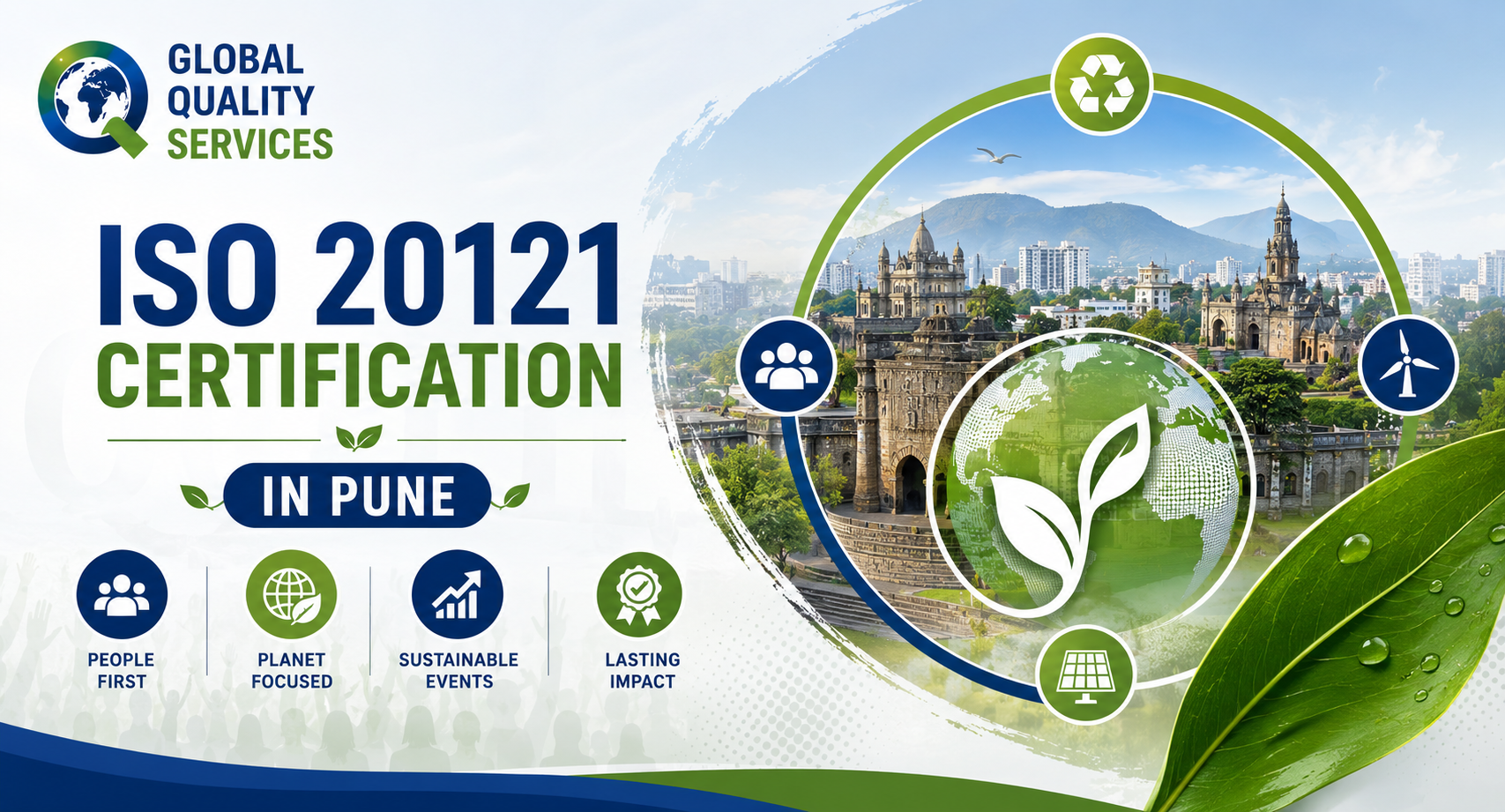
ISO 20121 Certification in Pune helps organisations establish a systematic approach to sustainable event management. The framework brings environmental, social and economic considerations into event planning instead of handling sustainability as a separate activity.
Global Quality Services (GQS) supports organisations in understanding ISO 20121:2024, developing the required management system and preparing for an appropriate conformity assessment or third-party certification process.
What Is ISO 20121?
ISO 20121:2024 is the current international standard for Event Sustainability Management Systems. It applies to events of different types and sizes and helps organisations manage their social, economic and environmental impacts. The 2024 edition was published in April 2024 and replaced ISO 20121:2012.
Organisations can refer to the official ISO 20121:2024 standard for its scope and requirements.
The standard does not prescribe one fixed method for organising a sustainable event. Instead, it provides a management framework through which an organisation can identify relevant sustainability issues, establish objectives, control operations, engage stakeholders and improve performance.
ISO also recognises different ways of demonstrating conformity, including self-declaration, supplier validation and third-party certification.
Why ISO 20121 Matters for Pune’s Event Industry
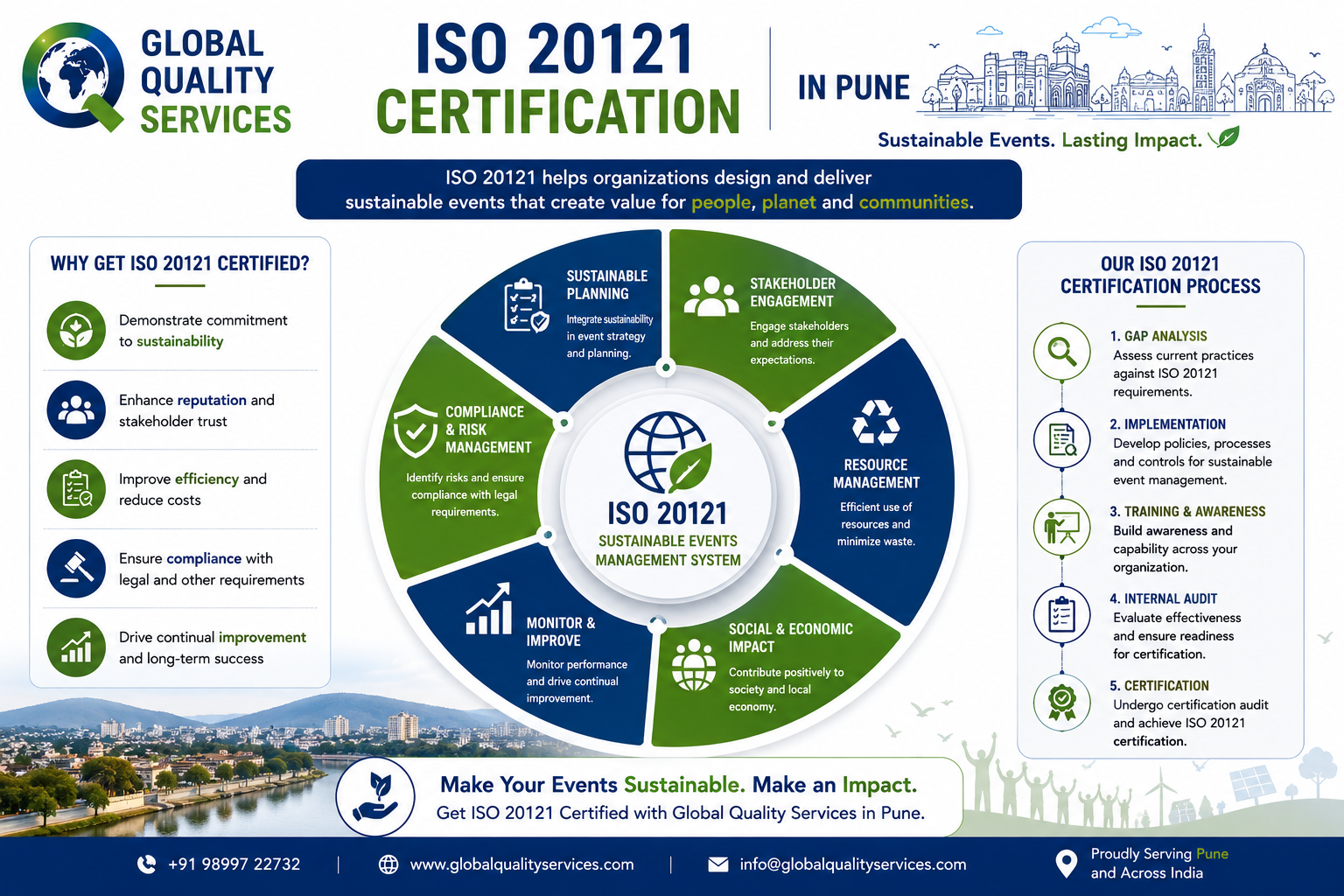
An event in Pune may involve a venue, caterers, decorators, transport providers, technology suppliers, security teams, temporary staff, exhibitors and many other service providers.
Managing sustainability across such a network can become difficult when every party follows its own approach.
For example, an exhibition organiser may control venue arrangements but rely on exhibitors for booth construction and waste management. A corporate conference may depend on external caterers, transportation providers and audiovisual suppliers. A university event may involve students, faculty, contractors and visitors.
ISO 20121 helps organisations establish a common management approach for such situations.
Instead of asking only, “How do we run the event?”, the organisation also considers questions such as:
- What resources will the event consume?
- Which sustainability impacts are most significant?
- What do attendees and clients expect?
- How will suppliers contribute?
- How will waste be managed?
- Are the event facilities accessible and inclusive?
- How will performance be measured afterwards?
This makes sustainability part of event decision-making from the beginning.
ISO 20121 and Event Stakeholder Management
One of the important elements of sustainable event management is understanding stakeholders.
A Pune event may involve corporate clients, sponsors, attendees, employees, exhibitors, venue owners, suppliers, local communities and government or regulatory authorities. Each group can have different expectations.
For example, attendees may expect accessible facilities, while clients may have specific sustainability targets. Suppliers may need clear environmental or social requirements before they can meet them.
An ISO 20121 management system helps organisations identify relevant interested parties and consider their expectations while establishing event objectives and controls.
This can lead to better communication and fewer surprises during event delivery.
Sustainable Procurement for Pune Events
Procurement decisions can influence an event long before guests arrive.
Consider a conference that requires furniture, banners, badges, catering materials, lighting, transportation and temporary equipment. Choosing products and suppliers without considering their wider impact can increase waste, transportation requirements and unnecessary resource consumption.
Under an ISO 20121 approach, sustainability considerations can be incorporated into purchasing and supplier evaluation.
Organisations may establish criteria around:
- Reusable or recyclable materials
- Packaging
- Resource efficiency
- Transportation requirements
- Waste-management practices
- Labour and social considerations
- Supplier environmental practices
- Product durability
The exact criteria should reflect the organisation’s event objectives rather than becoming a generic checklist.
Managing Waste During Events
Waste is often one of the easiest sustainability impacts to see at an event.
Food leftovers, disposable serving products, packaging, printed material, exhibition materials and temporary decorations can accumulate quickly when an event attracts hundreds or thousands of participants.
Pune Municipal Corporation has undertaken initiatives relating to waste management and resource efficiency. For example, its 2025 e-cart pilot initiative involved electrifying traditional waste-collection pushcarts to make collection more energy-efficient and environmentally friendly.
Event organisers can complement local waste-management arrangements by planning segregation, collection, storage and responsible disposal within their own event operations.
Organisations should also consider applicable national requirements. The Government of India notified the Solid Waste Management Rules, 2026, which came into force on 1 April 2026 and cover urban and rural local bodies as well as commercial, institutional and other non-residential solid waste generators.
The official Solid Waste Management Rules, 2026 can be reviewed when determining which requirements apply to a particular event or organisation.
Social Sustainability and Inclusion
A sustainable event should consider both people and resources.
Accessibility, inclusivity, health and safety, worker welfare, and human rights considerations can influence how an event is planned and delivered.
For example, an organisation may review whether attendees with different accessibility needs can use the venue comfortably, whether temporary workers receive appropriate instructions and facilities, and whether suppliers understand relevant social requirements.
The 2024 edition of ISO 20121 places greater emphasis on social legacies, inclusivity, human rights and children’s rights.
For Pune organisations, this can be especially useful when events involve educational institutions, public participation, large employee groups or diverse audiences.
ISO 20121 Certification Process in Pune
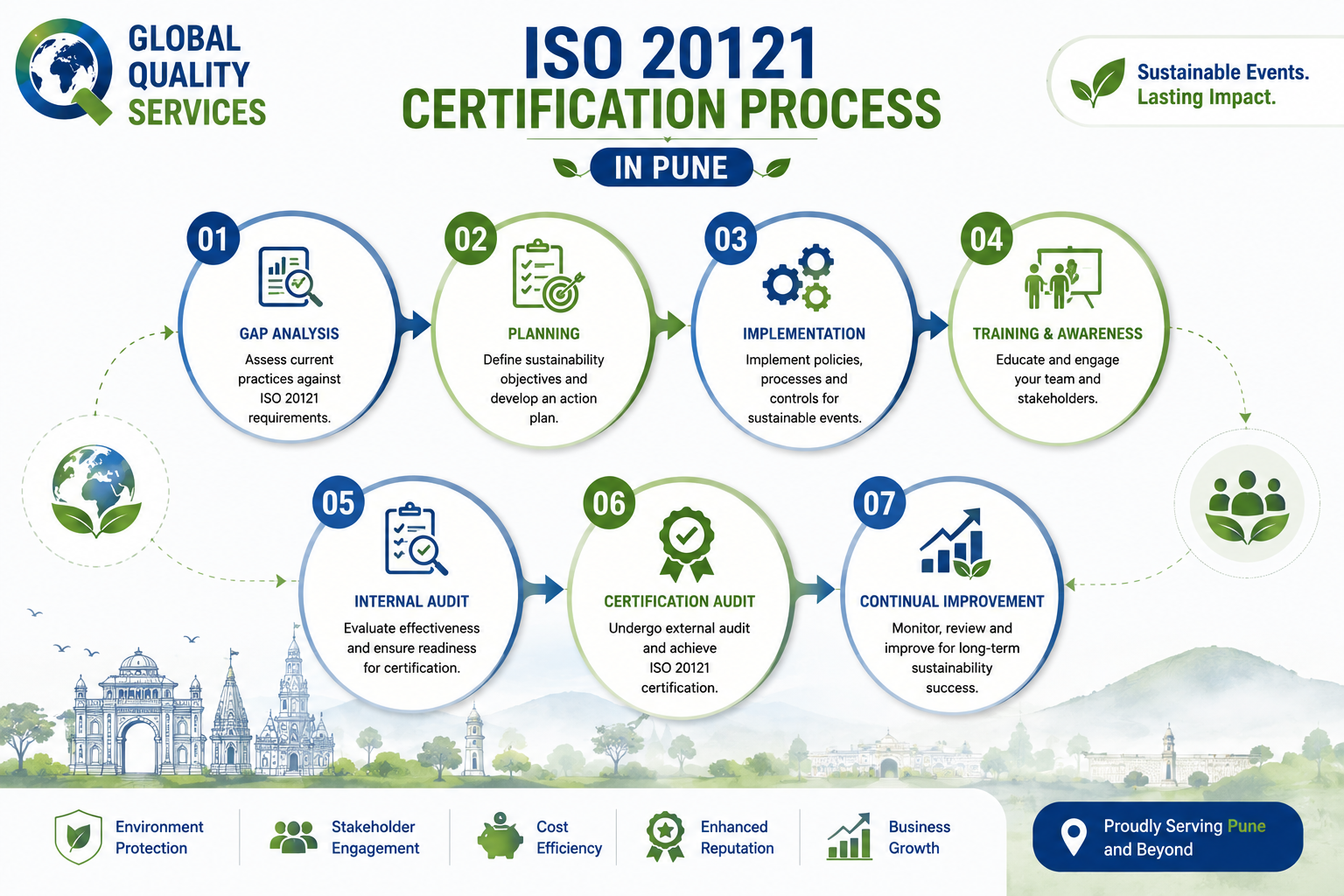
GQS follows a structured approach to help organisations establish an event sustainability management system.
1. Understanding Your Event Activities
The process starts by understanding your organisation, event portfolio and existing sustainability practices. An event agency organising exhibitions will have different requirements from a university, hotel, corporate office or conference venue.
2. Defining the Scope
The relevant activities, events, locations and responsibilities are identified. A clearly defined scope prevents the management system from becoming unnecessarily complicated and ensures that important event activities are properly covered.
3. Identifying Impacts and Stakeholders
The organisation identifies its significant environmental, social and economic impacts and determines which stakeholders need to be considered. This stage creates the foundation for setting meaningful sustainability objectives.
4. Gap Assessment
Existing practices are compared with applicable ISO 20121:2024 requirements. The assessment may identify gaps involving procurement, supplier management, event planning, documentation, communication, resource use, waste management or performance evaluation.
5. Developing the Management System
Relevant policies, procedures, objectives, responsibilities and operational controls are established. The documentation should support real event activities rather than becoming paperwork that employees rarely use.
6. Implementation and Monitoring
The organisation applies the system to its event operations. Relevant employees and suppliers are informed about their responsibilities, while appropriate records are maintained. Performance indicators can then be monitored against established sustainability objectives.
7. Internal Review
An internal audit or structured internal review helps determine whether the system has been implemented effectively. Management can then review results, address weaknesses and identify opportunities for improvement.
8. External Assessment
If the organisation chooses third-party certification, an appropriate certification body evaluates the management system against ISO 20121 requirements. GQS can support the organisation in preparing for this assessment and addressing identified gaps.
Benefits of ISO 20121 Certification in Pune
Let us have a look at the benefits of ISO 20121 Certification in Pune:
Better Event Planning
Sustainability is considered during planning rather than added at the final stage. This gives organisers more time to influence decisions about venues, suppliers, transport, materials and resources.
Improved Supplier Control
Event delivery depends heavily on external suppliers. A structured system helps organisations communicate sustainability expectations and evaluate supplier performance more consistently.
Reduced Resource Consumption
Planning the use of energy, water, food, materials and transport can help identify unnecessary consumption and opportunities for more efficient operations.
Better Waste Management
Waste-reduction objectives can be incorporated into procurement and event planning. This can help organisations prevent unnecessary waste instead of focusing only on disposal after the event.
Stronger Stakeholder Engagement
Understanding stakeholder expectations can improve communication with clients, attendees, sponsors, suppliers and other interested parties.
Support for Inclusive Events
Social considerations can be incorporated into event planning, helping organisations address accessibility, inclusion, worker welfare and other relevant people-related issues.
Stronger Business Reputation
A systematic approach to event sustainability can strengthen an organisation’s credibility with clients, sponsors and business partners who have sustainability expectations.
Continual Improvement
Post-event reviews provide an opportunity to learn from actual results. Organisations can use this information to improve future events rather than starting from scratch each time.
Who Needs ISO 20121 in Pune?
ISO 20121 can be useful for organisations involved in the planning, management or delivery of events, including:
- Event management companies
- Exhibition organisers
- Conference and seminar organisers
- Hotels and event venues
- Corporate event teams
- Educational institutions
- Sports-event organisers
- Cultural and entertainment organisations
- Wedding and social-event planners
- Catering companies
- Event logistics providers
- Exhibition contractors
- Audio-visual service providers
- Public and private organisations conducting large events
Because ISO 20121:2024 applies to events of all types and sizes, its approach can be adapted according to the organisation’s scope and circumstances.
ISO 20121 vs ISO 14001
ISO 20121 and ISO 14001 are related to sustainability and environmental management, but their intended applications are different.
ISO 14001 provides a framework for an organisation’s environmental management system. It can cover environmental aspects across broader business operations.
ISO 20121 is designed specifically for event sustainability management and considers environmental, social and economic impacts associated with events.
An event company may therefore find ISO 20121 more directly suited to its core operations, while a company seeking broader environmental management may consider ISO 14001.
Why Choose GQS for ISO 20121 Certification in Pune?
Global Quality Services supports organisations with management-system consultancy and certification-related requirements across different industries.
GQS can help organisations understand the requirements of ISO 20121:2024, assess existing practices, identify gaps, establish appropriate processes and prepare for external assessment.
The focus should be on creating a management system that works during actual event planning and delivery. A useful system should help teams make better decisions about suppliers, resources, people and event impacts rather than simply creating documents for an audit.
Organisations considering multiple management systems can also explore GQS’s wider quality certification services as part of a broader certification strategy.
Frequently Asked Questions
1. What is ISO 20121 Certification in Pune?
ISO 20121 certification relates to an Event Sustainability Management System based on ISO 20121:2024. It helps organisations manage environmental, social and economic considerations associated with their events.
2. Is ISO 20121:2024 suitable for small events?
Yes. The standard is intended for events of different types and sizes. Organisations can define a scope and management approach appropriate to their activities.
3. Can educational institutions in Pune implement ISO 20121?
Yes. Colleges and universities organising conferences, festivals, seminars, sports events or other large programmes can use ISO 20121 to structure sustainability planning and event operations.
4. Is ISO 20121 mandatory in India?
No. ISO 20121 is a voluntary international standard. Organisations can choose the conformity route that suits their needs, including third-party certification where appropriate.
5. How long does ISO 20121 certification take?
The timeframe varies according to the organisation’s size, event scope, existing processes, level of documentation and implementation readiness. A gap assessment can help establish a more realistic timeline.