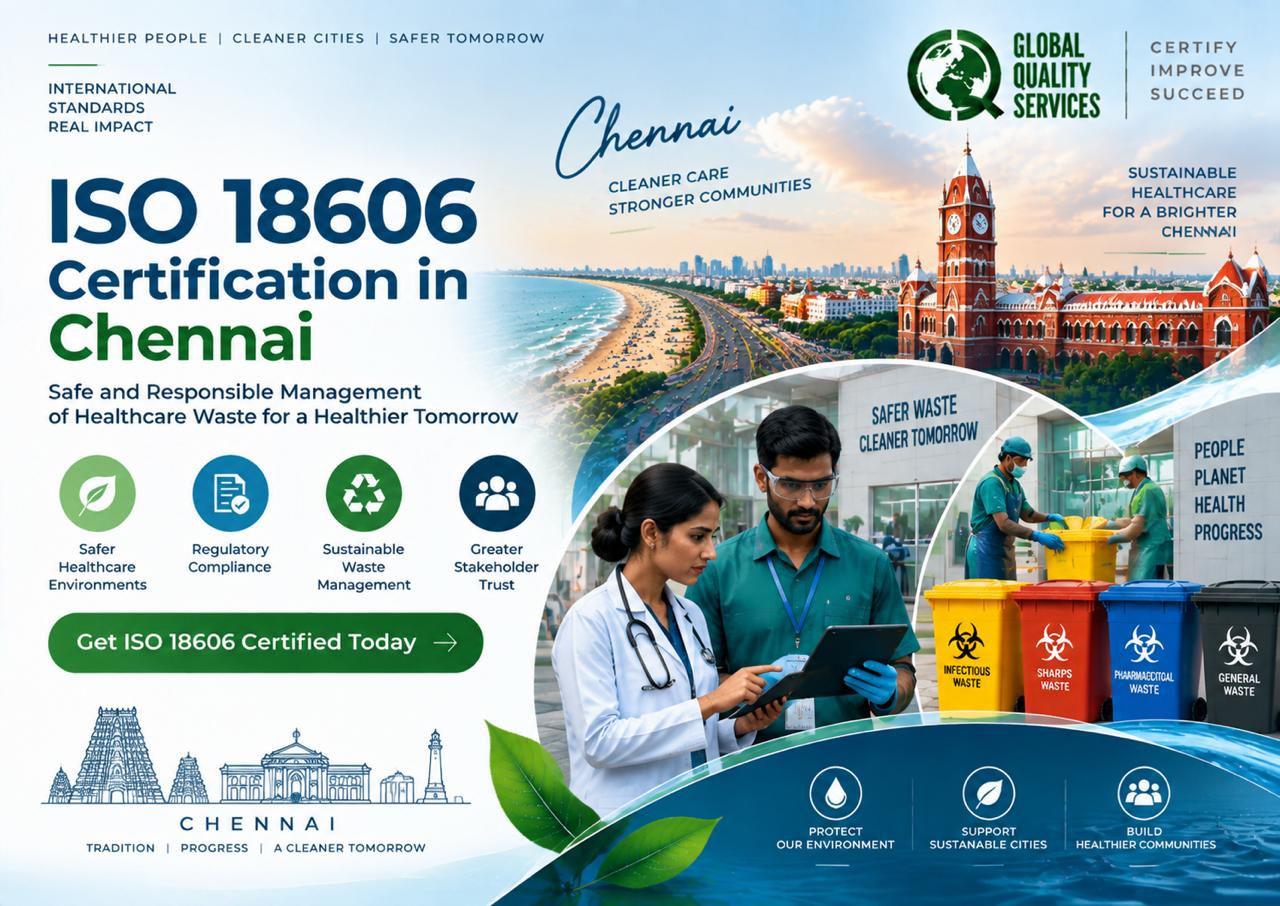
Is your organisation looking for a structured way to reduce packaging waste, improve recycling practices, and support a more circular approach to packaging? ISO 18606 Certification in Chennai can help organisations establish better practices for packaging intended for organic recycling, including composting and biodegradation.
Global Quality Services (GQS India) helps businesses understand and apply ISO 18606 requirements to their packaging, product, waste-management, and supply-chain activities. Our approach helps organisations assess existing practices, identify gaps, improve processes, and prepare for conformity assessment where applicable.
For businesses working towards broader environmental objectives, ISO 18606 can also complement ISO 14001 Environmental Management System and other sustainability-focused initiatives.
What Is ISO 18606?
ISO 18606:2013 is an international standard titled Packaging and the environment — Organic recycling. It establishes requirements for packaging and packaging materials that are suitable for organic recycling.
The standard addresses packaging that is intended to be recovered through organic recycling processes such as industrial composting and anaerobic digestion. It considers characteristics such as biodegradability, disintegration, and the potential effect of packaging materials on the biological treatment process.
For organisations searching for ISO 18606 Certification in Chennai, the standard provides a recognised framework for evaluating whether packaging is suitable for organic recycling and for establishing appropriate controls across the packaging lifecycle.
ISO 18606 is particularly relevant to manufacturers, packaging producers, food businesses, retailers, and organisations seeking to reduce the environmental impact associated with packaging.
Why Is ISO 18606 Important for Businesses in Chennai?
Chennai has a diverse manufacturing, food-processing, retail, logistics, and consumer-goods sector. As organisations face increasing pressure to manage packaging waste responsibly, the ability to demonstrate suitable packaging practices can become an important part of environmental performance.
ISO 18606 provides a structured approach to organic recycling of packaging rather than relying only on general claims such as “eco-friendly” or “green”.
Organisations can use the standard to assess packaging materials and determine whether they are appropriate for organic recycling processes while considering the requirements of the relevant recovery system.
Businesses can also refer to the official Central Pollution Control Board (CPCB) resources for information on India’s environmental regulations and waste-management framework.
Benefits of ISO 18606 Certification in Chennai
Support Organic Recycling
ISO 18606 helps organisations assess packaging intended for organic recycling. This can support better decision-making when selecting materials for composting or other biological treatment processes.
Reduce Packaging Waste
By evaluating packaging materials and their end-of-life characteristics, organisations can identify opportunities to reduce the amount of packaging that becomes conventional waste.
Improve Environmental Performance
ISO 18606 can support broader environmental objectives by encouraging organisations to consider what happens to packaging after its useful life.
Businesses seeking a wider environmental-management framework can also explore ISO 14001 Certification to establish a systematic approach to managing environmental impacts.
Strengthen Packaging Decisions
The standard can help organisations make more informed choices about packaging materials rather than evaluating packaging only on cost, appearance, or functionality.
Support Circular-Economy Objectives
Organic recycling forms part of a broader resource-recovery approach. Applying ISO 18606 can help organisations consider packaging recovery during product and packaging design.
Improve Supply-Chain Communication
Clear requirements for packaging materials can make it easier for manufacturers, suppliers, converters, retailers, and waste-management partners to communicate expectations.
ISO 18606 Certification Process in Chennai
GQS India can help organisations establish a structured approach towards ISO 18606 conformity.
Step 1: Initial Consultation
We first understand your packaging materials, products, manufacturing activities, supply chain, and intended end-of-life recovery route.
This helps determine how ISO 18606 applies to your organisation.
Step 2: Gap Assessment
Existing packaging specifications, material information, supplier documentation, testing records, and environmental practices are reviewed against relevant requirements.
The assessment identifies areas where additional controls or evidence may be required.
Step 3: Packaging and Material Evaluation
Relevant packaging components and materials are assessed based on their intended organic-recycling pathway.
Where testing or technical evidence is required, the organisation can determine the appropriate evaluation route for its packaging.
Step 4: Documentation and Controls
The organisation establishes suitable specifications, responsibilities, records, supplier controls, and processes for maintaining conformity.
Step 5: Implementation
The agreed controls are introduced into relevant procurement, production, quality, packaging, and supply-chain processes.
Employees and responsible teams are made aware of their roles in maintaining the required controls.
Step 6: Assessment and Continual Improvement
The final stage involves reviewing the effectiveness of the implemented arrangements and addressing identified gaps. Ongoing monitoring helps ensure that packaging requirements remain controlled as materials, suppliers, products, or processes change.
ISO 18606 and India’s Packaging Waste Requirements
ISO 18606 should be considered alongside applicable Indian environmental and waste-management requirements.
India has introduced specific regulatory measures relating to plastic packaging and extended producer responsibility. Organisations dealing with plastic packaging should therefore review the applicable requirements under India’s environmental framework.
The official Plastic Waste Management Rules and information published by the Ministry of Environment, Forest and Climate Change (MoEFCC) provide an important government reference point.
Organisations can also refer to the Central Pollution Control Board’s Plastic Waste Management resources for official information relating to plastic-waste management and applicable compliance requirements.
Where an organisation places packaging on the Indian market, it should assess its obligations under the applicable legislation rather than treating ISO 18606 as a substitute for statutory compliance.
ISO 18606 and Compostable Packaging
Compostable packaging is one of the areas where ISO 18606 can become particularly relevant.
However, compostability is not simply a marketing claim. Packaging needs to be evaluated against appropriate technical requirements and the conditions of the intended biological treatment process.
Organisations should also consider whether suitable organic-recycling infrastructure exists for the packaging’s intended disposal route. A packaging material that can technically undergo biological treatment may still require appropriate collection and processing systems to achieve its intended environmental benefit.
This is why packaging design, material selection, labelling, collection, and recovery arrangements should be considered together.
Industries That Can Benefit from ISO 18606 in Chennai
Food and Beverage
Food manufacturers and processors frequently use a wide range of packaging materials. ISO 18606 can help businesses evaluate packaging designed for organic recycling.
Packaging Manufacturing
Packaging producers and converters can use the standard when developing materials intended for composting or other organic-recycling processes.
Retail and E-Commerce
Retailers and online businesses can use suitable packaging requirements when selecting packaging from suppliers and reducing the environmental impact of their packaging operations.
Hospitality and Food Service
Restaurants, catering businesses, and food-service providers can consider ISO 18606 when selecting packaging and food-service items designed for organic recovery.
Consumer Products
Manufacturers of consumer products can incorporate packaging end-of-life considerations into product and packaging design.
How can GQS India help with ISO 18606?
GQS India can assist with gap assessment, interpretation of ISO 18606 requirements, packaging-process review, documentation, supplier controls, implementation support, and preparation for the applicable conformity-assessment process.
Packaging decisions have an impact long after a product reaches the customer. Organisations that consider how packaging can be recovered at the end of its useful life can take a more responsible approach to resource management.
ISO 18606 provides a structured framework for organisations working with packaging intended for organic recycling, helping them evaluate materials, processes, and relevant controls.
Frequently Asked Questions
What is ISO 18606?
ISO 18606 is an international standard providing requirements for packaging and packaging materials intended for organic recycling. It addresses aspects such as biodegradability and disintegration in relevant biological treatment processes.
Is ISO 18606 mandatory in India?
ISO 18606 itself is not a general mandatory legal requirement for all organisations in India. However, businesses must comply with applicable environmental and packaging-waste legislation. ISO 18606 can be used as a recognised framework for suitable packaging intended for organic recycling.
Who needs ISO 18606 Certification in Chennai?
Packaging manufacturers, food businesses, retailers, consumer-product companies, packaging converters, and other organisations developing or using packaging intended for organic recycling may benefit from ISO 18606.
Does ISO 18606 apply only to compostable packaging?
The standard concerns packaging intended for organic recycling and covers relevant requirements for such recovery. Organisations should assess the specific packaging material and intended biological treatment route rather than assuming that every compostable product automatically conforms.