NAID-AAA Certification in India ensures secure, compliant, and confidential destruction of sensitive information in line with international data protection standards. With rising cyber threats and regulatory scrutiny, organisations must protect personally identifiable information, financial records, and business-critical data.
Data sanitization helps reduce premature device destruction by securely erasing information before disposal or reuse, enabling better asset lifecycle management. Implementing NAID-AAA standards demonstrates strong governance, minimizes liability risks, and strengthens stakeholder trust while reinforcing structured, audit-driven information destruction practices across operations.
What is NAID-AAA Certification
NAID-AAA Certification is an internationally recognised accreditation issued by the National Association for Information Destruction (NAID). It validates that an organisation follows stringent procedures for secure destruction of paper records, hard drives, electronic media, and other confidential materials.
The certification verifies operational controls, employee screening, access management, audit trails, and documented destruction processes to prevent data breaches and identity theft risks.
Why NAID-AAA Certification Matters for Indian Businesses
NAID-AAA Certification helps Indian companies protect sensitive records while building immediate credibility with international clients. Throwing away old hard drives or paper files without verification opens the door to devastating data breaches. Partnering with a certified vendor guarantees that your physical and digital media are destroyed using audited forensic-level processes, turning secure disposal into a distinct competitive advantage.
It enhances client confidence, reduces liability exposure, and builds credibility with multinational partners who prioritise certified data destruction vendors. In sectors handling high volumes of sensitive records, certification is no longer optional; it is a competitive necessity. Companies can also follow ISO 20000 for better security.
This standard is now essential under the Digital Personal Data Protection (DPDP) Act in India. The DPDP Act grants individuals the right to erasure, legally obligating businesses to permanently destroy personal data once its purpose is fulfilled.
Key NAID-AAA Benefits
NAID-AAA Benefits extend beyond regulatory compliance by enhancing operational security, reducing legal exposure, and strengthening client trust through verified secure destruction practices.
Verified Secure Destruction Processes
Certification confirms documented procedures, controlled chain-of-custody systems, and monitored destruction methods that minimise risks of data leakage or unauthorised information access during disposal activities.
Reduced Legal and Compliance Risks
By aligning with global destruction standards, organisations significantly lower their exposure to regulatory penalties, litigation, and reputational damage arising from improper data disposal.
Enhanced Customer Trust and Market Credibility
Clients prefer certified service providers. NAID-AAA accreditation signals accountability, transparency, and adherence to internationally benchmarked information security practices.
Strong Internal Governance and Accountability
The certification framework enforces background screening, access controls, process monitoring, and management oversight, strengthening organisational discipline and operational integrity.
Competitive Advantage in Enterprise Contracts
Many corporations and global buyers mandate NAID-AAA-certified vendors, giving certified organisations a clear advantage in tenders, outsourcing contracts, and long-term partnerships.
Who Needs NAID-AAA Certification in India
NAID-AAA Certification is particularly relevant for organisations handling confidential records or providing destruction services, including:
- Document shredding companies
- IT asset disposition (ITAD) providers
- E-waste recycling companies
- Financial institutions
- Healthcare facilities and hospitals
- Insurance companies
- Government contractors
- BPO and data processing firms
NAID-AAA Certification Process
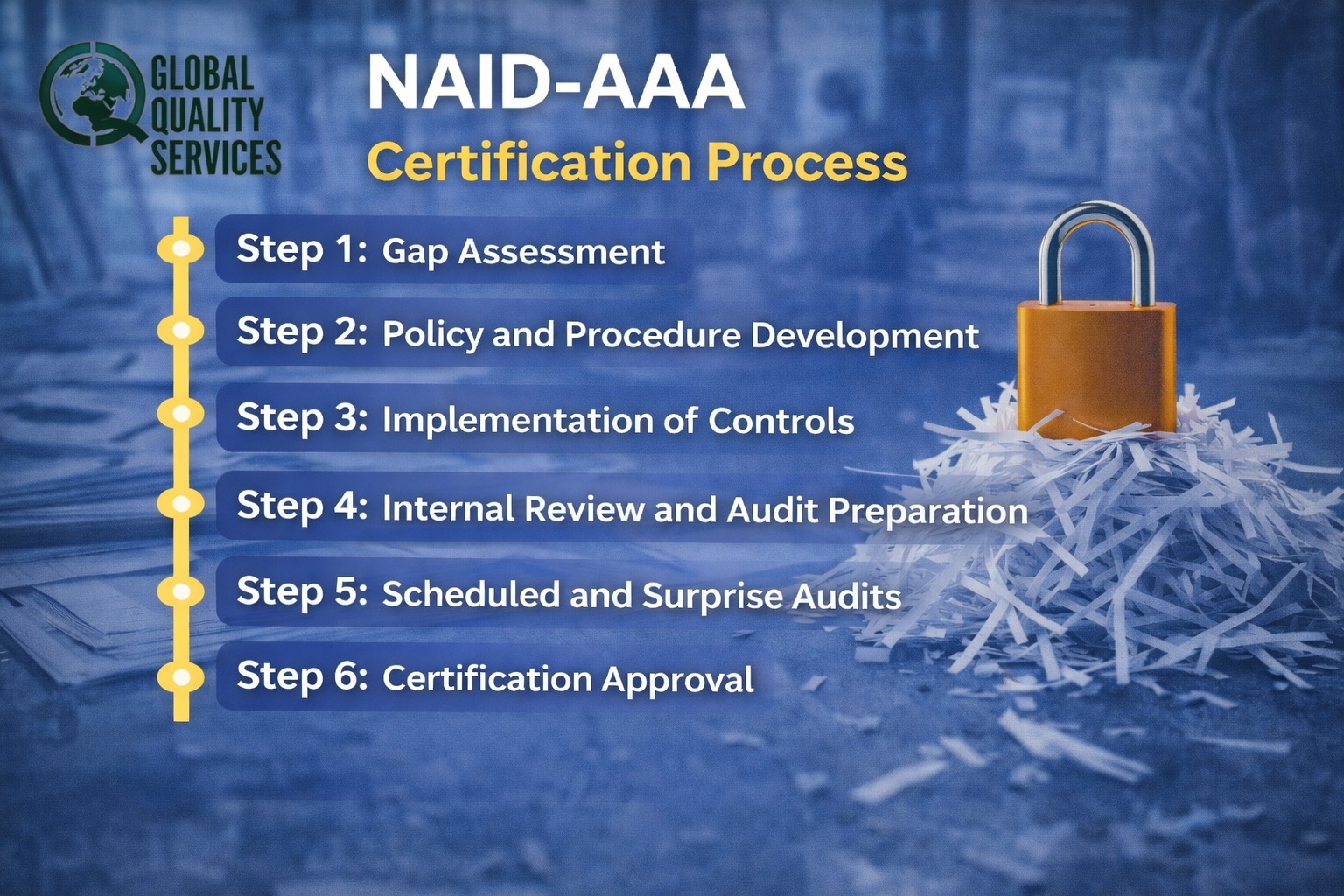
The certification journey follows a structured audit-based evaluation to verify secure destruction practices.
Step 1: Gap Assessment
Evaluate current destruction procedures, security controls, and documentation against NAID-AAA compliance requirements.
Step 2: Policy and Procedure Development
Develop documented policies covering data handling, employee screening, operational security, and chain-of-custody controls.
Step 3: Implementation of Controls
Deploy surveillance systems, secure containers, controlled access zones, and staff training aligned with certification criteria.
Step 4: Internal Review and Audit Preparation
Conduct internal assessments to address gaps and ensure operational readiness before the official audit.
Step 5: Scheduled and Surprise Audits
NAID auditors perform announced and unannounced audits to validate ongoing compliance and real-time operational effectiveness.
Step 6: Certification Approval
Upon successful audit completion, NAID grants AAA Certification, subject to continued compliance and periodic review.
Documents Required for NAID-AAA Certification
Organisations must maintain comprehensive records demonstrating compliance:
- Information Destruction Policy
- Chain-of-Custody Documentation
- Employee Background Verification Records
- Access Control and Surveillance Logs
- Incident Reporting Procedures
- Training and Awareness Records
- Audit Reports and Corrective Actions
- Vendor and Subcontractor Agreements
Cost of NAID-AAA Certification in India
Certification costs vary depending on operational scale, facility size, number of employees, and destruction methods used. Small providers may incur moderate audit and compliance preparation costs, while multi-location enterprises typically require higher investment due to expanded scope and surveillance infrastructure. Professional consultancy support may add to initial expenses but significantly reduces compliance delays and re-audit risks.
How Long Does It Take to Get NAID-AAA Certified
Most small and mid-sized organisations achieve certification within 2 to 4 months, depending on operational readiness. Larger facilities with complex processes may require 4 to 6 months for full implementation and audit clearance.
Common Challenges During NAID-AAA Certification
Businesses often face implementation hurdles such as:
- Incomplete documentation systems
- Lack of structured chain-of-custody processes
- Insufficient employee screening controls
- Limited surveillance infrastructure
- Resistance to operational process changes
Engaging experienced NAID-AAA Consultants helps organisations proactively address these compliance gaps.
NAID-AAA Certification Consultants in India
NAID-AAA Certification in Delhi | NAID-AAA Certification in Bengaluru
NAID-AAA Certification in Noida | NAID-AAA Certification in Hyderabad
NAID-AAA Certification in Ahmedabad | NAID-AAA Certification in Chennai
NAID-AAA Certification in Pune | NAID-AAA Certification in Mumbai
Why Choose NAID-AAA Certification
NAID-AAA Certification in India is a strategic investment in data security and regulatory resilience. It formalises destruction governance, strengthens risk management, protects customer privacy, and positions organisations as trusted custodians of sensitive information.
In an environment where data breaches can severely damage brand reputation and financial stability, certification delivers measurable operational assurance.
Your Trusted Partner for NAID-AAA Certification
Working with specialised NAID-AAA Consultants ensures structured implementation, audit readiness, and long-term compliance sustainability. From gap assessment to audit coordination, expert guidance accelerates certification success while minimising operational disruption.
Contact experienced consultants today to strengthen your organisation’s secure destruction framework and unlock the full spectrum of NAID-AAA Benefits.
FAQ’s
- What is NAID-AAA Certification in India?
It validates that a company follows internationally approved secure destruction practices for confidential information and electronic media. - Is NAID-AAA Certification mandatory in India?
No, it is voluntary, but widely required by enterprises seeking certified data destruction partners. - How long does NAID-AAA Certification take?
Typically 2-4 months for small and mid-sized organisations, depending on readiness and operational complexity. - What are the key requirements for NAID-AAA Certification?
Requirements include documented procedures, employee background checks, chain-of-custody controls, surveillance monitoring, audit compliance, and ongoing operational verification. - Does NAID-AAA Certification improve business opportunities?
Yes. Certification enhances credibility, increases eligibility for enterprise contracts, and builds trust with clients demanding verified data security standards.