As Chennai’s industrial sector accelerates, Tamil Nadu solidifies its position as South Asia’s premier manufacturing engine. State electronics exports reached a record $14.65 billion in FY25, according to official government reports. Known as the “Detroit of Asia,” the region ships over 30% of India’s automotive exports alongside vast consignments of hardware and machinery.
In this high-volume environment, shipping non-compliant goods triggers severe customs delays. A rigorous Second-Party or Third-Party Pre-Shipment Inspection (PSI) guarantees cargo aligns with global quality standards before dispatch.
Partnering with an expert inspection consultant removes compliance complexity. Consultants establish precise AQL defect limits, coordinate field audits, and resolve quality bottlenecks before dispatch, protecting your brand reputation and ensuring seamless export clearance.
What is Second-party / Third-party Pre-shipment Inspection
A Pre-Shipment Inspection (PSI) is a systematic quality evaluation carried out when a minimum of 80% of your production order is fully packaged and ready for dispatch. It checks finished products against your initial purchase order, technical drawings, safety guidelines, and destination market requirements.
Catching errors before cargo leaves the production floor prevents defective shipments from reaching overseas ports, giving international buyers and local manufacturers confidence before settling final payments.
Strategic Value of Pre-Shipment Inspections for Chennai Exporters
Implementing rigorous pre-shipment inspections provides strategic, operational, and financial advantages designed to protect local exporters trading in high-volume global markets:
- Prevents Disastrous Cargo Rejections: Fixing non-conforming batches at production facilities in Ambattur or Irungattukottai costs a fraction of handling rejected containers at European or US ports.
- Unlocks Commercial Letter of Credit (LC) Payments: Financial institutions strictly require an independent, verified inspection certificate before releasing funds under international Letter of Credit agreements.
- Enhances Vendor Credibility: Delivering fault-free components consistently elevates your rating among tier-1 automotive OEMs and global technology buyers.
- Accelerates Port and Air Logistics: Verified documentation and compliant outer-carton barcoding eliminate bottlenecks at Chennai Air Cargo, Ennore, and Kattupalli container terminals.
Key Checkpoints During a Pre-Shipment Audit
A comprehensive pre-shipment evaluation examines every element of your batch using proven statistical sampling frameworks like the Acceptable Quality Limit (AQL) standard:
- Quantity & Workmanship Checks: Verifying total container counts against packing slips while screening for surface blemishes, structural defects, welding flaws, or poor finishing.
- Dimensional & Mechanical Testing: Performing precise physical measurements, electrical safety checks, functional stress runs, and load testing on machinery or parts.
- Packaging & Barcode Compliance: Reviewing shipping marks, handling labels, drop-test durability, and moisture barrier integrity across export cartons.
- Traceability & Record Audits: Validating material certificates, batch codes, Certificates of Analysis (CoA), calibration records, and custom manifest forms.
Our 5-Step Pre-Shipment Inspection Execution Plan
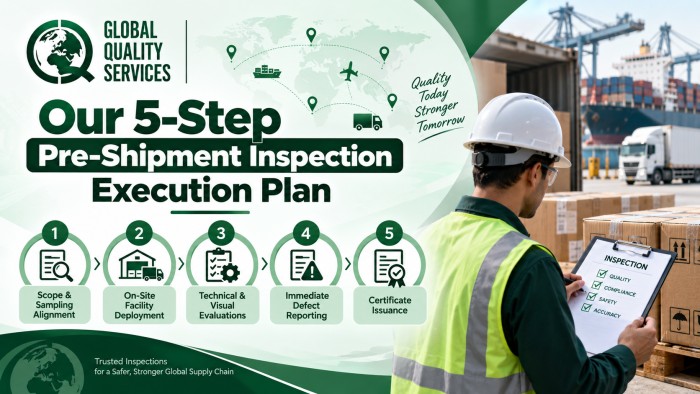
We follow a systematic five-step inspection protocol designed to verify cargo compliance, prevent transit delays, and guarantee international shipment quality:
- Scope & Sampling Alignment: We define clear acceptance criteria, defect severity levels (Critical, Major, Minor), and sample sizes following ANSI/ASQ Z1.4 standards.
- On-Site Facility Deployment: Certified inspectors travel directly to your warehouse, factory floor, or logistics park to confirm lot completion and draw random sample boxes.
- Technical & Visual Evaluations: Our team runs hands-on physical inspections, functional tests, barcode readability checks, and package drop-stress tests.
- Immediate Defect Reporting: We log observations on-site, delivering a transparent draft report supported by high-resolution photographic proof within hours.
- Certificate Issuance: Once the lot satisfies all contract specifications, we issue the official Pre-Shipment Inspection Certificate to clear the path for loading and payment release.
Why Partner with Global Quality Services for Inspections in Chennai
Managing varying international buyer criteria and strict port compliance requires local speed and seasoned technical expertise. Global Quality Services brings deep field experience auditing automotive assemblies, consumer electronics, industrial machinery, and textiles across Chennai’s premier industrial belts.
Our rapid reporting and practical solutions keep your shipments moving smoothly through air and sea ports without unexpected holds. Contact Global Quality Services today to book your pre-shipment inspection and protect your export supply chain.
Frequently Asked Questions
1. What step should a supplier take if a shipment fails the pre-shipment inspection?
When a batch fails, the auditor issues an immediate non-conformity report. The supplier must isolate, rework, or replace the defective units before scheduling a follow-up inspection.
2. How do auditors calculate the sample size during a pre-shipment audit?
Auditors use standardized statistical tables like ISO 2859-1 (ANSI/ASQ Z1.4) AQL, which define the exact sample size based on total order quantity and agreed inspection levels.
3. How fast can we expect the final pre-shipment inspection report?
Most on-site factory inspections take 1 to 2 days, with complete, photo-documented audit reports delivered within 24 hours of inspection completion.
4. Is a third-party inspection mandatory for all export containers?
While customs authorities do not always require it by law, most overseas buyers, shipping underwriters, and LC-issuing banks make 3PI certificates mandatory before authorizing dispatch.
5. Can pre-shipment inspections be performed at logistics parks or port warehouses?
Yes, qualified inspectors can conduct complete PSI audits at factory warehouses, third-party logistics (3PL) hubs, or Port Container Freight Stations (CFS) before final stuffing.