As Mumbai solidifies its status as the financial engine and primary export gateway for India’s pharmaceutical industry, Maharashtra’s pharma exports reached an impressive $5.94 billion in FY26. With JNPT handling massive cargo volumes alongside international air hubs like CSIA, local logistics networks operate under intense regulatory pressure. Obtaining Good Distribution Practice (GDP) certification is no longer optional it is a mandatory step for pharmaceutical distributors, cold-chain handlers, and exporters who want to safeguard drug quality and trade across global borders.
Navigating temperature-controlled logistics, data-logger validations, and complex QMS documentation often creates operational bottlenecks. Partnering with a dedicated GDP consultant gives your business a clear execution path, reducing compliance risk while speeding time-to-market.
What is Good Distribution Practice Certification?
Good Distribution Practice (GDP) certification is the global benchmark for safety and quality control across pharmaceutical distribution networks. While Good Manufacturing Practice (GMP) focuses strictly on cleanrooms and formulation processes inside the factory wall, GDP takes over the moment finished goods leave the facility.
It sets actionable guidelines for handling, storing, shipping, and tracking pharmaceuticals. Following GDP protocols ensures that products remain uncompromised, protected against thermal fluctuations, safe from contamination, and shielded from counterfeit drugs entering commercial channels.
Core Pillars of GDP Compliance
Building a fully compliant GDP framework requires a specialized Quality Management System (QMS) built specifically around the challenges of transport and warehousing:
- Environmental & Temperature Control: Continuous monitoring of cold-chain stock (2°C to 8°C), frozen lines (-20°C or lower), and controlled ambient ranges (15°C to 25°C) using calibrated monitoring devices with real-time alerting systems.
- Traceability & Audit Logs: Complete documentation of batch numbers, distribution history, carrier details, and deviation handling to back up every shipment with verifiable records.
- Facility & Storage Integrity: Maintaining clean zones, strictly controlled entry points, dedicated pest defense systems, and isolated holds for returned, rejected, or expired goods.
- Logistics Network Validation: Testing and approving insulated packaging solutions, thermal-mapped reefer trucks, and vetted transit corridors.
- Staff Competency & SOP Readiness: Regular training programs for depot managers, fleet operators, and logistics teams covering hygiene standards, spill handling, and risk management.
Crucial Role of Cold Chain Integrity in Port and Air Hub Logistics
Mumbai functions as India’s main gateway for international cargo. Pharma shipments moving through Jawaharlal Nehru Port Trust (JNPT) or Mumbai Airport experience extreme environmental exposure during loading, dock holds, and customs inspections.
Without strict cold chain integrity, high ambient humidity and heat can trigger severe temperature excursions. GDP compliance enforces unbroken thermal protection protocols, standardized container pre-cooling, and transit data logging, protecting sensitive biologics, vaccines, and API shipments from thermal damage prior to export.
Key Benefits of GDP Certification for Mumbai Enterprises
Achieving Good Distribution Practice (GDP) certification provides strategic, operational, and financial advantages tailored to Mumbai’s competitive, high-volume pharmaceutical trade landscape:
- Direct Access to Global Markets: Tier-1 markets across North America, Europe, and Asia-Pacific require GDP-compliant logistics networks before approving drug imports.
- Reduced Product Losses: Dynamic environmental tracking drastically lowers the risk of heat-damaged inventory, costly product wastage, and forced batch recalls.
- Preferred Status with Pharma Giants: Multinational pharmaceutical companies and generic producers in Maharashtra prioritize working with certified 3PL providers and warehouse operators.
- Faster Regulatory Approvals: Standardized, inspection-ready documentation makes routine checks by CDSCO and the FDA hassle-free.
Our Step-by-Step GDP Certification Process in Mumbai
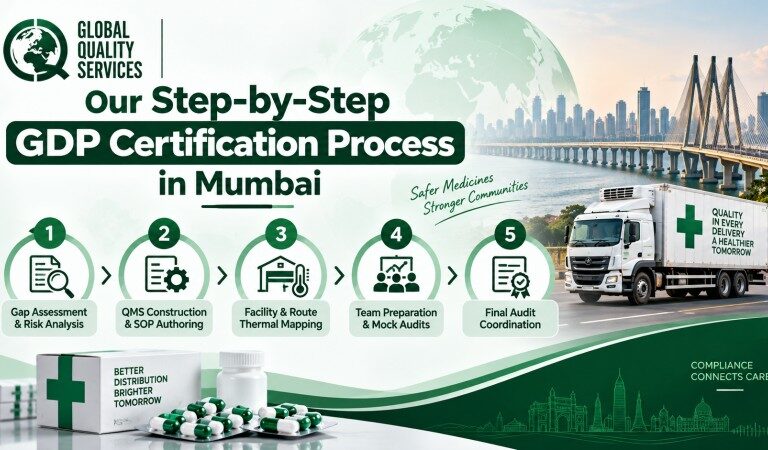
We provide direct technical consulting, system drafting, and field verification to guide your team to compliance without unnecessary friction:
- Gap Assessment & Risk Analysis: We audit your existing warehouses, fleet assets, and operational logs against WHO GDP guidelines to pin down compliance gaps.
- QMS Construction & SOP Authoring: Our experts write clear Standard Operating Procedures covering storage protocols, chain-of-custody tracking, equipment maintenance, and recall procedures.
- Facility & Route Thermal Mapping: We run multi-sensor temperature-mapping studies across warehouse zones, cold rooms, and transport vehicles during peak seasonal conditions.
- Team Preparation & Mock Audits: We conduct hands-on staff training and run simulated audits to identify and fix any residual weaknesses.
- Final Audit Coordination: We work alongside accredited certification bodies to support your team through the formal audit and secure your GDP certificate.
Why Choose Global Quality Services for GDP Certification in Mumbai
Securing your GDP certification in Mumbai does not have to slow down your daily operations. Global Quality Services brings over 26 years of hands-on compliance expertise to help you master thermal mapping, QMS documentation, and international audit standards. We build practical quality systems that keep your supply chain fully compliant and global-market ready. Contact Global Quality Services today to get your custom compliance plan and fast-track your GDP certification.
Frequently Asked Questions
1. Which businesses require GDP certification in Mumbai?
GDP certification is designed for pharma manufacturers, wholesale distributors, cold-storage warehouses, 3PL providers, freight forwarders, and repackagers involved in storage or transit.
2. How do GMP and GDP certifications differ?
GMP regulates product manufacturing and quality control inside production plants. GDP ensures product safety, thermal stability, and batch traceability after products leave the factory during storage and transport.
3. What is the average timeline to achieve GDP certification in Mumbai?
Getting certified usually takes between 3 to 6 weeks, depending on warehouse infrastructure readiness, existing QMS documentation, and the scope of transport fleet validation.
4. Why is thermal mapping required for GDP approval?
Thermal mapping proves that storage zones and reefer vehicles maintain steady target temperatures across seasonal shifts, preventing product damage caused by hot spots or cold pockets.
5. How long does a GDP certificate remain valid?
A GDP certificate remains valid for 3 years, provided your facility passes annual surveillance audits that confirm ongoing adherence to GDP standards.