
As Hyderabad surges as a powerhouse hub accounting for roughly 50% of India’s bulk drug exports, according to Bharat Tycoons, maintaining flawless quality standards on the factory floor is non-negotiable. Whether you are a buyer or a manufacturer, skipping second-party or third-party pre-shipment inspections means taking a massive risk on costly delays, sub-par batches, and damaged client trust.
You need boots on the ground to catch defects before goods ever leave the loading dock. Partnering with a specialized inspection consultant gives you the technical expertise and unbiased oversight required to protect your supply chain and secure flawless deliveries every single time.
What is Second-party / Third-party Pre-shipment Inspection
A second-party pre-shipment inspection (PSI) involves your internal team or direct customer auditing goods before dispatch. A third-party PSI brings in an independent certified agency to inspect quality, quantity, and compliance without bias.
Both models safeguard your supply chain by verifying specs, preventing costly import delays, and catching product defects before shipping. Utilizing professional pre-shipment inspections protects your brand reputation and guarantees seamless regulatory compliance globally.
Why Pre-Shipment Inspections Give Hyderabad Exporters a Competitive Edge
Pre-shipment inspections eliminate quality risks, boost buyer trust, and guarantee seamless international compliance before cargo leaves Hyderabad’s industrial hubs.
- Ensures Global Regulatory Compliance: Catching non-conformances early prevents costly customs holds and delays at destination ports in markets like the US, EU, and Gulf.
- Protects Brand Reputation: Consistent quality checks ensure overseas buyers receive faultless goods, building long-term trade trust and repeat orders.
- Prevents Financial Losses: Identifying defective batches before dispatch eliminates the massive expenses associated with international product returns and cargo rejections.
- Mitigates Supply Chain Risks: On-site verification confirms exact shipment quantities, packaging standards, and labeling accuracy before loading.
- Strengthens Export Buyer Confidence: Providing third-party certified inspection reports serves as verifiable proof of quality, giving Hyderabad exporters a distinct market advantage.
Essential Pre-Shipment Inspection Milestones for Hyderabad Exporters
When auditing export cargo across Hyderabad’s industrial corridors, certified inspectors execute a multi-point evaluation using statistical sampling frameworks like ISO 2859-1 (AQL tables) to guarantee zero non-conformances before dispatch:
- Quantity & Craftsmanship: Reconciling physical counts against packing lists while screening for surface blemishes, structural flaws, and assembly defects.
- Dimensions & Functionality: Performing exact physical measurements, electrical safety checks, operational runs, and performance tests against specifications.
- Packaging & Barcoding: Testing carton drop resistance, moisture barriers, destination shipping marks, and barcode scannability to protect goods in transit.
- Traceability & Documentation: Verifying batch production logs, Certificates of Analysis (CoA), calibration records, and customs paperwork for total audit readiness.
Step-by-Step Process for Pre-Shipment Inspection Service
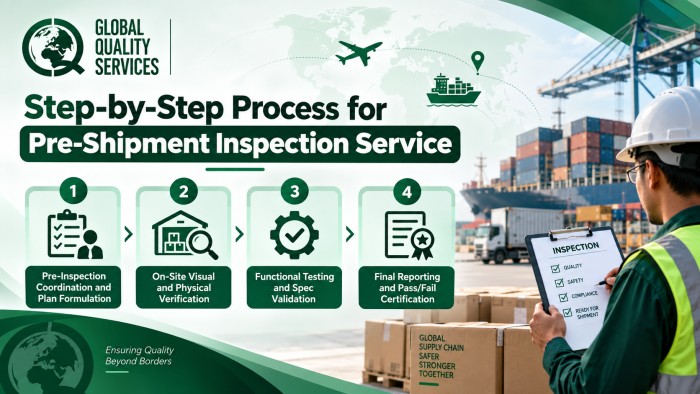
Partnering with an expert inspection agency transforms supply chain uncertainty into guaranteed product compliance through a structured, rigorous execution plan.
Step 1: Pre-Inspection Coordination and Plan Formulation
The process begins by defining clear inspection criteria, technical specifications, acceptable quality limits (AQL), and sampling frameworks based on buyer requirements, international regulatory standards, and manufacturing schedules.
Step 2: On-Site Visual and Physical Verification
Certified inspectors arrive at the Hyderabad facility to randomly select sample batches, verifying item quantity, packaging integrity, labeling precision, dimensions, and overall visual product aesthetics.
Step 3: Functional Testing and Spec Validation
Inspectors perform hands-on operational, safety, and performance tests on-site or collect sealed sample units for accredited laboratory analysis—to ensure strict adherence to precise buyer specifications.
Step 4: Final Reporting and Pass/Fail Certification
The agency generates a comprehensive, photo-documented audit report detailing all findings, technical metrics, and non-conformances, providing final clearance or rejection recommendations before dispatch.
Why Partner with Global Quality Services for Inspections in Hyderabad
Partner with Global Quality Services to eliminate supply chain risks and protect your international shipments. With over 26 years of hands-on industry experience, our certified local inspectors in Hyderabad conduct rigorous, unbiased pre-shipment evaluations to ensure total regulatory compliance and flawless quality. Contact Global Quality Services today to book your on-site inspection and secure complete peace of mind.
Frequently Asked Questions
1. When is the ideal time to conduct a pre-shipment inspection in Hyderabad?
Inspections typically occur at manufacturing facilities when production is 100% complete and at least 80% of the batch is packed in final shipping cartons.
2. Which major export industries in Hyderabad rely heavily on PSI services?
Hyderabad’s thriving pharmaceutical, bulk drug, biotechnology, IT hardware, defense manufacturing, and textile sectors heavily utilize third-party pre-shipment inspections to ensure global compliance.
3. What specific quality aspects do pre-shipment inspectors evaluate?
Inspectors systematically check total order quantities, visual appearance, dimensional tolerances, functional performance, packaging integrity, barcodes, and destination-specific compliance labeling.
4. How is the required sample size determined during an inspection?
Inspectors select random sample sizes using internationally recognized statistical sampling standards, primarily ISO 2859-1 (AQL tables), tailored to the total lot size and risk level.
5. What happens if a production batch fails the pre-shipment inspection?
The inspector issues a detailed non-conformance report, allowing the manufacturer to rework, replace, or re-verify defective units before requesting an official re-inspection.