Artificial intelligence is transforming how Indian enterprises operate, innovate, and compete globally. However, as adoption accelerates, the focus has shifted sharply toward management, oversight, and operational risk. According to the McKinsey Global Survey on the State of AI, nearly 90% of organizations regularly use AI in at least one business function, yet only 6% qualify as high performers capturing significant, enterprise-wide value.
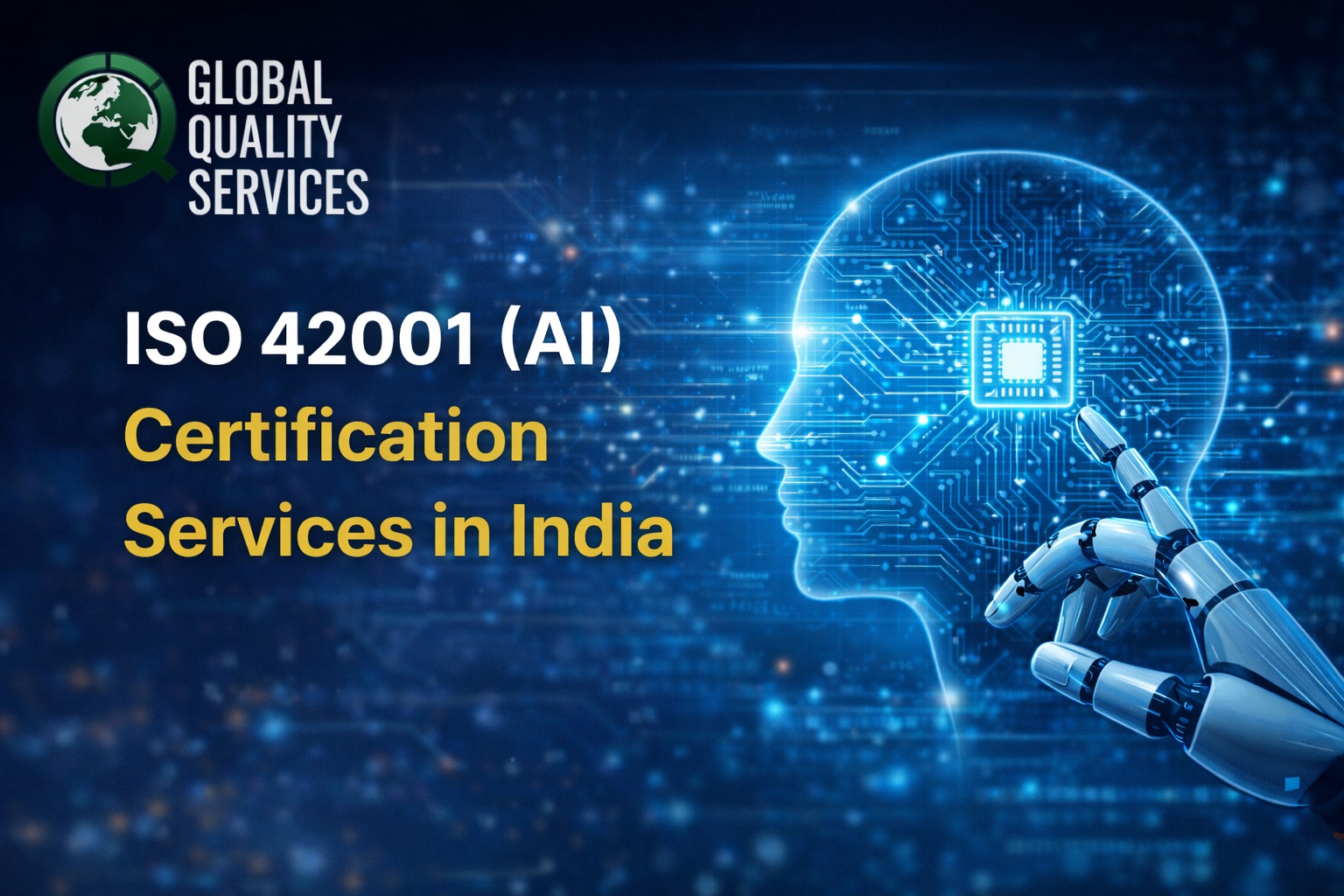
Rapid deployment without structured governance creates significant challenges around data privacy, algorithmic bias, model drift, transparency, and compliance. Global Quality Services offers end-to-end consulting, gap assessment, implementation, and audit support for ISO 42001 Certification in India. We help organizations establish structured governance, mitigate operational AI risks, and build long-term trust with global clients, enterprise procurement teams, and regulatory bodies.
What is ISO 42001 – AI Management System
ISO 42001 certification is the world’s first international management system standard specifically designed for artificial intelligence. Published jointly by the International Organization for Standardization (ISO) and the International Electrotechnical Commission (IEC), it defines requirements for establishing, implementing, maintaining, and continually improving an Artificial Intelligence Management System (AIMS).
Unlike technical model tests or isolated safety guidelines, ISO 42001 sets up organizational processes, policies, and controls to manage AI across its full lifecycle. Whether your organization builds proprietary machine learning models, integrates third-party LLMs via APIs, or leverages AI tools internally, ISO 42001 ensures your operations remain safe, ethical, transparent, and compliant.
Why ISO 42001 Certification Matters for Indian Organizations
India’s AI ecosystem is expanding across sectors such as IT services, fintech, healthcare, manufacturing, and e-commerce. ISO 42001 certification strengthens credibility in this competitive environment. Companies can also follow ISO 27701, ISO 27017, and more for better coverage and growth.
Achieving this certification helps businesses establish the robust governance required to meet the stringent data privacy obligations of the Digital Personal Data Protection Act. By doing so, companies build a verifiable system of accountability that protects user information while driving technological progress. Organizations can also implement complementary frameworks like ISO 27701 and ISO 27017 for comprehensive security coverage and long-term business growth.
Key Benefits for Businesses in India
- Demonstrates responsible and ethical AI practices
- Improves AI risk management and decision accountability
- Enhances customer and stakeholder trust
- Supports compliance with emerging AI and data regulations
- Improves internal governance and operational consistency
Purpose of ISO 42001 Standard
The primary objective of ISO 42001 is to give organizations a systematic way to balance AI innovation with risk management. Key operational objectives include:
- Lifecycle Governance: Managing AI systems consistently from initial design and training to deployment, monitoring, and retirement.
- Risk Mitigation: Identifying and treating AI-specific risks such as algorithmic bias, model drift, lack of explainability, and data security flaws.
- Ethical and Societal Consideration: Evaluating the impact of AI applications on individuals, end-users, and society.
- Traceability and Transparency: Ensuring clear documentation for data provenance, training methodology, and automated decision-making processes.
Why ISO 42001 Matters for Indian Organizations
India’s digital ecosystem is expanding rapidly across IT services, SaaS, fintech, healthcare, and manufacturing. As Indian companies scale globally, foreign clients and enterprise procurement teams demand verified proof of responsible AI governance.
Achieving ISO 42001 certification provides distinct strategic advantages:
Alignment with India’s DPDP Act 2023
The Digital Personal Data Protection (DPDP) Act mandates strict accountability for automated data processing and personal data handling. ISO 42001 establishes verifiable data governance and risk controls that align directly with statutory data protection mandates in India.
Enterprise B2B Vendor Qualification
Global enterprises, procurement teams, and product buyers now include detailed AI governance questionnaires in vendor evaluations. An accredited ISO 42001 certification serves as independent proof of compliance, speeding up vendor onboarding cycles.
Preparation for Global Regulations
ISO 42001 aligns naturally with international governance instruments, including the EU AI Act requirements and the NIST AI Risk Management Framework (AI RMF). Organizations certified under ISO 42001 gain an immediate head start in meeting international market requirements.
Who Should Consider ISO 42001 Certification
ISO 42001 applies to any organization that designs, develops, deploys, or uses AI systems.
Industries That Benefit Most
- IT and software development companies
- AI startups and SaaS providers
- BFSI and fintech organizations
- Healthcare and medical technology firms
- Manufacturing and automation companies
- Government and public sector entities
Key Structure of ISO 42001: Clauses 4 to 10
ISO 42001 follows the standard ISO Harmonized Structure (formerly Annex SL), making it seamless to integrate with existing standards across quality, cybersecurity, and management systems.
- Clause 4 — Context of the Organization: Defining the scope of the AIMS, mapping internal and external AI stakeholders, and establishing governance boundaries.
- Clause 5 — Leadership: Demonstrating top management commitment, establishing an AI policy, and assigning clear roles and governance accountabilities.
- Clause 6 — Planning: Conducting comprehensive AI risk assessments, defining AI objectives, and performing system impact assessments.
- Clause 7 — Support: Allocating necessary compute, data, human resources, competence training, and documented information.
- Clause 8 — Operation: Executing operational processes, managing the AI lifecycle, and carrying out mandatory AI System Impact Assessments (AIA).
- Clause 9 — Performance Evaluation: Monitoring AI outputs, evaluating model behavior, running internal audits, and conducting executive management reviews.
- Clause 10 — Improvement: Addressing system non-conformities, tracking corrective actions, and driving continual improvement of the AIMS.
Mandatory Requirement: AI System Impact Assessment (AIA)
Unlike traditional IT security standards that focus solely on data loss, ISO 42001 mandates an AI System Impact Assessment (AIA) under Clauses 6.1.4 and 8.4. Organizations must systematically assess and document how an AI system impacts:
- Individuals and user groups (fairness, safety, non-discrimination, privacy).
- Societal factors and ethical considerations.
- Operational safety, transparency, and decision explainability.
ISO 42001 Certification Process in India
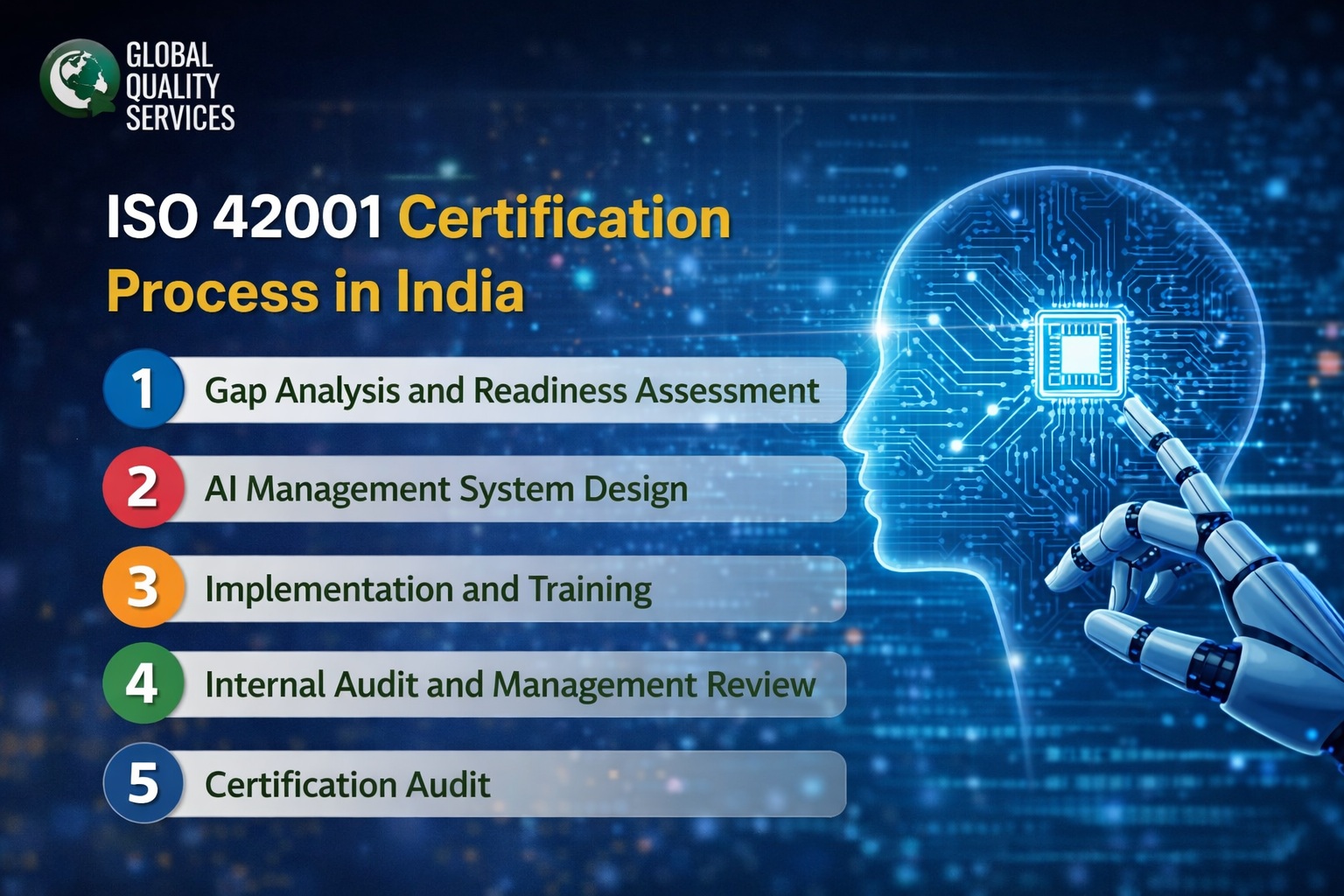
The ISO 42001 Certification Process in India follows a structured, step-by-step approach that helps organizations establish responsible AI governance, manage risks effectively, and achieve certification with expert guidance.
Step 1: Gap Analysis and Readiness Assessment
Organizations review current AI processes against ISO 42001 requirements to identify compliance gaps, assess AI risks, and determine readiness before planning structured improvements and corrective actions.
Step 2: AI Management System Design
Teams create a structured AI management framework by defining policies, governance roles, risk controls, documentation, and ethical guidelines that align clearly with organizational goals.
Step 3: Implementation and Training
Organizations apply defined AI controls, update operational practices, and train employees to ensure consistent, responsible AI use across teams and everyday business activities.
Step 4: Internal Audit and Management Review
Internal auditors evaluate system performance and compliance, while top management reviews findings to ensure effectiveness, address gaps, and support continual improvement.
Step 5: Certification Audit
An accredited certification body conducts a two-stage audit to verify compliance, confirm system maturity, and issue ISO 42001 certification upon successful completion.
Key Requirements of ISO 42001 Standard
ISO 42001 focuses on structured governance rather than technical performance alone.
Core Requirements Include:
- AI risk identification and impact assessment
- Ethical and responsible AI use policies
- Transparency and explainability controls
- AI lifecycle management
- Monitoring, evaluation, and continual improvement
Comparison: ISO 42001 vs. ISO 27001
Many organizations ask whether holding ISO 27001 (Information Security) makes ISO 42001 redundant. While both standards share the same top-level management structure, their focus areas differ significantly:
- ISO 27001 (ISMS): Protects information assets against unauthorized access, security breaches, and data corruption (Confidentiality, Integrity, and Availability).
- ISO 42001 (AIMS): Governs the operational behavior and ethical impact of AI models. It addresses risks unique to AI, including algorithmic bias, opaque decision-making, training data drift, and societal harm.
Why Choose Global Quality Services for ISO 42001 (AI) Certification
Selecting the right advisory partner is essential for establishing an effective management system. As a reputed consultant with 26 years of experience, Global Quality Services provides deep technical knowledge, practical implementation expertise, and end-to-end audit support.
-
26 Years of Proven Expertise: Over two decades of advisory experience assisting thousands of organizations across India and international markets in achieving management system certifications.
-
A Reputed Consultant Ecosystem: Trusted across India for providing practical, business-aligned consulting without introducing unnecessary operational overhead.
-
Comprehensive AI Governance Suite: Expertise across complementary ISO AI standards including ISO 23894 (AI Risk Management), ISO 38507 (Governance of AI), and ISO 42005 (AI Impact Assessment).
-
Pan-India Execution Capability: Local consultancy support across major tech hubs, including Bengaluru, Mumbai, Delhi NCR, Hyderabad, Chennai, Pune, and Ahmedabad.
ISO 42001 (AI) Certification Consultants in India
ISO 42001 (AI) Certification in Delhi | ISO 42001 (AI) Certification in Bengaluru
ISO 42001 (AI) Certification in Noida | ISO 42001 (AI) Certification in Hyderabad
ISO 42001 (AI) Certification in Ahmedabad | ISO 42001 (AI) Certification in Chennai
ISO 42001 (AI) Certification in Pune | ISO 42001 (AI) Certification in Mumbai
Frequently Asked Questions (FAQs)
To help address common concerns that organizations often have before starting their certification journey, the following FAQs provide additional clarity on ISO 42001 certification in India and related implementation considerations.
1. Is ISO 42001 applicable to organizations using third-party AI tools?
Yes. ISO 42001 applies even when AI systems are sourced externally, as organizations remain responsible for governance, risk management, and ethical use of AI outputs.
2. Does ISO 42001 require changes to existing IT infrastructure?
No. The standard focuses on governance and management practices, not mandatory infrastructure changes, allowing integration with existing IT and AI environments.
3. How long is ISO 42001 certification valid in India?
ISO 42001 certification is typically valid for three years, subject to annual surveillance audits to ensure continued compliance and system effectiveness.
4. Can startups in India apply for ISO 42001 certification?
Yes. Startups developing or using AI can achieve ISO 42001 certification by scaling requirements to their size, complexity, and AI risk profile.
5. Does ISO 42001 replace data protection or cybersecurity standards?
No. ISO 42001 complements standards like ISO 27001 and data protection laws by addressing AI-specific governance, ethics, and risk management.