Ahmedabad’s export economy is expanding, making sustainability performance increasingly important for businesses serving global buyers. The Times of India reports that Ahmedabad recorded ₹1.05 lakh crore in exports during FY 2025–26, up from ₹97,752 crore the previous year, driven by pharmaceuticals, automobiles, chemicals, engineering, and textiles.
As international customers increasingly assess suppliers on environmental, ethical, and social practices, businesses need stronger sustainability documentation. Hiring an EcoVadis consultant in Ahmedabad can help companies identify gaps, organise evidence, and prepare their assessment more effectively.
What is EcoVadis Sustainability Rating
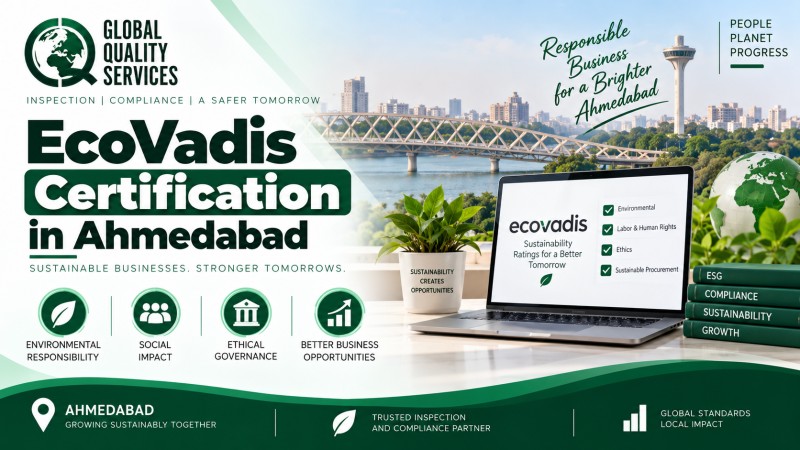
EcoVadis evaluates how effectively a company manages sustainability-related issues. Its methodology covers four major themes:
- Environment
- Labour & Human Rights
- Ethics
- Sustainable Procurement
The assessment considers 21 sustainability criteria across these themes. EcoVadis also considers factors such as the company’s industry, size, location, and risk profile when determining the assessment scope.
Why EcoVadis Matters for Ahmedabad Businesses
Ahmedabad has a diverse industrial base covering textiles, pharmaceuticals, chemicals, engineering, plastics, electronics, food processing, and automotive-related manufacturing.
Many businesses in these sectors work with national and international customers. Those customers may ask suppliers to demonstrate responsible sourcing, environmental management, labour practices, business ethics, and sustainability performance.
An EcoVadis assessment can help businesses:
- Understand their current sustainability management practices
- Identify documentation gaps
- Organise sustainability evidence
- Improve environmental and social practices
- Strengthen supplier sustainability programs
- Respond to customer sustainability requirements
- Track improvement through future assessments
EcoVadis states that its rating evaluates the quality of a company’s sustainability management system at the time of assessment.
What Does EcoVadis Assess
EcoVadis assesses key sustainability areas to understand how effectively your business manages environmental, social, ethical, and responsible procurement practices.
1. Environment
The environmental assessment can cover areas such as energy consumption, greenhouse gas emissions, waste, water, pollution, materials, biodiversity, and environmental practices.
For manufacturers, environmental evidence can include energy records, waste-management procedures, emissions data, environmental policies, targets, and action plans.
EcoVadis updated its methodology in 2026 to distinguish location-based and market-based Scope 2 emissions reporting, aligning the assessment with GHG Protocol reporting practices.
2. Labour & Human Rights
This area examines how a company manages issues related to employees and human rights.
Relevant evidence may include:
- Health and safety policies
- Employee training records
- Working-condition procedures
- Human rights policies
- Anti-discrimination measures
- Employee grievance mechanisms
- Labour-related performance indicators
3. Ethics
Ethics covers areas such as corruption prevention, responsible business practices, information security, and other relevant ethical risks.
Companies should maintain documented policies and demonstrate that those policies operate in practice.
4. Sustainable Procurement
Sustainable procurement looks at how companies manage sustainability risks within their supply chains.
Businesses may need evidence covering supplier assessments, supplier codes of conduct, responsible purchasing practices, sustainability requirements, and supplier monitoring.
EcoVadis Certification Process in Ahmedabad
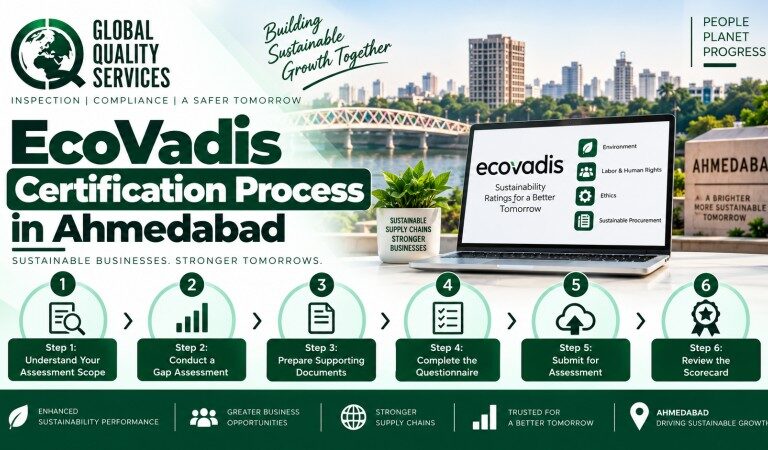
Although the exact assessment experience depends on the company profile, businesses can generally prepare through the following stages.
Step 1: Understand Your Assessment Scope
Start by identifying your legal entity, activities, locations, workforce, and operational scope. EcoVadis considers company activity, size, and location when tailoring its assessment.
Step 2: Conduct a Gap Assessment
Review your current policies, procedures, records, targets, and sustainability initiatives. This step helps identify missing evidence before you begin the questionnaire.
Step 3: Prepare Supporting Documents
Collect relevant documents under the four assessment themes. Avoid uploading documents simply to increase volume. Your evidence should directly support the practices described in your questionnaire.
Step 4: Complete the Questionnaire
Answer the questionnaire according to your company’s actual activities and management practices. EcoVadis uses company-provided evidence along with other information sources, including third-party and external stakeholder information.
Step 5: Submit for Assessment
After completing the questionnaire and attaching the required evidence, submit the assessment for evaluation. EcoVadis sustainability experts analyse the submitted information using its methodology.
Step 6: Review the Scorecard
Your scorecard can show strengths and improvement areas. These findings can help you decide where to focus future sustainability initiatives.
EcoVadis also introduced a two-business-day pre-publication review period in 2026, allowing rated companies to flag factual errors before results are published to the network.
EcoVadis Documentation Requirements
Good documentation can make a major difference during an assessment. Depending on your business and questionnaire, useful evidence may include:
- Environmental policy
- Sustainability policy
- Energy and emissions records
- Waste-management records
- Employee health and safety procedures
- Human rights policy
- Anti-corruption policy
- Supplier code of conduct
- Sustainable procurement procedures
- Training records
- Sustainability reports
- Environmental certifications
- Audit reports
- Performance indicators
- Improvement plans
EcoVadis expanded the types of supporting evidence accepted for certain certifications and began accepting certain sustainability and certification audit reports for policies, actions, and reporting in 2026.
EcoVadis Assessment for Different Ahmedabad Industries
Textile and Apparel Companies
Textile businesses can focus on energy consumption, water use, chemicals, waste, worker safety, labour practices, and responsible sourcing.
Pharmaceutical Companies
Pharmaceutical businesses may need strong evidence around environmental management, employee safety, ethical practices, responsible procurement, and supply-chain controls.
Chemical Manufacturers
Chemical companies often have significant environmental and occupational safety considerations. Their documentation should clearly demonstrate how they manage relevant risks.
Engineering and Automotive Suppliers
Engineering and automotive suppliers can benefit from organised evidence covering environmental performance, employee safety, ethical business practices, and sustainable supplier management.
Ahmedabad and surrounding industrial areas include clusters such as Sanand, Changodar, Naroda, Odhav, Vatva, and Mandal.
EcoVadis Support in Sanand, Vatva, Naroda and Changodar
Businesses located across Sanand, Vatva, Naroda, Changodar, Odhav, and other Ahmedabad industrial areas can prepare their sustainability documentation around their actual operational risks and customer requirements.
This local focus matters because Ahmedabad’s industrial ecosystem includes pharmaceuticals, chemicals, textiles, engineering, plastics, automotive, electronics, and food-related businesses.
For example, a chemical manufacturer may need stronger evidence around chemicals, waste, emissions, and occupational safety, while a textile manufacturer may focus more heavily on water, energy, chemicals, labour practices, and supplier management.
Why Start EcoVadis Preparation Early
Last-minute preparation often creates documentation gaps. It can also make it difficult to collect reliable performance data across departments.
Starting early gives your team time to:
- Review existing sustainability practices.
- Identify missing policies and procedures.
- Collect reliable performance data.
- Establish measurable targets.
- Improve supplier sustainability controls.
- Organise evidence before questionnaire submission.
- Address weaknesses identified during the review.
EcoVadis itself describes its methodology as evidence-based and designed around continuous improvement.
Why Choose Global Quality Services for EcoVadis in Ahmedabad
Ready to turn your sustainability efforts into a stronger EcoVadis assessment? Global Quality Services helps Ahmedabad businesses identify gaps, organise evidence, improve documentation, and prepare with confidence. Our practical approach keeps the process clear and focused on your business needs.
Whether you are preparing for your first assessment or improving your previous score, contact Global Quality Services today and take the next step toward stronger sustainability performance.
FAQ’s
- Is EcoVadis a certification or a sustainability rating?
EcoVadis provides a sustainability rating rather than traditional certification. It evaluates sustainability management using policies, actions, results, evidence, and relevant external information. - How long does EcoVadis assessment take in Ahmedabad?
The timeline varies by company size, industry, documentation quality, and questionnaire scope. Businesses with organised records can usually prepare faster than those starting from scratch. - What documents are needed for EcoVadis assessment?
Documents may include sustainability policies, environmental records, employee procedures, ethics policies, supplier controls, performance reports, certifications, audits, and measurable sustainability indicators. - Can Ahmedabad manufacturers apply for EcoVadis assessment?
Yes. Manufacturers can undergo EcoVadis assessment, with the evaluation considering their industry, size, location, activities, and relevant sustainability risks. - Can a consultant help improve an EcoVadis score?
A consultant can review gaps, organise evidence, improve documentation, and support corrective actions. The final rating depends on the evidence and practices evaluated by EcoVadis.