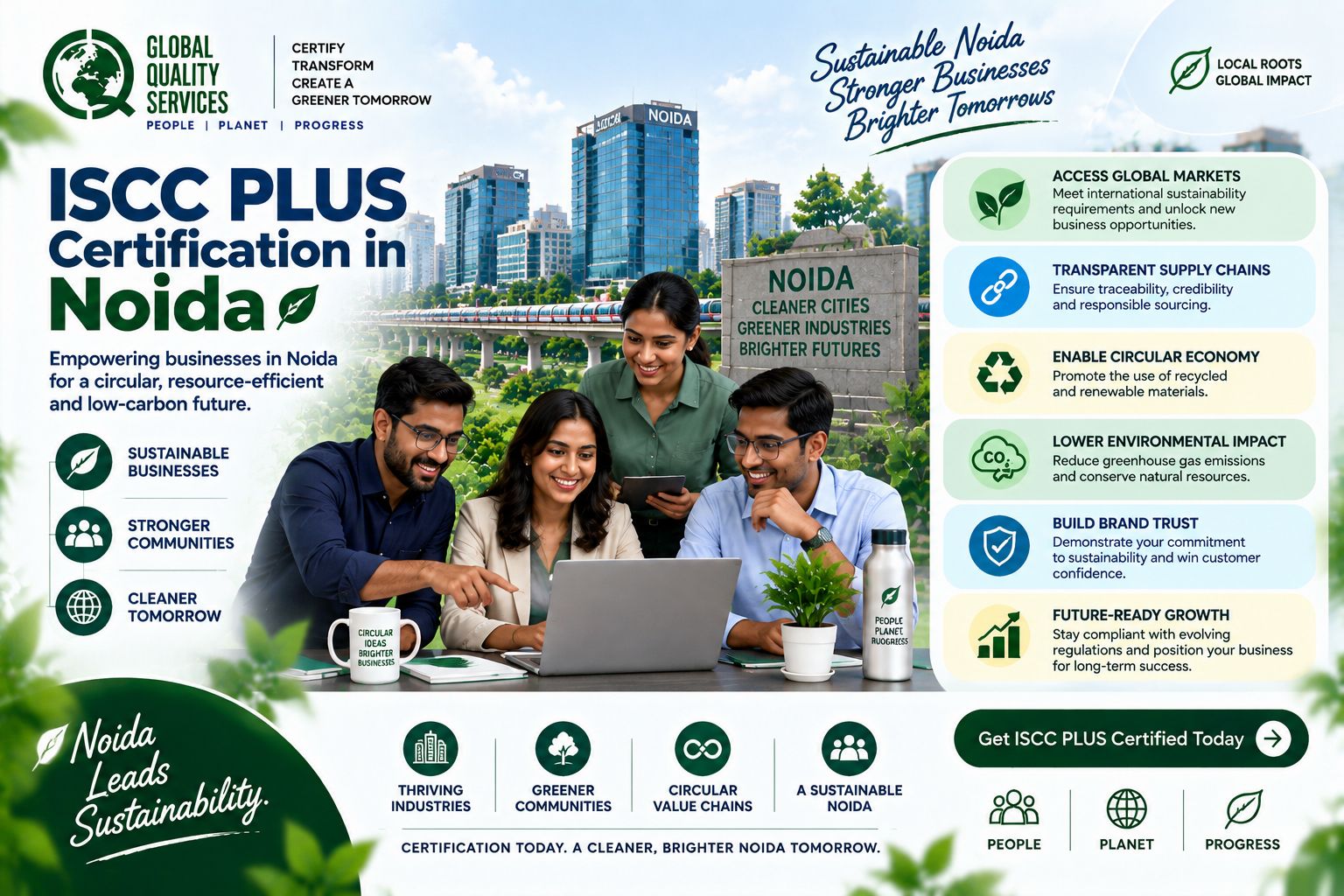
ISCC PLUS Certification in Noida helps organizations demonstrate the controlled use, traceability, and sustainability characteristics of eligible recycled, circular, renewable, and bio-based feedstocks used in their products and supply chains.
Noida and Greater Noida have developed into major manufacturing and electronics hubs, with strong activity in mobile phones, electronic components, IT hardware, plastics, packaging, automotive-related products, and advanced manufacturing. Uttar Pradesh’s current electronics manufacturing initiatives are also expanding the ecosystem from final assembly into components and sub-assemblies.
Global Quality Services (GQS) provides ISCC PLUS consultancy and certification-readiness support in Noida, including scope assessment, supplier controls, traceability, chain-of-custody preparation, mass-balance review, documentation, and audit preparation. The formal certification audit is conducted by an applicable independent ISCC cooperating Certification Body.
Why Is ISCC PLUS Relevant to Noida’s Manufacturing Supply Chain?
ISCC PLUS is particularly relevant to Noida where manufacturers are moving beyond simple assembly into components, materials, plastics, packaging, and more integrated supply chains.
Uttar Pradesh’s current electronics ecosystem includes mobile manufacturing, component manufacturing, consumer electronics, IT hardware, telecom, drones, medical electronics, defense electronics, robotics, and IoT. Invest UP identifies greenfield electronics clusters at the Yamuna Expressway and EcoTech VI & VII in Greater Noida.
This broader manufacturing structure creates several situations in which material traceability becomes important.
For example, a manufacturer may purchase recycled polymer for an electronic enclosure. A packaging supplier may use certified recycled or bio-based material. A component manufacturer may source an alternative feedstock from an upstream supplier. A recycling business may process eligible waste into material used further down the supply chain.
In each case, the organization needs evidence supporting what the material is, where it came from, how it was handled, and what sustainability characteristics can legitimately be attributed to the output.
What Does ISCC PLUS Certification Cover?
ISCC PLUS covers sustainability and chain-of-custody requirements for eligible alternative feedstocks and the products made from them within the certified scope.
The scheme is designed for markets including circular and bio-based products and other applications outside the regulatory scope of ISCC EU. ISCC PLUS provides chain-of-custody options including physical segregation, controlled blending, and mass balance.
The certification system can therefore involve controls over:
- Feedstock sourcing
- Supplier documentation
- Material identification
- Incoming quantities
- Storage
- Production
- Inventory
- Chain of custody
- Mass balance
- Sustainability characteristics
- Transaction records
- Customer documentation
- Sustainability claims
The exact requirements depend on the organization’s activities, selected scheme scope, feedstock, product, and chain-of-custody method.
Which Noida Industries Can Consider ISCC PLUS?
ISCC PLUS can be relevant to several Noida and Greater Noida industries where eligible alternative materials form part of the certified supply chain.
Electronics and Electronic Components
Noida’s electronics ecosystem is one of the clearest local applications.
Invest UP reports that Greater Noida hosts major electronics manufacturers and that the state’s manufacturing strategy is increasingly focused on components and sub-assemblies rather than assembly alone.
ISCC PLUS may become relevant where these supply chains incorporate eligible recycled or bio-based materials.
This could include selected:
- Electronic enclosures
- Plastic components
- Packaging materials
- Consumer-electronics components
- IT hardware components
- Automotive electronics
- Industrial electronics
ISCC PLUS does not certify an electronic device simply because it is manufactured in Noida. The certification applies to the relevant material and supply-chain activities that fall within the defined scope.
Plastics and Polymer Manufacturing
Plastic processors and polymer manufacturers may use ISCC PLUS where recycled, circular, bio-based, or other eligible alternative feedstocks are incorporated into production.
This is especially relevant where a customer wants evidence supporting a recycled or bio-based material claim.
Packaging
Noida and Greater Noida have a broad manufacturing base that includes plastics and packaging. The Uttar Pradesh plug-and-play industrial shed policy specifically lists plastics and packaging among its target sectors.
Packaging companies may need to establish controls covering incoming certified material, production quantities, inventory, finished goods, and customer documentation.
Chemical Manufacturers
Chemical manufacturers handling eligible alternative feedstocks may use ISCC PLUS to establish documented chain-of-custody controls between incoming materials and certified outputs.
Recycling Businesses
Recycling organizations can be relevant to ISCC PLUS supply chains where eligible waste or residues are processed into materials that subsequently enter circular product chains.
Automotive and Component Manufacturers
The Uttar Pradesh industrial ecosystem also includes automotive components and related manufacturing. Government industrial policy documents identify EV components and auto ancillaries among targeted manufacturing sectors.
Where eligible recycled or renewable materials are incorporated into automotive components, ISCC PLUS may provide a framework for documenting their sustainability characteristics.
What Are the Main ISCC PLUS Norms a Noida Company Needs to Address?
The main compliance requirement is to establish an auditable connection between eligible inputs, material movements, production, certified outputs, and sustainability information.
A Noida company preparing for certification should examine at least the following areas.
Sustainable Feedstock
The organization needs to establish what alternative feedstocks it receives and what sustainability characteristics are associated with them.
Supplier Evidence
Supplier information must be sufficiently reliable to support the relevant sustainability and chain-of-custody requirements.
Traceability
The company needs a method for tracing relevant materials through its defined operations.
Chain of Custody
The organization must apply the appropriate chain-of-custody method for its certified material flows.
Material Accounting
Quantities entering, being processed, stored, transferred, and sold need to be appropriately recorded.
Sustainability Information
Relevant sustainability characteristics need to remain connected to the applicable transactions and outputs.
Claims and Documentation
Customer-facing information must correspond with what the organization is permitted to claim within its certification scope.
These controls should be supported by actual records rather than relying only on procedures.
Which Chain-of-Custody Option Is Suitable for Noida Manufacturers?
The appropriate chain-of-custody option depends on how a Noida facility physically handles material and how its sustainability characteristics need to be transferred.
ISCC PLUS provides three principal approaches.
Physical Segregation
Physical segregation keeps relevant materials separate according to the applicable ISCC requirements.
This may suit a Noida manufacturer that has dedicated storage areas, tanks, production lines, batches, or other physical controls.
Controlled Blending
Controlled blending allows eligible and conventional materials to be combined according to defined conditions.
The organization needs appropriate evidence showing the relevant input and output characteristics.
Mass Balance
Mass balance manages eligible and conventional material through an accounting system rather than requiring every certified molecule to remain physically separate.
For a large manufacturing facility, this can be particularly important because the same production infrastructure may handle different material streams.
The accounting system therefore needs to demonstrate that certified outputs are supported by eligible inputs according to the applicable rules.
ISCC states that ISCC PLUS mass-balance requirements are covered by the ISCC PLUS System Document during the transition period and by ISCC PLUS 203-2 Chain of Custody, which became valid on November 13, 2025 and becomes mandatory from January 1, 2027.
How Does ISCC PLUS Mass Balance Work in Noida?
Mass balance requires the organization to maintain reliable accounting for eligible inputs and outputs within the defined certification system.
Consider a Noida polymer or electronics-component manufacturer that receives both conventional and recycled feedstock.
The materials may enter the same broader production system, but the organization must maintain an appropriate accounting system showing:
The company should be able to reconcile relevant quantities.
That means purchasing, warehouse, production, inventory, quality, finance, and sales records cannot operate as completely separate information systems.
For this reason, mass-balance preparation often requires more than writing a new procedure. Existing ERP, inventory, production, and transaction systems may need to be reviewed to determine whether they can provide the necessary evidence.
ISCC specifically states that mass-balance requirements for ISCC PLUS are contained in the current chain-of-custody documentation.
How Does the ISCC PLUS Certification Process Work in Noida?
The certification process starts with identifying the applicable ISCC PLUS scope and chain-of-custody method, followed by system preparation and an independent audit.
1. Identify the Material
Determine exactly which recycled, circular, renewable, bio-based, or other eligible material is being considered.
2. Identify the Product
Determine which finished or intermediate products will fall within the intended certification scope.
3. Define the Site and Activities
Identify the Noida or Greater Noida facility, production activities, storage arrangements, and relevant supply-chain functions.
4. Select the Chain-of-Custody Method
Determine whether physical segregation, controlled blending, or mass balance fits the actual operation.
5. Map the Supply Chain
Document the movement of material from supplier through the facility and into customer transactions.
6. Establish Operational Controls
Develop or strengthen supplier, purchasing, storage, production, inventory, accounting, and claims controls.
7. Review Evidence
Check whether actual records demonstrate that the procedures are being followed.
8. Conduct a Readiness Assessment
GQS can review the organization’s preparedness and identify gaps before the certification audit.
9. Complete the Independent Audit
The formal certification audit is conducted by an applicable ISCC cooperating Certification Body.
What Makes ISCC PLUS Important for Noida’s Electronics Component Ecosystem?
ISCC PLUS can become relevant to Noida’s electronics industry as manufacturing moves deeper into components, materials, and localized supply chains.
Uttar Pradesh’s current electronics component policy includes areas such as display and camera-module sub-assemblies, multi-layer PCBs, lithium-ion cells for digital applications, enclosures for mobile and IT hardware, electro-mechanical components, and related supply-chain and capital equipment.
- This matters because sustainability requirements can increasingly reach beyond the final device.
- A component manufacturer may need to demonstrate the characteristics of a polymer used in an enclosure.
- A packaging supplier may need to document recycled content.
- An electronics manufacturer may need to provide its customer with evidence about the certified material used in a particular product family.
ISCC PLUS can provide a structured framework for these material-level sustainability claims where the relevant inputs and products fall within the scheme.
What Are the Benefits of ISCC PLUS Certification for Noida Companies?
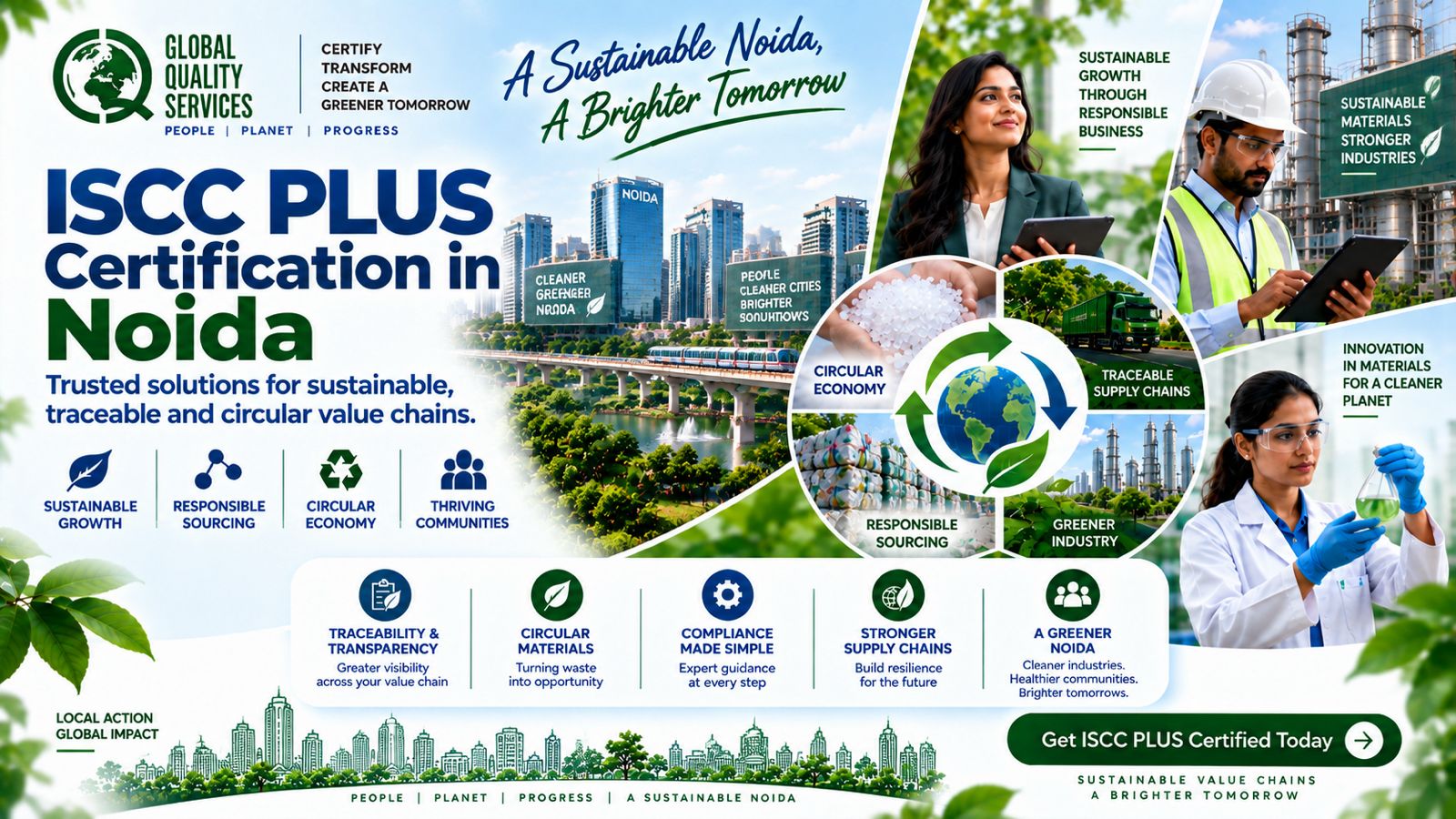
ISCC PLUS can give Noida manufacturers a structured and independently audited method for demonstrating sustainability characteristics associated with eligible alternative materials.
Stronger Material Traceability
The organization gains clearer controls over the movement of relevant materials.
Better Supplier Evidence
Procurement teams have a defined framework for managing information from suppliers.
Support for Recycled and Circular Materials
ISCC PLUS can support companies participating in circular material supply chains where the relevant requirements are met.
More Defensible Sustainability Claims
Claims can be supported by documented chain-of-custody information rather than relying solely on supplier statements.
Customer Supply-Chain Requirements
Certification can help organizations respond to customers seeking independently verified sustainability information.
Greater Internal Control
The process can improve coordination between purchasing, stores, production, quality, inventory, and sales.
How Can Global Quality Services Help With ISCC PLUS Certification in Noida?
Global Quality Services helps Noida organizations prepare their systems and evidence for the independent ISCC PLUS certification process. The approach can be adapted to the organization’s existing ERP, inventory, purchasing, production, warehouse, and quality systems.
GQS focuses on making ISCC PLUS requirements workable within the organization’s actual manufacturing and supply-chain processes.
- A Noida electronics manufacturer may need to focus on component and polymer traceability.
- A packaging manufacturer may need to control recycled or bio-based input claims.
- A plastics company may need a detailed mass-balance system.
- A recycling organization may need stronger controls over incoming feedstock and outgoing certified material.
The same certification framework can therefore require very different operational controls. GQS can help identify those differences before the formal certification audit rather than applying one generic checklist to every organization.
The first step is to identify the alternative material, its source, the products in which it is used, and the sustainability information that needs to be demonstrated.
From there, the organization can determine its ISCC PLUS scope and select the appropriate chain-of-custody approach.
Companies beginning preparation during 2026 should pay particular attention to the transition to ISCC PLUS 203-2, which becomes mandatory on January 1, 2027.
A readiness assessment can then identify gaps in supplier documentation, material traceability, inventory controls, mass-balance calculations, sustainability information, and customer documentation before the independent certification audit.
FAQs About ISCC PLUS Certification in Noida
Is ISCC PLUS Certification mandatory for Noida companies?
ISCC PLUS is a voluntary certification scheme. However, a customer, supply-chain program, procurement requirement, or particular market may require an organization to demonstrate certified sustainability characteristics.
Can electronics manufacturers in Noida obtain ISCC PLUS Certification?
Yes, potentially. ISCC PLUS is not an electronics certification, but electronics manufacturers and component suppliers may be relevant where eligible recycled, circular, renewable, or bio-based materials form part of the certified supply chain.
Can recycled plastic manufacturers in Noida use ISCC PLUS?
Yes, where the feedstock, process, product, and intended claim fall within the applicable ISCC PLUS requirements. The organization must establish appropriate traceability and chain-of-custody controls.
Is mass balance compulsory under ISCC PLUS?
No. ISCC PLUS provides different chain-of-custody approaches, including physical segregation, controlled blending, and mass balance. The appropriate approach depends on the organization’s actual material flow and certification scope.
What is the 2027 ISCC PLUS requirement change?
ISCC PLUS 203-2 Chain of Custody became valid on November 13, 2025 and becomes mandatory from January 1, 2027. It contains the current requirements for chain-of-custody approaches including mass balance, physical segregation, and controlled blending.