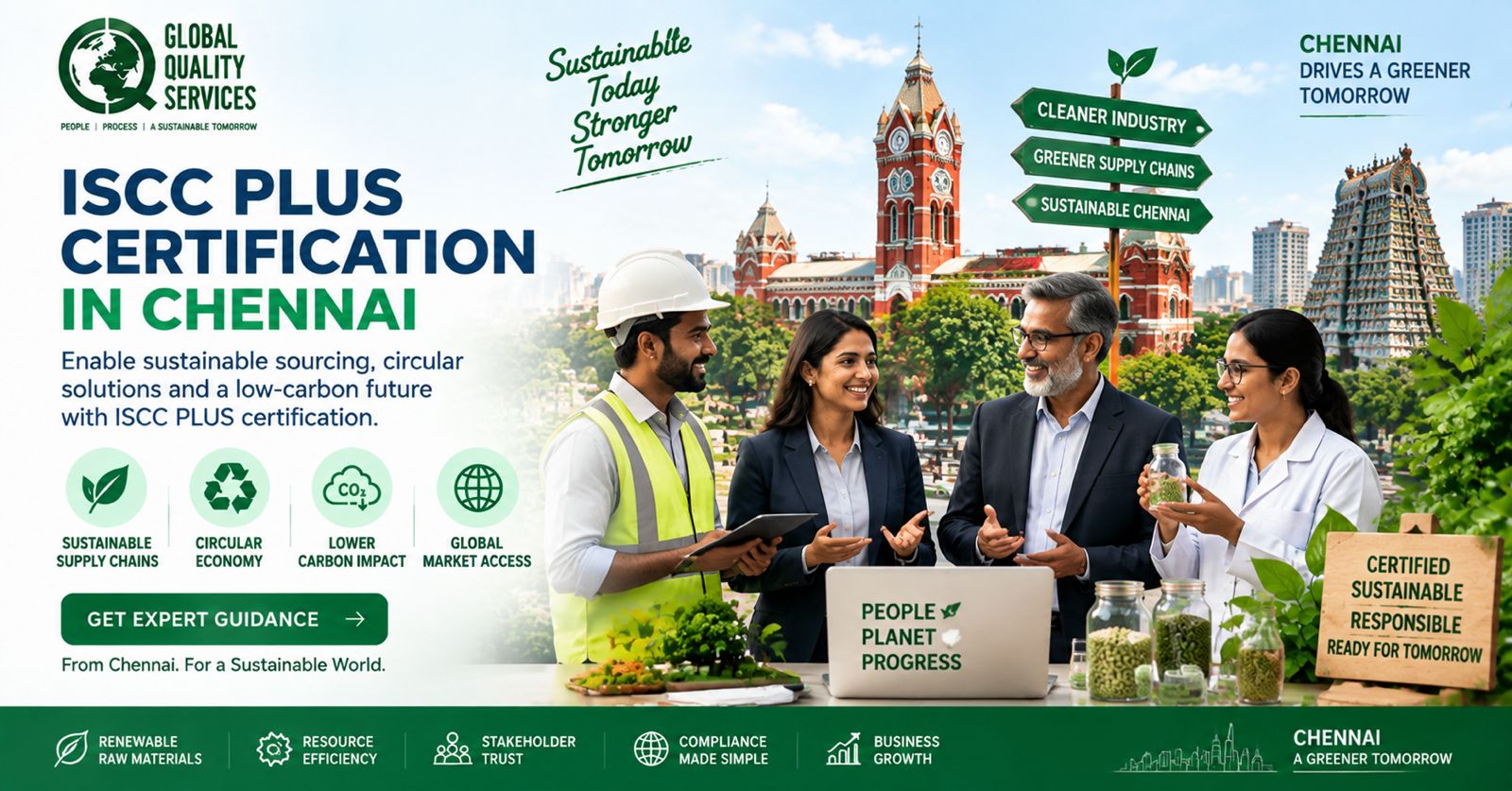
ISCC PLUS Certification in Chennai helps manufacturers and supply-chain organizations demonstrate the controlled use and traceability of renewable, bio-based, circular, and recycled feedstocks in products supplied to global markets.
ISCC PLUS is a voluntary certification system designed for alternative feedstocks and supports companies that want to demonstrate verified sustainability characteristics beyond basic regulatory compliance. It is particularly relevant to businesses producing or handling circular and bio-based materials, chemicals, plastics, packaging, and other products made with alternative feedstocks.
For Chennai organizations, the relevance of ISCC PLUS becomes particularly clear across the Manali petrochemical belt, Ambattur industrial area, Sriperumbudur, Oragadam, Pillaipakkam, and the wider Chennai manufacturing corridor.
Global Quality Services (GQS) provides ISCC PLUS consultancy and certification-readiness support, including requirements interpretation, scope definition, chain-of-custody preparation, traceability review, mass balance controls, documentation, and audit preparation. The formal certification audit is performed by an applicable independent ISCC cooperating Certification Body.
What Does ISCC PLUS Certification Require in Chennai?
ISCC PLUS requires an organization to demonstrate defined sustainability, traceability, and chain-of-custody controls for the certified material and activities within its scope.
The requirements go beyond having a sustainability policy on paper. The organization needs evidence showing how alternative feedstocks are sourced, received, controlled, processed, transferred, and ultimately represented in certified products.
The key areas generally include:
- Applicable sustainability requirements
- Supply-chain traceability
- Supplier and incoming-material controls
- Chain-of-custody management
- Material quantity accounting
- Sustainability declarations
- Mass balance where selected
- Physical segregation where selected
- Controlled blending where selected
- Record keeping
- Management responsibilities
- Internal controls
- Correct use of ISCC claims and logos where applicable
ISCC PLUS provides three chain-of-custody options: physical segregation, controlled blending, and mass balance.
Which ISCC PLUS Chain-of-Custody Method Should a Chennai Company Use?
The chain-of-custody method should be selected according to the organization’s physical material flow, production system, customer requirements, and the sustainability characteristics it needs to maintain.
Physical Segregation
Physical segregation requires materials with different sustainability characteristics to remain physically separated through the relevant supply chain.
This can be appropriate where a Chennai facility has dedicated storage, production lines, tanks, warehouses, or other arrangements that allow certified material to remain physically identifiable.
The ISCC PLUS requirements distinguish between different forms of physical segregation, including identity preservation and bulk commodity approaches.
Controlled Blending
Controlled blending involves a planned blending regime where the resulting product has a constant and verifiable content of relevant bio-based, circular, or renewable feedstock.
This can be useful where a manufacturer intentionally blends eligible and conventional materials according to a controlled formulation.
Mass Balance
Mass balance allows certified and conventional material flows to be managed within a defined accounting system rather than requiring every certified molecule to remain physically separated.
The organization must nevertheless maintain reliable records demonstrating that the sustainability characteristics attributed to outputs are supported by eligible inputs and that quantities remain within the applicable accounting rules.
Why Is Chain of Custody Important for ISCC PLUS Certification?
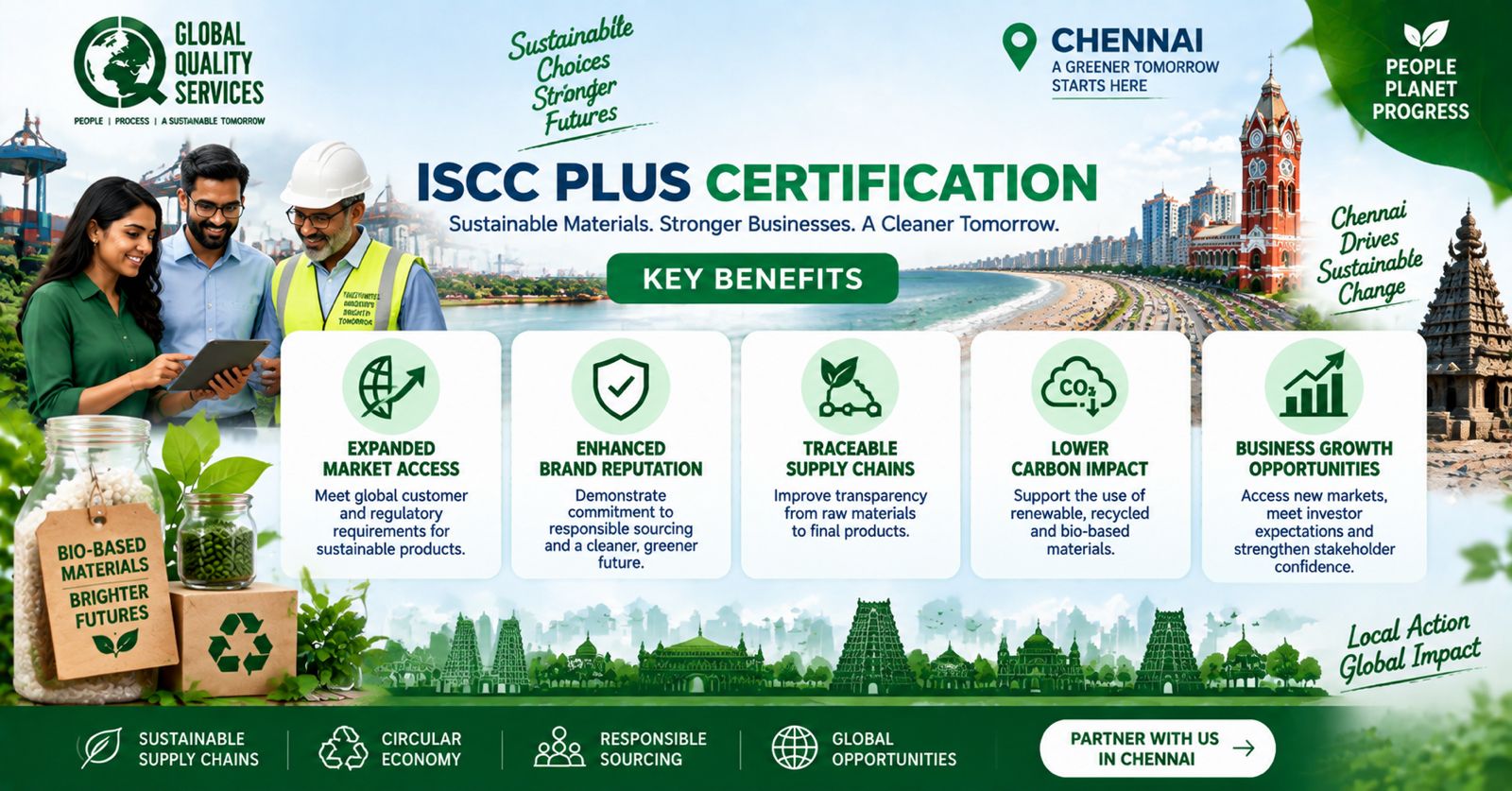
Chain of custody is the mechanism that connects the sustainability characteristics of an eligible input with the products and transactions moving through the certified supply chain.
ISCC describes chain of custody as the process through which inputs, outputs, and associated information are transferred, monitored, and controlled at each relevant stage.
For a Chennai manufacturer, this could mean maintaining a traceable relationship between:
Supplier → Raw Material Receipt → Storage → Production → Inventory → Finished Product → Customer
Each stage should have appropriate evidence.
A company should therefore be able to answer practical questions such as:
- What was purchased?
- From whom was it purchased?
- What sustainability characteristics were associated with the material?
- How much material was received?
- Where was it stored?
- How was it used?
- What quantity entered production?
- What quantity was produced?
- How was the certified quantity allocated?
- What information was passed to the customer?
These questions become particularly important when the organization uses mass balance or other controlled chain-of-custody methods.
What Sustainability Requirements Apply Under ISCC PLUS?
ISCC PLUS incorporates sustainability principles covering environmental protection, working conditions, human and labor rights, land rights, legal compliance, and responsible management practices.
The applicable requirements include principles relating to:
Protection of High-Biodiversity and High-Carbon-Stock Areas
Relevant feedstock production must comply with applicable land-related sustainability requirements.
Environmentally Responsible Production
Organizations need to consider responsible practices relating to soil, water, air, and environmental impacts where applicable.
Safe Working Conditions
Appropriate occupational health and safety practices form part of the sustainability framework.
Human, Labor, and Land Rights
The ISCC sustainability principles address compliance with relevant human, labor, and land rights requirements.
Legal and Treaty Compliance
Organizations and relevant supply-chain participants are expected to operate in accordance with applicable laws and international treaties.
Good Management Practices
The framework also incorporates responsible management and continuous improvement principles.
These principles form part of the sustainability requirements reflected in the ISCC PLUS framework.
Which Chennai Industries Can Apply ISCC PLUS?
ISCC PLUS can be relevant to Chennai’s chemical, petrochemical, plastics, packaging, electronics, manufacturing, and recycling supply chains where eligible alternative feedstocks are used.
Chemical and Petrochemical Manufacturers
The Manali area is particularly relevant because Tamil Nadu identifies Manali among its established chemical and petrochemical clusters. The state’s investment portal describes a wider chemicals ecosystem covering specialty chemicals, polymers, petrochemicals, plastics, pharmaceuticals, and related industries.
For these organizations, ISCC PLUS may be relevant where alternative feedstocks are incorporated into chemical or polymer production.
Plastic and Polymer Manufacturers
Manufacturers using recycled or bio-based feedstocks may consider ISCC PLUS where their products and material flows fall within the scheme’s requirements.
This can include companies involved in polymer production, plastic conversion, molded products, industrial packaging, and related downstream applications.
Packaging Manufacturers
Packaging companies may need to demonstrate the origin and controlled use of recycled or renewable inputs when customers require verified sustainability characteristics.
Electronics and Component Manufacturers
The Chennai-Sriperumbudur corridor has a significant electronics manufacturing ecosystem. SIPCOT identifies the Sriperumbudur Hi-Tech SEZ as an electronics industrial location and also identifies electronics manufacturing activity in Oragadam.
ISCC PLUS is not an electronics certification by itself. Its relevance arises where an electronics-related supply chain uses eligible alternative materials and needs verified sustainability claims.
Recycling and Circular Material Businesses
Organizations converting eligible waste and residues into recycled or circular feedstocks can be relevant participants in ISCC PLUS supply chains, subject to the applicable requirements and certification scope.
ISCC PLUS specifically includes circular materials derived from sources such as mixed plastic waste, waste textiles, and end-of-life tires among its alternative feedstock categories.
What Records Should a Chennai Facility Maintain?
An ISCC PLUS system depends on reliable records that allow the auditor to reconstruct relevant material and sustainability flows.
Depending on the organization’s scope and chain-of-custody method, records may include:
Purchase Records
Purchase orders, invoices, supplier information, material descriptions, quantities, and relevant sustainability documentation.
Incoming Material Records
Evidence showing when material was received, its quantity, identification, characteristics, and destination within the facility.
Storage Records
Stock records and controls showing how certified and other materials are handled under the selected chain-of-custody approach.
Production Records
Information connecting input quantities with production output and relevant certified characteristics.
Inventory Records
Opening stock, incoming quantities, consumption, production output, transfers, sales, and closing stock should be appropriately reconciled.
Sustainability Declarations
Relevant sustainability information needs to be passed through the supply chain in the prescribed manner.
Sales and Dispatch Records
The organization should maintain evidence supporting quantities and sustainability characteristics communicated to customers.
ISCC does not prescribe one universal mass-balance software template. Companies may integrate their calculations into existing internal systems or ERP platforms, provided the applicable requirements are fulfilled.
How Does Mass Balance Work Under ISCC PLUS?
Mass balance works by accounting for eligible inputs and outputs within a defined system boundary while maintaining the associated sustainability characteristics according to ISCC requirements.
For example, a chemical or polymer manufacturer may receive a combination of conventional and certified alternative feedstocks into a production system.
The organization does not necessarily need to keep every molecule physically separate when mass balance is the chosen chain-of-custody method. Instead, it needs an auditable accounting system that demonstrates how certified quantities and sustainability characteristics are allocated.
This makes the accuracy of purchasing records, inventory data, production figures, sales transactions, and mass-balance calculations particularly important.
ISCC PLUS 203-2 provides specific requirements for mass balance, physical segregation, and controlled blending.
What Has Changed in the Current ISCC PLUS Requirements?
Chennai organizations preparing for certification in 2026 and 2027 should work against the current ISCC PLUS documentation rather than relying on older certification procedures.
ISCC PLUS 203-2 Chain of Custody became valid on 13 November 2025 and is scheduled to become mandatory from 1 January 2027. ISCC identifies this document as the current source for chain-of-custody requirements covering physical segregation, controlled blending, and mass balance.
This transition is important for companies beginning certification preparation now.
A business should therefore review:
- Its selected chain-of-custody method
- Material accounting procedures
- Traceability records
- Sustainability declarations
- Supplier evidence
- Inventory controls
- Production records
- Certification scope
- Internal responsibilities
Using outdated procedures can create unnecessary gaps when the organization moves into the newer requirements.
How Does ISCC PLUS Certification Work in Chennai?
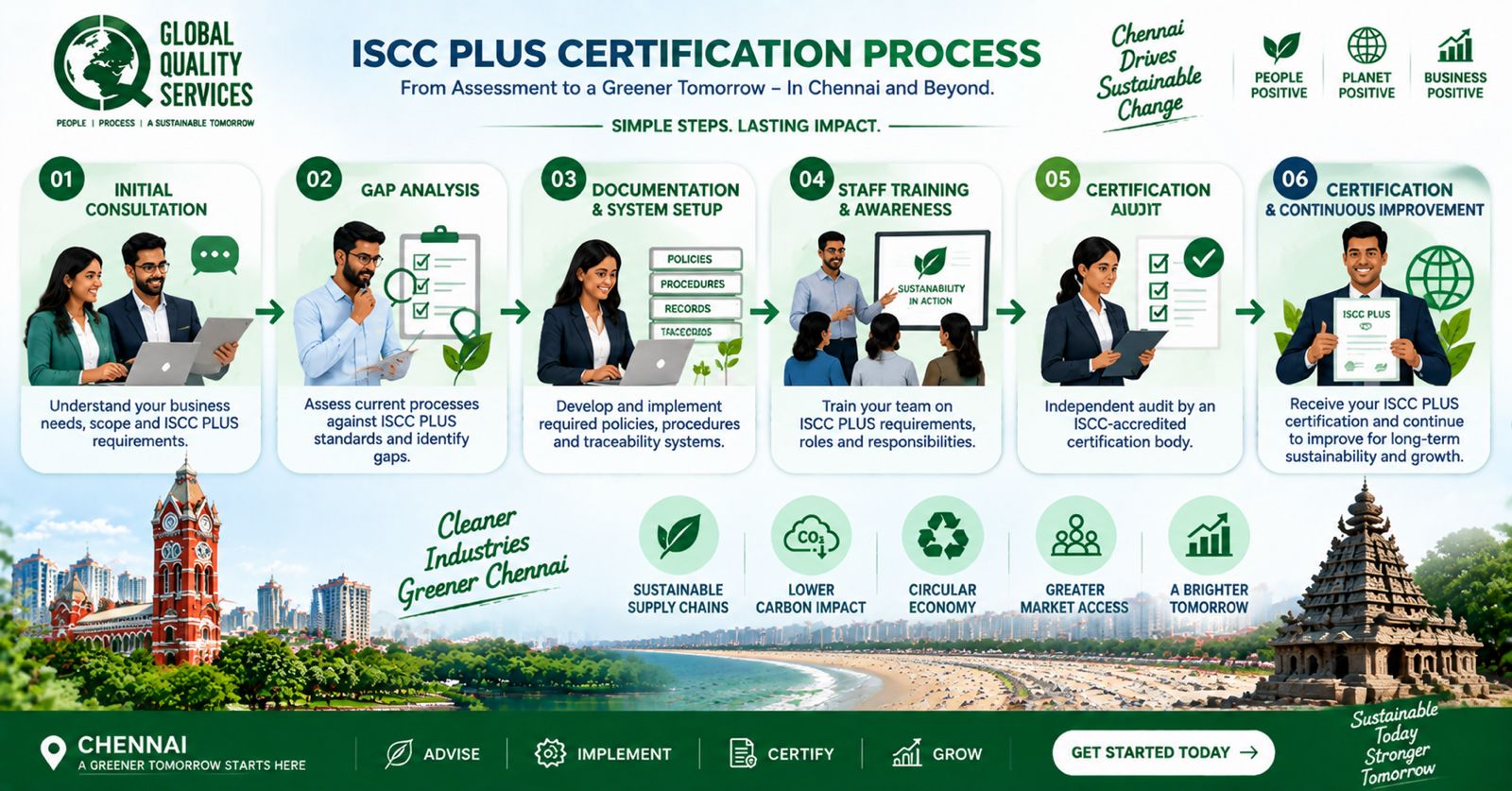
The process begins with scheme and scope identification, followed by implementation of the applicable controls and an independent certification audit.
1. Identify the ISCC PLUS Scope
Determine the facility, products, materials, activities, and supply-chain functions that need to be included.
2. Identify Alternative Feedstocks
Establish whether the organization is working with circular, bio-circular, bio-based, or other eligible alternative feedstocks.
3. Select the Chain-of-Custody Method
Determine whether physical segregation, controlled blending, mass balance, or an applicable combination is appropriate.
4. Map the Material Flow
Document how materials move through purchasing, receiving, storage, production, inventory, and dispatch.
5. Review the Sustainability Evidence
Assess supplier documents, sustainability characteristics, declarations, records, and other supporting information.
6. Establish the Accounting System
Develop or review the organization’s mass-balance or other chain-of-custody accounting controls.
7. Conduct a Readiness Assessment
GQS can review the system against applicable ISCC PLUS requirements and identify gaps before the certification audit.
8. Register and Proceed to Certification
ISCC states that an economic operator must successfully register in the ISCC HUB before an audit can take place.
The formal certification audit is performed by an ISCC cooperating Certification Body.
Who Conducts the ISCC PLUS Certification Audit?
The formal ISCC PLUS audit is conducted by an ISCC cooperating Certification Body, not by a consultancy providing readiness support.
ISCC requires its cooperating Certification Bodies to meet defined competence and accreditation requirements. ISCC states that the accreditation requirement for Certification Bodies is based on ISO/IEC 17065 and that auditors must meet relevant competence and training requirements.
GQS can therefore support the organization before the audit by helping it understand requirements, establish controls, prepare documentation, and identify readiness gaps.
How Can GQS Help With ISCC PLUS Certification in Chennai?
GQS helps organizations convert ISCC PLUS requirements into practical controls that can be integrated into their existing purchasing, production, inventory, and quality systems.
The objective is to create a system that can be demonstrated through records and operational evidence rather than simply producing a set of procedures for the audit.
Why Choose GQS for ISCC PLUS Consultancy in Chennai?
GQS takes a requirements-based approach that connects ISCC PLUS controls with the organization’s actual material and information flows.
For a chemical manufacturer in Manali, the key concern may be alternative feedstock accounting and mass balance.
For a plastics manufacturer, it may be recycled polymer traceability.
For a packaging company, the focus may be certified input control and customer claims.
For an electronics manufacturer in the Sriperumbudur corridor, the relevant issue may be the traceability of eligible alternative materials within a larger manufacturing supply chain.
FAQs About ISCC PLUS Certification in Chennai
What is ISCC PLUS Certification?
ISCC PLUS is a voluntary certification system for demonstrating sustainability characteristics associated with alternative feedstocks, including circular and bio-based materials. It supports traceability through physical segregation, controlled blending, and mass balance chain-of-custody methods.
Is ISCC PLUS mandatory for Chennai manufacturers?
ISCC PLUS itself is a voluntary certification scheme. However, a customer, supply chain, procurement program, or market requirement may make certification commercially important for a particular organization.
Can a chemical company in Manali apply for ISCC PLUS?
Potentially, yes. Manali is part of Tamil Nadu’s established chemical and petrochemical ecosystem, and ISCC PLUS can be relevant to chemical organizations handling eligible alternative feedstocks. The actual applicability depends on the company’s materials, products, processes, and intended claims.
Which chain-of-custody method is suitable for recycled plastic?
There is no single method that is automatically correct for every recycled-plastic manufacturer. ISCC PLUS permits physical segregation, controlled blending, and mass balance. The appropriate method depends on the organization’s physical processes, material flows, and certification scope.
Does GQS issue the ISCC PLUS certificate?
GQS provides consultancy and certification-readiness support. The independent ISCC cooperating Certification Body conducts the formal audit and certification activity. ISCC requires cooperating Certification Bodies to meet defined accreditation, competence, and scheme requirements.