Hyderabad’s manufacturing ecosystem is expanding, making reliable supplier assessment more important than ever. A recent Times of India report says a new mega fan manufacturing facility planned in Hyderabad involves an investment of ₹375 crore. As factories scale up, buyers need more than supplier promises; they need clear evidence of quality, capacity, processes, and compliance.
Professional factory inspection and second-party audit consultants in Hyderabad can independently assess these areas and help businesses identify supplier risks before they become costly problems.
What is a Second-Party Factory Audit
A second-party audit is an assessment that a customer conducts, or commissions through an independent auditor, at a supplier’s facility.
The audit focuses on whether the factory can consistently meet the buyer’s requirements. Depending on the product and contract, the audit may cover:
- Manufacturing processes
- Quality control procedures
- Production capacity
- Raw material management
- Equipment and machinery
- Inspection and testing
- Employee competence
- Traceability
- Storage and handling
- Workplace conditions
- Environmental practices
- Documentation and records
- Corrective action processes
Unlike a certification audit, a second-party audit focuses specifically on the customer-supplier relationship and purchasing requirements.
Why Do Companies Conduct Factory Inspections in Hyderabad
Supplier problems often become expensive after production starts. An inspection before onboarding or during an active contract can reveal those problems earlier.
For example, a buyer may discover that a supplier has limited production capacity despite quoting a large order. Another audit may reveal inconsistent inspection records or inadequate controls over rejected materials.
Hyderabad’s industrial ecosystem includes manufacturing operations in areas such as pharmaceuticals, engineering, aerospace, electronics, and other sectors.
A factory inspection can help buyers make decisions based on what actually happens on the shop floor rather than relying only on supplier claims.
What Does a Factory Inspection in Hyderabad Cover?
The inspection scope depends on the product, industry, purchase requirements, and supplier risk. A typical assessment can include the following areas.
1. Factory and Infrastructure Assessment
The auditor reviews the factory layout, production areas, warehouses, utilities, equipment and general working conditions.
They may check whether the facility has enough space and resources to handle the proposed order.
2. Production Process Inspection
The auditor follows the manufacturing process from incoming materials to finished goods.
They look for process controls, work instructions, inspection points, production records and potential bottlenecks.
3. Quality Control and Testing
Quality controls play a major role in supplier performance.
The audit may review:
- Incoming inspection
- In-process inspection
- Final product testing
- Calibration records
- Test equipment
- Non-conforming product controls
- Inspection reports
- Customer complaints
This helps determine whether the supplier has practical quality controls rather than simply holding a quality certificate.
4. Raw Material and Inventory Controls
The auditor checks how the factory receives, identifies, stores and issues materials.
They may also verify batch identification, stock records, segregation of rejected materials and traceability.
5. Production Capacity
Capacity claims deserve close attention when the buyer plans large or recurring orders.
The inspection can review machinery, manpower, production schedules, working shifts, historical production data and current workload.
This gives the buyer a clearer picture of whether the supplier can realistically meet delivery requirements.
6. Documentation and Records
The auditor compares documented procedures with actual practices.
Typical records include:
- Production records
- Inspection reports
- Calibration certificates
- Training records
- Maintenance records
- Purchase records
- Supplier evaluations
- Corrective action reports
- Customer complaint records
A gap between documented procedures and shop-floor practices can indicate a potential supplier risk.
How Does a Second-Party Factory Audit Work?
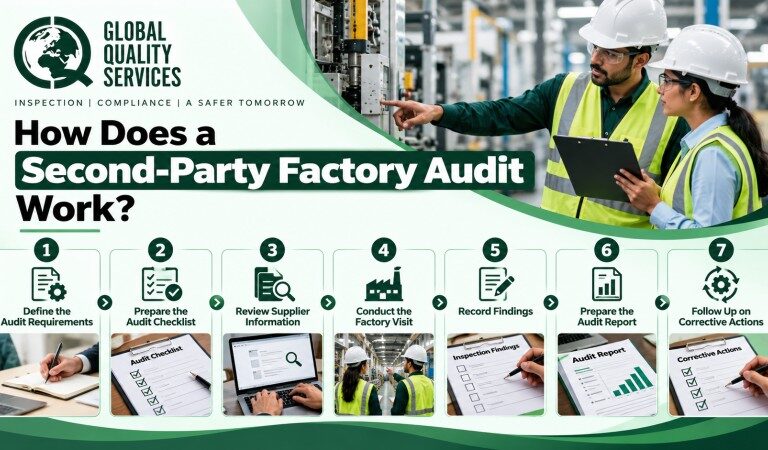
A well-planned audit normally follows a structured process.
Step 1: Define the Audit Requirements
The buyer identifies what the supplier must meet.
This may include product specifications, quality requirements, delivery expectations, regulatory requirements, and contractual conditions.
Step 2: Prepare the Audit Checklist
The auditor converts those requirements into practical checkpoints.
The checklist should match the supplier’s industry and the products being purchased.
Step 3: Review Supplier Information
Before visiting the factory, the auditor reviews available information such as certifications, previous audit reports, production details and relevant documentation.
Step 4: Conduct the Factory Visit
The auditor visits the facility and examines the actual operations.
They interview responsible personnel, inspect production areas, review records and observe processes.
Step 5: Record Findings
The auditor documents conformities, nonconformities, observations and areas that require improvement.
Evidence should support significant findings.
Step 6: Prepare the Audit Report
The final report gives the buyer a clear picture of supplier performance.
It can include photographs, evidence, findings, risk areas and recommended corrective actions, depending on the agreed scope.
Step 7: Follow Up on Corrective Actions
For significant findings, the buyer may request corrective action from the supplier.
A follow-up review can confirm whether the supplier actually addressed the identified issue.
When Should You Conduct a Supplier Factory Audit?
A factory audit can be useful at several stages of the supplier relationship.
- Before supplier approval: Check whether a potential supplier has the facilities, processes and resources needed for your requirements.
- Before placing a large order: Verify production capacity and operational readiness before committing significant expenditure.
- During supplier development: Identify process gaps and work with the supplier on improvements.
- After quality problems: Investigate recurring defects, complaints or delivery failures.
- For high-risk suppliers: Increase oversight when the supplier handles critical components, sensitive materials, or safety-related products.
- Periodically: Reassess important suppliers as their processes, facilities, equipment or personnel change.
Key Benefits of Second-Party Audits for Buyers
A supplier audit does more than produce an audit report. It gives purchasing and quality teams practical information to manage suppliers.
Better Supplier Visibility
A second-party audit lets you see how a supplier actually works, beyond documents and declarations. You get practical insights into daily operations, controls, and capabilities.
Early Identification of Quality Risks
Auditors can spot weak inspection controls, poor traceability, material segregation issues, and process gaps early, helping you address problems before they affect your orders.
Stronger Supplier Selection
Audit findings give procurement teams useful evidence about supplier capabilities, processes, and controls, making supplier evaluations more informed and grounded in actual site conditions.
Improved Product Consistency
Regular supplier assessments encourage stronger manufacturing and inspection controls. Over time, these checks can help suppliers maintain more consistent processes and reduce avoidable quality variations.
Reduced Supply Chain Risk
Understanding supplier capacity, processes, and controls helps buyers identify operational weaknesses early, allowing them to address concerns before they disrupt production or deliveries.
Industries That Can Benefit From Factory Audits in Hyderabad
Second-party audits can support buyers across many manufacturing sectors, including:
- Pharmaceuticals
- Aerospace and defence
- Automotive
- Engineering
- Electronics
- Electrical equipment
- Chemicals
- Medical devices
- Plastics
- Packaging
- Industrial machinery
- Food and beverage manufacturing
The audit checklist should always reflect the specific product and associated risks rather than using one generic checklist for every factory.
What Should You Look for When Hiring a Factory Inspection Company in Hyderabad?
The auditor’s technical understanding matters as much as the checklist.
Before engaging an inspection company, consider:
- Experience in your industry
- Auditor qualifications
- Understanding of manufacturing processes
- Ability to conduct supplier audits
- Geographic coverage
- Reporting format
- Evidence and photographic documentation
- Corrective-action follow-up
- Understanding of applicable standards
- Ability to customize the audit scope
A good audit report should help you understand what was checked, what the auditor found, why it matters, and what action may be needed.
Why Choose Global Quality Services for Factory Inspection in Hyderabad
Global Quality Services can help buyers assess supplier facilities, manufacturing processes, and quality controls through structured factory inspections and second-party audits in Hyderabad. The audit scope can match your product requirements, supplier risks, and purchasing conditions.
From supplier evaluation to corrective-action follow-up, the process focuses on practical findings that your procurement and quality teams can actually use. Contact Global Quality Services to get smooth and reliable service.
FAQ’s
1. What is a second-party audit of a factory?
A second-party factory audit assesses a supplier against customer requirements. It typically covers production, quality controls, capacity, documentation, traceability, equipment, and operational practices.
2. What is checked during a factory inspection in Hyderabad?
Inspectors may review production processes, raw materials, machinery, quality testing, storage, documentation, employee practices, capacity, traceability, and corrective-action records.
3. When should a company conduct a supplier audit?
Companies commonly conduct supplier audits before approval, before large orders, after quality problems, during supplier development, or periodically for high-risk suppliers.
4. Is a factory audit the same as an ISO certification audit?
No. An ISO certification audit assesses conformity with a specific management-system standard. A second-party audit evaluates the supplier against customer-defined requirements and purchasing needs.
5. How long does a factory inspection take?
The duration depends on the factory size, product complexity, number of processes, and audit scope. A focused inspection may take one day, while broader audits can require more time.