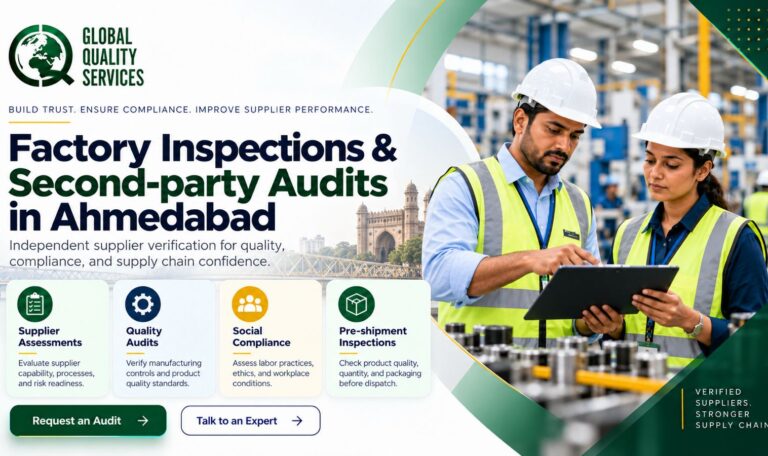
A supplier may meet your requirements on paper, but the real question is whether its factory processes, production controls, quality checks, and capacity can consistently deliver what your business expects. For companies sourcing components, machinery, equipment, or finished products, an on-site assessment can provide valuable visibility before a supplier issue affects production or delivery.
Inspection or Second-Party Audits of Factories in Pune help buyers, OEMs, procurement teams, importers, and businesses evaluate suppliers against defined quality, technical, process, and customer requirements.
Pune’s strong presence in automotive, engineering, industrial manufacturing, electronics, pharmaceuticals, and technology-related industries makes supplier assessment particularly relevant. Global Quality Services (GQS) supports organizations with factory inspections and second-party audits tailored to the purpose, product, supplier, and assessment criteria.
Why Are Factory Inspections Important for Pune Suppliers?
Pune has a well-established manufacturing network extending from established industrial areas within the city to major manufacturing clusters across the Pune region. Businesses may source from large established factories as well as specialized component and process suppliers.
A factory inspection allows the customer to look beyond submitted documents and assess what is actually happening at the manufacturing site. Depending on the assignment, an assessment can help verify:
- Manufacturing capability and available resources
- Production and process controls
- Product specifications and quality requirements
- Inspection and testing arrangements
- Material identification and traceability
- Equipment and calibration records
- Storage and handling practices
- Packaging and dispatch controls
- Compliance with customer-specific requirements
- Corrective actions from earlier assessments
This can be especially useful when a supplier is being considered for a new product, larger order, or long-term business relationship.
Benefits of Inspection and Second-Party Audits in Pune
For companies managing suppliers across Pune’s manufacturing network, regular factory assessments can strengthen visibility and support more informed supplier management.
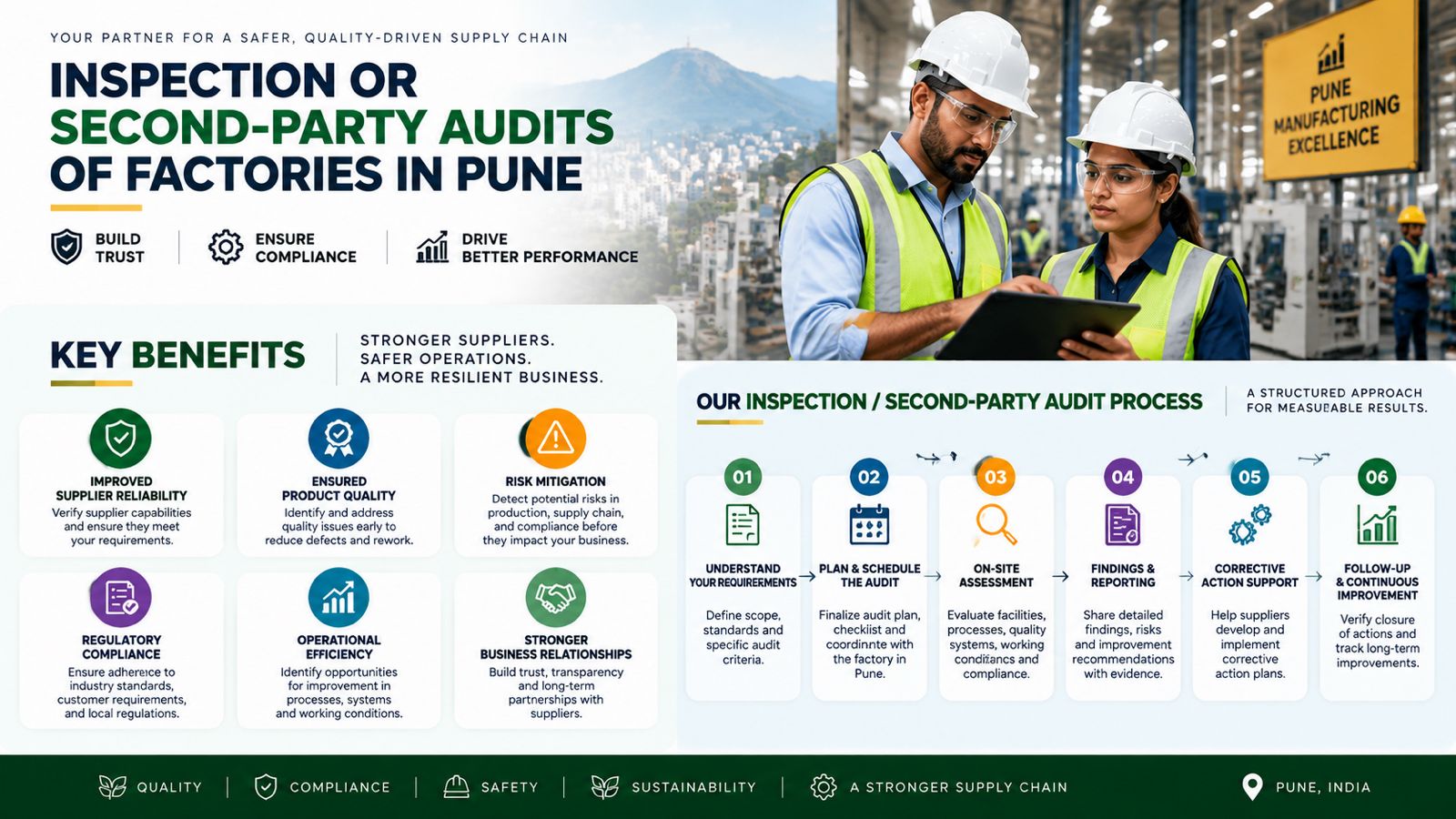
- Supplier Capability Verification: Understand whether the factory has the resources and processes needed to meet your requirements.
- Quality Risk Identification: Identify potential weaknesses before they lead to recurring product problems.
- Production Visibility: See how materials move through actual manufacturing and inspection processes.
- Customer Requirement Checks: Evaluate supplier performance against defined specifications and expectations.
- Pre-Order Confidence: Obtain on-site information before committing to significant production volumes.
- Corrective Action Verification: Check whether previously identified issues have been addressed.
- Ongoing Supplier Monitoring: Use periodic audits as part of a structured supplier evaluation program.
Area We Cover For Second-Party Audits in Pune
Supplier audits can be relevant across Pune’s major industrial and commercial manufacturing locations.
- Pimpri-Chinchwad: A significant manufacturing area where supplier assessments may be relevant to automotive, engineering, machinery, and component manufacturers.
- Chakan: Factory audits can support businesses sourcing automotive components, engineering products, industrial equipment, and other manufactured goods.
- Bhosari: Inspections may cover engineering units, fabrication, machining, components, and industrial manufacturing processes.
- Talegaon: Supplier assessments can be relevant to automotive, engineering, manufacturing, and industrial facilities.
- Ranjangaon: Manufacturing and supplier evaluations may be required for automotive, electronics, engineering, and other industrial operations.
- Hinjawadi and surrounding areas: Technology-oriented manufacturing, electronics, equipment, and supporting supplier operations may also require customer assessments.
The exact audit scope should be established according to the supplier, product, customer requirements, and purpose of the assessment.
What Can a Factory Inspection in Pune Cover?
No single inspection checklist applies to every supplier. GQS can structure the factory audit assessment around the areas that matter to the customer.
Manufacturing and Production Processes
The assessment can examine production stages, process controls, machinery, operator practices, inspection points, and controls used to maintain product quality.
Raw Materials and Components
The assessment can review incoming materials for identification, specifications, certificates, storage, traceability, and other agreed requirements.
Product Inspection
Depending on the assignment, products may be assessed for dimensions, artistry, quantity, specifications, identification, and other customer-defined characteristics.
Quality Control and Testing
The assessment may include review of inspection methods, testing facilities, measuring equipment, calibration records, test reports, and quality records.
Traceability and Documentation
Where applicable, the company can examine production records, inspection reports, material certificates, procedures, specifications, and traceability systems.
Packaging and Dispatch
For shipment-related inspections, you can also verify packaging, labeling, quantities, product identification, loading, and other agreed requirements.
When Should a Company Conduct a Second-Party Audit?
A supplier audit does not have to be limited to the beginning of a business relationship. Companies may use second-party assessments at different stages of supplier management.
Before Supplier Approval
Assess a potential supplier’s manufacturing capability and quality controls before adding it to the approved supplier list.
Before Major Orders
Verify production resources and process controls before placing a significant or technically important order.
During an Ongoing Supplier Relationship
Periodically evaluate whether the supplier continues to meet defined requirements.
After Quality Problems
Investigate recurring defects, customer complaints, delivery concerns, or other supplier-related issues.
After Corrective Actions
Review whether the supplier has appropriately addressed previously identified problems.
Before Increasing Production Volumes
Assess whether the supplier has the processes, equipment, personnel, and controls required to support increased demand.
Industries That Can Benefit from Factory Audits in Pune
Pune’s manufacturing ecosystem supports a wide range of industries, making second-party audits relevant across many supplier types.
- Automotive and automotive components: Assessment of manufacturing processes, component quality, traceability, testing, and process controls.
- Engineering and machinery: Review of fabrication, machining, assembly, testing, documentation, and production capabilities.
- Electrical and electronics: Assessment of component handling, assembly processes, testing, inspection, and product requirements.
- Pharmaceutical and healthcare manufacturing: Review of relevant production controls, documentation, material management, traceability, and customer requirements.
- Industrial equipment: Verification of manufacturing capability, specifications, inspection, testing, and final product controls.
- Consumer and manufactured goods: Evaluation of raw materials, production quality, packaging, and order-specific requirements.
How Does a Second-Party Factory Audit Work?
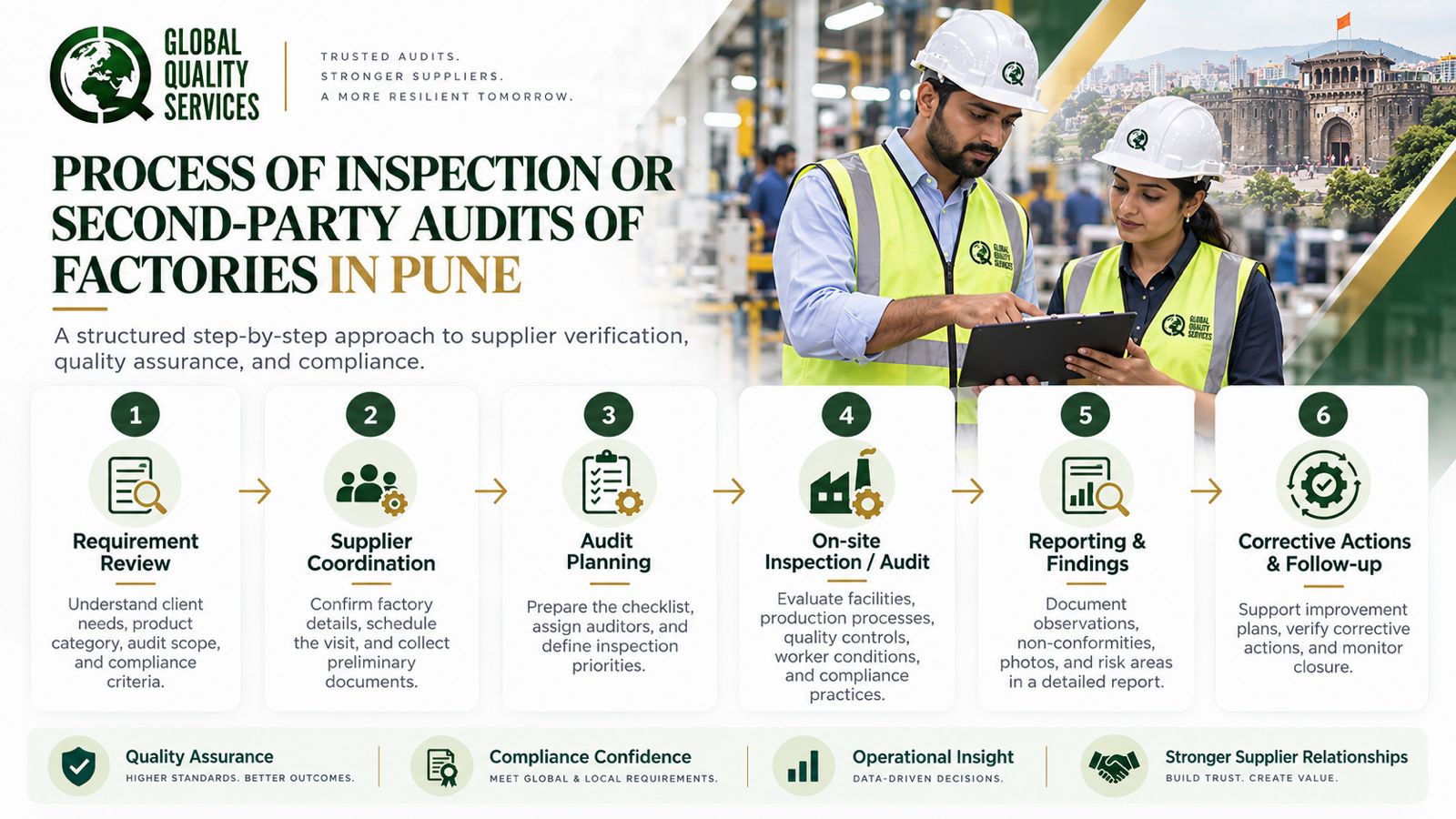
A well-planned second-party factory audit starts with the customer’s requirements, not a generic checklist.
1. Define the Assessment Scope
The customer and audit team establish the supplier location, products, processes, requirements, and areas that need to be evaluated.
2. Review Available Information
The auditor reviews relevant specifications, procedures, previous audit reports, quality records, customer requirements, and other available information.
3. Conduct the Factory Visit
The auditor visits the supplier’s facility and assesses the agreed areas through observation, discussions, document review, and examination of objective evidence.
4. Verify Actual Practices
The auditor compares production-floor activities with documented procedures, specifications, and customer requirements.
5. Record Findings
The auditor documents non-conformities, observations, gaps, and other relevant findings based on evidence identified during the assessment.
6. Prepare the Audit Report
The customer receives a structured report presenting the assessment results and relevant findings.
7. Review Corrective Actions
Where required, subsequent follow-up can assess the supplier’s response to identified issues and the evidence provided for corrective action.
How Can GQS Help with Factory Inspections and Second-Party Audits in Pune?
Global Quality Services supports organizations that need factory inspections and second-party audits across Pune and surrounding manufacturing areas.
The assessment can cover supplier qualification, manufacturing capability, product inspection, process verification, quality evaluation, customer-specific requirements, or corrective-action follow-up.
GQS can work with the customer to establish the assessment scope and applicable criteria before the factory visit. The on-site assessment then focuses on objective evidence from the relevant production, quality, documentation, and operational areas.
The resulting report provides the customer with structured findings that can support supplier evaluation and ongoing supply-chain monitoring.
Frequently Asked Questions
1. What is a second-party audit of a factory?
A second-party audit is an assessment conducted by or on behalf of a customer to evaluate a supplier against defined requirements. The scope may include manufacturing, quality, documentation, production capability, and other supplier-specific criteria.
2. What is the difference between a factory inspection and a second-party audit?
A factory inspection generally focuses on a specific product, process, material, shipment, or manufacturing activity. A second-party audit is usually broader and evaluates a supplier against defined customer or contractual requirements.
3. Can GQS inspect automotive and engineering suppliers in Pune?
Yes. Factory inspections and second-party audits can be structured for automotive, engineering, machinery, electronics, pharmaceutical, industrial, and other manufacturing suppliers, based on the customer’s requirements.
4. Can we provide our own audit checklist?
Yes. We can incorporate a customer-specific checklist, product specification, supplier requirement, internal procedure, or agreed assessment criteria into the audit scope.
5. Can second-party audits be conducted regularly?
Yes. Organizations can use periodic second-party audits for supplier qualification, performance monitoring, risk management, and corrective-action follow-up.