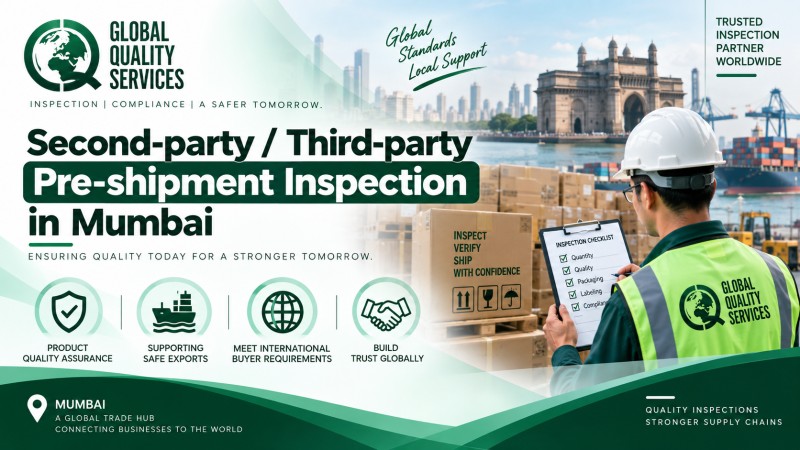
As manufacturing and trade expand across the Mumbai Metropolitan Region, conducting second-party or third-party pre-shipment inspections is essential to protect your supply chain. With Mumbai’s Jawaharlal Nehru Port Authority (JNPA) handling a record 102 million tonnes of cargo in FY26, local factories are dispatching unprecedented volumes of industrial goods worldwide (Press Information Bureau).
Our expert inspection teams verify that every lot meets your strict specifications, packaging guidelines, and quality standards before leaving the factory. Hiring a qualified inspection consultant prevents costly container rejections, safeguards your brand equity, and guarantees seamless international deliveries.
What is Second-Party and Third-Party Pre-Shipment Inspection
Pre-shipment inspection is a structured quality audit carried out when your production batch is at least 80% completed and 100% packed.
- Second-Party Inspection (2PI): Conducted by a party with a direct commercial connection to the deal, such as your in-house quality control team, an authorized client representative, or a designated procurement partner auditing a factory in the Mumbai Metropolitan Region (MMR).
- Third-Party Inspection (3PI): Executed by an independent, neutral inspection body. A third-party inspector has zero commercial interest in the transaction, giving both buyer and seller an unbiased, objective evaluation of product quality, dimensions, functionality, and packaging.
Why is Pre-Shipment Inspection Crucial for Mumbai Manufacturers & Exporters
Operating in Mumbai’s fast-moving industrial and export ecosystem requires absolute compliance with international trade standards. Missing a critical defect before container seal-locking leads to heavy financial fallout:
- Prevents Costly Port Rejections & Return Freight: Catching non-compliant goods at a factory in Bhiwandi or Taloja costs a fraction of handling rejected containers at foreign destination ports.
- Safeguards Buyer Relationships: Enterprise buyers, European distributors, and global OEMs demand flawless shipments. Consistently meeting quality benchmarks protects your commercial standing and vendor ratings.
- Unlocks Letter of Credit (LC) Payments: International banks frequently mandate a clean Third-Party Inspection Certificate before releasing funds under documentary credit agreements.
Step-by-Step Process for Pre-Shipment Inspection in Mumbai
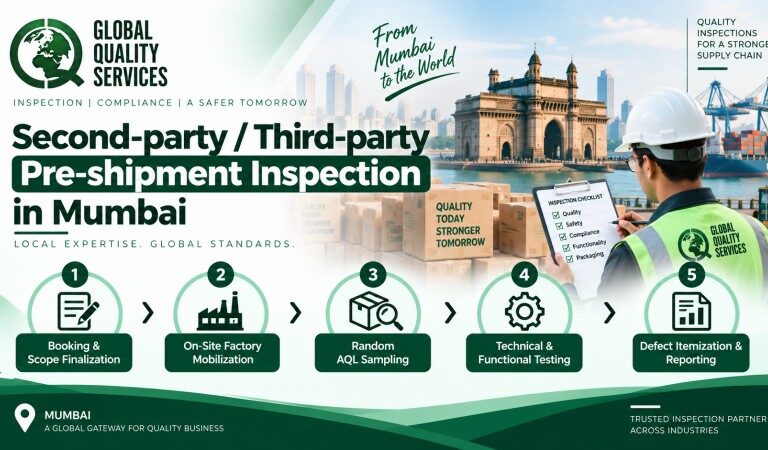
Our streamlined inspection protocol keeps your supply chain moving smoothly without compromising quality:
Booking & Scope Finalization
You submit purchase orders, technical drawings, acceptable quality limit (AQL) standards, and packaging requirements to establish exact evaluation guidelines for our Mumbai inspection team before site deployment.
On-Site Factory Mobilization
Our engineer arrives at the supplier facility in Mumbai, Thane, or Navi Mumbai once your production batch is at least 80% completed and 100% packed for export.
Random AQL Sampling
Using internationally accepted ISO 2859-1 standards, our inspector draws unbiased, mathematically representative sample units across various cartons to ensure a statistically accurate lot assessment.
Technical & Functional Testing
The inspector evaluates workmanship, checks dimensions against engineering specs, tests electrical/mechanical functions, and verifies carton durability, shipping marks, and barcode readability.
Defect Itemization & Reporting
Our team compiles an audit-grade report within 24 hours, categorizing critical, major, and minor defects with clear photo evidence to provide a decisive pass/fail result.
Why Choose Global Quality Services for Inspection in Mumbai
Want to clear your export shipments out of Mumbai with complete peace of mind? Catching defects before your cargo reaches JNPT port shouldn’t be a stressful waiting game.
At Global Quality Services, our Mumbai-based engineers deliver rapid, unbiased second- and third-party pre-shipment inspections tailored to your exact standards. We bridge technical gaps, verify packaging, and protect your commercial revenue. Contact Global Quality Services for smooth and reliable service.
Frequently Asked Questions
1. What AQL standard is typically applied during pre-shipment inspections?
Most commercial inspections utilize AQL Level II (Normal Inspection) under ISO 2859-1 standards. Standard tolerance thresholds are generally set at 0% for Critical defects, 2.5% for Major defects, and 4.0% for Minor defects.
2. How far in advance should I book an inspection in Mumbai?
We recommend scheduling your inspection 3 to 4 business days before your planned container loading or port cutoff date. This buffer allows sufficient time for sampling, testing, report evaluation, and any necessary factory corrective actions.
3. What steps follow a “FAILED” inspection report?
If the number of identified defects exceeds the agreed AQL limit, the lot is flagged as “FAIL.” You can instruct the factory to re-sort, repair, or replace defective units before booking a follow-up re-inspection.
4. How does Pre-Shipment Inspection (PSI) differ from Container Loading Supervision (CLS)?
PSI evaluates product quality, specification adherence, quantity, and packaging before container packing. Container Loading Supervision (CLS) focuses strictly on the physical loading process, checking container structural integrity, seal placement, weight balancing, and cargo securing.
5. Can Global Quality Services customize the inspection checklist for specific international buyers?
Yes. We adapt our inspection checklists, sample sizes, and testing protocols to mirror your buyer’s exact engineering drawings, purchase order clauses, and compliance guidelines.