As Pune cements its reputation as a global manufacturing giant across automotive, engineering, and electronics sectors, implementing second-party and third-party pre-shipment inspections is critical to protecting your supply chain. With India’s total passenger car exports surging by 19% year-on-year to hit a record 8.13 lakh units (Auto Punditz), local factories in Chakan, Bhosari, and PCMC are shipping unprecedented volumes to international markets.
Hiring an expert inspection consultant streamlines quality verification, catches costly manufacturing defects on the factory floor, and ensures seamless compliance before your cargo ever leaves Pune.
What is Second-Party and Third-Party Pre-Shipment Inspection
A pre-shipment inspection verifies finished goods before dispatch. In a second-party inspection, your internal team, customer, or designated business partner audits the supplier’s facility directly. In a third-party inspection, an independent, neutral agency evaluates product quality, packaging, and specs without any commercial bias. Both approaches catch defects early, protecting your revenue and reputation.
Why is Pre-Shipment Inspection Important for Pune Manufacturers
Operating in Pune’s high-volume automotive and engineering corridors requires strict adherence to international tolerances, safety regulations, and client-specific purchase orders. Skipping final quality assessments creates critical operational vulnerabilities:
- Eliminates Overseas Recall Costs: Detecting material flaws, dimensional discrepancies, or cosmetic defects locally in Chakan or Hadapsar is significantly cheaper than managing container rejections at overseas ports.
- Protects Commercial Reputation: Global buyers, Tier-1 automotive suppliers, and original equipment manufacturers (OEMs) demand zero-defect deliveries. Consistent compliance protects your brand equity and vendor ratings.
- Satisfies Letter of Credit (LC) Terms: Many international banks mandate an independent Third-Party Inspection Certificate before releasing funds under documentary credit terms.
- Ensures Regulatory Compliance: Verifies that your shipment conforms to target market standards, including CE marking, ISO requirements, ASME codes, and BIS norms.
Step-by-Step Process for Pre-Shipment Inspection
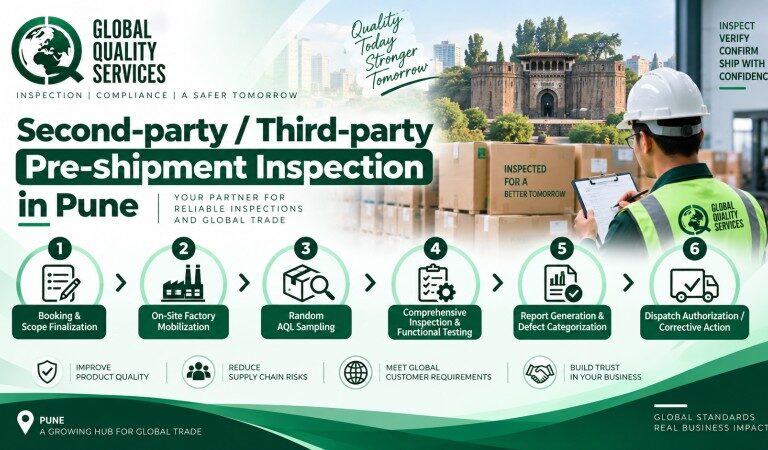
A transparent, standardized inspection workflow guarantees that your shipments arrive intact and fully compliant:
- Booking & Scope Finalization:
You submit your purchase order (PO), engineering drawings, product specs, and Acceptable Quality Limit (AQL) parameters to define explicit testing rules. - On-Site Factory Mobilization:
Our inspector arrives at the manufacturer’s plant in Pune (Bhosari, Chakan, PCMC, or Pirangut) once the lot meets the 80/100 production threshold. - Random AQL Sampling:
Using internationally accepted sampling standards (ISO 2859-1 / ANSI/ASQ Z1.4), the inspector selects random samples across multiple production boxes to guarantee an unbiased, mathematically valid assessment. - Comprehensive Inspection & Functional Testing:
Identifies surface scratches, burrs, welding flaws, or assembly errors. Measures critical dimensions, tests electrical parameters, and verifies performance metrics against approved drawings. Checks carton strength, shipping marks, barcode readability, weight accuracy, and moisture barriers. - Report Generation & Defect Categorization:
The inspector drafts an audit-grade report complete with high-resolution photos, itemizing critical, major, and minor defects found during testing. - Dispatch Authorization / Corrective Action:
You review the report to issue a formal release certificate clearing the shipment for transport or instruct the supplier to perform corrective rework.
Why Choose Global Quality Services Global Quality Services for Inspection in Pune
Partnering with the right technical inspection provider ensures fast turnaround times and audit-ready precision across Pune’s industrial belts.
- Local Boots on the Ground: Our team of certified quality engineers is stationed directly in Pune, enabling rapid mobilization to Chakan, Bhosari, Ranjangaon, Talegaon, and Khed GIDC on short notice.
- Cross-Industry Engineering Expertise: Our inspectors possess deep hands-on experience across automotive components, heavy fabrication, electrical control panels, plastic injection molding, precision machining, and industrial valves.
- 24-Hour Inspection Reporting: You receive a detailed, photo-backed inspection report within 24 hours of site visits, helping you clear shipments promptly without causing logistical bottlenecks.
- Unbiased & Independent Assessments: Global Quality Services operates as an independent inspection body, delivering clear, objective data that global buyers and financial institutions trust implicitly.
Contact Global Quality Services today to get smooth and reliable services.
Frequently Asked Questions
1. What is the standard Acceptable Quality Limit (AQL) used during pre-shipment inspections?
Most industrial inspections follow AQL Level II (Normal Inspection) under ISO 2859-1 standards, typically setting limit thresholds at 0% for Critical defects, 2.5% for Major defects, and 4.0% for Minor defects.
2. How early should I schedule a pre-shipment inspection in Pune?
It is best to book your inspection 3 to 5 business days before your planned container loading or dispatch date. This allows sufficient time to sample, test, review reports, and complete any required factory rework without missing shipping schedules.
3. What happens if a production lot fails the pre-shipment inspection?
If the total number of defective units exceeds the agreed AQL limit, the lot receives a “FAIL” status. You can instruct your factory or vendor in Pune to re-sort, repair, or re-manufacture the batch before scheduling a second re-inspection.
4. What is the difference between Pre-Shipment Inspection (PSI) and Container Loading Supervision (CLS)?
PSI evaluates product quality, dimensional accuracy, quantity, and packaging before goods leave the factory floor. Container Loading Supervision (CLS) focuses on the physical loading process into sea containers or trucks, verifying container conditions, seal integrity, weight distribution, and proper cargo securing.
5. Can GQS customize the inspection checklist according to my buyer’s technical standards?
Yes. We customize our inspection protocols, checklist items, and testing methods using your specific technical drawings, purchase order details, material specifications, and client guidelines.