Building safety in India is no longer a reactive process but a rigorous and technology-driven mandate. The rapid expansion of industrial corridors and high-rise commercial hubs across the country makes structural integrity a critical factor for long-term risk mitigation. For any modern organization, ensuring the physical safety of a facility is a legal necessity and a fundamental pillar of operational excellence.
The current landscape for safety is defined by an increasing focus on infrastructure resilience in every major Indian state. Several factors underscore the urgency of these inspections:
- According to the National Crime Records Bureau (NCRB), structural collapses and industrial fires remain a primary cause of accidental deaths in Indian urban areas.
- Recent data from the International Labour Organization (ILO) and NDMA (2025) reveal that India reports over 2.3 lakh workplace accidents and 22,000 preventable fatalities annually.
- Manufacturing and construction sectors remain the most affected. In 2024 alone, workplace safety lapses resulted in over 400 fatalities in the manufacturing and mining sectors, as per the IndustriALL Global Union 2024.
- As per the Times of India report, Municipalities like Navi Mumbai have identified over 500 structures as unsafe in 2025 and set a strict deadline of March 31, 2026, for mandatory structural audits.
These realities show that building safety is not something that can be assumed once construction is complete. Buildings change over time. Materials age, infrastructure experiences wear, usage patterns evolve, and once compliant systems may no longer meet current safety expectations.
In the sections below, we explain what building safety inspections involve in India, why they matter for organisations, and how a structured inspection process maintains safer and more reliable buildings.
What are Building Safety Inspection Services in India?
A building safety inspection is a systematic evaluation of a building’s physical condition, safety systems, and compliance with applicable codes and regulations. The primary objective is to determine whether the building remains structurally sound and safe for occupants, including employees, residents, visitors, and facility staff.
Unlike routine maintenance checks, safety inspections focus specifically on identifying risks and verifying compliance with safety standards. Inspectors review structural components, fire protection systems, electrical infrastructure, and emergency preparedness measures to understand whether the building continues to meet safety expectations.
In India, these inspections are usually conducted by:
- Qualified structural engineers
- Fire safety professionals
- Accredited inspection agencies.
Depending on the situation, inspections may also be reviewed or mandated by local municipal authorities, fire departments, or regulatory bodies responsible for building compliance.
Why Building Safety Inspection Services Matter
Neglecting safety protocols can lead to serious legal and financial consequences. Regular inspections serve several critical functions for business owners and facility managers in India.
Occupant Protection and Well-being
The most important reason for an audit is the safety of human life. A safe working environment ensures that every individual inside the premises is protected from structural hazards or fire outbreaks. This builds trust among employees and tenants, which is essential for any successful business operation.
Asset Preservation and Cost Management
Identifying moisture seepage or electrical overheating early saves a company from expensive long-term repairs. In India, monsoon-related water damage often leads to the corrosion of reinforcement steel. Early detection through a safety audit allows for targeted repairs, which are far more cost-effective than a full structural renovation.
Insurance Benefits and Financial Security
Many insurance providers in India now offer lower premiums for buildings that maintain updated safety audit certificates. In the event of an accident, a documented history of professional inspections ensures that your insurance claims are processed without complications.
Operational Continuity
Regular audits avoid government-mandated shutdowns or stop work notices due to non-compliance. A building that meets all safety standards can operate without the fear of sudden legal interventions or penalties from municipal authorities.
Key Building Safety Regulations in India
Compliance in India involves multiple layers of national and local rules. Navigating these requirements is essential for industrial and commercial entities to avoid litigation.
| Regulation Name | Primary Scope of Application | Key Compliance Requirement |
| NBC 2016 Updates | National Structural Standards | Comprehensive guidelines for structural design and fire safety |
| State Fire Safety Acts | Regional Fire Mandate | Mandatory Fire NOC and annual safety renewals |
| BOCW Act 1996 | Construction and Labor Phase | Safety standards for workers and site stability |
| Electricity Act 2003 | Electrical Systems Safety | Mandatory regular audits of high-voltage installations |
| Factory Act 1948 | Industrial Workplaces | Health and safety provisions for factory workers |
Types of Buildings That Require Safety Inspection Services
Building safety inspections are relevant across many different sectors. While the level of inspection required may vary, certain types of buildings commonly undergo safety evaluations due to their complexity or occupancy levels.
Examples include:
- Commercial office buildings, where large numbers of employees work daily
- Industrial facilities, which often contain heavy machinery and complex infrastructure
- Hospitals and healthcare facilities, where safety systems are critical for patient care
- Educational institutions, including schools and universities with large student populations
- Residential apartment complexes, particularly high-rise developments
- Warehousing and logistics centres, where storage systems and mechanical equipment introduce unique risks
When Building Safety Inspection Services Are Required
Although inspection requirements vary, several situations commonly trigger the need for a building safety inspection.
Age-Based Requirements
- Buildings 15 to 29 years old: A structural audit is recommended every 5 years in most states to monitor early signs of wear.
- Buildings 30-plus years old: A structural audit is mandatory in Mumbai, Navi Mumbai, Pune, and several other municipal areas. Many other states are now adopting similar rules to prevent urban infrastructure failure.
- Buildings 50 plus years old: An annual inspection is generally required at this stage. Some municipalities classify these as Potentially Dangerous Structures and require an immediate professional assessment.
Event Triggered Inspections
- Seismic Events: Even after a minor earthquake, a structural integrity check is required to ensure no hidden shifts have occurred.
- Flooding or Waterlogging: Foundation and substructure assessments are necessary after heavy rains to check for soil erosion or structural weakening.
- Fire Incidents: A full structural and fire safety re-inspection is mandatory before any occupants can return to the building.
- Renovations: Any significant structural alteration requires a fresh occupancy re-certification to confirm the changes meet safety codes.
- Change of Use: Converting a residential floor to a commercial space requires a new inspection and a revised occupancy permit to handle the increased load.
Regulatory and Licensing Milestones
- Pre-occupancy: A completion certificate and occupancy permit inspection under NBC 2016 standards are required. This involves step-wise inspections during construction and a final sign-off by the local authority.
- Fire NOC Renewal: Annual renewals are required for most commercial and high-risk buildings across most Indian states.
- RERA Compliance: Real estate developers must certify the structural safety of all delivered properties to protect buyers.
- ISO 45001 Internal Audits: Building safety conditions are a core part of hazard identification and are reviewed regularly during management meetings.
Note for facility managers: Even where no specific regulation mandates an inspection frequency, courts have consistently held that building owners have a duty of care to occupants. A documented, regular inspection programme is the strongest defence in the event of an accident or legal action.
Common Risks Identified During Building Safety Inspection Services
Experienced inspectors consistently find the same categories of defects across building types in India. Understanding these helps property owners prioritise resources and act before problems escalate:
Electrical Overloading and Short Circuits
Poorly managed wiring or machinery lines often create significant fire risks. Many buildings in India use old electrical panels that are not rated for the modern power demands of high-tech equipment.
Structural Seepage and Corrosion
Water damage is a major concern during the Indian monsoon. Seepage leads to the corrosion of the steel bars inside concrete pillars. This weakens the structure and can lead to a sudden collapse if not addressed early.
Blocked Emergency Exits
In many commercial buildings, emergency exits are often used for storage or are locked during work hours. This is a severe violation of safety codes and can lead to fatalities during an emergency.
Faulty Fire Fighting Equipment
Inspections often reveal expired fire extinguishers or fire pumps that fail to start. Without regular testing, these systems become useless during an actual fire.
Non-Compliant Alterations
Unauthorised structural modifications, removal of load-bearing walls, and addition of floors without approval
Note: The most dangerous combination and the one that appears repeatedly in post-collapse investigations across India is structural deterioration combined with unauthorised alterations and no documented inspection history. Each factor alone is manageable. Together, they create conditions for catastrophic failure.
Building Safety Inspection Checklist
A professional audit covers several critical domains to provide a complete picture of the health of the building.
- Structural Health Assessment: This includes checking foundations, beams, columns, and slabs for cracks or signs of settlement.
- Fire Safety Systems: Auditors verify the functionality of smoke detectors, sprinklers, fire hydrants, emergency exits, Fire NOC validity & renewal status, and alarm systems.
- Electrical System Audit: This involves checking panel health, earthing values, wiring insulation conditions, cable routing, DG set safety, exhaust routing, fuel storage, and identifying hotspots using thermal imaging.
- Plumbing and Sanitary Evaluation: Detection of leaks in the internal and external plumbing lines, drainage and sewage system, water tank cleanliness, seepage in walls, terrace waterproofing conditions, and STP/ETP functioning.
- Lifts and Escalators: Verification of load tests, emergency brakes, and the presence of a valid AMC from the manufacturer.
Industries Covered
Building safety inspections apply to facilities across different sectors, with inspection scope determined by the building type, applicable requirements, and agreed inspection criteria.
- Manufacturing and Industrial Facilities: Inspection of building structures, electrical installations, and fire safety systems.
- IT Facilities and Data Centers: Examination of building infrastructure, electrical systems, and installed fire protection arrangements.
- Commercial and Residential Buildings: Inspection of structural components, common areas, and relevant safety systems.
- Warehouses and Logistics Facilities: Examination of building elements, storage-related structural concerns, and applicable safety arrangements.
- Pharmaceutical and Healthcare Facilities: Inspection of building infrastructure and relevant fire safety and electrical installations.
The Building Safety Inspection Services Process
A professional inspection follows a clear and systematic four-step journey to ensure no detail is overlooked.
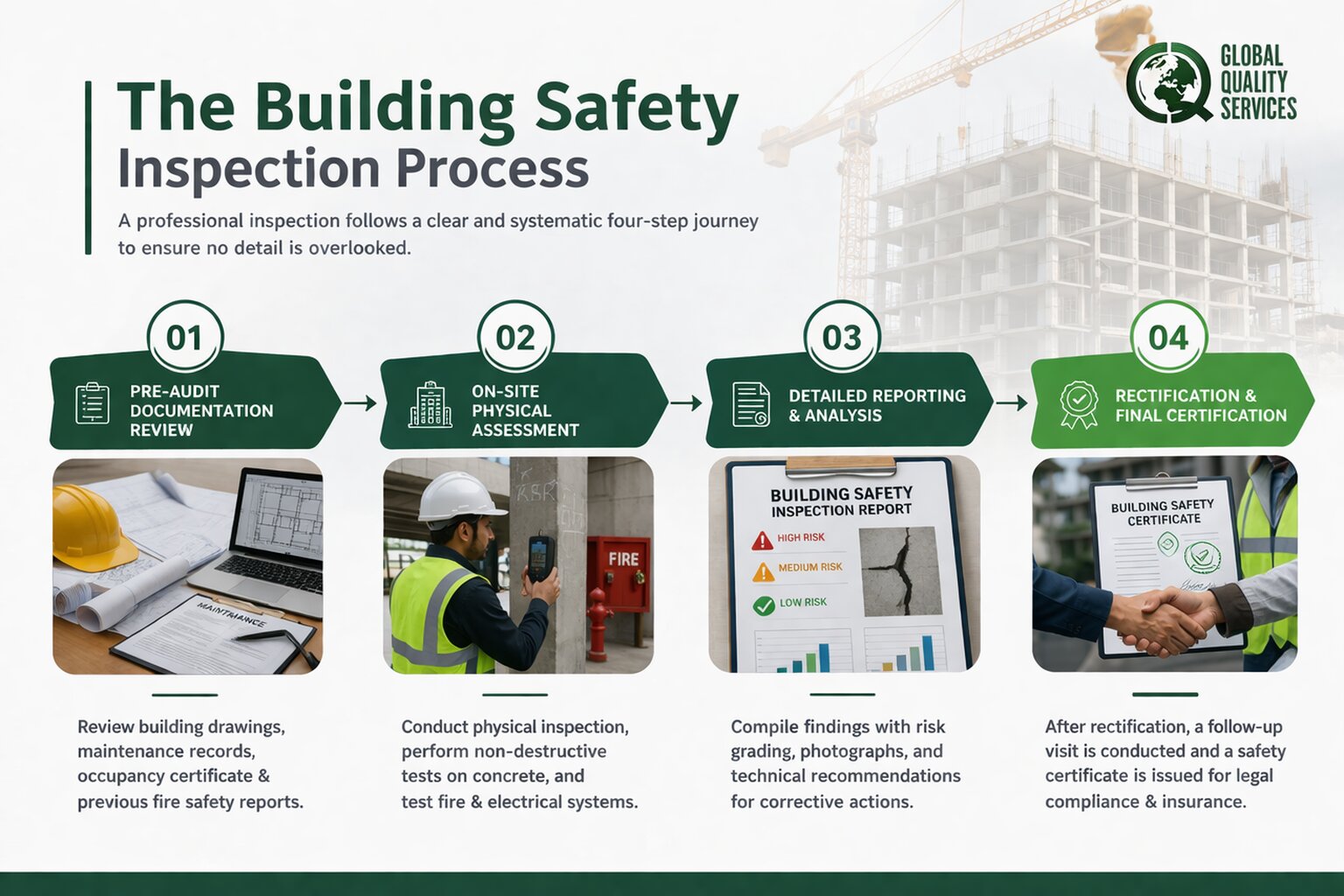
Step 1: Pre-Audit Documentation Review
The process begins with an examination of the building blueprints and previous maintenance logs. The auditors review the occupancy certificate and the previous fire safety reports to identify any history of issues.
Step 2: On-Site Physical Assessment
The technical team conducts a physical site visit. They use non-destructive testing methods to check the strength of the concrete. They also perform live tests on the fire hydrants and the electrical backup systems.
Step 3: Detailed Reporting and Analysis
The findings are compiled into a comprehensive report. Every identified risk is graded based on its level of severity. The report includes photographs of the problem areas and technical recommendations for rectification.
Step 4: Rectification and Final Certification
Once the facility manager addresses the identified issues, a follow-up visit is conducted. After verification, a safety certificate is issued, which can be used for legal compliance and insurance purposes.
Building Safety Inspection Services
Building Safety Inspection Services in Delhi | Building Safety Inspection Services in Bengaluru
Building Safety Inspection Services in Noida | Building Safety Inspection Services in Hyderabad
Building Safety Inspection Services in Ahmedabad | Building Safety Inspection Services in Chennai
Building Safety Inspection Services in Pune | Building Safety Inspection Services in Mumbai
Building Safety Inspection Services in Noida | Building Safety Inspection Services in Hyderabad
Building Safety Inspection Services by Global Quality Services
With 26 years of experience, Global Quality Services (GQS) conducts impartial, professional, and certified inspections for organizations across India.
Our building safety inspection services cover:
- Structural Safety Inspection: Examination of structural components for visible defects, deterioration, and other observable concerns.
- Fire Safety Inspection: Inspection of fire protection systems and related safety arrangements against applicable requirements.
- Electrical Safety Inspection: Examination of electrical installations and associated components for observable defects and non-conformities.
- Building Condition Inspection: Assessment of building elements, facilities, and infrastructure to establish their observed condition.
- Inspection Reporting: Documentation of inspection observations, identified non-conformities, and findings in a clear, factual report.
At Global Quality Services, every inspection is conducted with impartiality, objectivity, and professional integrity. Our certified inspection professionals record findings based on established criteria, ensuring inspection results reflect the actual conditions observed.
Start Strengthening Your Building Safety Compliance
Safety is a continuous commitment for every business in India. Whether you manage an industrial unit in Pune or a corporate office in Bangalore, regular audits are essential for risk management. A safe building is a productive building. Contact Global Quality Services today to schedule a comprehensive safety assessment and protect your business from future liabilities.
Frequently Asked Questions
1. What is the specific difference between a structural certificate and a fire safety audit?
A structural certificate confirms the physical strength of the building components, such as the foundation and columns. A fire safety audit specifically checks the systems meant to detect or extinguish fires, like alarms and sprinklers. Both are necessary to ensure the total safety of the occupants and the property.
2. Can a business be fined for missing a safety inspection in India?
Yes. Municipal authorities and fire departments have the power to impose heavy fines or disconnect utility services if a building lacks valid safety certifications. In extreme cases of non-compliance, the building can be sealed by the authorities.
3. How does professional auditing offers insurance claims for industrial units?
In the event of an accident, insurance companies look for proof of regular maintenance and due diligence. A history of regular inspections from an expert like Global Quality Services serves as professional evidence that you took all necessary precautions.
4. Is a safety inspection required for a rented warehouse or factory?
Yes. Both the property owner and the tenant have a shared responsibility to ensure the workspace is safe. A safety audit confirms that the warehouse can handle the intended storage load and meets all local fire safety codes.
5. How long does a standard building safety audit typically take to complete?
A standard commercial building audit usually takes three to five days to complete. This timeframe includes the physical site visit, the technical testing, and the generation of the final audit report.