ISCC Certification in Bengaluru helps organisations demonstrate sustainability, traceability, and responsible sourcing across supply chains involving bio-based, recycled, renewable, or other eligible materials. It can be relevant to manufacturers, processors, traders, suppliers, and other organisations in Bengaluru that need to meet international sustainability requirements or customer expectations.
The International Sustainability and Carbon Certification (ISCC) system provides certification schemes for different markets and supply-chain applications. Depending on the organisation’s activities and target market, the applicable scheme may include ISCC EU, ISCC PLUS, ISCC CORSIA, ISCC CORSIA PLUS, ISCC Carbon Footprint Certification, or another relevant ISCC scheme. ISCC states that the appropriate certification depends on factors such as the target market and applicable regulatory requirements.
For businesses in Bengaluru, ISCC can be particularly relevant where materials need to be traced through complex supply chains and sustainability characteristics need to be demonstrated with documented evidence.
Global Quality Services provides consultancy and preparation support to help organisations understand applicable ISCC requirements, assess their current systems, prepare documentation, establish traceability controls, and get ready for the certification audit.
What Is ISCC Certification?
ISCC is a globally applicable sustainability certification system designed to verify sustainability and traceability requirements across supply chains.
The exact requirements depend on the ISCC scheme selected.
For example, ISCC EU is designed for markets covered by European renewable-energy legislation, including renewable transport fuels and recycled carbon fuels under the applicable EU framework. ISCC PLUS is a voluntary scheme covering areas such as circular and bio-based products, renewable materials, food, feed, industrial applications, and renewable fuels outside the EU regulatory framework. ISCC CORSIA and ISCC CORSIA PLUS address sustainable aviation fuel supply chains in the context of the ICAO CORSIA framework.
Why Is ISCC Certification Important for Bengaluru Businesses?
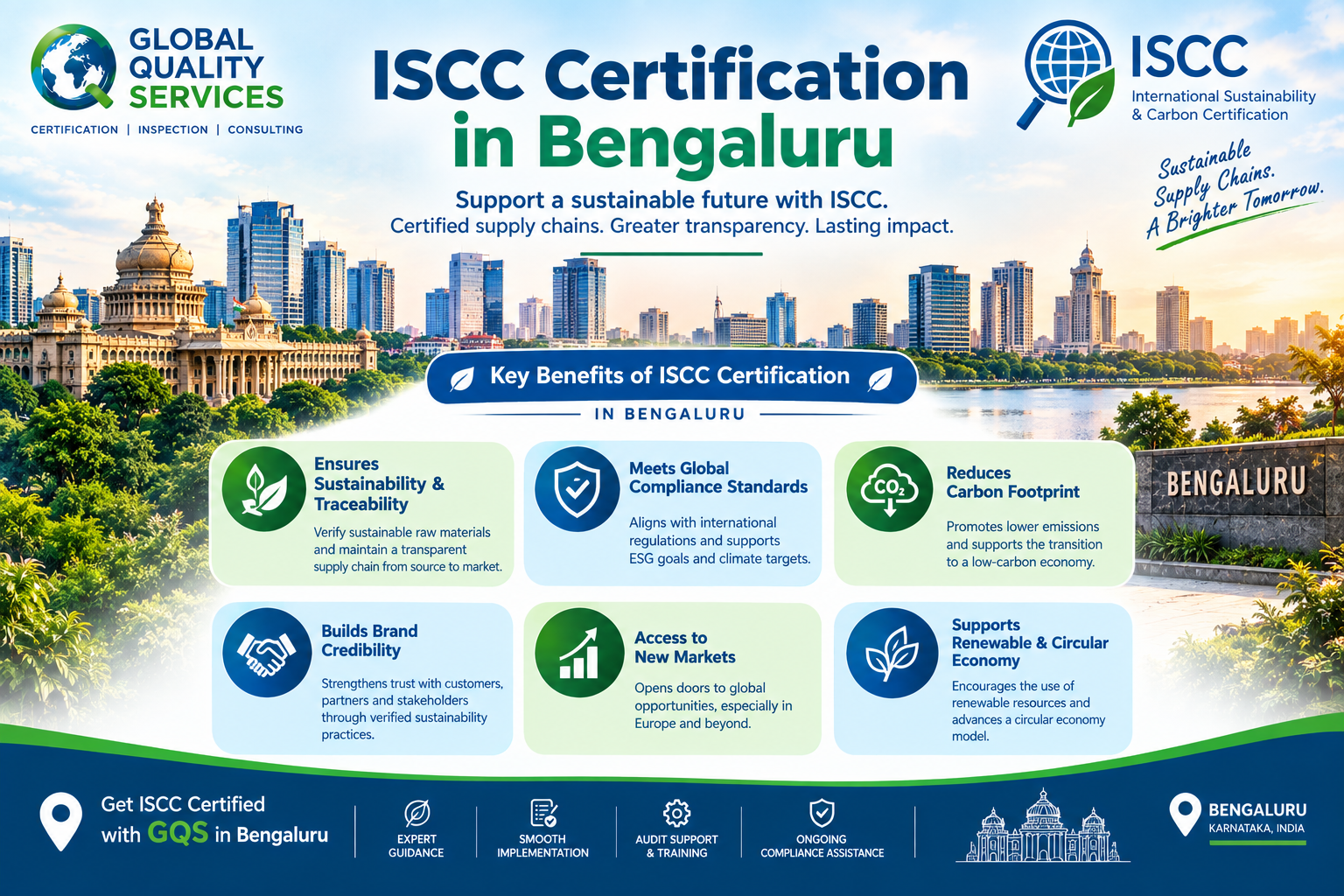
Demonstrates Sustainability Practices
ISCC certification provides independent verification that an organisation has addressed the sustainability requirements applicable to its certified activities and supply chain.
This can be important for companies selling materials or products into markets where sustainability claims need credible supporting evidence.
Improves Supply-Chain Traceability
Traceability is an important part of ISCC certification. Organisations need to be able to demonstrate how eligible materials enter, move through, and leave the certified supply chain.
This can help companies establish clearer controls over suppliers, material quantities, transactions, and sustainability information.
Supports International Market Access
Companies supplying international customers may encounter sustainability and responsible-sourcing requirements as part of their commercial relationships.
An appropriate ISCC certification can help organisations demonstrate compliance with the requirements applicable to their target market.
Strengthens Material Accounting
Where a chain-of-custody method such as mass balance applies, organisations need reliable systems for recording incoming and outgoing certified material.
This requires clear material accounting and supporting records that can be reviewed during an audit.
Improves Customer Confidence
Customers increasingly require suppliers to provide evidence supporting sustainability-related claims.
Independent certification can provide customers with greater confidence that the relevant sustainability and traceability requirements have been evaluated by an authorised Certification Body.
Creates Better Internal Controls
Preparing for ISCC certification encourages organisations to establish clearer responsibilities, records, supplier controls, material tracking, and verification processes.
These controls can become part of the organisation’s regular supply-chain management activities.
What Does ISCC Certification Require?
Applicable Sustainability Requirements
The organisation must identify the sustainability requirements applicable to its selected ISCC scheme and activities.
These requirements can differ depending on the type of feedstock, product, supply chain, geographical market, and certification scheme.
Traceability and Chain of Custody
The organisation needs to demonstrate how certified or eligible material is controlled through its operations.
Depending on the applicable scheme and supply chain, this can involve physical segregation, controlled blending, mass balance, or other recognised chain-of-custody approaches.
For ISCC PLUS, for example, ISCC recognises physical segregation, controlled blending, and mass balance as chain-of-custody options.
Supplier and Incoming Material Controls
Supplier certificates, material information, quantities, sustainability characteristics, and relevant transaction records need to be controlled appropriately.
Organisations should also verify the status of relevant suppliers and certificates where required.
Records and Documentation
ISCC audits can involve reviewing documents, data, processes, sites, and relevant records. Organisations should therefore maintain evidence that supports their sustainability and traceability claims.
Internal Verification
An internal review before the certification audit can help identify missing records, inconsistencies, process gaps, or weaknesses in material accounting.
ISCC itself advises System Users to conduct an internal audit before the certification audit.
What Is the ISCC Certification Process in Bengaluru?
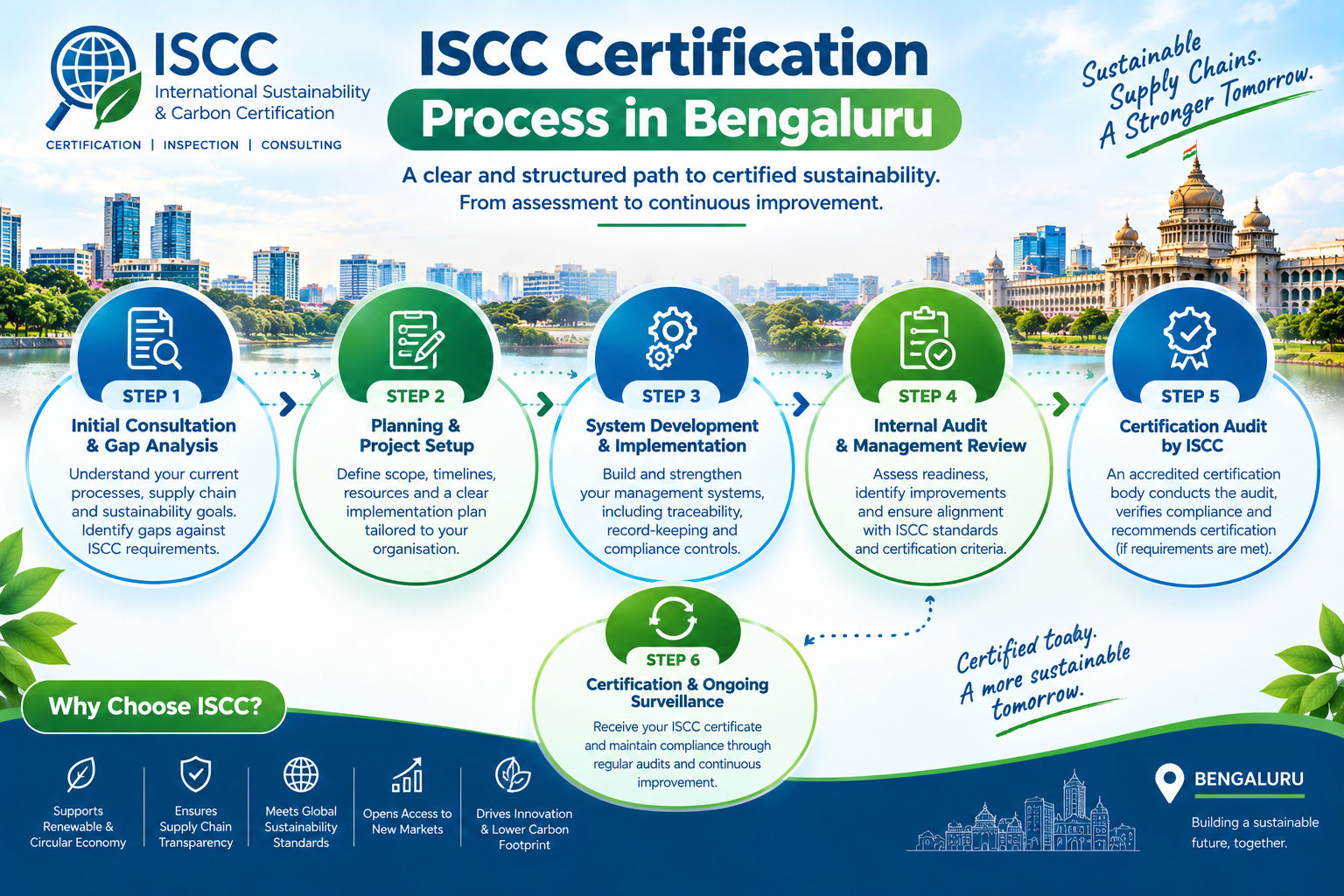
Step 1: Identify the Applicable ISCC Scheme
The first step is determining which ISCC certification scheme matches the organisation’s activities and target market.
This is important because ISCC EU, ISCC PLUS, ISCC CORSIA, ISCC CORSIA PLUS, and other ISCC schemes have different scopes and requirements.
Step 2: Define the Certification Scope
The organisation identifies the relevant site, activities, products, materials, suppliers, processes, and supply-chain relationships that will fall within the certification scope.
Step 3: Conduct a Gap Assessment
Existing sustainability controls, supplier management, traceability systems, material accounting, records, and procedures are reviewed against the applicable ISCC requirements.
The assessment identifies areas that need to be corrected or strengthened before the formal audit.
Step 4: Establish Documentation and Controls
Required procedures, records, responsibilities, supplier controls, material tracking systems, and sustainability documentation are established or improved.
The objective is to make sure the documented system reflects the organisation’s actual operations.
Step 5: Select an ISCC Certification Body
ISCC certification is carried out by an independent, recognised ISCC Certification Body. ISCC does not conduct the certification audit itself. The System User selects a Certification Body and enters into a contract with it.
Step 6: Register Through the ISCC HUB
Before the audit can take place, the organisation must submit its registration application through the ISCC HUB.
The registration is reviewed by the selected Certification Body and ISCC. The audit can proceed once the required registration approval has been completed.
Step 7: Complete the Certification Audit
The selected Certification Body conducts the certification audit. Documents, data, processes, and relevant operations are assessed against the applicable ISCC requirements.
If non-conformities are identified, corrective measures must be addressed within the applicable timeframe. ISCC states that corrective measures identified during the certification audit must be implemented within 40 days before a certificate can be issued.
Step 8: Receive and Maintain the Certificate
After successful completion of the audit and closure of applicable corrective measures, the Certification Body issues the ISCC certificate.
Certification does not end the organisation’s responsibilities. Certified organisations must continue meeting ISCC requirements, including applicable traceability, sustainability declaration, supplier verification, and system-update requirements.
What Government Rules or Laws Apply to ISCC Certification in Bengaluru?
ISCC certification should not be treated as a replacement for Indian environmental, waste-management, manufacturing, energy, or other statutory requirements.
Whether ISCC certification is voluntary or connected to a particular regulatory market depends on the selected ISCC scheme.
For example, ISCC PLUS is expressly described by ISCC as a voluntary certification scheme for circular and bio-based products and related applications outside the EU regulatory framework. It is designed to verify sustainability characteristics beyond regulatory compliance.
Other ISCC schemes may be connected to specific international regulatory frameworks. ISCC EU, for example, addresses renewable transport and recycled carbon fuels in the context of the applicable EU renewable-energy requirements.
An organisation operating in Bengaluru must therefore continue to meet applicable Indian and Karnataka requirements relating to environmental protection, waste management, pollution control, occupational safety, manufacturing, hazardous materials, and other relevant areas.
The ISCC certificate provides an additional sustainability and supply-chain assurance mechanism. It does not remove the organisation’s legal responsibilities in India.
How Can Global Quality Services Help?
Global Quality Services helps Bengaluru organisations prepare for the applicable ISCC certification requirements through a practical gap-based approach.
Our support can include scheme selection guidance, scope definition, ISCC gap assessment, sustainability documentation, supplier-control review, traceability procedures, mass-balance preparation where applicable, material accounting, internal audit support, corrective-action guidance, and certification-audit readiness.
We first look at the organisation’s actual products, materials, suppliers, customers, and target markets to understand which ISCC requirements are relevant.
GQS does not replace the independent Certification Body. The formal ISCC audit and certificate issuance are handled by an ISCC-recognised Certification Body. ISCC confirms that only cooperating Certification Bodies are authorised to conduct ISCC certification activities and issue certificates within their recognised scope.
FAQs About ISCC Certification in Bengaluru
What is ISCC Certification in Bengaluru?
ISCC Certification in Bengaluru is an independent sustainability certification process for organisations whose activities fall within an applicable ISCC scheme. It can address sustainability, traceability, chain of custody, and related requirements across eligible supply chains.
Which ISCC certification should a Bengaluru company choose?
It depends on the organisation’s activities and target market. ISCC EU applies to specific EU regulatory markets, while ISCC PLUS is designed for circular and bio-based products and other applications outside the EU regulatory framework. Other schemes address areas such as sustainable aviation fuel and carbon footprint certification.
Is ISCC certification mandatory in India?
ISCC is not a single mandatory certification applicable to every company in India. Whether certification is required depends on the relevant market, regulation, customer requirement, supply chain, and selected ISCC scheme.
Who conducts the ISCC certification audit?
The audit is conducted by an independent Certification Body that is recognised by ISCC for the applicable scheme and scope. ISCC itself does not conduct the certification audit.
Can GQS provide ISCC certification?
GQS provides ISCC consultancy and certification-readiness support. The formal audit and certificate issuance are performed by an independent ISCC-recognised Certification Body. GQS can help the organisation prepare its systems, documentation, traceability controls, and evidence before that audit.