
Delhi is more than the national capital. It is a major center for government institutions, regulatory activity, pharmaceutical manufacturing, healthcare, research, testing, chemicals, diagnostics, and industrial operations. Its wider industrial network extends across established areas. The Government of Delhi lists 28 conforming industrial areas across the National Capital Territory.
GLP Certification in Delhi provides eligible test facilities with a structured quality framework for conducting and documenting applicable non-clinical health and environmental safety studies.
Delhi also has a direct connection with India’s national GLP framework. The National GLP Compliance Monitoring Authority (NGCMA) operates under the Department of Science and Technology, and its secretariat is located at Technology Bhawan, New Mehrauli Road, New Delhi.
For pharmaceutical, biotechnology, chemical, toxicology, environmental, and contract research organizations, GLP provides a recognized approach to controlling applicable non-clinical studies. Global Quality Services helps Delhi-based organizations assess their current systems, identify gaps, strengthen documentation, and prepare for applicable GLP inspections, assessments, or recognition processes.
What Is GLP Certification?
Good Laboratory Practice (GLP) is a quality system governing the organization and conditions under which applicable non-clinical health and environmental safety studies are planned, performed, monitored, recorded, reported, and retained. The objective is to ensure that study data is generated and managed in a way that supports its quality, integrity, reliability, and traceability.
What Is the GLP Compliance Process in Delhi?
Approach GLP implementation as a complete system rather than a documentation exercise. The process normally begins by understanding the study scope and applicable requirements before moving into system development, implementation, verification, and assessment readiness.
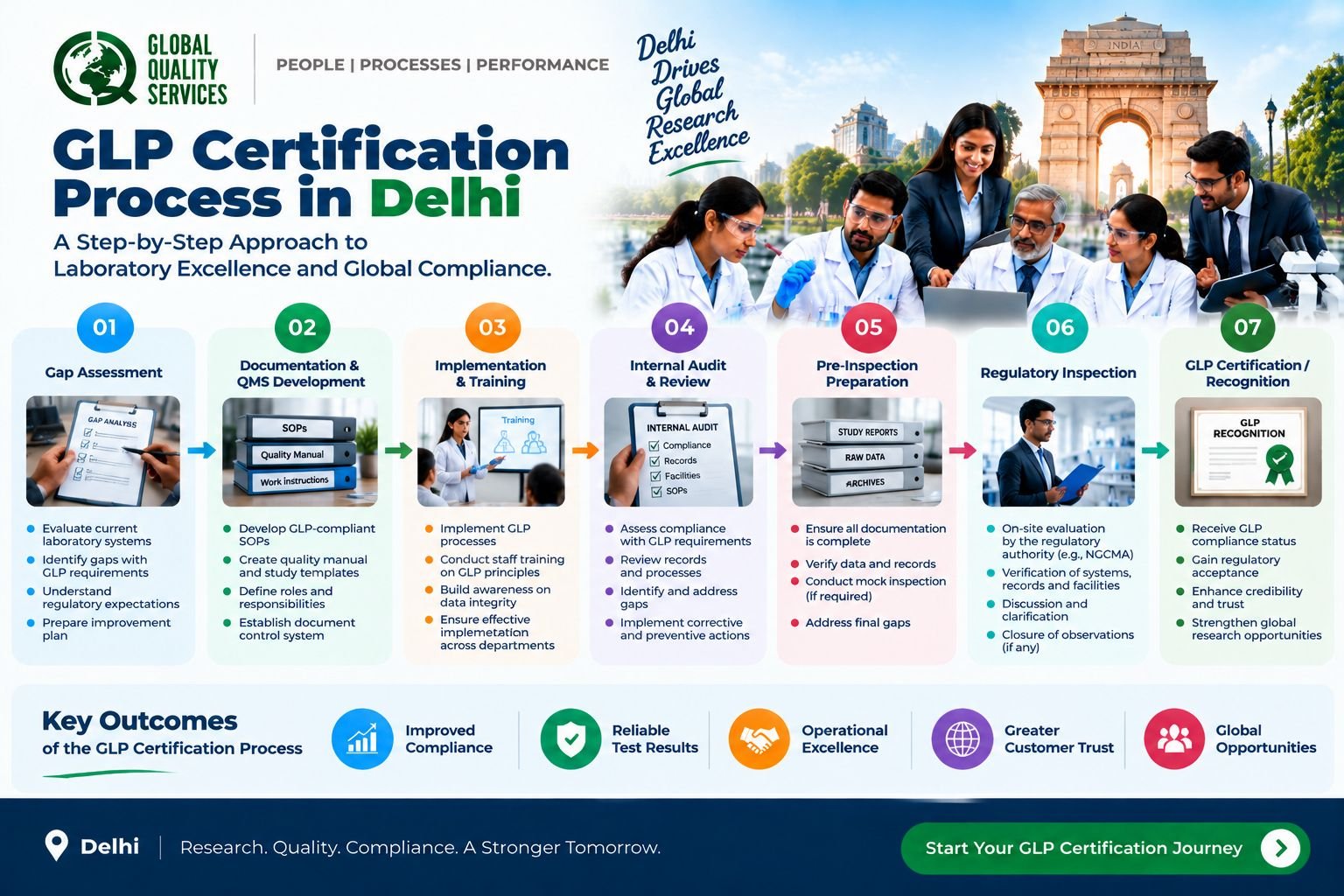
Identify the Applicable GLP Requirements
The first step is to determine which studies and activities fall within the applicable GLP framework. The organization should also identify the regulatory or program requirements connected with the intended use of the study data.
Conduct a Detailed Gap Assessment
Review existing facilities, personnel responsibilities, study procedures, equipment controls, SOPs, data practices, QA activities, and archiving arrangements to identify areas for improvement.
Develop and Strengthen the GLP System
Establish or update required procedures, SOPs, study documentation, responsibilities, equipment controls, data-management processes, QA arrangements, and record-retention controls.
Implement the Requirements
Implement the documented system across relevant laboratory activities. Personnel need to follow approved procedures and maintain appropriate records throughout the study lifecycle.
Conduct Internal Checks and QA Reviews
Internal reviews and quality assurance activities help verify that procedures are followed and that study records and data meet the required controls.
Prepare for Inspection or Assessment
The organization reviews its readiness, addresses outstanding gaps, and prepares the relevant documentation and personnel for the applicable GLP inspection, assessment, or recognition process.
Address Findings and Maintain Compliance
Any findings identified during the applicable assessment are addressed through appropriate corrective action. Organizations must then maintain GLP compliance through ongoing adherence to procedures, QA oversight, controlled documentation, training, equipment management, and archiving.
Why Is GLP Particularly Relevant to Organizations in Delhi?
Delhi brings together regulatory institutions, pharmaceutical businesses, healthcare organizations, research activities, and a large industrial base. This creates a different compliance environment from a location page that lists generic laboratory services.
For organizations involved in applicable non-clinical studies, GLP is relevant where the reliability, traceability, and controlled generation of study data are important.
Okhla and South Delhi
Okhla Industrial Area and Okhla Industrial Estate are among Delhi’s established industrial locations. Government records identify pharmaceutical and life-science organizations operating in the Okhla Industrial Area, including manufacturers and organizations involved in diagnostic and life-science activities.
For pharmaceutical manufacturers, testing organizations, and research facilities in and around Okhla, GLP may become relevant when the organization conducts applicable non-clinical safety studies or generates data intended for regulatory submission.
Patparganj and East Delhi
Patparganj is another established industrial area listed by the Government of Delhi and DSIIDC. The area forms part of Delhi’s wider manufacturing and industrial network.
Organizations in this part of Delhi may include manufacturers, chemical-related businesses, food and allied-product companies, and other industrial units. Where applicable, non-clinical safety studies are performed or commissioned; GLP requirements should be assessed according to the actual study and regulatory purpose.
Naraina and West Delhi
Naraina Industrial Area is one of Delhi’s established industrial areas. Its proximity to the wider commercial and manufacturing network of central and western Delhi makes it relevant to organizations involved in manufacturing, testing, and product-related activities.
For laboratories and organizations conducting applicable safety studies, GLP can provide controls for study planning, procedures, data generation, QA, and archiving.
Bawana and Narela
Bawana and Narela form part of Delhi’s larger planned industrial network. DSIIDC identifies both areas as industrial estates developed for industrial activity and the relocation of eligible units.
The organizations operating in these areas span multiple industrial categories. For those conducting applicable chemical, pharmaceutical, environmental, or other non-clinical studies, GLP applicability should be determined from the nature of the study rather than simply the location.
Mayapuri, Wazirpur and Other Industrial Areas
Mayapuri and Wazirpur are also among Delhi’s officially recognized industrial areas. The Government of Delhi’s industrial-area records include them alongside Badli, Mangolpuri, Lawrence Road, Mohan Cooperative, Okhla, Patparganj and several other industrial locations.
This wide geographical spread matters because Delhi’s potential GLP audience isn’t limited to one pharmaceutical cluster. Different types of manufacturers, testing organizations, research facilities, and laboratories may have different reasons for establishing GLP controls.
What Are the Benefits of GLP Certification in Delhi?
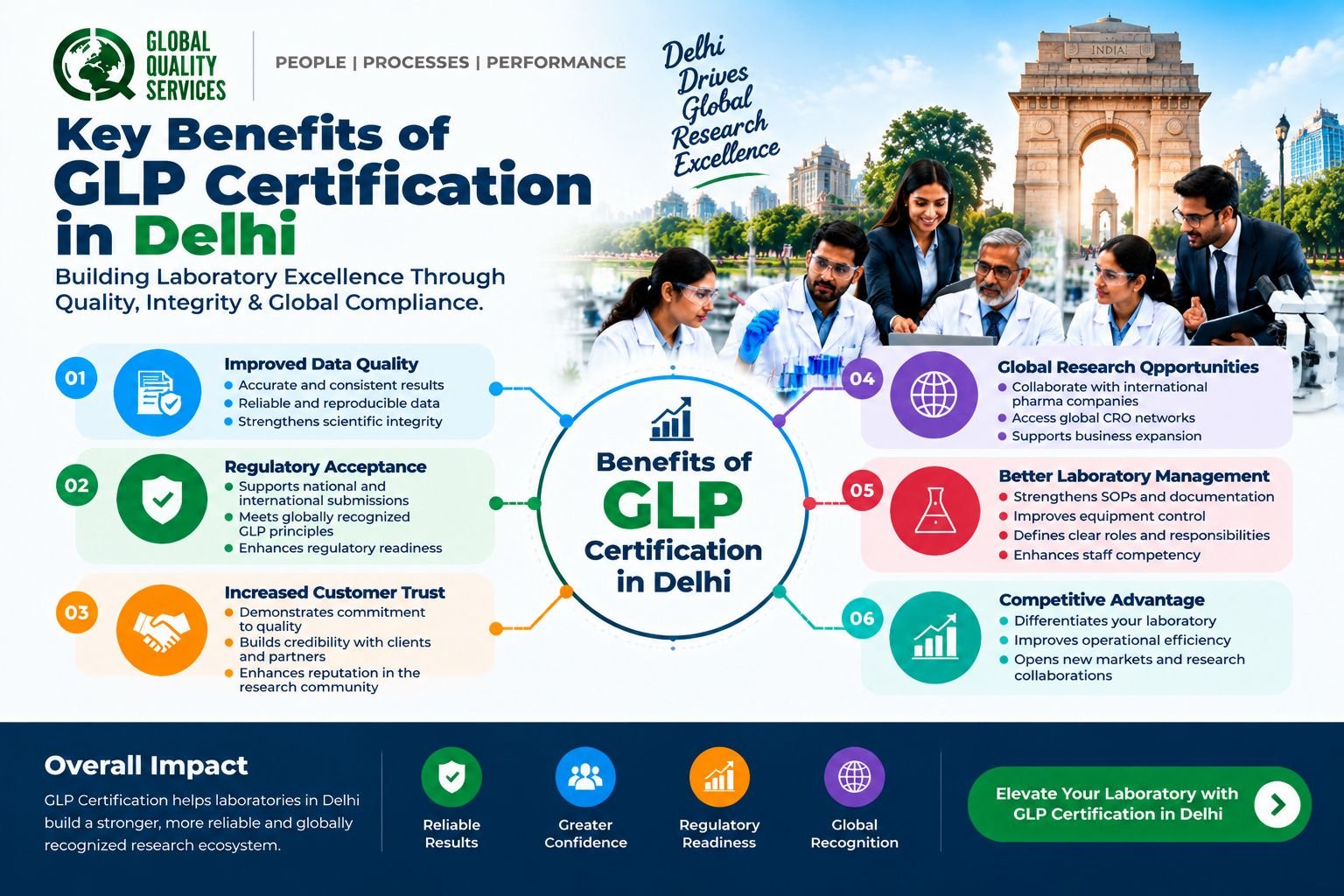
GLP provides Delhi-based test facilities with a structured system for controlling study activities and demonstrating the reliability and traceability of non-clinical study data.
Stronger Data Integrity
GLP establishes controls around the creation, recording, review, modification, transfer, and retention of study data. This helps maintain a reliable connection between the work performed and the results reported.
Better Control Over Study Activities
Defined study plans, responsibilities, SOPs, equipment controls, and documentation provide greater consistency across study phases.
Improved Quality Assurance
An established QA program provides independent oversight of study activities and helps identify non-compliance, procedural weaknesses, and documentation issues.
Easier Study Reconstruction
Proper documentation and archiving make it possible to trace the study from its planning and execution through to the final report. This is especially important when study data must be reviewed later.
Greater Regulatory Confidence
Where GLP applies, a well-controlled GLP system can give receiving authorities and other stakeholders greater confidence in the quality and integrity of submitted non-clinical safety data.
Which Organizations in Delhi Can Benefit from GLP?
GLP can be relevant to eligible organizations conducting applicable non-clinical health and environmental safety studies.
Pharmaceutical Research and Development Organizations
Pharmaceutical organizations may conduct or commission studies related to the safety evaluation of substances, products or formulations. Where the studies fall within the applicable GLP framework, controlled study systems can help establish traceability from study planning through reporting and archiving.
Biotechnology and Life-Science Organizations
Biotechnology and life-science organizations generating non-clinical safety data may need defined controls around study personnel, facilities, equipment, procedures, data, and quality assurance.
Contract Research Organizations
CROs can have particularly detailed GLP requirements because they may conduct studies on behalf of multiple sponsors. Clear responsibilities, study plans, SOPs, raw-data controls, QA, and archiving become important for maintaining study integrity across projects.
Toxicology and Safety Testing Laboratories
Laboratories performing applicable toxicity, mutagenicity or related safety studies are directly relevant to the GLP framework. NGCMA identifies toxicity and mutagenicity among its areas of GLP expertise.
Chemical andAgrochemical Organizationss
Organizations dealing with industrial chemicals, agrochemicals and other substances covered by the GLP program may require GLP controls where safety studies are conducted for regulatory submission.
Environmental Testing Organizations
Facilities conducting applicable environmental toxicity, aquatic or terrestrial organism studies, residue studies, bioaccumulation studies, or related work may fall within relevant GLP areas identified by NGCMA.
Research Institutions and Other Test Facilities
GLP may also apply to research institutions, specialized test facilities, and other organizations where applicable non-clinical studies are conducted for regulatory purposes.
What Does GLP Compliance Cover?
GLP compliance covers the complete framework used to plan, conduct, monitor, document, report, and archive applicable non-clinical laboratory studies. It addresses laboratory organization and personnel, facilities, equipment, test and reference substances, standard operating procedures, study plans, raw data, reports, quality assurance, and archiving.
The scope goes beyond maintaining SOPs. A GLP-compliant system needs to connect responsibilities, procedures, equipment controls, study documentation, data management, quality assurance, and record retention into one controlled process.
For example, test and reference items need appropriate identification, handling, storage, characterization, and documentation. Equipment used in studies needs suitable maintenance and control. Electronic systems used to generate or manage study data may also require appropriate validation and data-integrity controls.
The exact GLP requirementsdepend ono the laboratory’s study activities, the type of data generated, and the relevant regulatory framework.
How Can Global Quality Services Help with GLP Certification in Delhi?
Global Quality Services helps pharmaceutical companies, CROs, toxicology laboratories, biotechnology organizations, chemical testing facilities, and other eligible test facilities across Delhi prepare for applicable GLP requirements.
Whether an organization operates in Okhla, Patparganj, Naraina, Mayapuri, Bawana, Narela, Wazirpur, or another part of the National Capital Region, GQS can assess existing laboratory and study practices, identify gaps, strengthen SOPs and documentation, review quality assurance and data-integrity controls, and support preparation for the applicable GLP inspection or assessment process.
The focus is on building a practical GLP system that reflects the facility’s actual studies, personnel, equipment, records, and regulatory requirements rather than creating documentation solely for an inspection.
FAQs About GLP Certification in Delhi
Is GLP mandatory for every laboratory?
No. GLP applies to specific types of non-clinical health and environmental safety studies and depends on the relevant regulatory or program requirements.
Is GLP the same as ISO/IEC 17025 accreditation?
No. GLP and ISO/IEC 17025 address different requirements. GLP focuses on the organization and conduct of applicable non-clinical studies, while ISO/IEC 17025 addresses the competence of testing and calibration laboratories.
What is the role of Quality Assurance in GLP?
Quality Assurance provides independent oversight to determine whether studies and relevant test facility activities are being conducted in accordance with applicable GLP principles and approved procedures.
Does GLP cover electronic laboratory data?
Yes. GLP requirements apply to study data regardless of whether it is generated or maintained electronically or on paper. Computerized systems used in GLP studies may require appropriate validation and data-integrity controls.
Does GQS conduct the formal GLP inspection?
GQS provides consultancy and readiness support. The applicable competent authority or GLP compliance-monitoring program conducts the formal inspection, assessment, or recognition.