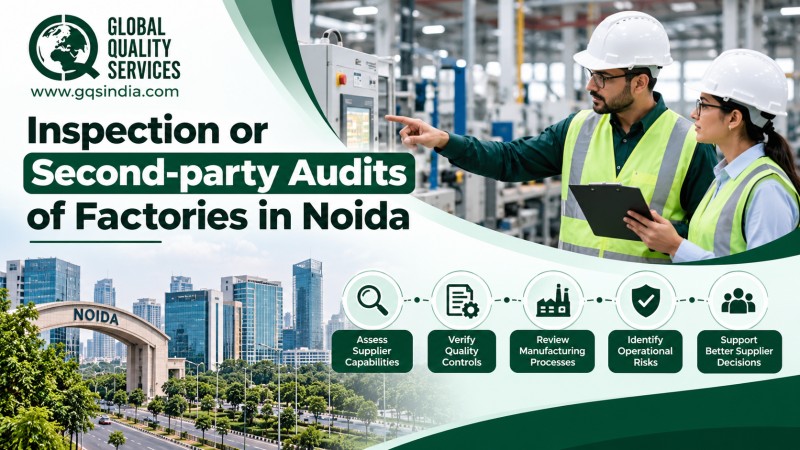
Noida’s manufacturing sector is expanding, bringing more suppliers and production facilities into the region. In FY 2025–26, 4,746 new factories were registered across Uttar Pradesh, according to Hindustan Times. As supplier networks grow, buyers need more than paperwork to assess factory capabilities, quality controls, and production practices.
A professional factory inspection or second-party audit in Noida gives you an on-site view of supplier performance and helps identify gaps before they affect your products, orders, or customers.
What is a Second-party Factory Audit
A second-party audit is an assessment conducted by a customer or by an independent consultant on the customer’s behalf.
The audit checks whether a supplier meets your defined requirements. These requirements may cover:
- Product quality
- Manufacturing processes
- Quality management systems
- Production capacity
- Raw material controls
- Inspection and testing
- Worker safety
- Environmental practices
- Documentation
- Traceability
- Packaging and storage
- Delivery controls
Unlike a certification audit, a second-party audit focuses specifically on the requirements of the buyer or organisation commissioning the assessment.
Why are Factory Inspections Important in Noida
Noida’s industrial ecosystem includes electronics manufacturing, automotive and auto components, engineering, and other production activities. Government information also identifies industrial clusters across Noida and Greater Noida, including sectors 57–68, 80–90, and several Ecotech industrial areas.
This creates a wide supplier base for businesses sourcing products from the region. However, choosing a supplier based only on price or production capacity can create problems later.
An inspection gives procurement teams evidence about the supplier’s actual capabilities before they commit to a long-term relationship.
A factory audit can help you:
- Verify supplier capabilities
- Identify quality risks early
- Check production capacity
- Review manufacturing controls
- Assess raw material management
- Examine testing and inspection procedures
- Verify corrective action practices
- Review workplace conditions
- Check product traceability
- Reduce the risk of defective shipments
What Does a Second-party Audit Cover
The audit scope should match your products, contract requirements, and supplier risks. A typical second-party factory audit in Noida may examine the following areas.
1. Supplier Profile and Factory Information
The auditor begins by reviewing basic information about the supplier.
This can include the company’s legal details, factory location, production lines, workforce, operating history, certifications, and major customers.
This stage helps confirm whether the supplier has the infrastructure and experience required for your order.
2. Production Capacity
A supplier may claim that it can handle your required volume. An on-site assessment gives you a better way to verify that claim.
The auditor may review:
- Production lines
- Number of machines
- Production capacity
- Current utilisation
- Workforce
- Production schedules
- Maintenance practices
- Capacity planning
This becomes particularly important when you plan large or recurring orders.
3. Raw Material and Supplier Controls
Poor-quality raw materials can create problems throughout the production process.
Auditors review how the factory:
- Selects suppliers
- Receives materials
- Inspects incoming materials
- Stores materials
- Identifies approved materials
- Handles rejected materials
- Maintains supplier records
The auditor can also check whether the factory maintains adequate traceability.
4. Manufacturing Process Controls
A factory needs consistent controls at every important production stage.
The assessment may cover process instructions, work instructions, machine settings, operator controls, process inspections, production records, and handling of deviations.
The auditor also checks whether employees actually follow documented procedures rather than simply maintaining them for inspection purposes.
5. Quality Control and Testing
Quality control forms an important part of any supplier assessment.
Depending on the product, the auditor may review:
- Incoming inspection
- In-process inspection
- Final inspection
- Sampling procedures
- Testing equipment
- Calibration records
- Non-conforming product controls
- Inspection records
- Product release procedures
For technical products, the audit can also examine whether testing methods match customer specifications.
6. Product Identification and Traceability
Traceability becomes critical when you need to investigate a defective batch.
The auditor checks whether the factory can trace products back to relevant information such as:
- Raw material batches
- Production dates
- Machine or production lines
- Operators
- Inspection records
- Finished-product batches
Strong traceability helps businesses investigate problems faster and control affected products.
7. Warehouse and Inventory Management
The audit does not stop at the production floor.
Auditors may inspect warehouses to assess:
- Material identification
- Storage conditions
- Stock rotation
- Finished-product segregation
- Damaged-product controls
- Packaging
- Loading practices
Poor storage practices can damage otherwise acceptable products before shipment.
8. Worker Health and Safety
A responsible supplier should maintain appropriate workplace controls.
The assessment may include emergency exits, fire safety equipment, personal protective equipment, machine safety, housekeeping, warning signs, emergency procedures, and worker training.
The exact requirements depend on the industry and applicable regulations.
9. Environmental Practices
Where environmental requirements form part of the buyer’s supplier criteria, the auditor can examine relevant practices.
These may include waste management, chemical handling, emissions controls, wastewater management, energy use, and environmental records.
The audit scope should reflect the supplier’s activities and the buyer’s contractual requirements.
10. Corrective and Preventive Actions
Finding a problem is only the first step.
A useful audit also examines how the factory responds to non-conformities. Auditors may review previous findings, root-cause analysis, corrective actions, implementation records, and evidence that the actions actually solved the problem.
This helps distinguish between suppliers that simply close findings on paper and those that address their underlying causes.
Factory Inspection Process in Noida
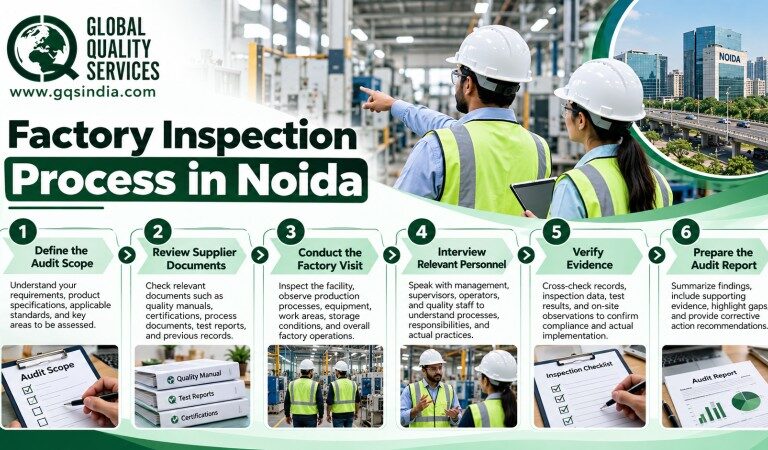
A structured inspection gives buyers consistent information across different suppliers.
Step 1: Define the Audit Scope
First, identify what you want to evaluate. The scope may include quality, production, social compliance, safety, environmental controls, or specific customer requirements.
Step 2: Review Supplier Documents
The auditor reviews relevant documents before or during the visit. These may include certifications, quality records, procedures, production information, inspection reports, and previous audit findings.
Step 3: Conduct the Factory Visit
The auditor visits the supplier’s facility and observes actual operations.
They may inspect production areas, warehouses, laboratories, testing facilities, maintenance areas, and other relevant locations.
Step 4: Interview Relevant Personnel
Auditors may speak with managers, quality personnel, production supervisors, technicians, and workers.
These discussions help determine whether employees understand and follow the required processes.
Step 5: Verify Evidence
The auditor compares documented procedures with actual practices and available records.
This evidence-based approach helps identify gaps that a document review alone may miss.
Step 6: Prepare the Audit Report
The final report typically records observations, non-conformities, risks, supporting evidence, and recommendations.
The buyer can then use the report when deciding on supplier approval, corrective actions, or continued monitoring.
Second-party Audit vs Third-party Audit
These audits serve different purposes.
| Second-party audit | Third-party audit |
| Usually conducted for a customer or buyer | Conducted by an independent certification or conformity assessment body |
| Focuses on buyer-specific requirements | Usually evaluates requirements of a recognised standard or certification scheme |
| Helps qualify and monitor suppliers | Can support certification or independent conformity assessment |
| Scope can be customised | Scope follows applicable certification requirements |
| Often supports procurement decisions | Usually supports formal certification or compliance purposes |
For example, a buyer may conduct a second-party audit to determine whether a Noida supplier can consistently manufacture products according to its specifications.
When Should You Conduct a Factory Audit?
You do not necessarily need to wait until something goes wrong.
Consider conducting a supplier factory inspection in Noida when:
- You are evaluating a new supplier.
- You plan a large purchase.
- You are changing suppliers.
- A supplier has recurring quality issues.
- You have received customer complaints.
- Production requirements have changed.
- You need to verify corrective actions.
- You want to periodically monitor critical suppliers.
- Your customers require supplier assessments.
- You source high-risk or safety-critical products.
For strategic suppliers, periodic audits can help you maintain visibility after the initial qualification.
Why Choose Global Quality Services for Factory Inspections in Noida
Choose Global Quality Services for reliable factory inspections in Noida. Our experienced auditors assess production processes, quality controls, documentation, safety practices, and supplier capabilities on-site. We tailor each inspection to your product requirements and business needs.
Get clear findings, practical recommendations, and detailed reports that help you make informed supplier decisions. Whether you are evaluating a new factory or monitoring an existing supplier, we help you identify issues before they affect your business. Contact Global Quality Services today to get smooth and reliable service.
FAQ’s
1. What is a second-party audit of a factory in Noida?
A second-party factory audit evaluates a supplier against buyer-defined requirements, covering production, quality, capacity, documentation, safety, traceability, and other agreed criteria.
2. What does a factory inspection in Noida check?
A factory inspection can check production processes, machinery, raw materials, quality controls, testing, warehouse practices, documentation, worker safety, traceability, and corrective actions.
3. Who conducts second-party factory audits?
A buyer can conduct the audit internally or appoint an independent inspection consultant with relevant technical, industry, auditing, and supplier-assessment experience.
4. When should I conduct a supplier audit in Noida?
Conduct an audit before approving a new supplier, placing major orders, investigating quality issues, verifying corrective actions, or periodically reviewing critical existing suppliers.
5. Can factory audits help reduce supplier quality risks?
Yes. Audits identify process gaps, weak controls, documentation issues, and operational risks early, allowing buyers to address problems before they affect production or customer deliveries.