

Pune has emerged as one of India’s leading industrial and manufacturing hubs, with major sectors such as automotive, engineering, pharmaceuticals, and warehousing expanding rapidly across areas like Chakan, Pimpri-Chinchwad, and Talegaon. As industrial operations continue to grow, managing energy consumption has become a major challenge for businesses aiming to control operational costs and improve efficiency.
According to Maharashtra State Electricity Distribution Company Limited data, industrial consumers account for 42.73% of the state’s total electricity consumption, showing how critical energy optimization has become for industrial facilities.
Industrial energy audits help businesses identify hidden energy losses, improve system performance, and reduce unnecessary power usage. Keep reading to understand how industrial energy audits can help Pune businesses operate more efficiently and reduce energy-related expenses.
Why Industrial Energy Audits Are Important for Businesses in Pune
Relying on basic in-house maintenance reviews is rarely sufficient to identify deep systemic losses. Conducting a professional industrial energy audit offers significant financial, legal, and operational advantages for your enterprise.
Direct Financial Savings and Faster ROI
Every kilowatt-hour saved directly increases your net profit margin. Industrial energy audits uncover high-impact optimization opportunities, including poor power factor penalties on your MSEDCL bills, oversized motor usage, and massive thermal losses in boiler systems. Most recommended interventions carry a payback period of less than 12 to 18 months, converting immediate operational waste into self-sustaining capital.
Regulatory Compliance and BEE Alignment
The Bureau of Energy Efficiency continually lowers the threshold for designated consumers. Large-scale manufacturing units must complete mandatory energy audits to avoid heavy statutory penalties. Aligning your facility with national energy conservation mandates protects your business from legal risks and demonstrates operational transparency to corporate auditors.
Extended Equipment Lifespan and Operational Reliability
When industrial machinery operates outside its optimal energy parameters, it generates excess heat, experiences voltage stress, and suffers accelerated wear. Correcting power quality issues like harmonic distortions prevents premature motor burnouts and unexpected production line shutdowns.
Proactive Carbon Footprint Management
With global supply chains prioritizing green procurement, carbon reduction targets are directly tied to new business acquisition. Minimizing energy intensity prepares your facility for emerging carbon market regulations while making your operations highly attractive to multinational business partners.
Our Industrial Energy Audit Services in Pune
We deliver highly detailed, data-driven energy assessment solutions tailored specifically to the unique infrastructure of your plant. Instead of relying on generic checklists, we execute comprehensive technical evaluations designed to uncover hidden losses across your entire operational framework.
Electrical System and Power Quality Assessment
Our engineering team analyzes your complete electrical distribution setup to identify power supply imbalances, line losses, and harmonic contamination. We carefully monitor main transformers, motor control centers, and variable speed drives to ensure peak performance.
Thermal Utility Optimization
Thermal processing accounts for a massive portion of total energy spending in chemical, pharmaceutical, and heavy forging plants. We trace thermal energy from generation straight to the final point of use to minimize structural dissipation.
Process and Plant Automation Audits
Beyond individual machines, we assess how your entire plant functions as an integrated system, looking specifically for automation bottlenecks and mechanical mismatching.
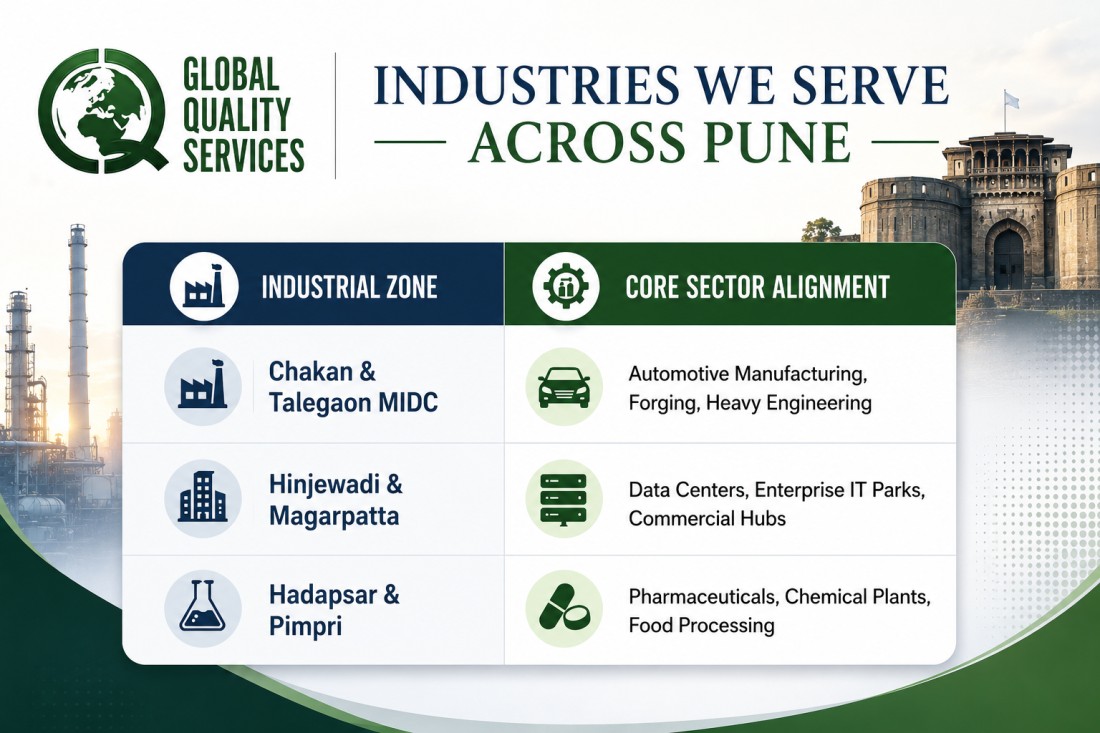
Industries We Serve Across Pune
Common Energy Efficiency Problems Found in Industrial Buildings
Years of evaluating complex industrial infrastructure reveal several recurring issues that silently drain enterprise operational budgets.
Oversized Electric Motors Operating at Low Loads
Many production facilities run heavy electric motors that are significantly larger than their actual driven loads require. Operating a motor consistently below 50% of its rated capacity drops its running efficiency and drastically lowers the power factor, drawing excess current without delivering productive output.
Neglected Compressed Air Network Leakages
Compressed air is one of the most expensive utilities to generate in any factory. Because air leaks are invisible and quiet in a loud production zone, they are often left ignored. A typical unmaintained distribution loop easily wastes 25% to 30% of total compressor capacity simply feeding leaks in overhead piping.
Poor Thermal Insulation on High-Temperature Lines
Uninsulated steam pipes, valves, and process vessels constantly radiate valuable thermal energy directly into the plant atmosphere. This structural heat loss forces boilers to burn significantly more fuel to maintain necessary process temperatures while placing an extra cooling burden on factory ventilation systems.
Harmonic Distortion from Non-Linear Loads
The widespread use of variable frequency drives, automated welding lines, and electronic switching systems introduces harmonic distortion back into the facility power network. This electrical pollution causes distribution transformers to run dangerously hot and triggers premature component degradation across nearby control panels.
Our Industrial Energy Audit Process
We follow a highly structured, data-driven assessment methodology that delivers deep visibility into your operations while causing zero disruption to your daily production schedules.
Phase 1: Preliminary Site Assessment and Diagnostic Scope Definition
We begin by evaluating your past 12 to 24 months of MSEDCL electricity bills, fuel purchase records, and production throughput data. This initial analysis helps establish a baseline energy consumption pattern and clarifies the exact testing boundaries for your plant layout.
Phase 2: On-Site Engineering Fieldwork and Instrumentation Logging
Our certified energy auditors deploy to your facility equipped with advanced, calibrated field tools. We hook up data loggers directly to primary electrical panels and mechanical systems to collect real-time data without stopping your assembly lines.
Phase 3: Deep Technical Data Analytics and Engineering Synthesis
Back at our engineering offices, we process the raw field data to isolate specific performance drops. We cross-reference your equipment performance curves with ideal design parameters to calculate exact energy variances and identify structural losses.
Phase 4: Presentation of Actionable Energy Conservation Measures (ECMs)
We deliver a comprehensive, boardroom-ready technical report that avoids complex engineering jargon, focusing instead on practical business solutions. Every single recommendation is backed by hard field data and organized by financial impact.
Why Choose Us for Industrial Energy Audit Services in Pune
Partnering with the right energy audit team ensures your final report transitions smoothly into a successful real-world execution strategy.
BEE Certified and Accredited Energy Auditors
Our multi-disciplinary engineering team is led by Bureau of Energy Efficiency-certified auditors. Every assessment we deliver complies fully with national energy conservation frameworks, providing you with verified documentation suitable for any corporate board or regulatory body.
Advanced In-House Inventory of Calibrated Tools
We never rely on guesswork or loose estimates. Our engineers utilize an extensive range of advanced diagnostic tools, including class-A power quality analyzers, flue gas testers, and ultrasonic leak detectors, ensuring every recommendation is backed by precise field data.
Proven Focus on Measurable ROI
We approach energy management through a practical business lens. Our final reports focus directly on your bottom-line requirements, presenting clear project costs, projected annual utility savings, and verified payback timelines for every single recommendation.
Optimize Industrial Energy Performance with Global Quality Services
Industrial energy losses directly affect operational profitability, production efficiency, and long-term business sustainability. A professionally conducted energy audit helps identify where energy is being wasted and what improvements can create measurable savings.
Global Quality Services helps industrial facilities across Pune evaluate energy usage, improve system efficiency, reduce unnecessary operating costs, and support smarter energy management decisions.
If your facility is facing rising electricity costs, inefficient equipment performance, or increasing operational expenses, this is the right time to conduct a detailed industrial energy audit.
Frequently Asked Questions
1. How long does an industrial energy audit usually take?
The duration depends on the facility size, operational complexity, and number of systems being evaluated. Most industrial audits may take several days to a few weeks.
2. Can energy audits help reduce electricity bills significantly?
Yes. Many facilities identify unnecessary energy losses during audits. Improvements in system efficiency, load management, and equipment optimization can reduce operational costs considerably.
3. Are industrial energy audits useful for manufacturing plants with older equipment?
Yes. Older equipment often consumes more energy due to wear, outdated technology, and inefficient operation. Energy audits help identify improvement opportunities and modernization priorities.
4. Do energy audits include recommendations for improving equipment efficiency?
Yes. A detailed audit report usually includes recommendations related to motors, HVAC systems, compressed air systems, thermal operations, lighting, and electrical infrastructure.
5. How often should industrial facilities conduct energy audits?
Many industries conduct periodic audits every few years or after major operational changes, equipment upgrades, production expansion, or rising energy costs.