Bengaluru’s biopharma and logistics sectors are scaling rapidly, making strict cold chain integrity non-negotiable for medical supply chains. Handling sensitive vaccines, biologicals, and active pharmaceutical ingredients across open storage networks leaves products vulnerable to thermal degradation and contamination. Good Distribution Practice (GDP) Certification establishes the exact quality framework required to validate temperature-controlled warehousing, optimize transportation routes, and protect drug efficacy from factory floors to end-users.
According to government trade metrics reported by The Times of India, Karnataka’s total exports reached ₹19.7 lakh crore powered heavily by Bengaluru’s surging biopharma and engineering hubs. Partnering with an experienced GDP consultant simplifies complex thermal mapping, streamlines SOP documentation, and guarantees seamless audit readiness for local distributors.
What is GDP Certification
GDP Certification is a specialized Quality Management System (QMS) framework designed for supply chain, warehousing, and logistics operators.
Unlike Good Manufacturing Practice (GMP) which governs drug manufacturing inside factory walls GDP governs everything that happens after production. It lays down mandatory standards for purchasing, receiving, storing, temperature monitoring, and transporting human medicines and healthcare goods.
Why GDP Certification Matters for Bengaluru Businesses
Bengaluru is a leading hub for bio-pharma, clinical trials, and life sciences innovation. Local cold-chain logistics providers, air cargo handlers at Kempegowda International Airport (KIA), third-party logistics (3PL) centers, and pharma distributors manage sensitive biologicals, vaccines, and active pharmaceutical ingredients (APIs).
- Supports International Trade: Global pharmaceutical firms in North America and Europe mandate GDP compliance before contracting local 3PL and warehousing partners.
- Minimizes Product Spoilage: Bengaluru’s high ambient temperatures demand precise cold-chain management; GDP ensures validated transport and temperature logging throughout transit.
- Ensures Regulatory Alignment: Keeps local supply chains compliant with Central Drugs Standard Control Organization (CDSCO) expectations and international WHO-GDP guidelines.
Step-by-Step Process to Get GDP Certified
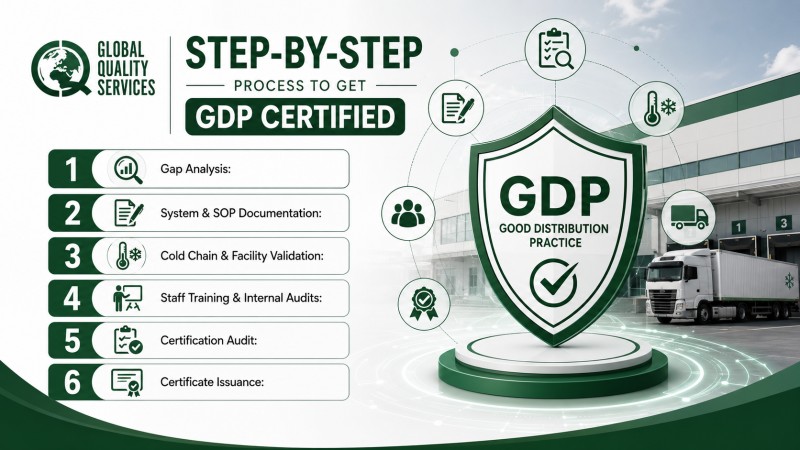
Achieving GDP certification in Bengaluru requires a structured operational roadmap to ensure medical supply chains meet global quality parameters.
- Gap Analysis: Evaluate existing warehouse operations, temperature monitoring tools, and distribution workflows against global GDP standards.
- System & SOP Documentation: Establish Standard Operating Procedures (SOPs) for cold storage, vehicle sanitation, batch tracking, product recalls, and handling damaged stock.
- Cold Chain & Facility Validation: Calibrate temperature data loggers, conduct thermal mapping of warehouses, and validate temperature-controlled vehicles.
- Staff Training & Internal Audits: Train warehouse staff and drivers on handling procedures, hygiene, and emergency protocols, then run an internal audit to patch remaining gaps.
- Certification Audit: Undergo a two-stage evaluation by an accredited third-party certification body to verify live operational compliance.
- Certificate Issuance: Address any audit observations to receive official GDP Certification, valid for 3 years subject to annual surveillance audits.
Benefits of GDP Certification
Implementing Good Distribution Practice standards unlocks significant operational efficiencies while safeguarding the integrity of sensitive pharmaceutical products throughout transit.
- Guarantees Product Safety: Prevents product contamination, falsified medicines, and thermal degradation across transit routes.
- Improves End-to-End Traceability: Enables precise batch tracking to execute fast, surgical product recalls if quality issues arise.
- Boosts Tender Qualification: Qualifies logistics and warehousing providers for lucrative government and enterprise healthcare contracts.
- Reduces Operational Losses: Eliminates costly inventory write-offs caused by improper storage or delayed transit conditions.
Industries That Need GDP Certification
| Sector | Operational Scope |
| Pharma Wholesalers & Distributors | Bulk drug handling, regional distribution, and pharmacy fulfillment centers. |
| Cold Chain Logistics & Freight | Temperature-controlled air, road, and ocean transport providers. |
| Warehousing & 3PL Centers | Dedicated ambient and cold-storage facilities for medical supplies. |
| Medical Device Suppliers | Distributors handling high-value diagnostic devices and surgical consumables. |
| Clinical Research Organizations | Teams moving investigational medicinal products (IMPs) and biological samples. |
Why Choose Global Quality Services for GDP Certification
Protecting sensitive healthcare supply chains demands specialized quality expertise. Backed by 26 years of industry experience, Global Quality Services provides end-to-end consulting for GDP compliance across Bengaluru’s biotech and logistics sectors.
Global Quality Services delivers a streamlined path to certification by offering hands-on gap assessments, facility mapping assistance, customized SOP development, and comprehensive auditor support. The result is an efficient, audit-ready management system built around your existing logistics workflows. Contact Global Quality Services to get smooth and reliable services.
Frequently Asked Questions
1. How long does GDP certification take in Bengaluru?
The entire process typically takes 4 to 8 weeks, depending on warehouse size, fleet complexity, and existing cold chain infrastructure.
2. What is the typical cost of obtaining a GDP certificate?
Total costs range from ₹1.5 Lakhs to ₹3.5 Lakhs, depending on the facility acreage, headcount, vehicle validation needs, and chosen accredited audit body.
3. Can a third-party logistics (3PL) provider get GDP certified?
Yes. 3PL providers, standalone warehouses, freight forwarders, and transport fleet operators can all attain independent GDP certification.
4. What is the validity period of a GDP certificate?
A GDP certificate remains valid for 3 years, subject to passing annual surveillance audits to ensure ongoing operational compliance.
5. Is thermal mapping mandatory for GDP-compliant warehouses?
Yes. Warehouses must perform seasonal thermal mapping to identify hot and cold spots, ensuring temperature-sensitive medications stay within safe storage zones.