Is your organisation involved in drinking water or wastewater services in Noida? Are you looking for a structured approach to understanding user expectations, evaluating service performance, and identifying practical opportunities for improvement?
ISO 24510 Certification in Noida is a valuable framework for organisations seeking to assess and improve drinking water and wastewater services from the user’s perspective. The standard focuses on understanding user needs, defining important service characteristics, establishing service objectives, developing assessment criteria, and using performance indicators to evaluate service delivery.
Global Quality Services (GQS) supports organisations in Noida with ISO 24510 assessment, implementation, gap analysis, documentation, performance evaluation, and continual improvement. Our approach helps organisations turn service data and user feedback into practical improvements that can strengthen reliability, responsiveness, accessibility, and overall service quality.
Important: ISO 24510:2024 is a guidance standard. It is not an accredited management system certification standard such as ISO 9001. Organisations can implement its guidance and demonstrate alignment through appropriate assessment and improvement activities.
What Is ISO 24510?
ISO 24510:2024 — Activities relating to drinking water and wastewater services — Guidelines for the assessment and for the improvement of the service to users provides international guidance for evaluating drinking water and wastewater services from the user’s perspective. ISO states that the standard helps organisations identify users’ needs and expectations and assess whether those needs are being met.
The standard establishes a common approach for understanding what users consider important and how service providers can assess their performance against those expectations. Rather than focusing solely on infrastructure, treatment processes, or technical operations, ISO 24510 focuses on the service delivered to users. For an organisation operating in Noida, this can mean looking beyond questions such as whether a treatment plant is functioning and considering wider service issues such as:
- Is the service accessible to intended users?
- Is service delivery reliable and consistent?
- Are users receiving appropriate information?
- Are complaints and enquiries handled effectively?
- Are service objectives clearly defined?
- Can service performance be measured using meaningful indicators?
- Are identified service problems followed by improvement actions?
ISO 24510:2024 covers service elements, user needs and expectations, service objectives, guidance for satisfying those needs, assessment criteria, and performance indicators. The current edition was published in January 2024 and replaced the withdrawn ISO 24510:2007.
Why Is ISO 24510 Important in Noida?
Noida has developed into a major residential, commercial, industrial, and technology hub. As urban infrastructure expands, organisations responsible for water and wastewater services need effective ways to assess service quality and respond to changing user requirements.
ISO 24510 can provide a useful framework for this purpose.
Improving User-Centred Water Services
Water services ultimately exist for users. ISO 24510 encourages organisations to identify what users need and expect from drinking water and wastewater services and use this information when evaluating performance.
For example, users may be concerned about service continuity, accessibility, responsiveness, communication, complaint handling, and reliability. A user-focused assessment can reveal issues that may not become apparent through technical monitoring alone.
Establishing Clear Service Objectives
Organisations need clear objectives if they want to determine whether their services are performing effectively.
ISO 24510 provides guidance on establishing service objectives in relation to user needs and expectations. This helps organisations move from general commitments towards measurable and reviewable service goals.
Measuring Service Performance
Performance indicators provide evidence of how effectively services are being delivered.
Instead of relying only on assumptions or occasional complaints, organisations can use appropriate indicators to monitor trends, identify weaknesses, and evaluate improvement actions.
Supporting Continual Improvement
ISO 24510 encourages organisations to use assessment findings to improve services. This creates a practical cycle:
Understand users ? define objectives ? assess performance ? identify gaps ? implement improvements ? review results.
Strengthening Stakeholder Communication
Water and wastewater services involve multiple stakeholders, including users, service providers, local authorities, infrastructure operators, businesses, and communities. A common assessment framework can help different stakeholders understand service objectives, performance results, and improvement priorities.
Who Can Benefit from ISO 24510 in Noida?
ISO 24510 can be relevant to a wide range of organisations involved in drinking water and wastewater services.
Water Service Providers
Water utilities and service providers can use ISO 24510 to understand user expectations, evaluate service characteristics, and establish appropriate performance indicators.
Wastewater Service Organisations
Wastewater operators can use the framework to assess how effectively services meet user and stakeholder expectations and identify areas requiring improvement.
Municipal and Public Authorities
Authorities responsible for urban water and sanitation services can use ISO 24510 to develop a structured approach to service assessment and continual improvement.
Industrial Organisations
Manufacturing plants, industrial facilities, technology parks, and large commercial establishments may use ISO 24510 principles to assess internal water and wastewater service arrangements.
Infrastructure Operators
Organisations responsible for operating, maintaining, or managing water-related infrastructure can use service assessment principles to strengthen performance monitoring and stakeholder satisfaction.
Engineering and Environmental Consultancies
Consultancies involved in water, wastewater, environmental engineering, and infrastructure projects can incorporate ISO 24510 principles into service assessments and improvement programmes.
What Does ISO 24510 Cover?
ISO 24510 provides guidance across several important areas of drinking water and wastewater services.
Access to Water Services
Organisations should consider whether users can access the relevant services and whether service arrangements meet their needs. Accessibility can be particularly important when assessing service coverage, availability, and the ability of different user groups to obtain services.
Service Provision
The standard considers characteristics associated with the delivery of services to users. Organisations can evaluate whether services are being provided consistently and whether identified objectives are being achieved.
Contracts and Billing
Service relationships often involve contractual arrangements, billing, communication, and customer information. These areas can influence user experience and should be considered when evaluating service quality.
User Relationships and Communication
Effective communication can significantly influence how users perceive water and wastewater services. Organisations should consider how information is provided, how enquiries are managed, and how complaints or concerns are addressed.
Environmental Protection
Water and wastewater services have direct environmental implications. Service assessment should therefore consider relevant environmental aspects and how service delivery supports responsible resource management.
Safety and Emergency Management
Water and wastewater organisations must also consider how services are managed during emergencies and how users are protected in the event of disruptions or unexpected events.
Key Requirements for ISO 24510 Implementation
Although ISO 24510:2024 is a guidance standard rather than a conventional certifiable management-system standard, organisations can establish a structured implementation framework around its principles.
Identify Users and Stakeholders
Start by identifying who receives or depends on the service. This may include households, businesses, industrial customers, public institutions, communities, and other stakeholders. Understanding different user groups helps organisations identify different expectations and priorities.
Determine User Needs and Expectations
User requirements should be collected through suitable methods such as feedback, surveys, complaints, service data, consultations, and stakeholder engagement. The objective is to understand what users consider important.
Identify Service Characteristics
Once user expectations are understood, organisations can identify the service characteristics that influence satisfaction and performance. These may include reliability, continuity, accessibility, responsiveness, communication, and other relevant characteristics.
Establish Service Objectives
Objectives should provide a clear direction for service performance. They should reflect organisational responsibilities as well as relevant user needs and expectations.
Establish Assessment Criteria
Assessment criteria provide a basis for determining whether service objectives are being achieved. Organisations can use suitable qualitative and quantitative measures depending on their service environment.
Develop Performance Indicators
Performance indicators allow organisations to track service performance over time. Useful indicators should provide meaningful information that management can use when making operational and improvement decisions.
Review and Improve
Assessment results should lead to action. Where performance gaps are identified, organisations can establish improvement measures, assign responsibilities, monitor progress, and review results.
ISO 24510 Assessment and Implementation Process in Noida
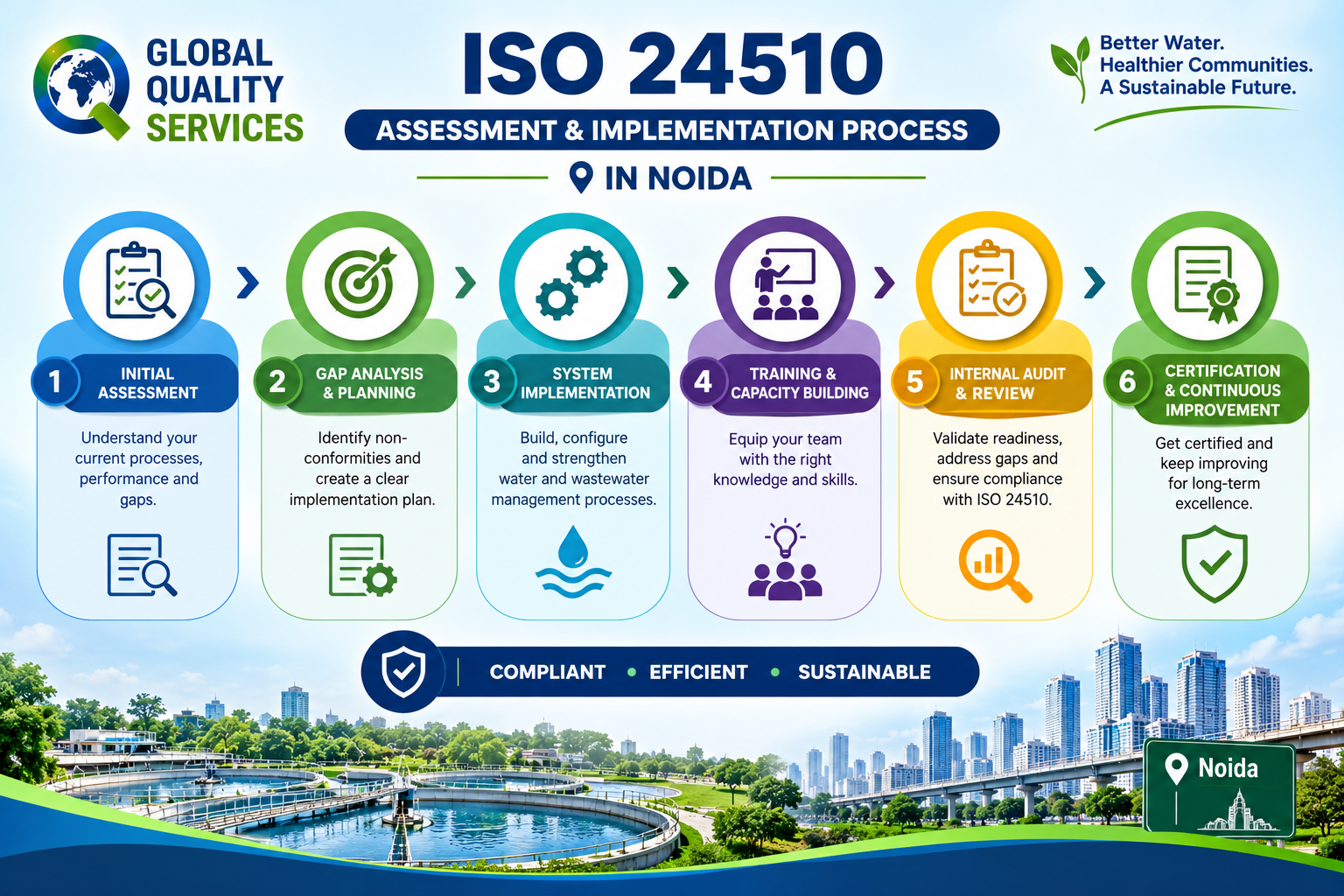
GQS provides a structured approach to help organisations apply ISO 24510:2024 to their specific water or wastewater service environment.
Step 1 — Initial Consultation
We begin by understanding your organisation, services, users, stakeholders, infrastructure, operating environment, and existing service assessment practices. This allows us to determine how ISO 24510 can be applied in practice within your organisation.
Step 2 — Current-State Assessment
Our consultants review existing service processes, user feedback mechanisms, performance indicators, objectives, records, and documentation. The purpose is to understand what is already working and where further development may be required.
Step 3 — Gap Analysis
We compare your existing approach with relevant ISO 24510 guidance. The assessment identifies gaps in user needs, service objectives, performance assessment, indicators, communication, and improvement processes.
Step 4 — User and Stakeholder Assessment
We help your organisation establish a structured approach for identifying user expectations and stakeholder requirements. This provides an important foundation for developing meaningful service objectives.
Step 5 — Performance Framework Development
GQS supports the development of appropriate service characteristics, assessment criteria, and performance indicators. Indicators are selected based on your organisation’s services and operational priorities, rather than relying on unnecessary generic measures.
Step 6 — Documentation and Implementation
Where required, we support the development or improvement of procedures, assessment records, performance monitoring methods, review mechanisms, and improvement plans. The objective is to create a practical framework that your team can actually use.
Step 7 — Performance Review
Your organisation reviews service performance against established objectives and assessment criteria. We help interpret results, identify significant gaps, and determine where improvement action is required.
Step 8 — Continual Improvement
The final stage is not the end of the process. Performance should be reviewed periodically, improvement actions should be monitored, and service objectives should be updated when user requirements or operating conditions change.
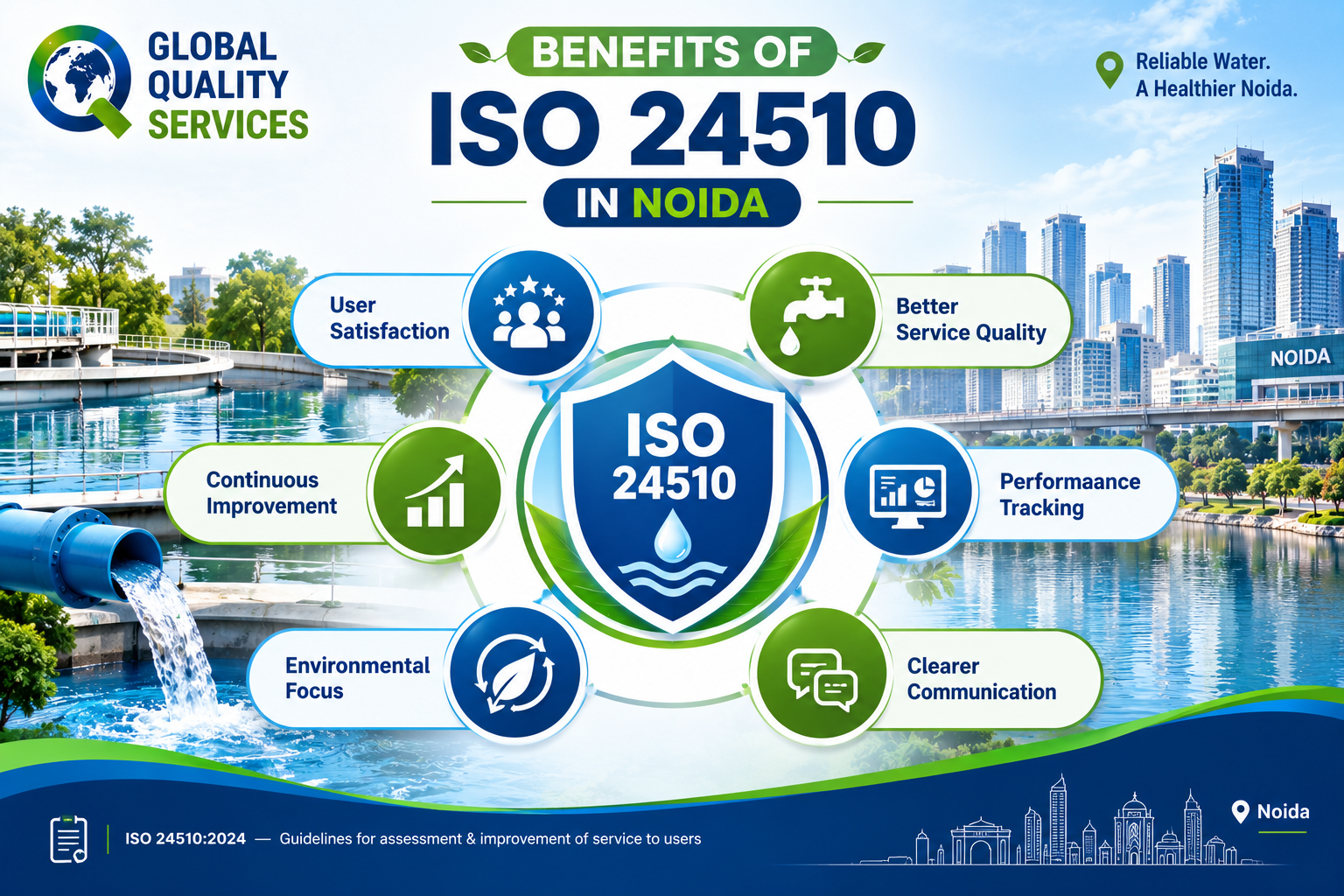
Benefits of ISO 24510 Implementation in Noida
Let us understand the benefits of ISO 24510 in Noida in detail:
Better Understanding of User Expectations
ISO 24510 helps organisations look at service delivery from the user’s perspective. This can provide a clearer understanding of what users value and where service expectations may not be fully met.
Improved Service Performance
Defined objectives and performance indicators provide a structured basis for monitoring service quality and identifying weak areas.
More Effective Decision-Making
Reliable service performance information allows management to prioritise improvements based on evidence rather than assumptions.
Stronger Complaint Management
User feedback and complaints can become valuable sources of performance information. Analysing recurring issues can help organisations identify underlying service problems.
Improved Communication
Clear service objectives and performance information can support better communication with users, authorities, business customers, and other stakeholders.
Greater Service Reliability
Regular performance assessment can help identify issues affecting continuity, responsiveness, and reliability before they develop into larger problems.
Support for Environmental Responsibility
Effective drinking water and wastewater services are closely connected with environmental protection and sustainable resource management.
Continual Improvement Culture
ISO 24510 encourages organisations to move beyond one-time assessments and establish an ongoing approach to measuring, reviewing, and improving services.
Is ISO 24510 Certification Mandatory in Noida?
No. ISO 24510:2024 is not a mandatory legal requirement simply because an organisation provides drinking water or wastewater services in Noida. More importantly, organisations should understand that ISO 24510:2024 is a guidance standard and is not intended to provide accredited management-system certification. Therefore, businesses searching for ISO 24510 Certification in Noida should distinguish between:
- Implementing ISO 24510 guidance
- Assessing alignment with ISO 24510
- Conducting service performance assessments
- Developing ISO 24510-based improvement programmes
- Obtaining certification to a different certifiable ISO management-system standard
GQS can help organisations determine the appropriate route based on their service objectives and business requirements.
Start Your ISO 24510 Assessment in Noida with Global Quality Services
Improving water and wastewater services requires more than infrastructure and technical controls. Organisations also need to understand users, measure service performance, identify weaknesses, and continually improve service delivery.
Global Quality Services (GQS) can help your organisation apply ISO 24510:2024 in a practical and structured manner. From initial gap assessment to performance indicators and continual improvement, our team can help you build a service assessment framework suited to your organisation. Contact GQS today to discuss ISO 24510 assessment and implementation in Noida.
Global Quality Services provides practical consulting and assessment support for organisations seeking to improve the performance of drinking water and wastewater services. Our approach focuses on understanding your existing operations before recommending improvements.
Practical Assessment
We evaluate existing practices rather than imposing a generic framework.
User-Focused Approach
We help organisations consider the needs and expectations of actual service users and stakeholders.
Performance-Based Improvement
Our approach connects service objectives with measurable performance indicators and improvement actions.
Industry-Specific Support
The framework is adapted to your organisation’s services, operating environment, users, and stakeholder requirements.
Support from Assessment to Improvement
GQS can support the complete process, from initial gap assessment and documentation through performance review and continual improvement.
Frequently Asked Questions
1. What is ISO 24510 Certification in Noida?
ISO 24510:2024 is an international guideline for assessing and improving drinking water and wastewater services from the user’s perspective. Although people commonly search for “ISO 24510 Certification in Noida”, the standard itself is not an accredited management system certification. GQS supports organisations with implementation, assessment, performance evaluation, and improvement based on ISO 24510 guidance.
2. Is ISO 24510:2024 a certifiable standard?
No. ISO 24510:2024 provides guidelines for assessing and improving services to users. It is different from standards such as ISO 9001, which establish requirements for certifiable management systems.
3. Who can use ISO 24510 in Noida?
Water service providers, wastewater organisations, municipal and public authorities, infrastructure operators, industrial organisations, and engineering or environmental service providers can use ISO 24510 guidance where relevant to their activities.
4. What does ISO 24510 focus on?
ISO 24510 focuses on drinking water and wastewater services that are relevant to users. It addresses user needs and expectations, service characteristics, service objectives, assessment criteria, and performance indicators.
5. What are the main benefits of implementing ISO 24510?
Implementation can help organisations better understand user expectations, assess service performance, establish meaningful indicators, improve communication, identify service gaps, strengthen decision-making, and create a structured continual improvement process.
6. Is ISO 24510 relevant to wastewater services?
Yes. ISO 24510 covers both drinking water and wastewater services from the perspective of the service provided to users. Organisations focused specifically on wastewater utility management may also consider ISO 24511:2024.
7. What is the difference between ISO 24510 and ISO 24511?
ISO 24510 provides guidelines for assessing and improving drinking water and wastewater services for users. ISO 24511:2024 focuses specifically on the management of wastewater utilities and assessment of wastewater services.
8. How can GQS help with ISO 24510 implementation in Noida?
GQS can conduct an initial assessment and gap analysis, identify user and stakeholder requirements, develop service objectives and performance indicators, support documentation, assess service performance, and help establish continual improvement processes in accordance with ISO 24510:2024.
9. How long does ISO 24510 implementation take?
There is no single implementation period because ISO 24510 is a guidance standard rather than a conventional certification programme. The timeframe depends on your organisation’s size, service complexity, existing performance measurement systems, documentation, and improvement requirements. GQS can establish a practical roadmap after an initial assessment.
10. Can ISO 24510 work alongside ISO 9001 and ISO 14001?
Yes. ISO 24510 can complement quality and environmental management systems such as ISO 9001 and ISO 14001. Combining related frameworks can help organisations create a more coordinated approach to service quality, environmental performance, stakeholder needs, and continual improvement.