ISO 22301 certification is a formal system that helps businesses plan for and survive major operational disruptions. It gives companies a practical blueprint to keep their data secure, protect their employees, and maintain customer deliveries when an emergency hits. The framework is flexible. It applies equally to a small software development agency handling remote client databases and a large factory floor running round-the-clock assembly lines. What all certified companies share is a documented, tested plan that keeps the business moving forward through unexpected crises.
In Pune, this level of preparedness is becoming a standard requirement for closing business deals. The city has seen massive commercial growth recently. Real estate tracking from Cushman and Wakefield shows that global capability centers took up nearly 70% of all newly leased office spaces here in early 2026. A matching market study by KPMG highlights that over 500 of these major international hubs now operate across the city. Because local suppliers and service firms form the backbone for these global operations, a single local power failure or supply chain halt can disrupt contracts on an international scale.
Why Businesses in Pune Need ISO 22301 Certification
ISO 22301 gives businesses a structured way to prepare for these situations before they occur. Rather than reacting during a crisis, your organization has documented procedures that help teams respond quickly and recover in an organized manner. Here is how ISO 22301 certification benefits businesses in Pune:
Keep Critical Operations Running
Every organization has activities that cannot stop for long. ISO 22301 helps identify these critical functions and creates recovery plans so they can continue during unexpected events.
Reduce Downtime and Financial Losses
Long interruptions often lead to missed deadlines, lost revenue, and dissatisfied customers. A business continuity plan helps reduce recovery time and minimizes operational losses.
Strengthen Supply Chain Reliability
Many Pune businesses depend on suppliers, logistics providers, and manufacturing partners. ISO 22301 helps organizations prepare alternative processes so operations continue even when part of the supply chain is affected.
Build Customer and Partner Confidence
Customers want to work with businesses that can deliver products and services consistently. Having ISO 22301 certification demonstrates that your organization has a structured approach to managing disruptions.
Support Regulatory and Contractual Requirements
Many public sector projects, multinational companies, and enterprise clients prefer working with organizations that have internationally recognized management systems. ISO 22301 can strengthen your position during vendor evaluations and contract discussions.
Improve Internal Preparedness
Employees know exactly what to do during emergencies because responsibilities, communication plans, and recovery procedures are already documented and tested.
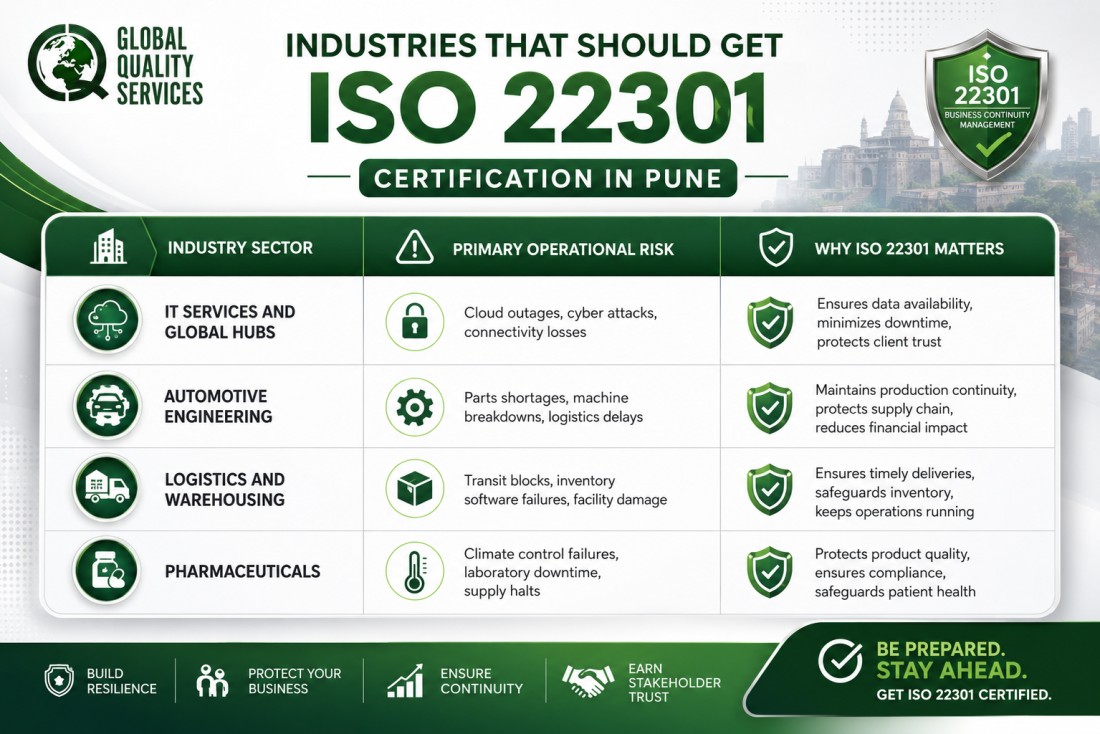
Industries That Should Get ISO 22301 Certification in Pune
Certain business sectors in the local market face intense pressure to maintain continuous operations due to the nature of their work.
ISO 22301 Certification Process in Pune
Getting your company certified is a straightforward process that aligns with your day-to-day workflows. The international standard follows a step-by-step cycle designed to turn emergency planning into a natural company habit.
Step 1: Gap Analysis and Assessment
Consultants review your existing backup plans and compare them with the international standard. This quick review reveals where your current emergency steps are weak, giving your leadership a clear list of what needs to change.
Step 2: Business Impact Analysis
Your department heads isolate the functions that your company cannot afford to lose for more than a few hours. We calculate exactly how much downtime each department can tolerate and identify the specific threats that could cause those stoppages.
Step 3: Strategy and Documentation
Using the data from your impact analysis, we write down clear recovery playbooks. These files establish exactly who takes charge during an emergency, how your staff communicates, and where your teams can work if a primary office closes.
Step 4: Team Training and Simulation
A business continuity plan only works if your employees know what to do. We walk your staff through realistic mock drills to test your backup networks and emergency processes, making sure everyone can transition to secondary systems without confusion.
Step 5: External Certification Audits
An independent certification body reviews your completed management system. The auditor checks your paperwork during Stage 1 and reviews how well your employees follow those rules in real scenarios during Stage 2 before issuing your final certificate.
Documents Required for ISO 22301 Certification
To pass your official audit, you must show the external registrar organized records of your continuity system. You will need to prepare these specific items:
- A business continuity policy document approved by your executive team
- The completed business impact analysis report with all department dependencies
- A risk assessment registry listing local operational hazards and mitigations
- Standard operating procedures for incident response and management escalation
- Technical recovery plans for IT hardware, databases, and office infrastructure
- Logs from your recent internal audits and any corrective steps you took
- Recorded results and feedback from your annual employee simulation drills
How Does Global Quality Services Support ISO 22301 Certification Across Pune
Implementing ISO 22301 becomes much easier when you have experienced professionals guiding the process. Global Quality Services works closely with organizations to develop a Business Continuity Management System that reflects their operations, risks, and business goals.
Our support includes:
- Initial gap assessment to identify existing strengths and improvement areas.
- Business Impact Analysis and risk assessment tailored to your operations.
- Preparation of practical documentation that is easy to implement and maintain.
- Employee awareness sessions and implementation guidance.
- Internal audit support to identify and address gaps before certification.
- Assistance during the certification audit process.
- Continued guidance to help maintain compliance through surveillance audits.
Get Ready for ISO 22301 Certification with Expert Support
Protecting your daily operations from sudden disruptions protects your market share and qualifies your company for high-value corporate contracts. You can accelerate this compliance project by mapping out a distinct timeline built specifically for your organization. Contact Global Quality Services to receive a practical implementation plan tailored to your team size, physical locations, and industry operational risks.
- Fixed Resource Forecasts: Know the exact time and team commitments required before the project starts
- Logical Implementation Milestones: Follow a phase-by-phase schedule that avoids disrupting your daily client work
- Focused Risk Scoping: Learn about the most common continuity vulnerabilities found in your specific local business park
Frequently Asked Questions
1. What is the main difference between disaster recovery and business continuity?
Disaster recovery focuses almost entirely on restoring your technology systems, such as pulling data from cloud backups or restarting server networks after an outage. Business continuity handles your entire organization.
2. What is the total cost of getting an ISO 22301 certification in Pune?
The total cost depends on the size of your workforce, the number of office locations or factories you run, and the overall complexity of your business services.
3. Do small startups in Pune need this certification to win enterprise clients?
Yes, large corporations frequently require all vendors to show proof of continuity planning regardless of vendor size. Enterprise clients want to ensure their supply chain will not break if a small software or service provider goes offline, making this certificate a major competitive advantage for growing startups.
4. How often does our company need to update the continuity plan?
Your team must review and update your documentation at least once a year. You should also update the plan whenever your business undergoes major structural changes, such as moving to a new office building, opening a new production line, or adopting a brand-new corporate IT platform.
5. What happens if our organization fails the initial external audit?
If the external auditor finds gaps in your system, they will issue a non-conformance report rather than failing you permanently. Your company receives a specific timeframe, usually between 30 and 90 days, to fix those specific paperwork or process gaps before the auditor reviews your application again for final certificate approval.