An unexpected shutdown can hit a business at any time. For companies operating in India’s leading corporate hubs, keeping systems online is not just a daily goal but a strict commercial necessity. Bengaluru continues to grow as the primary destination for global corporate infrastructure. According to the latest market research published by The Hindu, Bengaluru recorded over 12 million square feet of Global Capability Center leasing. This massive footprint represents more than 35 percent of the entire country’s corporate capability center activity.
As these large hubs scale up, their operational risks change. A simple power failure, a localized network hack, or a sudden software freeze can stall global workflows in seconds. This reality makes a verified business continuity setup essential for local leaders. ISO 22301 certification provides a clear international framework that helps companies protect their income, maintain business compliance, and assure global clients that their services can survive unexpected emergencies.
Why Bengaluru Businesses Need ISO 22301
An ISO 22301 Certification in India gives growing companies a major commercial advantage by proving to global clients that their operations never stop. Here are the key reasons why today’s businesses need ISO 22301:
- Sustaining Global Contracts: Large international enterprises require their vendors to prove they have verified recovery mechanisms. Having this certificate helps you clear vendor onboarding checks much faster.
- Mitigating Complex Cyber Threats: Modern software failures are rarely limited to physical events. The framework forces your IT and management teams to build shared recovery plans that counter ransomware and system breaches.
- Minimizing Financial Losses: Unplanned downtime costs money every single minute. A certified system establishes clear steps to resume operations before major financial penalties kick in.
- Strengthening Brand Authority: Showing your board, investors, and clients that your business continuity framework is independently verified builds deep market trust.
Industries That Should Get ISO 22301 Certification
While any growth-oriented company benefits from resilience planning, certain high-stakes sectors in Bengaluru find this specific certification vital for daily operations.
IT Services and Cloud Infrastructure Providers
Tech firms managing remote server setups, software development pipelines, and live databases along the Outer Ring Road must ensure continuous uptime. A certified system guarantees that service level agreements remain intact during unexpected network outages.
Global Capability Centers (GCCs)
With hundreds of global enterprises running their core engineering, legal, and human resource functions out of Whitefield and North Bengaluru, these centers cannot afford operational blind spots. They use the standard to align their local resilience policies with global corporate governance mandates.
Fintech and Banking Units
Financial technology institutions handle millions of digital transactions every day. They must comply with strict national banking regulations regarding data security and transactional uptime. The ISO framework provides the exact blueprint needed to satisfy these rigorous regulatory oversight checks.
Logistics and Advanced Manufacturing
From aerospace component manufacturers to pharmaceutical logistics firms, maintaining a predictable supply chain is vital. The certification safeguards physical operations against warehouse disruptions, supplier failures, and transport bottlenecks.
ISO 22301 Certification Process
Getting ISO 22301 certified is all about moving away from chaotic damage control and setting up a clear, repeatable plan. Here is how the process looks:
Step 1: Baseline Gap Analysis
Consultants evaluate your current corporate continuity plans against the official clauses of the ISO standard. This phase highlights hidden structural deficiencies and outlines the exact steps required to bring your corporate setup up to par.
Step 2: Business Impact Analysis and Risk Assessment
Your leadership team identifies critical operational workflows and calculates two vital metrics. First is the Recovery Time Objective, which defines how fast a system must be restored. Second is the Maximum Tolerable Period of Disruption, which marks the absolute limit a business can survive without facing irreversible damage.
Step 3: Continuity Strategy Design
Teams document formal Business Continuity Plans and Incident Management Plans. These blueprints explicitly state who commands the recovery operations, where backup systems reside, and how teams communicate when primary networks go dark.
Step 4: Execution and Staff Drills
A strategy is only as good as the people executing it. Organizations conduct targeted training sessions and desktop simulation exercises. These drills ensure that key personnel can confidently execute recovery workflows under operational pressure.
Step 5: Internal Assessment Review
Before inviting an external certification body, your team conducts a thorough internal audit. This comprehensive health check confirms that your management system is fully functional and complies with every clause of the standard.
Step 6: Independent Registrar Audit
An accredited external certification body reviews your setup in two distinct stages. Stage one validates your documentation layout. Stage two assesses your actual operational execution. Successful completion of this step results in the issuance of your official certificate.
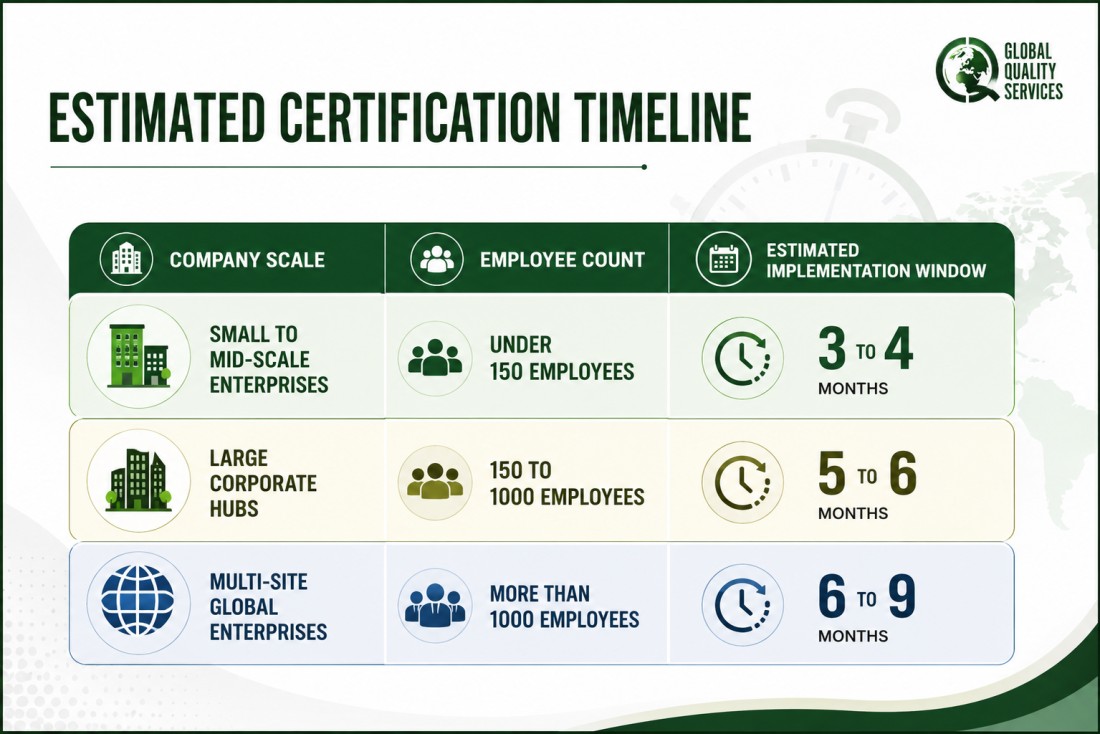
Estimated Certification Timeline
The time required to complete this lifecycle depends heavily on the initial maturity of your corporate systems and the total size of your workforce.
Factors Affecting Certification Cost
Every organization requires a tailored corporate resilience framework. Because of this customization, certification costs vary based on several clear operational variables.
- Total Corporate Headcount: Larger teams require more extensive training sessions, internal awareness audits, and interview sessions during the final assessment.
- Number of Operational Sites: Securing a single office in Electronic City costs less than certifying a distributed network of offices and data centers across multiple states.
- Scope of the Management System: A company can choose to certify its entire operational footprint or focus strictly on its most critical client-facing digital services.
- Choice of Certification Body: The fees charged by independent registrars fluctuate based on their international reputation, market standing, and required auditor travel times.
How does Global Quality Services support ISO 22301 Certification Across Bengaluru?
Building a resilient business continuity framework demands local market insight paired with deep international expertise. Our approach removes the confusion from the compliance process. We work side by side with your operations teams to turn complex compliance rules into highly practical corporate workflows:
Our support includes:
- Finding Your Starting Point: We look at your current setup to see what is already working and map out a clear, step-by-step path to get you fully certified.
- Mapping Key Risks: Our team helps you identify your most critical daily operations, figure out how much downtime your business can actually handle, and pinpoint potential vulnerabilities.
- Building Practical Documentation: We create clear, straightforward policies and procedures that fit your actual daily workflows instead of just giving you generic templates.
- Designing Actionable Recovery Plans: We help you write simple, clear response strategies so your team knows exactly who to call and what to do if primary networks or systems go dark.
- Getting Your Team Ready: We run engaging training sessions and real-world simulations so your employees feel confident handling an emergency without panicking.
- Running a Practice Run Audit: Before the official inspectors arrive, we do a thorough internal test run to catch any lingering gaps and fix them ahead of time.
- Managing the Official Inspection: We take care of the coordination with trusted, independent certification bodies and stay by your side through the entire final assessment.
- Keeping You Secure Long-Term: We do not just disappear after you get certified. We stick around to help you handle your annual checkups and keep your recovery plans updated as your company grows.
Get Your Clear Path to ISO 22301 Certification
Protect your business against unexpected operational downtime and secure a definitive edge in elite enterprise tenders. Achieving international compliance does not have to disrupt your daily workflows. A structured, practical approach can seamlessly turn resilience into a clear revenue driver for your organization.
- Gain full clarity on your operational risks with an objective, expert-led gap analysis.
- Design clear business continuity plans tailored to your specific organizational structure.
- Accelerate your path to official compliance through comprehensive, hands-on audit support.
Partner with an experienced team that understands the corporate terrain of India’s tech capital. Reach out to Global Quality Services today to get a detailed compliance roadmap and a clear pricing quote tailored precisely to your operational scale.
Frequently Asked Questions
1. Is ISO 22301 suitable for small businesses?
Yes. ISO 22301 is designed for organizations of all sizes. Small businesses can use it to reduce operational risks, improve preparedness, and build customer confidence without creating unnecessary complexity.
2. How long does the official certificate remain valid for our business?
The official certificate remains valid for a period of 3 years from the date of issuance. To keep the credential active, your organization must pass a simplified surveillance audit every year.
3. Can we certify just one specific department instead of the whole company?
Yes, the standard allows you to define a specific boundary for your management system. A company can choose to limit the scope of certification to a vital business unit, such as a core data center or a specific client delivery team, before scaling it across the rest of the organization.
4. How does this framework align with India’s digital data privacy laws?
The standard integrates perfectly with modern data protection regulations, including the Digital Personal Data Protection Act. It requires your teams to build structured incident response plans for data breaches, ensuring your business can quickly contain security incidents and report them within legal timelines.
5. Who within our corporate structure should own the implementation process?
The system requires active involvement from senior leadership, but daily management is usually led by a dedicated risk officer, an operations director, or an information security head. This leader works closely with managers from IT, human resources, facilities, and legal departments to ensure total corporate alignment.