Hyderabad has officially become the primary growth engine for global business operations in India. The city has experienced incredible corporate expansion, capturing 20% of all new Global Capability Centers (GCCs) launched nationwide. According to Deccan Herald, technology exports from the state have climbed to an unprecedented 3.13 lakh crore rupees while providing direct employment to over 9.39 lakh professionals. This rapid scale-up underscores a clear reality for local organizations: as your operations expand, your exposure to operational risks multiplies.
Managing major client relationships requires a flawless approach to business resilience. Securing an ISO 22301 Certification in Hyderabad provides your company with a globally recognized Business Continuity Management System (BCMS). This international standard serves as a practical blueprint to safeguard your daily workflows against unexpected shutdowns, protecting both your financial stability and your hard-earned corporate reputation.
Why Businesses in Hyderabad Need ISO 22301 Certification
Hyderabad is home to businesses that serve clients across India and around the world. Even a brief interruption caused by a cyberattack, power outage, supply chain issue, or natural disaster can delay projects, affect customer confidence, and impact revenue. ISO 22301 certification provides a structured framework to prepare for these situations before they become business-critical problems.
- Protects Rising GCC Investments: With Hyderabad leading the nation in new greenfield corporate setups, international parent companies expect their local centers to possess certified operational safety nets to protect high-value assets.
- Secures Critical Tech SLA Compliance: Technology firms across Madhapur, Gachibowli, and the Financial District avoid heavy contract penalties by meeting strict uptime agreements through pre-planned database backups and automated system failovers.
- Safeguards Global Pharma Supply Chains: Large pharmaceutical and biotech manufacturers in Genome Valley and Shameerpet maintain non-stop production loops, preventing massive revenue losses from power issues, logistics delays, or equipment failures.
- Unlocks Elite Corporate and Government Tenders: Achieving this certification gives local businesses an immediate edge, satisfying the strict risk-assessment prerequisites needed to win high-ticket corporate and public contracts.
- Minimizes the Cost of Sudden Downtime: The framework replaces panic and guesswork with pre-tested recovery steps, keeping your teams productive during local grid failures, internet blackouts, or critical system crashes.
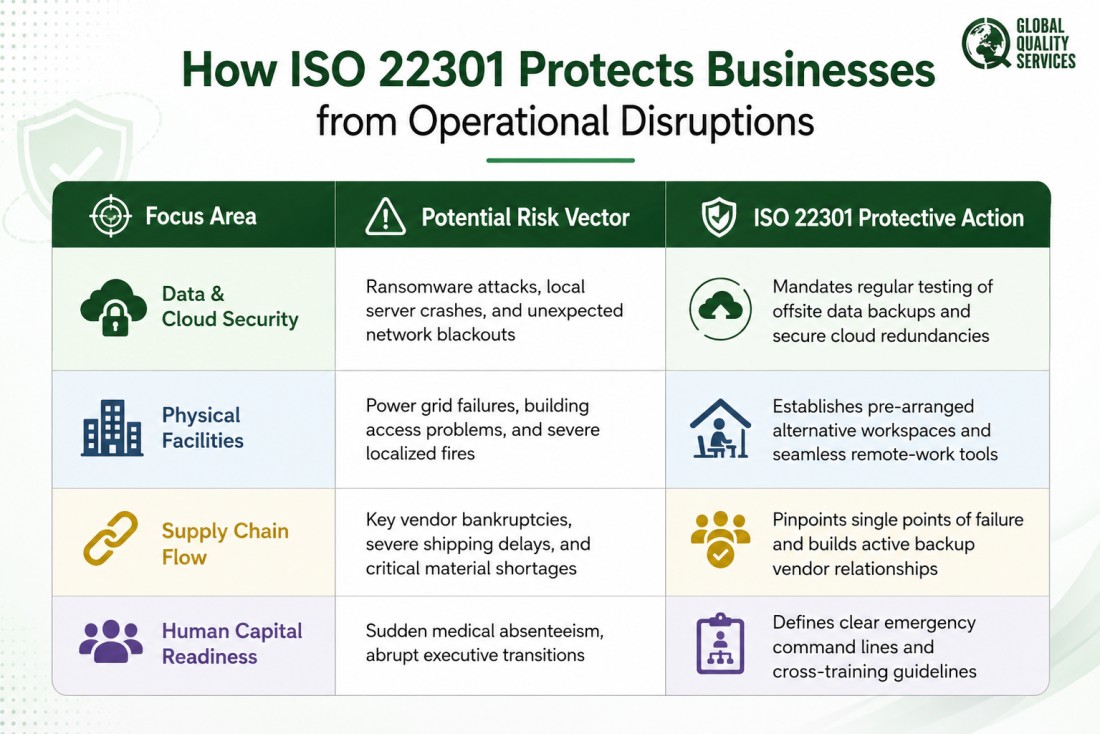
How ISO 22301 Protects Businesses from Operational Disruptions
The standard replaces reactive crisis control with a highly structured, proactive system. It helps your team identify vulnerabilities, calculate recovery goals, and test emergency plans long before an actual crisis hits.
Which Businesses Should Get ISO 22301 Certification in Hyderabad?
Operational resilience is a major asset for any company handling sensitive data or strict client deadlines. The following industries in the local market benefit the most from achieving compliance.
- IT Services and Software Providers: Teams managing round-the-clock technical support, live software deployments, and critical cloud ecosystems across Hitech City.
- Pharmaceutical and Biotech Entities: Production facilities that need to protect temperature-controlled storage, clinical research data, and global drug delivery timelines.
- Banking, Finance, and FinTech Firms: Platforms processing millions of secure digital payments daily or managing confidential investment portfolios.
- Data Center and Infrastructure Operators: Facilities hosting enterprise cloud environments where even a brief power or cooling failure triggers immense contract violations.
- Logistics and Fulfillment Companies: Logistics networks that coordinate real-time freight, corporate warehouse management, and large business-to-business retail supply paths.
ISO 22301 Certification Process
Getting certified is a straightforward journey focused on making resilience a natural part of your daily corporate operations. The entire process follows five clear execution steps.
Phase 1: Context Definition and Gap Analysis
The process starts by comparing your current emergency plans against the precise requirements of the standard. This initial review helps reveal hidden workflow vulnerabilities, missing documentation, and areas where your existing recovery protocols need a lift.
Phase 2: Business Impact Analysis
This stage maps out your business activities to identify which departments keep the company alive. We help your management determine acceptable recovery timelines and the maximum amount of data loss your business can handle without serious harm.
Phase 3: Strategy Formulation and Documentation
With clear risk metrics ready, we write your official Business Continuity Plan. This phase establishes specific response teams, coordinates alternate communication channels, and builds simple policy manuals tailored to your unique workforce.
Phase 4: Framework Awareness and Internal Audits
A great plan is only useful if your staff knows how to use it. This stage focuses on training your personnel and running easy crisis simulations. Internal audit teams then check the results to make sure your continuity setup runs perfectly.
Phase 5: Independent External Assessment
The final step is an independent review by an accredited third-party certification body. Auditors evaluate your documents and interview your team to ensure compliance. Once everything is confirmed, your business receives its official corporate certificate.
How Does Global Quality Services Support ISO 22301 Certification Across Hyderabad?
Global Quality Services provides end-to-end support throughout the certification journey by helping organizations build a Business Continuity Management System that is practical, compliant, and easy to maintain. Our support includes:
- Initial business continuity assessment
- ISO 22301 implementation planning
- Gap analysis and compliance review
- Documentation preparation
- Risk Assessment and Business Impact Analysis
- Employee awareness and implementation guidance
- Internal audit support
- Certification audit coordination
- Post-certification guidance for continual improvement
Protect Your Global Client Contracts with ISO 22301 Compliance
An unexpected system shutdown can result in lost revenue, canceled contracts, and severe damage to your brand. Securing an ISO 22301 Certification shows your global clients that your business can withstand and bounce back from any major operational crisis.
- Turn your corporate risk management strategy into an active marketing tool that wins major enterprise accounts.
- Safeguard your entire operational infrastructure across your technology platforms, facility lines, and supply paths.
- Enjoy a flat-fee consulting roadmap with clear milestones managed by local compliance specialists.
Secure your corporate operations before a disruptive event happens. Reach out to the business continuity experts at Global Quality Services today to book your initial gap analysis and receive a clear compliance roadmap tailored to your company’s scale.
Frequently Asked Questions
1. What is the official validity period for an ISO 22301 certificate in India?
An officially issued certificate stays valid for a maximum period of 3 years. To keep your certified standing active, the international certification bodies require simple annual surveillance reviews.
2. How does ISO 22301 differ fundamentally from the ISO 27001 standard?
The difference comes down to the core focus of the system. ISO 27001 looks specifically at data privacy, network protection, and locking down information from cyber threats. ISO 22301 looks at the survival of the whole business, making sure your physical offices, supplier chains, workforce logistics, and manual workflows keep running during any disaster.
Can a growing mid-sized startup apply this business continuity framework?
The standard is completely flexible and scales easily to fit any corporate size. It does not require massive budgets or complex software setups. For growing startups, the framework focuses strictly on your most essential, revenue-generating activities, helping you pass strict corporate client procurement checks without stretching your teams thin.
What internal resources must a business assign to the audit phase?
Your business only needs to appoint an internal coordinator or a small team to act as the point of contact. This team works directly with our consultants to note down current procedures, participate in quick incident training simulations, and ensure that different department leads understand their specific roles during an emergency.
What is the typical timeline required to achieve complete certification?
Most mid-sized organizations move from the initial gap analysis to full certification within three to four months. This timeframe fluctuates depending on the complexity of your workflow setups, the number of physical offices you operate, and how quickly your staff can adopt the new operational safety habits.