Noida stands as a core industrial and manufacturing center in Northern India. Active manufacturing zones across Sector 57, Sector 63, and Greater Noida are subject to steady regulatory oversight by authorities such as the Uttar Pradesh Food Safety and Drug Administration (UPFSDA). According to official data from the Press Information Bureau, India’s manufacturing Gross Value Added (GVA) expanded by 9.13% in Q2 of FY 2025-2026, driven by growth in medium and high-spec production facilities.
To keep pace with this expansion, maintaining fully compliant facilities is necessary. Good Manufacturing Practice (GMP) goes beyond basic paperwork. It serves as an operational framework ensuring your products are consistently produced and controlled to meet clear quality benchmarks. Whether preparing for a joint CDSCO inspection or securing long-term contract manufacturing deals, establishing a robust compliance framework is essential.
Why GMP Compliance Matters for Manufacturers in Noida
Operating a processing or production plant in Gautam Buddha Nagar requires adhering to local and national safety norms. Achieving and maintaining GMP certification provides direct business advantages:
- Regulatory Survival and Compliance: Enforcement of revised Schedule M standards under the Drugs and Cosmetics Rules means pharmaceutical units must maintain digital audit trails, cleanroom HVAC validations, and risk assessment models to keep their manufacturing licenses active.
- Access to High-Value B2B Contracts: Major retail brands, hospital networks, and global distributors mandate third-party audit reports and valid GMP certificates before onboarding new contract partners.
- Fewer Product Recalls and Batch Failures: Controlled sanitation, raw material testing, and environmental monitoring significantly lower the risk of cross-contamination, product spoilage, and rejected batches.
- Smooth Inspection Readiness for UPFSDA Visits: Maintaining an updated Site Master File (SMF) and clear Standard Operating Procedures (SOPs) reduces delays during routine or unannounced visits by local drug inspectors.
Which Industries in Noida Need GMP Certification or GMP Compliance
Different sectors operating across Noida require specific GMP frameworks tailored to their product categories and regulatory bodies:
- Pharmaceutical and formulation manufacturers
- Nutraceutical and dietary supplement manufacturers
- Ayurvedic and herbal product manufacturers
- Food and beverage manufacturers
- Cosmetic and personal care manufacturers
- Medical device manufacturers
- Biotechnology and healthcare product manufacturers
- Contract and third-party manufacturing units
- Export-oriented manufacturing businesses
- Manufacturers supplying products to regulated buyers
GMP Certification Process in Noida
Upgrading your manufacturing facility to complete audit readiness involves a structured 5-step process designed to remove operational bottlenecks.
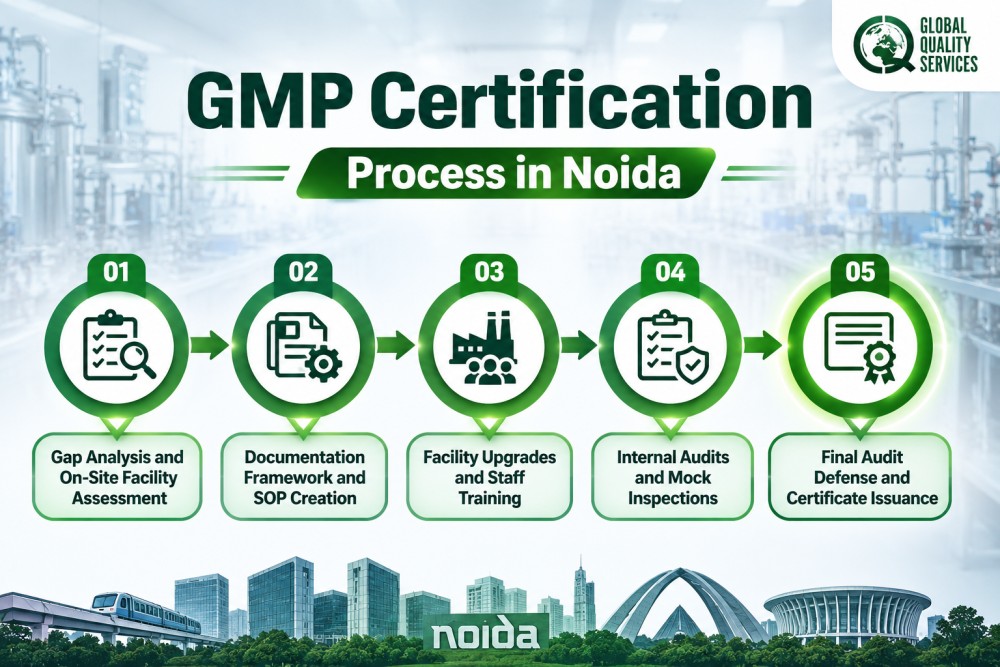
Step 1: Gap Analysis and On-Site Facility Assessment
Our technical auditors visit your unit in Noida to evaluate floor plans, air handling units (AHUs), drainage systems, equipment layouts, and existing documentation against applicable GMP standards.
Step 2: Documentation Framework and SOP Creation
We draft, refine, and help implement essential operational files, including the Site Master File (SMF), Validation Master Plan (VMP), equipment qualification records (IQ/OQ/PQ), and batch manufacturing records (BMRs).
Step 3: Facility Upgrades and Staff Training
Based on the gap analysis, your engineering team receives practical guidance for structural adjustments, cleanroom layouts, or airflow corrections. Simultaneously, we train floor personnel on hygiene practices, gowning protocols, and precise record logging.
Step 4: Internal Audits and Mock Inspections
Before facing official regulators or third-party registrars, we run a simulated audit. This identifies lingering compliance gaps, tests data integrity practices, and prepares department heads to answer inspector queries with confidence.
Step 5: Final Audit Defense and Certificate Issuance
We support your team during the formal certification audit or government inspection. Once the assessment is complete and any preventive action items are resolved, your facility receives its official GMP certification or inspection compliance report.
Common GMP Compliance Gaps Found in Manufacturing Facilities
During initial facility audits across Noida industrial areas, our team regularly identifies specific operational oversights that can cause audit delays:
- Inadequate HVAC and Differential Pressure Controls: Failing to maintain required pressure gaps between cleanrooms and corridors, which increases airborne cross-contamination risks.
- Incomplete Data Integrity and Logbooks: Manual production records with missing entries, backdated signatures, or unvalidated digital spreadsheet tracking.
- Unvalidated Water Systems: Using basic filtration without regular monitoring of total organic carbon (TOC), bioburden levels, or loop recirculation speeds.
- Poor Material Flow and Cross-Traffic: Raw materials, finished products, and waste streams crossing paths because of flawed plant layouts.
- Deficient Vendor Qualification: Sourcing active ingredients or primary packaging material without verified certificates of analysis (CoAs) or regular vendor audits.
Why Choose Global Quality Services for GMP Certification Support in Noida
GMP preparation should not be limited to paperwork. Your consultant should understand how the manufacturing facility operates and help connect documentation with actual work practices.
Global Quality Services can support Noida businesses through a practical approach focused on readiness, implementation, and audit preparation.
- Facility-focused assessment: Review of your actual manufacturing environment and existing controls.
- Practical documentation support: Development and improvement of GMP documents based on your operations.
- Implementation guidance: Help with putting required controls into regular practice.
- Employee training: Clear training so employees understand what they need to do and record.
- Internal audit support: Identification of gaps before the formal assessment.
- Corrective action support: Practical assistance in addressing findings and strengthening weak areas.
- Noida and Greater Noida support: On-site assistance for manufacturers operating across the wider industrial region.
Secure Your GMP Audit Readiness with Global Quality Services
Whether preparing for a UPFSDA regulatory inspection, upgrading your facility for revised Schedule M standards, or working to win high-value contract manufacturing deals, delaying your compliance strategy can result in license holds, failed buyer audits, and unexpected plant downtime.
Partner with Global Quality Services to streamline your path to complete compliance. Our senior technical consultants will visit your facility, conduct an on-site gap assessment, and deliver a practical, step-by-step roadmap to audit readiness.
- Call Our Compliance Team: Connect directly with experienced technical leads.
- Request an On-Site Gap Audit: Receive an evaluation of your plant’s structural and documentation readiness.
- Get a Custom Action Plan: Obtain clear project timelines and a direct scope of work tailored to your Noida facility.
Frequently Asked Questions
1. What is the main difference between WHO-GMP and standard ISO certification?
WHO-GMP is a mandatory regulatory framework for pharmaceutical manufacturing. It focuses heavily on product safety, cleanroom controls, and batch integrity, verified directly through state or central drug inspector audits. Standard ISO certifications (such as ISO 9001) are voluntary quality management systems applicable to general business operations across any industry sector.
2. How long does it take to get a factory GMP certified in Noida?
For facilities that already have modern infrastructure and primarily need documentation and procedural alignment, the process usually takes 6 to 10 weeks. If your plant requires physical floor upgrades, HVAC installations, or upgraded water treatment systems, complete implementation can take between 3 and 6 months.
3. Is GMP certification mandatory for food and nutraceutical units in Uttar Pradesh?
Yes. Basic hygiene and sanitary requirements under FSSAI Schedule 4 serve as mandatory GMP standards for all food businesses. Advanced nutraceutical and dietary supplement manufacturers must comply with these guidelines to obtain and keep their Central FSSAI License.
4. Do startup cosmetic manufacturers in Noida need a separate GMP audit?
Yes. Cosmetic production units must demonstrate compliance with sanitary manufacturing standards outlined in the Cosmetic Rules. Securing an ISO 22716 certificate or an official GMP compliance report helps startups earn buyer trust and secure third-party contract manufacturing deals.
5. How often do we need to renew our GMP certification?
Private third-party GMP certificates remain valid for 3 years, provided the facility passes annual surveillance audits. Regulatory WHO-GMP certificates and state drug manufacturing licenses require periodic renewals based on scheduled government re-inspections by state and central drug control officers.