Events are no longer judged only by attendance, presentation or successful execution. Clients, sponsors, venues and participants increasingly want events to be organised in ways that consider environmental impact, social responsibility and the efficient use of resources.
For event organisers in Ahmedabad, this creates a need for a more organised approach to sustainability. ISO 20121 Certification in Ahmedabad helps organisations establish an Event Sustainability Management System that brings sustainability into planning, procurement, event operations and post-event evaluation.
Global Quality Services (GQS) provides consultancy support to organisations seeking to implement ISO 20121 and to prepare their event sustainability system for an appropriate conformity assessment or certification process.
What Is ISO 20121 Certification?
ISO 20121 is an international standard for Event Sustainability Management Systems. The current edition is ISO 20121:2024, which replaced ISO 20121:2012. The standard applies to events of different types and sizes and considers environmental, social and economic impacts associated with event activities.
You can review the current requirements and scope directly through the official ISO 20121:2024 standard page.
ISO 20121 is not simply about making an event “green”. It gives organisations a management-systems approach to identifying sustainability issues, setting objectives, assigning responsibilities, controlling relevant activities, and evaluating performance.
The 2024 edition also places greater emphasis on areas such as inclusivity, human rights, children’s rights and event legacy.
Why Ahmedabad Event Businesses Need a Structured Sustainability Approach
Ahmedabad hosts a wide range of business, cultural, educational and social events. Trade exhibitions, corporate conferences, product launches, weddings, public programmes and large gatherings can involve numerous suppliers and temporary operations.
An event may require venue infrastructure, electricity, lighting, catering, transportation, accommodation, decorations, printed materials, technology and waste-management arrangements. When every supplier manages sustainability differently, it becomes difficult for an organiser to measure or control the overall impact.
ISO 20121 provides a way to bring these activities under a common management approach.
For example, an Ahmedabad event organiser could establish sustainability criteria before selecting a caterer, require suppliers to follow defined waste practices, reduce unnecessary printed material, consider accessibility requirements and review resource consumption after an event.
This makes sustainability part of event planning and decision-making, rather than an activity added shortly before guests arrive.
What Does an ISO 20121 Management System Include?
A successful system starts with understanding how your organisation actually manages events.
Understanding the Organisation and Event Context
The organisation first identifies internal and external factors that can influence event sustainability. The scope can then be defined according to the organisation, event type, venue or other relevant activities. A corporate event company managing conferences throughout Ahmedabad may require a different scope from a venue that hosts exhibitions, weddings and public events.
Identifying Stakeholders
Events involve more people than just the organiser and attendees. Clients, sponsors, employees, suppliers, contractors, venue operators, local communities and authorities can all have relevant expectations. Understanding these expectations helps the organisation decide which sustainability issues need to be addressed.
Setting Sustainability Objectives
The organisation establishes objectives based on its significant sustainability impacts. For one event, reducing disposable materials may be a priority. For another, transportation, accessibility, energy use or supplier practices may require greater attention. The important point is that objectives should relate to actual event operations and should be capable of being monitored.
Controlling Event Operations
Once objectives are established, operational controls can be introduced across procurement, suppliers, catering, logistics, energy, water, waste, communications and other relevant activities.
Measuring and Reviewing Performance
After implementation, the organisation evaluates whether its sustainability objectives have been achieved. Feedback, monitoring results, internal audits and management review can then be used to identify improvements.
Managing Event Waste in Ahmedabad
Waste can become one of the most visible sustainability issues during a large event. Food leftovers, packaging, disposable serving products, promotional material, decorations and temporary infrastructure can all contribute to waste generation.
Ahmedabad Municipal Corporation has an established Solid Waste Management Department, and its published material describes waste collection, transportation, processing and disposal activities across the city.
Event organisers can use this broader local context when designing their own waste controls. For example, event plans can consider segregation at source, reusable materials, responsible disposal arrangements and better estimation of food and material requirements.
Organisations should also identify applicable national requirements. The Ministry of Environment, Forest and Climate Change has published the Solid Waste Management Rules, 2026, which came into force from 1 April 2026 and apply broadly to different establishments and waste generators.
You can refer to the government’s published Solid Waste Management Rules, 2026 when reviewing applicable waste-management obligations.
Sustainable Procurement for Events
Procurement decisions can have a major influence on an event’s sustainability performance.
An organiser may work with caterers, decorators, transport providers, printing companies, equipment suppliers, venue contractors and temporary infrastructure providers. If sustainability is considered only after contracts have been awarded, it may be difficult to change supplier practices.
ISO 20121 encourages organisations to consider sustainability during decision-making. Supplier selection can therefore include relevant criteria covering resource efficiency, waste handling, social practices, transportation, reusable materials and other factors important to the event.
The purpose is not to select a supplier simply because it describes itself as sustainable. Organisations should establish suitable criteria, communicate expectations and retain evidence of how suppliers are evaluated.
Social Responsibility in Event Management
Environmental performance is only one part of sustainable event management.
An event also affects employees, contractors, participants and communities. Accessibility, inclusive participation, worker welfare, health and safety, human rights and responsible communication can all become relevant depending on the event.
This is one area where the 2024 edition of ISO 20121 provides a broader sustainability perspective, including stronger attention to human rights, children’s rights, inclusivity and event legacy.
For an Ahmedabad organisation, this could mean considering accessibility when selecting a venue, communicating requirements clearly to contractors, reviewing working conditions within the supply chain and ensuring event facilities are suitable for different groups of attendees.
ISO 20121 Certification Process in Ahmedabad
GQS follows a practical approach that begins with understanding the organisation’s existing event-management practices.
1. Initial Discussion and Scope Definition
The process starts by identifying what your organisation does, what types of events are covered and how sustainability is currently managed. The scope is important because an event company, venue, hotel or corporate event department may have very different responsibilities.
2. Gap Assessment
GQS reviews existing policies, processes and operational practices against relevant ISO 20121 requirements. This assessment helps identify what is already working and where additional controls or documentation are required.
3. Sustainability Planning
The organisation identifies significant sustainability issues, interested parties, risks, opportunities and objectives. At this stage, sustainability goals should be connected to measurable actions rather than remaining broad statements.
4. System Documentation
Relevant policies, procedures, responsibilities and operational controls are developed or updated. Documentation can cover areas such as supplier management, procurement, waste management, resource use, communication, event planning, emergency arrangements, and performance monitoring.
5. Implementation
The system is put into practice through actual event activities. Employees and relevant suppliers need to understand their responsibilities. Records and evidence should also be maintained to demonstrate how the organisation applies its sustainability controls.
6. Internal Audit and Management Review
An internal audit is conducted to evaluate whether the system is working as intended. Management then reviews performance, findings, objectives, and opportunities for improvement. Any identified gaps can be addressed before an external assessment.
7. External Certification or Conformity Assessment
ISO 20121:2024 allows different methods of demonstrating conformity, including self-declaration, supplier validation and third-party certification. Organisations choosing third-party certification can have their management system assessed by an appropriate certification body. GQS can assist with preparation for the selected assessment route.
Benefits of ISO 20121 Certification in Ahmedabad
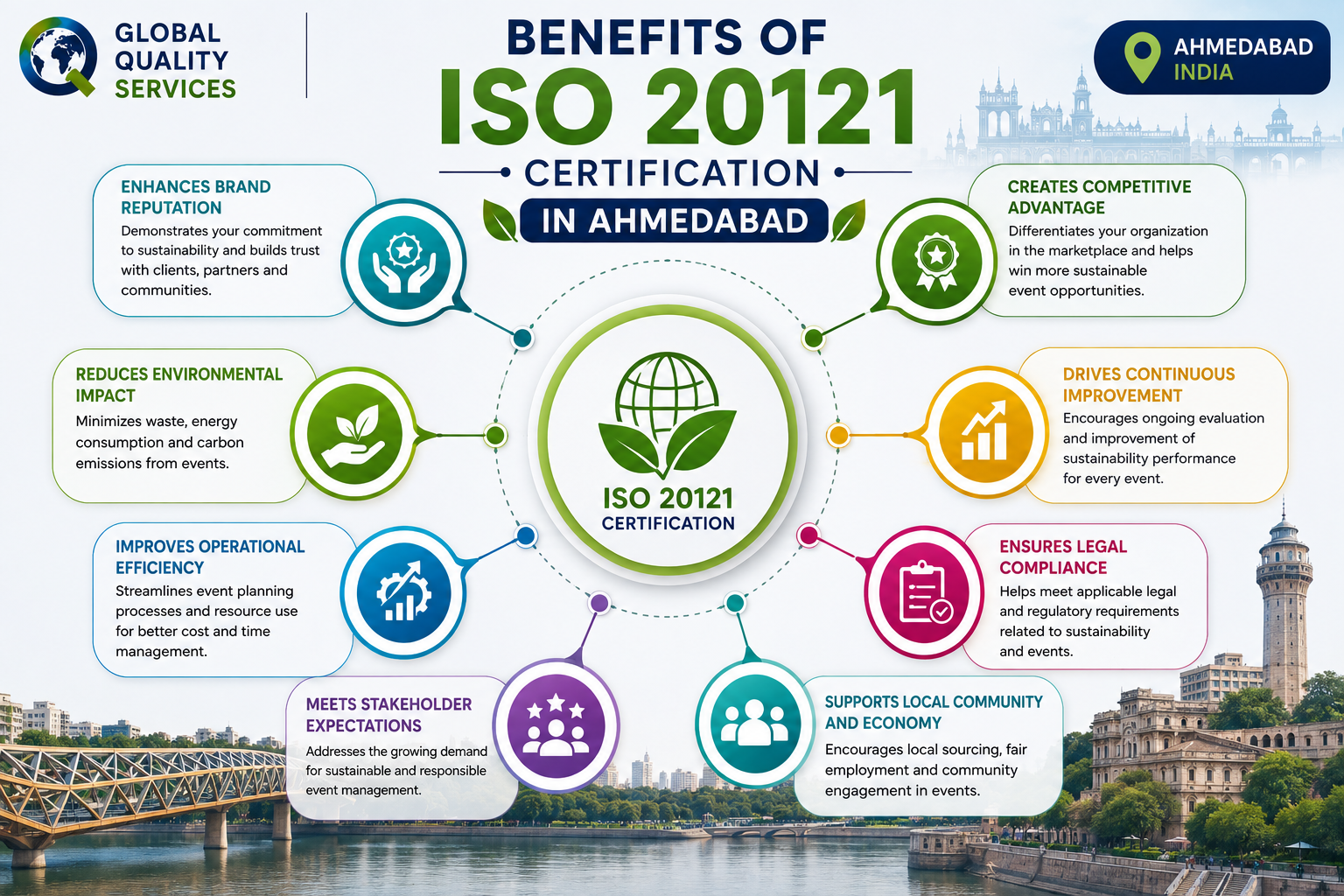
Let us have a look at the benefits of ISO 20121 Certification in Ahmedabad:
More Consistent Event Planning
Sustainability becomes part of the normal event planning process rather than relying on individual employees or one-off initiatives. This can make practices more consistent across different projects.
Better Resource Management
When organisations monitor materials, energy, water, transport and other resources, they can identify unnecessary consumption and make more informed operational decisions.
Improved Supplier Coordination
A structured system allows sustainability expectations to be communicated to suppliers and contractors before event delivery. This can make it easier to manage sustainability across the event supply chain.
Lower Waste and Avoidable Costs
Better forecasting, purchasing and resource planning can reduce excess materials, food waste and unnecessary purchases. Waste reduction can therefore support both sustainability and cost management.
Stronger Stakeholder Confidence
Clients, sponsors, employees, participants and business partners may increasingly want evidence that events are being managed responsibly. A recognised management system can provide a structured way to demonstrate this commitment.
Better Preparation for International Events
Event organisations working with international clients or sponsors may benefit from having a sustainability system based on an internationally recognised standard. It can provide a common framework when sustainability expectations differ between clients and markets.
Continual Improvement
ISO 20121 is not intended to be a one-time exercise. Monitoring performance and reviewing event results create opportunities to improve future events based on actual experience.
Who Can Implement ISO 20121 in Ahmedabad?
ISO 20121 can be relevant to many organisations involved in the event value chain, including:
- Event management companies
- Exhibition and trade-fair organisers
- Conference and convention organisers
- Hotels and event venues
- Corporate event departments
- Wedding and social-event planners
- Sports and entertainment organisers
- Cultural-event organisations
- Catering companies
- Event logistics providers
- Audio-visual and technical service providers
- Public-sector organisations managing events
The standard is applicable to events of all types and sizes, so the system can be scaled according to the organisation’s activities.
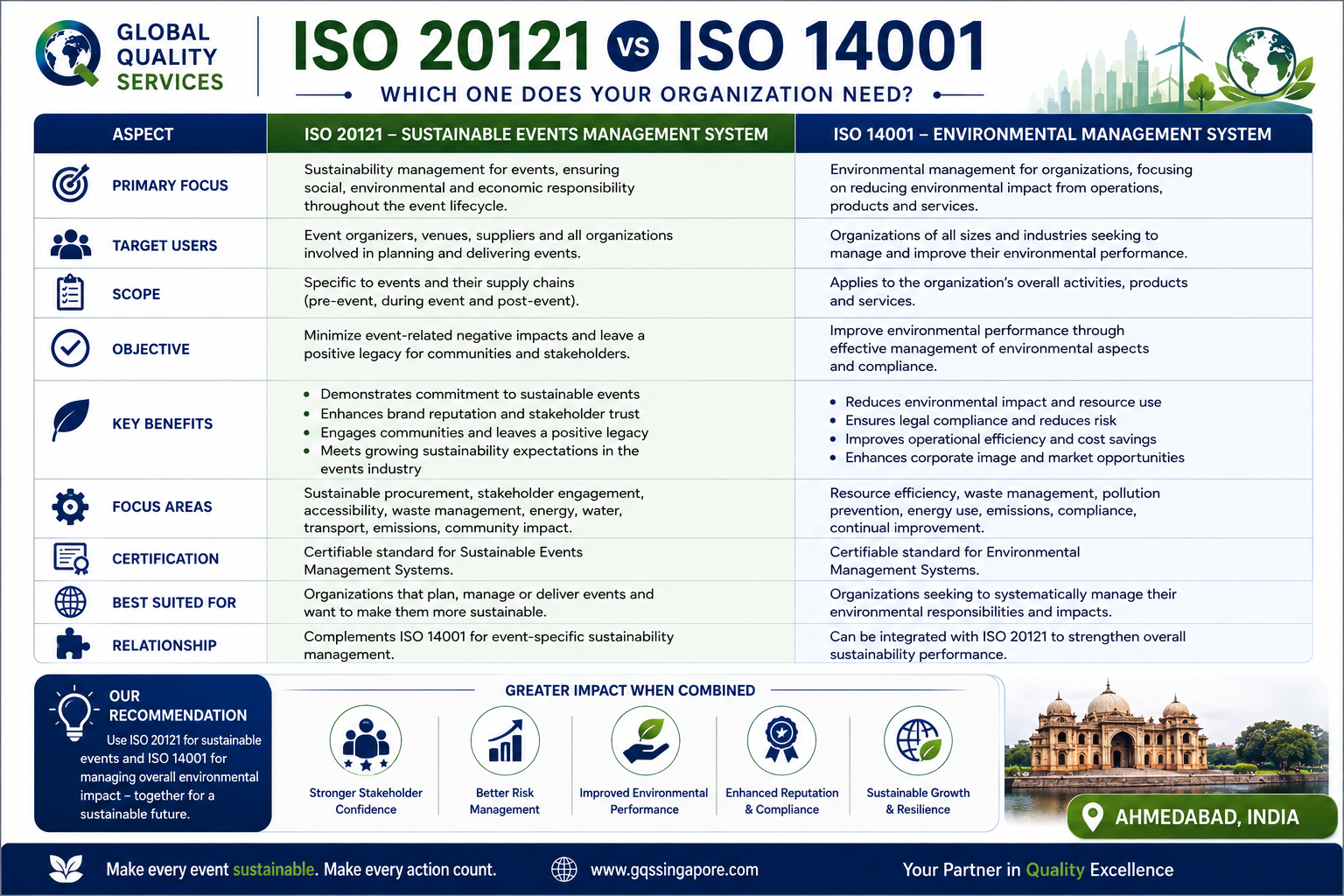
ISO 20121 vs ISO 14001
Although both standards can address environmental concerns, they have different purposes. ISO 14001 is an environmental management system standard that can be applied to an organisation’s broader operations. ISO 20121 is specifically designed for sustainability management within the event context and considers environmental, social and economic impacts. An event company that already operates an environmental management system may therefore use ISO 20121 to introduce a more event-specific approach to sustainability.
Why Choose GQS for ISO 20121 in Ahmedabad?
Global Quality Services supports organisations with management-system consultancy and certification-related requirements across India. Its existing ISO 20121 Certification in Ahmedabad service is designed for organisations involved in planning, organising and delivering events.
GQS can help with gap assessment, management-system development, implementation support, internal audit preparation and coordination with the appropriate certification process. Organisations can also explore GQS’s wider quality certification services when ISO 20121 needs to be considered alongside other management-system requirements.
Frequently Asked Questions
1. What is ISO 20121 Certification in Ahmedabad?
ISO 20121 certification relates to an Event Sustainability Management System based on ISO 20121. The current edition, ISO 20121:2024, helps organisations manage environmental, social and economic aspects associated with events.
2. Is ISO 20121:2024 applicable to small event companies?
Yes. ISO confirms that the standard applies to events of different types and sizes. Smaller organisations can establish a system appropriate to their activities and resources.
3. Can wedding planners in Ahmedabad implement ISO 20121?
Yes. Wedding planners can use the standard to structure areas such as supplier selection, venue management, resource use, waste, accessibility, transportation and stakeholder requirements.
4. Is ISO 20121 mandatory in India?
No. ISO 20121 is a voluntary international standard. Organisations may choose third-party certification or another recognised conformity route based on their business objectives and stakeholder requirements.
5. How long does ISO 20121 certification take?
There is no single timeframe for every organisation. The duration depends on the scope, number and complexity of events, existing processes, documentation, implementation readiness and assessment requirements. A gap assessment can provide a more realistic estimate.