Reliable drinking-water and wastewater services are essential for a growing city. For water utilities, service providers, infrastructure operators and organisations involved in water-service activities, performance cannot be measured only by whether water reaches users or wastewater is collected. Service quality also depends on reliability, communication, accessibility, responsiveness and the ability to understand and meet user expectations.
ISO 24510 Certification in Bengaluru is a commonly used term for organisations looking to demonstrate alignment with ISO 24510. The current standard, ISO 24510:2024, provides guidelines for assessing and improving drinking-water and wastewater services from the user’s perspective. It helps organisations identify user needs, establish service objectives, assess performance and use suitable indicators for continual improvement.
Global Quality Services (GQS) supports organisations seeking to understand ISO 24510 and develop practical approaches for improving water and wastewater service performance.
What Is ISO 24510:2024?
ISO 24510:2024 is titled Activities relating to drinking water and wastewater services — Guidelines for the assessment and for the improvement of the service to users.
The standard identifies elements of drinking-water and wastewater services that are important to users. It provides guidance on understanding user needs and expectations, establishing service objectives, assessing whether expectations are being met and using performance indicators.
You can review the current ISO 24510:2024 standard directly through ISO.
An important distinction is that ISO 24510:2024 is a guideline document, not a certifiable management system standard, unlike ISO 9001 or ISO 14001. Therefore, organisations should be careful about claiming formal “ISO 24510 certification” without confirming the applicable conformity-assessment arrangement.
For SEO purposes, businesses may search for ISO 24510 Certification in Bengaluru, while the actual engagement may involve assessment, implementation guidance, service-performance improvement or another appropriate conformity route.
Why ISO 24510 Matters in Bengaluru
Bengaluru’s water services involve a complex urban environment with households, commercial properties, industries, institutions and rapidly expanding infrastructure.
The Bangalore Water Supply and Sewerage Board (BWSSB) is the government water and wastewater service authority for Bengaluru. Its official systems provide services such as water connections, application tracking and consumer complaint management.
This type of service environment makes the user perspective particularly important.
A water-service organisation needs to understand questions such as:
- Are services reliable and accessible?
- Are customer complaints handled effectively?
- Are users receiving clear information?
- Are service objectives being achieved?
- Which performance indicators should be monitored?
- Where are recurring service problems occurring?
- How can service quality be improved over time?
ISO 24510 provides a structured way of looking at such questions.
A User-Centred Approach to Water Services
Traditional water-service improvement can sometimes focus heavily on infrastructure, equipment and technical performance.
Those elements are important, but users experience a water service differently.
A customer may judge service quality based on whether supply is reliable, whether a complaint receives a timely response, whether billing or service information is understandable, and whether the organisation communicates effectively when a disruption occurs.
ISO 24510 brings this user perspective into service assessment.
The organisation can identify different categories of users, understand their expectations and determine which characteristics of service are important to them. The resulting information can then be connected with service objectives and performance indicators.
What ISO 24510 Covers
ISO 24510:2024 provides guidance around several important areas.
Understanding User Needs
Different users can have different expectations. Residential consumers, businesses, hospitals, educational institutions and industrial users may place different priorities on reliability, responsiveness and service information.
An organisation can identify relevant user groups and understand their needs rather than applying the same assumptions to everyone.
Defining Service Objectives
Once user expectations are understood, appropriate service objectives can be established. Objectives should provide a meaningful basis for assessing service performance. They may relate to reliability, responsiveness, communication, accessibility or other service characteristics relevant to users.
Assessing Service Performance
Assessment helps determine whether established service objectives are being achieved. This requires suitable information and evidence rather than relying only on general customer perception.
Using Performance Indicators
ISO 24510 introduces the use of performance indicators and provides examples. Indicators can help organisations identify trends, compare performance against objectives and identify areas requiring improvement. The exact indicators should be selected according to the organisation’s services, users and objectives.
ISO 24510 and Bengaluru’s Water-Service Environment
Bengaluru has an extensive and evolving water-service infrastructure. Official government data also provides ward-wise 2026 water-consumption data from BWSSB, demonstrating how water-use information can be analysed at a local level.
For organisations working within this environment, data can support better service decisions. For example, service teams can analyse consumption patterns, complaints, interruptions, response times or other relevant information to understand where service performance needs attention.
ISO 24510 does not prescribe one universal set of indicators for every organisation. Instead, it provides a framework for identifying appropriate service characteristics and developing meaningful performance measures.
ISO 24510 and Customer Complaints
Complaints can provide valuable information about service performance.
A complaint is not simply an issue that needs to be closed. Repeated complaints about the same problem may indicate an underlying service weakness.
An organisation following an ISO 24510-based approach can examine complaint information alongside other performance data.
For example, management may review:
- Type and frequency of complaints
- Response times
- Resolution times
- Recurring service issues
- User feedback
- Communication during disruptions
- Differences between user groups
This can help shift complaint handling from a purely reactive function towards a source of service-improvement information.
Improving Communication With Water-Service Users
Good technical performance does not always guarantee a good user experience.
When planned maintenance, service interruptions or other disruptions occur, users need accurate and timely information.
Communication can therefore become part of service quality.
An organisation can establish suitable methods for informing users about disruptions, expected restoration times, service changes, complaint channels and other relevant information.
The appropriate communication method will depend on the organisation and its user groups.
ISO 24510 Assessment and Improvement Process in Bengaluru
GQS can help organisations develop a structured approach to ISO 24510 based service assessment and improvement.
1. Understand the Service Environment
The first stage involves reviewing the organisation’s drinking-water or wastewater service activities, user groups, existing performance measures and current service practices. This establishes a practical starting point.
2. Identify Users and Expectations
Relevant user groups are identified and their needs and expectations are evaluated. The organisation can then determine which aspects of service are most important from the user’s perspective.
3. Establish Service Characteristics and Objectives
The next stage involves identifying relevant service characteristics and setting objectives against which performance can be assessed. Objectives should be realistic, measurable where appropriate and connected to actual user expectations.
4. Review Existing Performance Indicators
Existing data and indicators are examined to determine whether they provide useful information about service performance. Where necessary, additional indicators can be developed.
5. Conduct a Service Assessment
Performance is evaluated against established objectives and user expectations.
This assessment can identify gaps, recurring problems and areas where service improvements may be required.
6. Develop Improvement Actions
Once weaknesses are identified, appropriate corrective and improvement actions can be planned. Actions should address the underlying service issue rather than simply treating individual complaints.
7. Monitor Results
After improvements are introduced, performance should be monitored again. This creates a continual improvement cycle in which service providers can learn from performance data and user feedback.
Benefits of Applying ISO 24510 in Bengaluru 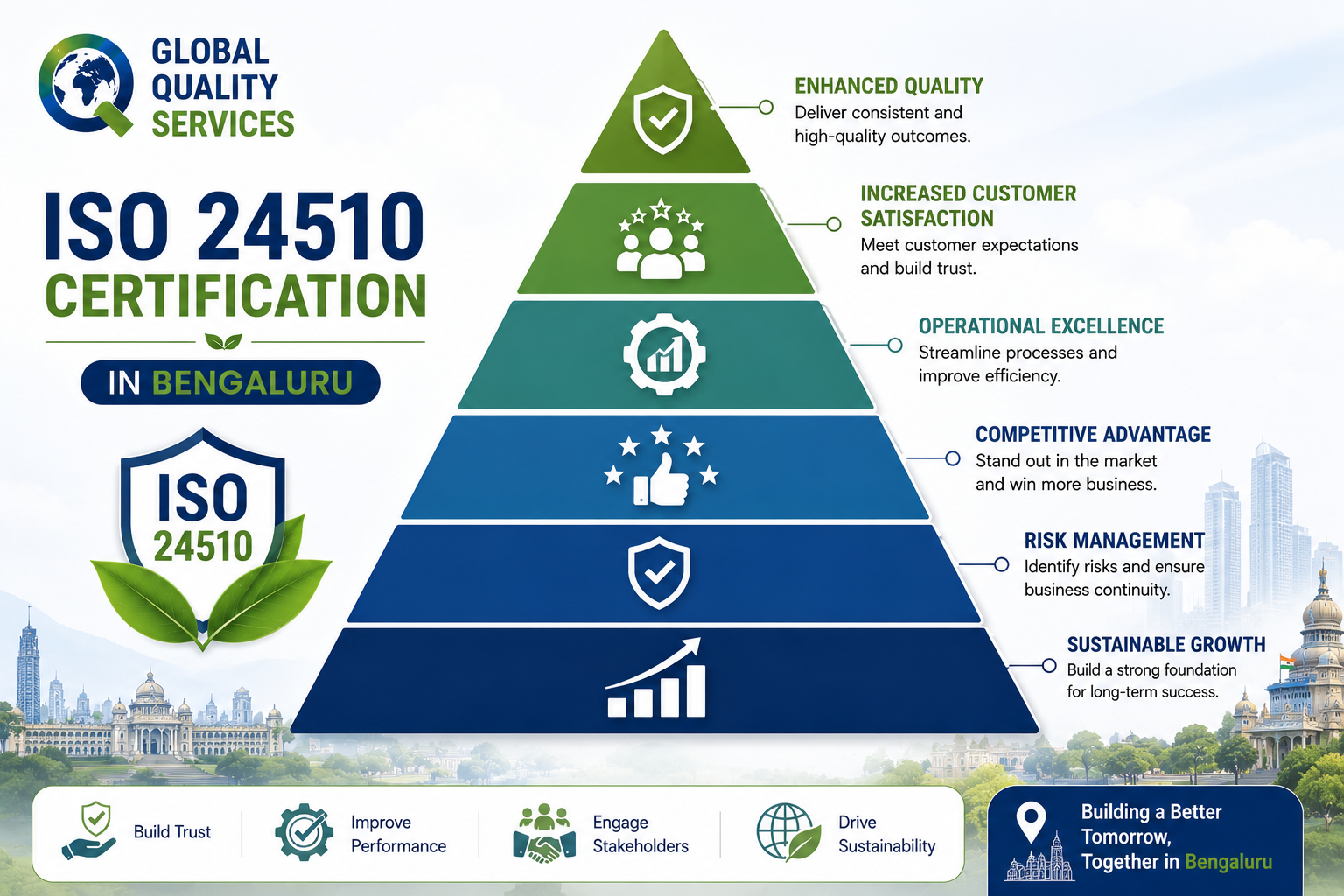
Let us have a look at the benenfits of ISO 24510 in Bengaluru:
Better Understanding of Users
The organisation gains a clearer picture of what different users actually expect from drinking-water and wastewater services.
More Meaningful Performance Measurement
Performance indicators can be linked to service objectives instead of being collected simply because data is available.
Improved Complaint Management
User complaints and feedback can become valuable sources of information for identifying recurring service problems.
Stronger Service Planning
Understanding user needs and service performance can support more informed decisions about service improvement priorities.
Better Communication
A structured approach can encourage organisations to consider how service information is communicated to users, especially during disruptions or changes.
Greater Transparency
Clearly defined service objectives and performance measures can make it easier to explain service performance to relevant stakeholders.
Continual Improvement
Regular assessment allows organisations to identify weaknesses, introduce improvements and measure whether those improvements have produced better results.
Who Can Use ISO 24510?
ISO 24510 can be relevant to organisations involved in drinking-water and wastewater services, including:
- Water utilities
- Wastewater service providers
- Municipal water-service organisations
- Public water authorities
- Private water-service operators
- Organisations managing water-service contracts
- Infrastructure service providers
- Water-service consultants
- Organisations evaluating service performance
The standard is focused on service to users. It is not intended to provide detailed methods for designing or constructing drinking-water and wastewater systems. ISO’s published scope specifically excludes design and construction methods and topics relating to systems inside buildings.
ISO 24510 vs ISO 24511 and ISO 24512
ISO 24510 is part of a wider family of standards relating to drinking-water and wastewater services.
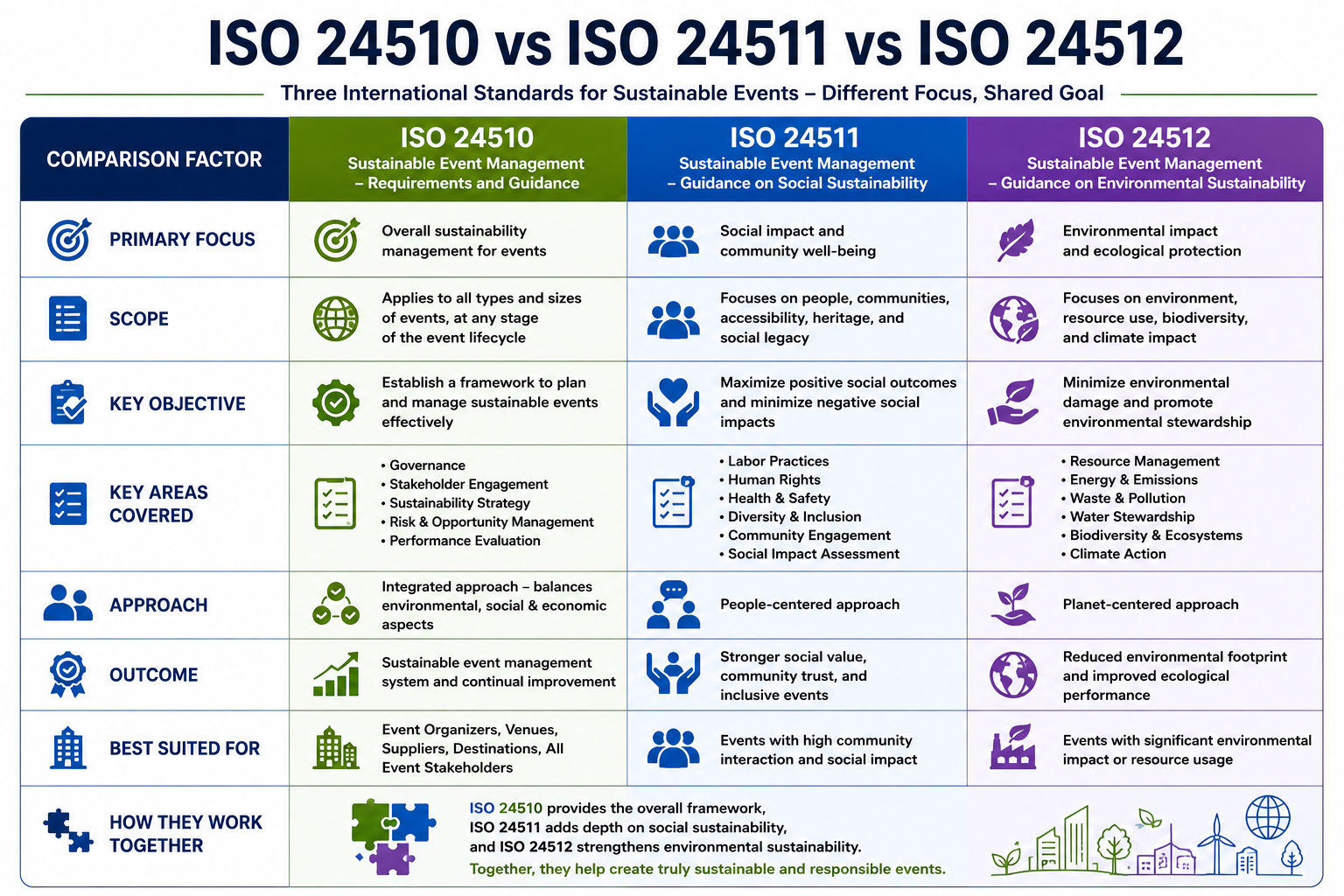
ISO 24510 focuses on guidelines for assessing and improving the service provided to users.
ISO 24511 addresses management and assessment of wastewater services.
ISO 24512 addresses management and assessment of drinking-water utilities and services.
Together, these standards can provide complementary guidance for organisations looking at different aspects of water and wastewater service management.
Why Choose GQS for ISO 24510 Consultancy in Bengaluru?
Global Quality Services helps organisations understand international standards and develop practical systems suited to their operational requirements.
For ISO 24510, GQS can assist organisations in understanding the standard, reviewing existing service practices, identifying gaps, developing suitable performance measures and establishing an improvement-oriented approach.
The focus should remain on service performance and users, rather than producing documentation simply for the sake of an assessment.
For organisations working with other management-system standards, GQS also provides wider quality certification services, allowing related requirements to be considered together where appropriate.
Water-service quality is not determined only by infrastructure. Users also care about reliability, accessibility, responsiveness, communication and how effectively service problems are resolved.
ISO 24510 Certification in Bengaluru provides a useful framework for organisations seeking to assess these aspects systematically and improve services based on user expectations and measurable performance.
GQS can help your organisation understand ISO 24510:2024 and develop a practical approach to service assessment and continual improvement.
Contact Global Quality Services to discuss your ISO 24510 requirements in Bengaluru and identify the right approach for your water or wastewater service operations.
Frequently Asked Questions
1. What is ISO 24510 Certification in Bengaluru?
ISO 24510:2024 provides guidelines for assessing and improving drinking-water and wastewater services from the user’s perspective. It focuses on user needs, service characteristics, objectives, assessment criteria and performance indicators.
2. Is ISO 24510 a certifiable ISO standard?
ISO 24510:2024 is a guideline standard rather than a conventional certifiable management-system standard. Organisations should therefore confirm the applicable conformity-assessment arrangement before making a formal certification claim.
3. Who should implement ISO 24510 in Bengaluru?
Water utilities, wastewater service providers, municipal organisations, service operators and other organisations involved in drinking-water or wastewater services can use ISO 24510 guidance to assess and improve service to users.
4. Does ISO 24510 apply to drinking water and wastewater?
Yes. Its scope covers elements of both drinking-water and wastewater services that are relevant to users.
5. How can GQS help with ISO 24510?
GQS can help organisations understand the standard, identify user expectations, review service performance, develop suitable indicators, identify improvement areas and prepare an appropriate assessment or conformity approach.