Mumbai is a city where business, entertainment, hospitality and large public gatherings come together throughout the year. Corporate conferences, exhibitions, award functions, film and media events, product launches, festivals and private celebrations often involve multiple venues, suppliers, contractors and service providers.
Managing an event at this scale also means managing its wider impact. Energy consumption, transportation, food, materials, waste, accessibility, worker welfare and local communities can all form part of the sustainability picture.
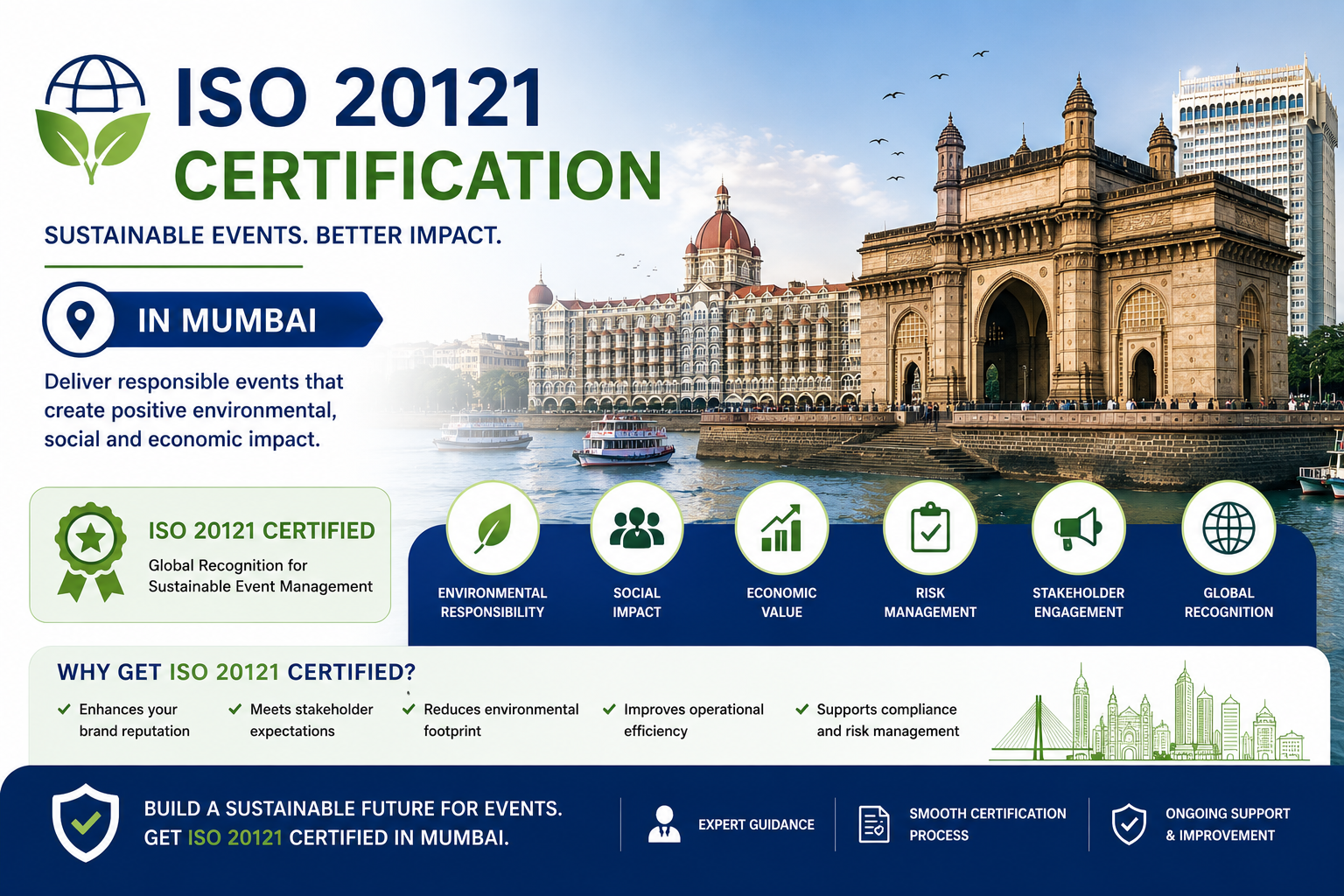
ISO 20121 Certification in Mumbai helps organisations establish a systematic approach to sustainable event management. Rather than treating sustainability as a collection of individual initiatives, ISO 20121:2024 provides a framework for integrating environmental, social and economic considerations into event planning and delivery.
Global Quality Services (GQS) supports organisations that want to develop an Event Sustainability Management System and prepare for an appropriate conformity assessment or third-party certification.
What Is ISO 20121?
ISO 20121:2024 is the current international standard for Event Sustainability Management Systems. It applies to events of different types and sizes and helps organisations address their environmental, social and economic impacts. The 2024 edition replaced ISO 20121:2012. ISO 20121:2024
The standard is designed to help organisations integrate sustainability into event management rather than treating it as a separate environmental programme. It can cover the way an organisation plans events, works with suppliers, manages resources, engages stakeholders and evaluates results.
The latest edition also gives greater attention to areas such as inclusivity, human rights, children’s rights and event legacy.
Why ISO 20121 Is Relevant to Mumbai’s Event Sector
Large events often depend on a long chain of external organisations. A single corporate event, for example, may involve a venue, caterer, decorator, audiovisual company, transportation provider, security contractor, printing supplier and temporary workforce.
If sustainability requirements are not communicated early, organisers may have limited control over what happens during the event.
ISO 20121 encourages organisations to consider sustainability at the planning stage. This means asking practical questions before contracts are finalised and before event infrastructure is installed.
For a Mumbai-based event company, this could involve evaluating suppliers, reducing unnecessary materials, planning waste segregation, considering public transport options, improving accessibility and establishing measurable sustainability objectives.
The result is a more organised approach in which sustainability becomes part of normal event management.
Sustainability Across the Mumbai Event Lifecycle
An event sustainability system should not begin on the day an event opens its doors. Important decisions are made much earlier.
Before the Event
Planning can include selecting suitable venues, identifying sustainability objectives, reviewing suppliers, estimating resource requirements and understanding stakeholder expectations. For example, an organiser can consider whether a venue has appropriate waste-management arrangements or whether suppliers can provide reusable rather than single-use materials.
During Event Delivery
Operational controls then become important. Teams may need to monitor waste collection, energy use, catering arrangements, transportation, accessibility and supplier performance. Responsibilities should be clear so that sustainability does not depend on one person remembering what needs to be done.
After the Event
Post-event evaluation provides an opportunity to understand what actually happened. Organisations can review waste quantities, resource consumption, stakeholder feedback, supplier performance and progress against sustainability objectives. This information can then be used when planning the next event.
ISO 20121 and Event Legacy
One of the important areas highlighted by the 2024 edition is event legacy. An event can have effects that continue beyond its closing date. A conference may create professional or educational value for participants. A cultural programme may contribute to local communities. A major public event can influence local businesses and the surrounding area. Considering legacy encourages organisers to look beyond what happens during the event itself.
For Mumbai organisations, this can be particularly relevant when planning large conferences, exhibitions, cultural programmes and public-facing events where the relationship with the surrounding community is important.
Sustainable Supplier Management
Supplier management is one of the areas where an event sustainability system can make a practical difference.
Mumbai events can involve dozens of vendors, particularly when an event requires temporary infrastructure, catering, transportation, lighting, sound, staging, printing or exhibition booths.
Rather than evaluating suppliers only on price and delivery time, organisations can establish appropriate sustainability criteria.
Depending on the event, criteria may cover:
- Use of reusable or recyclable materials
- Packaging and material consumption
- Waste-management arrangements
- Transportation requirements
- Energy-efficient equipment
- Labour and social practices
- Responsible sourcing
- Ability to provide sustainability-related information
Supplier requirements should be proportionate to the event and relevant to its sustainability objectives.
Managing Food and Catering Impacts
Catering can represent a significant part of an event’s resource footprint. Over-ordering food can create avoidable waste, while disposable serving products and excessive packaging can increase the amount of material requiring disposal.
An ISO 20121 approach allows organisations to consider catering during sustainability planning. This could include better attendance forecasting, suitable portion planning, reusable serviceware where practical, responsible food-waste handling and clear supplier requirements.
Organisations should also consider applicable Indian food-safety and waste-management requirements alongside their sustainability objectives.
Waste Management for Mumbai Events
Waste planning needs to happen before an event begins. Organisers can identify the types of waste likely to be generated and determine how collection, segregation, temporary storage and disposal will be managed. This can include food waste, packaging, printed material, decorations, exhibition materials and temporary event infrastructure.
The approach should also consider applicable local arrangements and legal requirements. Mumbai’s municipal authority, the Brihanmumbai Municipal Corporation (BMC), is responsible for municipal solid-waste management within the city.
Organisations should review applicable requirements and coordinate with venues and authorised service providers rather than assuming that all event waste can be handled through ordinary disposal arrangements.
Accessibility and Social Responsibility
A sustainable event is not only about reducing environmental impact. Event organisers also need to consider the experience and wellbeing of people involved in an event. Accessibility, inclusion, worker welfare, health and safety, human rights and community considerations may all be relevant.
For example, organisers can consider accessible entry routes, seating arrangements, communication formats and facilities for people with different needs. The ISO 20121:2024 framework places increased emphasis on inclusivity and human-rights-related considerations, helping organisations take a broader view of what responsible event management means.
ISO 20121 Certification Process in Mumbai
GQS follows a structured process to help organisations develop an event sustainability management system suited to their activities.
1. Review of Event Activities
The process begins with an understanding of the organisation’s event portfolio. This may include corporate conferences, exhibitions, entertainment events, cultural programmes, private events or other activities. The organisation’s existing sustainability practices are also reviewed.
2. Scope Definition
The next step is to determine what activities and events will fall within the management system. A clear scope helps avoid unnecessary complexity while ensuring that important event-related activities are covered.
3. Stakeholder and Impact Assessment
The organisation identifies relevant stakeholders and examines its significant environmental, social and economic impacts. This provides a basis for deciding where sustainability controls are most important.
4. Establishing Objectives
Sustainability objectives are then developed according to the organisation’s priorities. For one event company, reducing material waste may be a major objective. For another, supplier performance, transportation or accessibility may require greater attention.
5. Developing Processes and Controls
Relevant policies, procedures, responsibilities and operational controls are established. These can cover procurement, suppliers, communication, resource management, waste, catering, event operations and performance monitoring.
6. Implementation
The management system is introduced into actual event activities. Employees, contractors and relevant suppliers need to understand their responsibilities so that sustainability requirements are applied consistently.
7. Monitoring and Internal Review
The organisation monitors performance against its objectives and reviews whether established processes are working effectively. Internal audits, stakeholder feedback and management review can help identify weaknesses and improvement opportunities.
8. External Assessment
Where third-party certification is selected, an independent certification body assesses the organisation’s Event Sustainability Management System against applicable requirements. ISO 20121:2024 recognises several conformity-demonstration options, including self-declaration, supplier validation and third-party certification. GQS can assist the organisation in preparing for its selected assessment route.
Benefits of ISO 20121 Certification in Mumbai
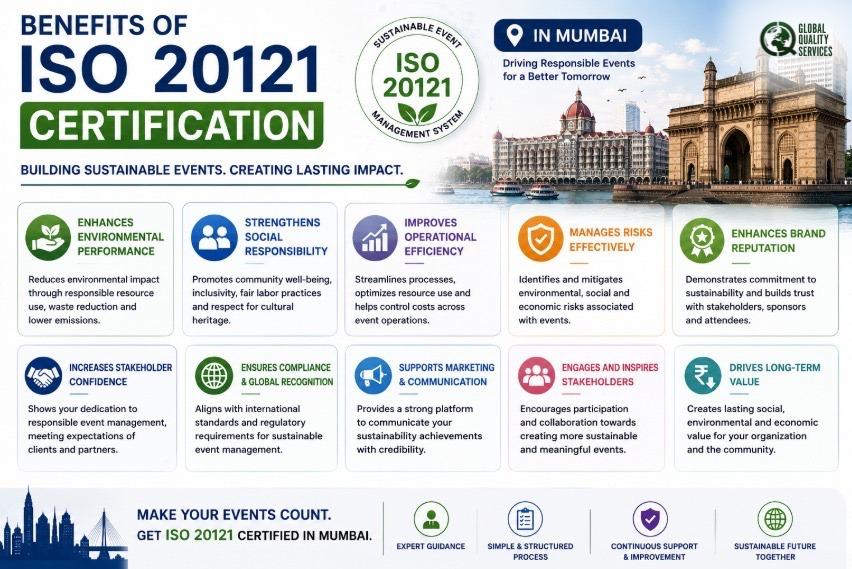
More Responsible Event Planning
Sustainability considerations are incorporated into event planning rather than being added at the last minute. This allows organisers to influence important decisions about suppliers, materials, venues and resources.
Better Control Over Suppliers
A structured approach makes it easier to communicate sustainability expectations to contractors and service providers and evaluate whether agreed requirements are being followed.
Reduced Resource Waste
Better planning can reduce unnecessary consumption of materials, energy, water, food and other resources.
Improved Stakeholder Relationships
Clients, sponsors, attendees, employees, suppliers and local communities may have different sustainability expectations. Identifying these expectations early can improve communication and event planning.
Greater Social Inclusion
Considering accessibility, inclusivity and people-related impacts can help organisations create events that are more welcoming and responsible.
Stronger Brand Reputation
For event businesses competing for corporate clients and large projects, having a structured sustainability management system can demonstrate that environmental and social considerations are being managed systematically.
Better Event Performance Data
Monitoring sustainability objectives gives organisations useful information about what worked and where improvements are required.
Continual Improvement
Each event can become an opportunity to improve the next one. Post-event reviews allow organisations to learn from actual performance rather than relying on assumptions.
Who Can Use ISO 20121 in Mumbai?
ISO 20121 can be useful for organisations involved in the design, planning, management or delivery of events, including:
- Event management companies
- Exhibition and trade-show organisers
- Corporate event agencies
- Conference and convention organisers
- Hotels and event venues
- Entertainment companies
- Media and production organisations
- Sports-event organisers
- Cultural organisations
- Wedding and social-event planners
- Catering businesses
- Event logistics providers
- Exhibition contractors
- Audio-visual service providers
- Companies organising internal corporate events
The standard is designed to accommodate organisations and events of different types and sizes.
Why Choose GQS for ISO 20121 Certification in Mumbai?
Global Quality Services provides consultancy and certification support for management system standards across various industries. The objective should be more than creating documents for an audit. A useful Event Sustainability Management System should help teams make better decisions about suppliers, resources, people and event impacts during actual operations.
Organisations considering other management systems can also explore GQS’s quality certification services to determine whether ISO 20121 can be integrated into a wider certification strategy.
Frequently Asked Questions
1. What is ISO 20121 Certification in Mumbai?
ISO 20121 certification relates to an Event Sustainability Management System based on ISO 20121:2024. It provides a structured approach to managing environmental, social and economic aspects of events.
2. Is ISO 20121:2024 suitable for large events?
Yes. ISO states that the standard applies to events of all types and sizes. It can therefore be used for smaller gatherings as well as large conferences, exhibitions, festivals and other major events.
3. Can hotels and venues in Mumbai implement ISO 20121?
Yes. Hotels, convention centres and other venues involved in hosting or supporting events can use ISO 20121 to establish processes around sustainability, suppliers, resource management, stakeholder requirements and event operations.
4. Is ISO 20121 mandatory in India?
No. ISO 20121 is a voluntary international standard. Organisations can choose an appropriate method of demonstrating conformity depending on their business objectives and stakeholder requirements. ISO 20121:2024 recognises self-declaration, supplier validation and third-party certification routes.
5. How long does ISO 20121 certification take?
There is no standard timeframe for every organisation. The duration depends on the scope, size and complexity of the organisation, existing processes, number of events covered and implementation readiness. A gap assessment can provide a more realistic estimate.