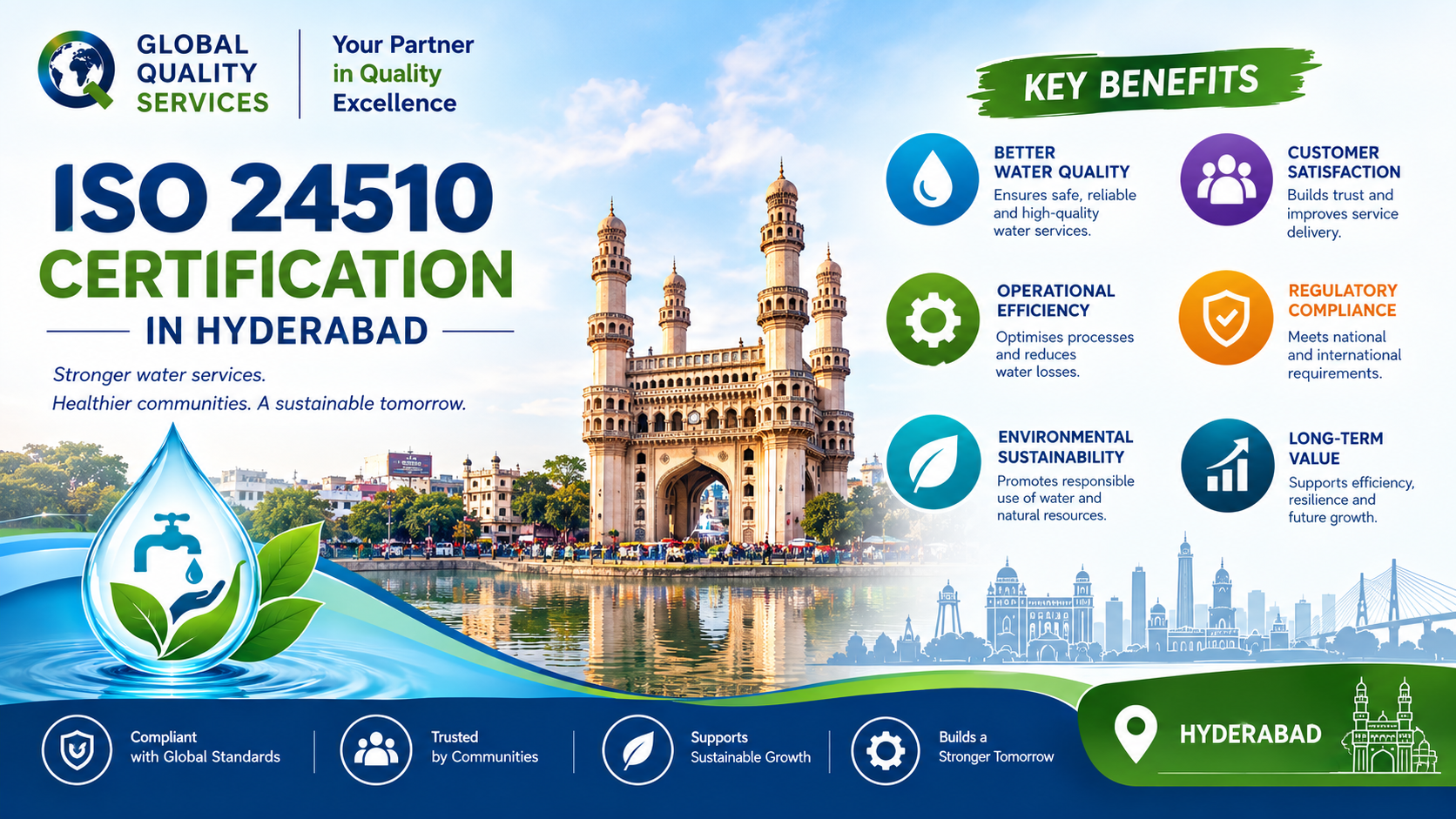
Is your organisation responsible for drinking water or wastewater services in Hyderabad? Are you looking for a structured way to understand user expectations, assess service quality, measure performance, and identify practical opportunities for improvement?
ISO 24510:2024 in Hyderabad provides internationally recognised guidance for assessing drinking water and wastewater services from the user’s perspective. It helps organisations look beyond infrastructure and technical operations to understand whether the service being delivered actually meets user needs and expectations.
Global Quality Services (GQS) supports water utilities, wastewater service providers, local authorities, infrastructure operators, industrial organisations, and other service stakeholders in Hyderabad with ISO 24510 assessment and implementation support. Our approach helps organisations translate the requirements of the standard into measurable service objectives, assessment criteria, performance indicators, user-focused processes, and continual improvement actions.
For organisations working within Hyderabad’s water and sanitation ecosystem, this approach can complement the service requirements and operational responsibilities of the Hyderabad Metropolitan Water Supply and Sewerage Board (HMWSSB) and broader urban water-management initiatives of the Ministry of Housing and Urban Affairs (MoHUA).
What Is ISO 24510:2024?
ISO 24510:2024 is an international standard titled Activities relating to drinking water and wastewater services — Guidelines for the assessment and for the improvement of the service to users. It provides guidance for understanding the elements of drinking water and wastewater services that matter to users, identifying their needs and expectations, and assessing whether those expectations are being met.
The standard covers areas such as:
- Understanding user needs and expectations
- Defining service characteristics
- Establishing service objectives
- Developing assessment criteria
- Introducing appropriate performance indicators
- Evaluating service performance
- Identifying opportunities for improvement
ISO 24510:2024 is developed by ISO/TC 224, the technical committee responsible for standards relating to drinking water, wastewater and stormwater systems and services. The wider family also includes ISO 24511:2024, which focuses on wastewater utility management and wastewater service assessment, and ISO 24512:2024, which addresses drinking water utility management and drinking water service assessment.
The standard is particularly useful because it shifts attention from simply asking “Are our systems operating?” to also asking “Are our services meeting the needs and expectations of the people who depend on them?”
Is ISO 24510 a Certifiable Standard?
This distinction is important for organisations searching for ISO 24510 Certification in Hyderabad.
ISO 24510:2024 is a guideline standard, not a certifiable management-system standard such as ISO 9001 or ISO 14001. Organisations can implement its guidance, assess conformity with relevant principles, measure service performance and demonstrate continual improvement. However, organisations should not present ISO 24510 as an accredited management system certification in the same manner as ISO 9001.
GQS therefore focuses on ISO 24510 assessment, implementation support, service performance evaluation, and continual improvement, helping organisations use the standard correctly and credibly.
Why Is ISO 24510 Important for Water and Wastewater Services in Hyderabad?
Hyderabad’s water and wastewater infrastructure serves a large and expanding urban population, industrial areas, commercial establishments and institutional users. Reliable supply, wastewater collection, treatment, customer response, service continuity and effective communication all influence how users experience a water service.
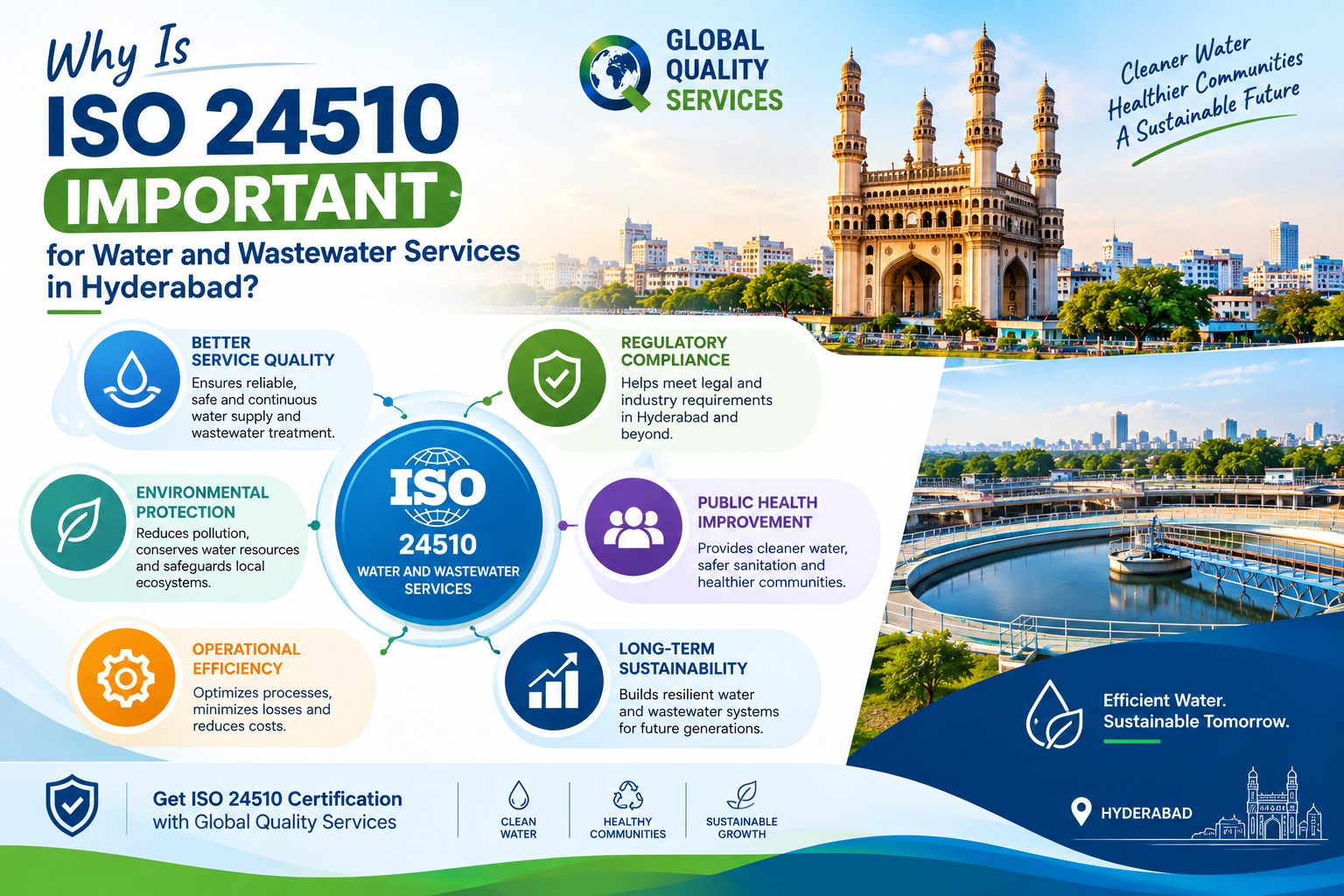
The HMWSSB is responsible for major water supply and sewerage functions across Hyderabad, making service quality and user expectations important considerations within the city’s wider water-management environment.
At the national level, the Ministry of Housing and Urban Affairs has identified water supply, sewerage, wastewater treatment, reuse and customer complaint redressal among important areas for assessing urban water and sanitation services. Its guidance on improving urban water supply and sanitation services includes indicators such as water-supply coverage, continuity, water quality, wastewater-network coverage, treatment adequacy and complaint-redressal efficiency.
ISO 24510 adds another important dimension: the user’s perspective.
Understanding What Users Actually Expect
Water services are not assessed only through engineering specifications. Users also care about reliability, communication, accessibility, responsiveness, service continuity and how quickly problems are addressed.
ISO 24510 helps organisations identify and document these expectations so that service objectives can be based on real user needs.
Turning Service Quality Into Measurable Performance
A service cannot be improved effectively if performance is not measured.
ISO 24510 introduces the use of assessment criteria and performance indicators that can help organisations monitor whether service objectives are being achieved. This can support more informed operational and management decisions.
Improving Customer and Stakeholder Confidence
Water and wastewater services involve multiple stakeholders, including consumers, businesses, regulators, local authorities, infrastructure operators and service contractors.
A structured assessment approach creates a clearer basis for communicating service objectives, performance results and improvement actions.
Supporting Continual Improvement
ISO 24510 encourages organisations to use assessment results to identify gaps and improvement opportunities rather than treating service evaluation as a one-time exercise.
The result is a more structured cycle of:
Understand → Assess → Measure → Improve → Review
Supporting Sustainable Water and Sanitation Objectives
ISO 24510:2024 is identified by ISO as contributing to Sustainable Development Goal 6 — Clean Water and Sanitation, while also supporting broader objectives related to health, sustainable communities and protection of water resources.
Who Can Benefit From ISO 24510 in Hyderabad?
ISO 24510 guidance can be applied by a wide range of organisations involved in drinking water and wastewater services.
Water Utilities and Service Providers
Utilities can use ISO 24510 to assess service characteristics, understand user expectations, establish performance indicators and identify service gaps.
Wastewater Service Organisations
Wastewater operators can use the framework to evaluate collection, treatment and service-related performance from the user’s perspective.
Municipal and Local Authorities
Authorities responsible for water and sanitation planning can use structured service indicators and assessment criteria to support monitoring and improvement.
Industrial Organisations
Large industrial facilities with internal water-supply, wastewater-treatment or utility operations can use ISO 24510 principles to assess service quality and stakeholder expectations.
Infrastructure and Utility Operators
Operators managing treatment plants, distribution networks, sewerage infrastructure and related services can use the framework to strengthen performance assessment.
Engineering and Environmental Service Providers
Consultants and contractors supporting water and wastewater projects can use ISO 24510 principles when developing service-performance frameworks, assessment models and improvement plans.
Key Elements of ISO 24510:2024
ISO 24510 provides a practical structure for understanding and evaluating water and wastewater services.
1. User Needs and Expectations
The process begins by identifying who uses or is affected by the service and understanding what those users expect.
This may include expectations relating to:
- Reliability
- Accessibility
- Continuity
- Communication
- Responsiveness
- Service quality
- Complaint handling
- Information availability
2. Service Characteristics
Organisations identify the characteristics that determine how users experience the service.
For a water service, this could include availability, continuity and communication. For wastewater services, relevant characteristics may include collection, treatment, service reliability and response to service issues.
3. Service Objectives
Once expectations are understood, organisations can establish measurable objectives that reflect user needs, organisational responsibilities and applicable requirements.
4. Assessment Criteria
Assessment criteria provide a consistent basis for determining whether service objectives are being achieved.
This allows organisations to move from general statements about service quality to structured evaluation.
5. Performance Indicators
Performance indicators help turn service objectives into measurable information.
Depending on the organisation, indicators may relate to service availability, complaints, response times, continuity, user satisfaction, wastewater service performance, or other relevant characteristics.
6. User Feedback and Communication
Performance data alone does not provide the complete picture. User feedback, complaints and stakeholder communication can reveal problems that technical measurements may not identify.
7. Continual Improvement
Assessment findings should lead to practical action. Organisations can prioritise gaps, assign responsibilities, establish timelines and review whether improvement actions have produced the expected results.
ISO 24510 Assessment and Implementation Process in Hyderabad
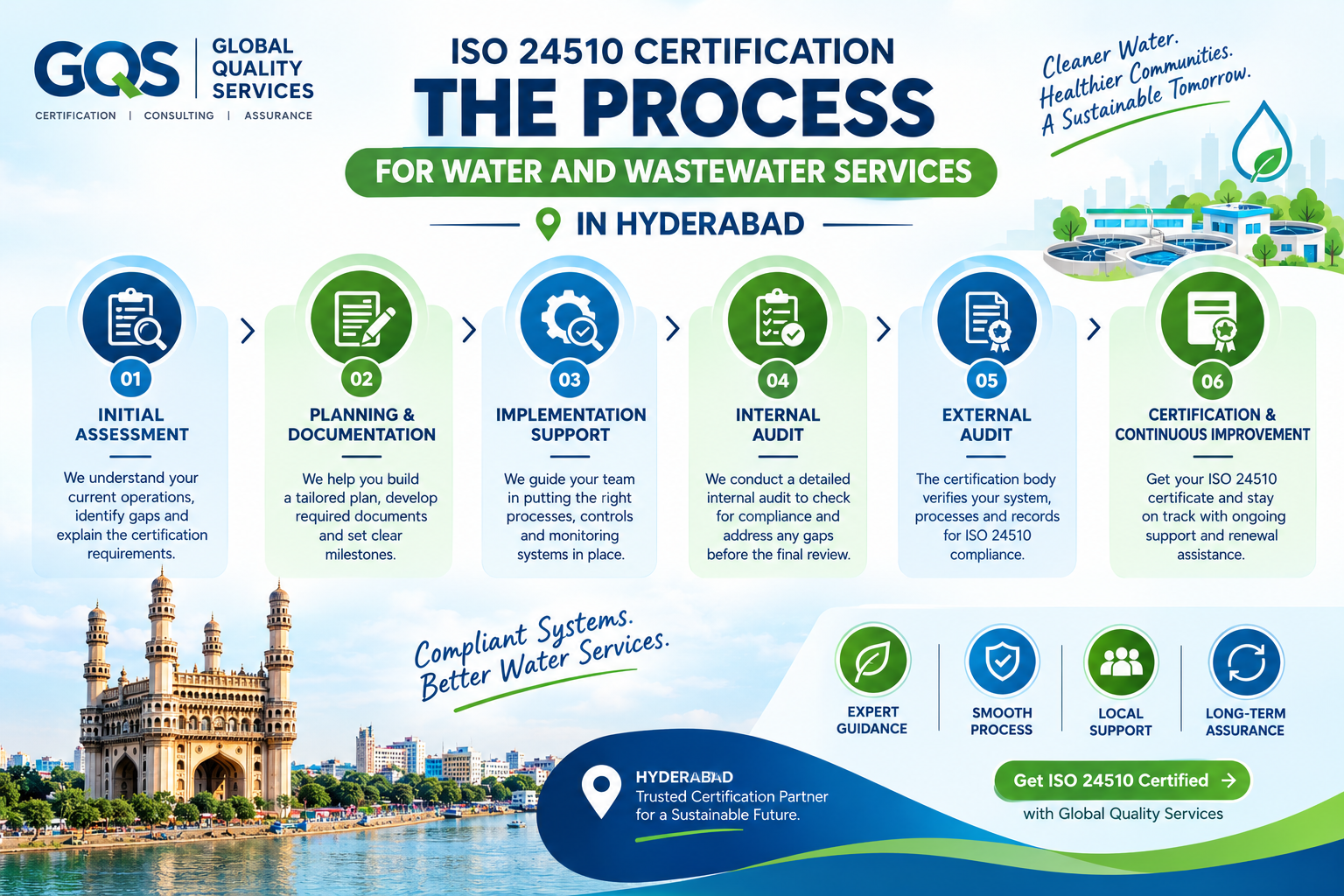
GQS takes a practical approach to implementing ISO 24510. The objective is not simply to produce documentation, but to help organisations establish a service-assessment framework for day-to-day operations.
Step 1 — Initial Service Assessment
We begin by understanding your existing drinking water or wastewater service model.
Our assessment considers:
- Service scope
- User groups
- Existing service objectives
- Performance measures
- User feedback
- Complaint-handling processes
- Existing documentation
- Operational and management practices
This provides a baseline for the implementation project.
Step 2 — Gap Analysis
We compare existing practices with the relevant guidance of ISO 24510:2024.
The assessment identifies where your organisation already meets the standard’s intent and where additional processes, measurements, or controls may be required.
Step 3 — Identify Users and Their Expectations
The next stage focuses on the people and organisations that receive or depend on the service.
We help identify relevant user groups and establish a structured approach for understanding their needs, expectations, concerns and priorities.
Step 4 — Define Service Characteristics and Objectives
Relevant service characteristics are identified and translated into practical service objectives.
Objectives should be realistic, measurable and aligned with the organisation’s responsibilities and service context.
Step 5 — Establish Assessment Criteria and Performance Indicators
GQS helps establish suitable criteria and indicators for monitoring service performance.
Rather than selecting generic indicators, focus on choosing measurements that provide useful information for your organisation’s specific service environment.
Step 6 — Develop Improvement Actions
Assessment results are converted into an improvement plan.
Actions may address areas such as:
- Service reliability
- User communication
- Complaint management
- Performance monitoring
- Data collection
- Service gaps
- Operational coordination
- Stakeholder engagement
Step 7 — Review and Continual Improvement
Performance information is reviewed periodically to determine whether objectives are being achieved and whether improvement actions are producing meaningful results.
This creates a continual improvement cycle rather than a one-time assessment.
Benefits of ISO 24510 Implementation in Hyderabad
A well-designed ISO 24510 framework can provide benefits beyond compliance or documentation.
Better Understanding of User Needs
Organisations gain a clearer understanding of what different users expect from drinking water and wastewater services.
More Meaningful Performance Measurement
Instead of collecting data simply because it is available, organisations can select indicators that directly support service objectives and decision-making.
Improved Service Consistency
Clearly defined objectives and assessment criteria can help different teams work towards consistent service expectations.
Stronger Complaint and Feedback Management
User feedback can be incorporated into service assessment rather than being treated as an isolated customer-service activity.
Better Management Decisions
Reliable performance information helps management identify recurring problems, prioritise resources and monitor whether improvement actions are working.
Stronger Stakeholder Communication
A structured assessment framework provides a clearer way to communicate service objectives and performance to users, authorities, partners and other stakeholders.
Support for Sustainable Water Management
ISO 24510 can complement broader urban water and sanitation initiatives by helping organisations link service performance to user needs and continual improvement.
Integration With Other Management Standards
Where an organisation already operates systems such as ISO 9001, ISO 14001 or ISO 24510 principles can be incorporated into the wider management framework rather than being treated as an isolated initiative.
ISO 24510 and Hyderabad’s Water-Sector Environment
ISO 24510 should not be viewed as a replacement for Indian legislation, municipal requirements, technical standards or regulatory obligations.
Instead, it can provide a service-assessment framework that works alongside existing requirements.
For organisations operating in Hyderabad, relevant government resources may include:
- Hyderabad Metropolitan Water Supply and Sewerage Board (HMWSSB) — information relating to Hyderabad’s water supply and sewerage services.
- Ministry of Housing and Urban Affairs (MoHUA) — national guidance and programmes relating to urban water supply, sewerage and sanitation.
- AMRUT 2.0 — Government of India’s urban water and sewerage infrastructure programme, including projects relating to water supply, sewerage, wastewater treatment and reuse.
- Ministry of Jal Shakti — central government information relating to water resources and water-sector initiatives.
These government resources can help organisations understand the broader regulatory, infrastructure and policy environment within which their water and wastewater services operate.
Why Choose GQS for ISO 24510 Support in Hyderabad?
Global Quality Services (GQS) takes a practical, service-focused approach to ISO 24510.
We do not treat the standard as a documentation exercise. Our work focuses on helping organisations understand who their users are, what those users expect, how service performance is measured, where gaps exist and how improvement can be demonstrated.
Our support can include:
- ISO 24510:2024 awareness and interpretation
- Initial service assessment
- Gap analysis
- User and stakeholder assessment
- Service-characteristic evaluation
- Service objective development
- Assessment criteria development
- Performance-indicator development
- Documentation support
- Improvement planning
- Performance review
- Continual improvement support
For organisations already using other management systems, we can also help identify opportunities to integrate ISO 24510 principles into existing quality, environmental, operational or sustainability processes.
Looking to improve drinking water or wastewater service performance in Hyderabad? Contact Global Quality Services to discuss your ISO 24510:2024 assessment and implementation requirements.
Frequently Asked Questions
1. What is ISO 24510:2024 in Hyderabad?
ISO 24510:2024 provides international guidance for assessing and improving drinking water and wastewater services from the user’s perspective. It helps organisations understand user needs and expectations, define service objectives, establish assessment criteria, use performance indicators and identify improvement opportunities.
2. Is ISO 24510:2024 a certifiable standard?
No. ISO 24510:2024 is a guideline standard and is not a certifiable management-system standard. Organisations can implement its guidance, conduct assessments and demonstrate conformity with relevant practices, but they should not claim accredited ISO 24510 certification in the same manner as ISO 9001 certification.
3. What is the difference between ISO 24510, ISO 24511 and ISO 24512?
The standards address different aspects of water and wastewater services.
ISO 24510:2024 focuses on assessing and improving services from the user’s perspective.
ISO 24511:2024 provides guidance on wastewater utility management and wastewater service assessment.
ISO 24512:2024 provides guidance on drinking water utility management and drinking water service assessment.
Organisations may use one or more of these standards depending on their activities and objectives.
4. What happened to ISO 24510:2007?
ISO 24510:2007 has been withdrawn and replaced by ISO 24510:2024. The 2024 edition was published in January 2024 and is the current edition of the standard.
5. Who can use ISO 24510 in Hyderabad?
Water utilities, wastewater service providers, municipal and local authorities, infrastructure operators, industrial organisations, engineering companies and other organisations involved in drinking water or wastewater services can use ISO 24510 guidance.
6. How can GQS help with ISO 24510 implementation?
GQS can support organisations through initial assessment, gap analysis, user and stakeholder assessment, service-objective development, performance-indicator development, documentation, improvement planning and continual improvement reviews based on ISO 24510:2024.
7. Can ISO 24510 be combined with ISO 9001 or ISO 14001?
Yes. ISO 24510 can complement existing management systems. Organisations can use its service-assessment and improvement principles alongside quality, environmental and other relevant management-system frameworks.
8. How long does ISO 24510 implementation take?
The timeframe depends on the size of the organisation, the complexity of its water or wastewater services, the number of users and stakeholders involved, existing performance-monitoring practices and the maturity of its current processes. A preliminary assessment can help establish a more realistic implementation plan.