
Ahmedabad continues to lead as a major industrial hub in 2026. However, rising production activity has pushed electricity demand to new heights. According to recent data, power demand in Gujarat reached a record 25,360 GWh in April 2025. For industrial facilities in Ahmedabad, this surge highlights the urgent need to optimize energy use to maintain profitability and competitiveness.
Managing high operational costs is no longer just about production volume but about how efficiently you use every unit of power. A professional energy audit helps identify these efficiency gaps and provides a clear path to reducing your monthly utility expenses.
Why Energy Audits Are Important for Industrial Buildings in Ahmedabad
In the current business landscape, energy audits are a strategic necessity for sustainable industrial operations. Here is why Ahmedabad’s factory owners and plant managers are prioritizing these assessments:
- Financial Savings: Energy is often the second-highest operating cost for industries. Audits pinpoint exactly where energy is being wasted—such as through old motors, air leaks, or inefficient heating systems—allowing you to redirect those lost funds into business growth.
- Legal Compliance: The Gujarat Energy Development Agency (GEDA) and the Bureau of Energy Efficiency (BEE) have updated their 2026 mandates. Regular audits ensure your facility stays compliant with the latest Energy Conservation Building Codes (ECBC) and avoids heavy non-compliance penalties.
- Operational Reliability: By identifying overloaded circuits or struggling machinery, audits act as a form of predictive maintenance. This prevents unexpected equipment failures and costly production downtime.
- ESG and Carbon Goals: With the global shift toward green manufacturing, an energy audit helps your firm document a lower carbon footprint, making you a preferred partner for international supply chains.
Our Energy Audit Services for Industrial Facilities
We provide a comprehensive technical assessment of your entire plant. Our engineers use advanced diagnostic tools to identify specific areas where energy is being wasted and where performance can be improved.
- Electrical System and Power Quality Assessment: A significant portion of energy loss occurs within the electrical distribution network. We analyze your systems to ensure you are not paying for reactive energy.
- Thermal Energy and Process Heating Audits: For industries in Ahmedabad that rely on steam or heat, thermal efficiency is the biggest driver of fuel costs. Our audit focuses on the heart of your utility system.
- Compressed Air System Optimization: Compressed air is often the most expensive utility in a factory. Most systems have significant hidden leaks that drain profits every hour.
- HVAC and Industrial Cooling Systems: Given the high temperatures in Ahmedabad, cooling systems often work overtime. We ensure these systems are not over-consuming energy.
- Water and Pumping System Efficiency: Pumps are often overlooked, but can account for a large percentage of industrial power use.
Industries We Serve Across Ahmedabad
Our experience spans the diverse industrial landscape of Ahmedabad. We tailor our audits to the specific technical requirements of different sectors and their respective GIDC zones.
- Pharmaceuticals and Chemicals (Vatva & Odhav): These facilities require strict temperature and humidity controls. We focus on optimizing refrigeration plants and cleanroom air handling units to meet safety standards while using minimal power.
- Textiles and Process Houses (Naroda): With heavy reliance on steam and high-duty motors, our audits for textile units focus on thermal efficiency and motor loading to reduce the high energy intensity of these processes.
- Engineering and Automotive (Sanand): For Sanand’s advanced manufacturing plants, we specialize in optimizing compressed air systems and automated production lines to ensure precision without energy waste.
Our Industrial Energy Audit Process
We follow a systematic approach that focuses on data accuracy and minimal disruption to your manufacturing schedule.
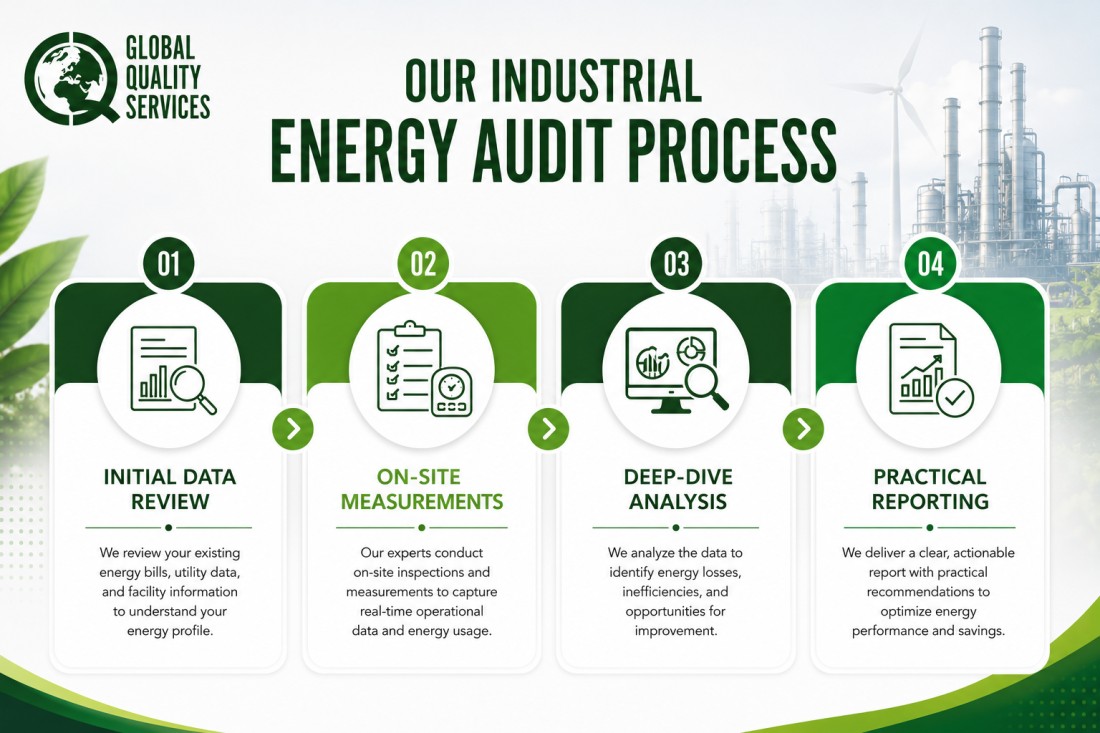
- Step 1: Initial Data Review: We analyze your last 12 months of electricity and fuel bills to understand consumption patterns and identify obvious anomalies.
- Step 2: On-Site Measurements: Our engineers visit your Ahmedabad facility with portable meters, thermal cameras, and ultrasonic leak detectors to gather real-time performance data from your machines.
- Step 3: Deep-Dive Analysis: We compare your data against 2026 industry benchmarks to identify specific areas of underperformance.
- Step 4: Practical Reporting: You receive a structured report with prioritized recommendations. Each point includes the expected investment cost and a clear payback period calculation.
Why Choose Global Quality Services for Industrial Energy Audits in Ahmedabad
Working with a certified partner ensures that your audit results are accurate, actionable, and legally recognized.
- Accredited Auditors: Our team consists of Bureau of Energy Efficiency-certified experts who understand the rigorous standards required for industrial compliance.
- Local GEDA Expertise: We stay updated on Gujarat-specific energy regulations and subsidy schemes, helping you navigate the local administrative landscape easily.
- No-Downtime Audits: We use non-invasive tools to measure your equipment performance while your plant is fully operational.
- Result-Oriented Approach: We do not just hand over a report. We provide a roadmap that focuses on high-ROI changes that pay for themselves quickly.
Transform Your Energy Usage into a Competitive Advantage
Stop paying for energy you don’t use. Partner with Global Quality Services to conduct a professional audit that uncovers hidden savings and streamlines your operations. Our Ahmedabad-based team is ready to help you reduce your carbon footprint while significantly lowering your overhead costs.
Frequently Asked Questions
1. Will an energy audit cause any production delays?
No. Our team uses non-contact measurement tools to gather data while your machinery is running. We coordinate closely with your plant managers to ensure our presence never interferes with your production schedule.
2. What is the difference between a walk-through audit and a detailed audit?
A walk-through audit is a quick visual inspection to identify obvious waste. A detailed audit involves using precision instruments to measure actual power consumption and thermal loss, providing the data needed for significant capital investments.
3. Can an energy audit help if we are planning to install solar power?
Yes. Before installing solar, it is essential to optimize your current consumption. Reducing your overall load through an audit allows you to install a smaller, more cost-effective solar system that perfectly matches your efficient needs.
4. Which industrial equipment typically has the most energy-saving potential?
In most Ahmedabad plants, air compressors and pumping systems offer the quickest returns. However, in process-heavy industries, waste heat recovery from boilers and furnaces often provides the largest long-term savings.
5. How long does it take to receive the final audit report?
A standard field visit usually takes 2 to 4 days, depending on the size of the building. We then provide the detailed analysis and finalized report within 10 to 14 business days.