
From electronics and IT to automobiles and manufacturing, Chennai has a prominent footprint. As such, the question of how companies should responsibly recycle and reuse electronic products becomes more pertinent than ever. According to the Tamil Nadu Government Budget 2025-26, the state is responsible for 33% of India’s electronics exports. In 2023-24, electronics exports were valued at $9.56 billion. Additionally, the government will set up a Semiconductor Fabless Lab in Chennai as part of the Tamil Nadu Semiconductor Mission 2030.
Chennai-based electronics recyclers, refurbishers, ITAD firms, and any other organizations dealing with electronic devices will benefit greatly from adopting R2v3 Certification in their operations. Such certification gives a systematic approach towards ensuring safe, responsible, and secure electronics recycling, data destruction, worker protection, environmental compliance, and resource conservation. For the organization involved, adopting proper R2v3 Certifications will improve transparency and control of processes throughout the lifecycle of electronics.
What is R2v3 Certification and What It Covers
R2v3 certification is a responsible recycling practice standard applicable to organizations involved in collecting, refurbishing, repairing, processing, and recycling end-of-life electronics. Within Chennai, R2v3 certification applies to electronics recyclers, ITADs, refurbishers, and organizations that manage significant amounts of electronic equipment.The standard addresses practices surrounding the lifecycle of electronic products from collection through to processing. Some key components covered by the standard include:
- Data Security: Safe treatment, disposition, and sanitization of information storage media.
- Environmental Protection: Measures to prevent contamination and correct disposal of e-waste.
- Worker Health & Safety: Workplace safety standards for those working with electronics.
- Regulatory Compliance: Adherence to environmental regulations, OSHA laws, and others.
- Reuse and Recovery: Preferential reuse, repair, refurbishment, and recycling when feasible.
- Downstream Management: Vendor monitoring and downstream accountability for proper handling of materials.
Similar businesses can also explore R2v3 Certification in Delhi for their local certification requirements.
Why R2v3 Matters for ITAD Facilities and Electronics Recyclers in Chennai
R2v3 is voluntary, but for refurbishers, ITAD (IT Asset Disposition) companies, and recyclers in Chennai, it offers a powerful competitive advantage.
Increasingly, clients from large corporations to public institutions prefer partners who adhere to rigorous, globally recognized practices for the ethical, secure, and environmentally responsible processing of electronics. Companies can also follow other standards, such as ISO 22301 and ISO 27001, for even better coverage.
Here is what R2v3 certification brings to the table:
- Data protection: Secure handling, traceable sanitization of devices, and maintained chain-of-custody.
Environmental stewardship: Safe dismantling and recovery of hazardous materials, minimizing environmental harm. - Downstream accountability: Full traceability of components, even when they leave your facility.
- Worker safety: Standard operating procedures (SOPs), risk assessments, and worker training.
Who Requires R2v3 Certification in Chennai?
R2v3 certification is highly relevant for organizations in Chennai that deal with used electronics, especially those containing data. This includes:
- E-waste recyclers and refurbishers
- ITAD firms (which handle corporate or institutional device retirements)
- Data-destruction or data-sanitization providers
- Electronics repair and resale businesses
- Reverse logistics and collection centres
- Dismantling and disassembly facilities
If your operations involve handling end-of-life devices, especially devices that store sensitive data, then R2v3 is extremely relevant and beneficial.
A Clear Breakdown of the R2v3 Core Principles
R2v3 is built on seven core principles, which provide a structured framework for responsible electronics processing. These principles help organizations in Chennai establish transparent, secure, and sustainable operations:
- Data security: Secure handling, erasure or destruction, and detailed record-keeping.
- Environmental care: Properly manage hazardous materials and ensure safe recycling and recovery.
- Worker health & safety: Risk assessments, training, documented SOPs, and regular audits.
- Legal compliance: Adherence to all relevant laws, including e-waste rules in India / Tamil Nadu.
- Quality systems: Robust documented procedures, continuous improvement, and control systems.
- Reuse & recovery: Maximize device reuse and efficiently recover materials from end-of-life electronics.
- Transparent chain of custody: End-to-end traceability, including downstream partners.
Step-by-Step Process of R2v3 Certification in Chennai
Here is a practical, step-by-step guide for Chennai-based firms, recyclers, ITAD companies, and refurbishment units to obtain R2v3 certification:
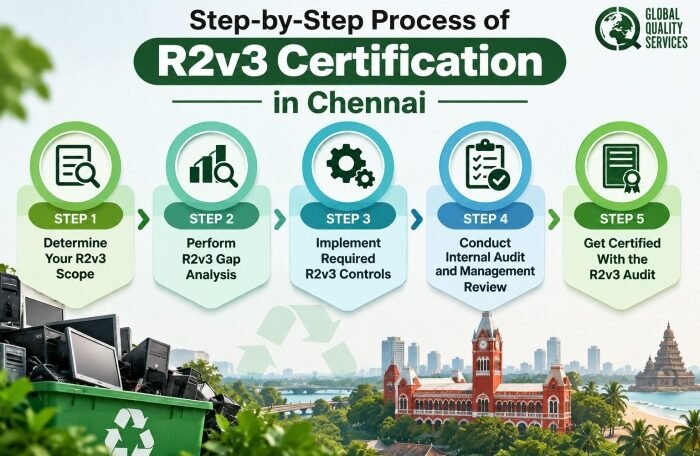
Step 1: Determine Your R2v3 Scope
Determine which Chennai facility, activities, equipment, and electronic materials fall under your scope of certification. For example, will you handle collections, repairs, refurbishments, data destruction, recycling, and reselling?
Step 2: Perform R2v3 Gap Analysis
Assess where your current processes align and fall short of meeting the R2v3 requirements. Gaps may exist in many different categories, such as data sanitization, environmental controls, worker safety, downstream vendors, tracking materials, and regulatory compliance.
Step 3: Implement Required R2v3 Controls
Implement the necessary controls based on your gap analysis. It may involve documenting protocols related to data wiping, testing equipment, emergency plans, employee training, environmental protection, and material tracking throughout the recycling process.
Step 4: Conduct Internal Audit and Management Review
Prior to the certification audit, perform an internal audit to verify if the R2v3 controls are functioning properly within the Chennai site. Make corrections to any nonconformities and complete a management review of the management system.
Step 5: Get Certified With the R2v3 Audit
Your organization will undergo an evaluation by a certified auditing organization of your operations relative to R2v3 compliance. Should all controls be properly executed and all issues corrected during this process, then certification is achievable.
Benefits of R2v3 Certification for Chennai Businesses
For Chennai-based electronics service organizations, R2v3 certification delivers multiple, valuable advantages:
- Enhanced data security & risk reduction: Shows you handle data-bearing devices securely, minimizing data breach risks.
- Trust & business growth: Builds credibility with corporate clients, OEMs, and government agencies.
- Regulatory alignment: Supports alignment with Indian e-waste regulations and other environmental / safety standards, such as ISO 14001 and ISO 45001.
- Market differentiation: Sets you apart in a city where informal recycling remains widespread.
- Sustainable branding: Demonstrates commitment to environmental responsibility, helpful for ESG-conscious clients.
Cost and Timeline for R2v3 Certification in Chennai
Understanding the cost and timeline helps Chennai-based organizations plan realistically for certification.
Factors influencing cost:
- Scale of operations (facility size, shifts)
- Scope (collection, refurbishment, downstream vendor oversight, data destruction)
- Maturity of existing systems (how much process documentation you already have)
- Need for external consultant support / pre-audit services
Typical Timeline:
- Most organisations in Chennai can complete certification in 3–6 months.
- This covers readiness assessment, implementation, audit, corrective actions, and certification.
- More mature or smaller operations may finish more quickly if they already have many processes in place.
Why Partner with a Local Certification Consultant in Chennai
Working with a certified consultant in Chennai can make implementing R2v3 simpler and easier. A local consultant will guide you through meeting R2v3 compliance standards while ensuring that you meet compliance within Tamil Nadu’s regulatory framework.
- Regulatory insight into the region: Gain knowledge of what the Tamil Nadu Pollution Control Board requires, any applicable e-waste laws, and other considerations when working in the region.
- Certification strategy based on needs: Create a plan for meeting R2v3 certification based on your plant’s size, activities, equipment, current processes, and level of certification desired.
- Implementation of certification: Receive hands-on assistance in developing policies, SOPs, document control, training employees, conducting internal audits, and getting ready for certification audits.
- Improved audit readiness: Find problem areas early on to prevent non-conformances during your certification audit, which could slow down certification unnecessarily.
- Expertise: Global Quality Services has over 26 years of experience and is an established certification consultant that helps organizations comprehend and implement certification.
Businesses operating in other major technology and industrial hubs can also seek R2v3 Certification in Hyderabad with location-specific implementation support.
Get R2v3 Certification Support Across Chennai
Getting R2v3 Certification in Chennai becomes easier when you have the right support at each stage. Global Quality Services helps electronics recyclers, refurbishers, IT asset management companies, and other businesses prepare for R2v3 certification across Guindy, Ambattur, Sriperumbudur, Oragadam, Sholinganallur, Perungudi, Taramani, Manali, Ennore, Poonamallee, Porur, Tambaram, and Maraimalai Nagar, along with other key areas in and around Chennai.
With 26 years of experience as a reputed certification consultant, our team provides practical support for gap assessment, R2v3 documentation, implementation, employee training, internal audits, and certification audit preparation. Build a well-organized R2v3 system and move toward certification with clear, hands-on guidance. Contact our team today to start your certification journey.
Frequently Asked Questions
1. Is R2v3 certification mandatory in Chennai?
No, R2v3 certification is voluntary in Chennai. Businesses adopt it to strengthen credibility, enhance data security, meet client expectations, and differentiate themselves in the competitive electronics recycling and ITAD sector.
2. Who can apply for R2v3?
Any Chennai-based organization handling used electronics, such as recyclers, refurbishers, ITAD firms, dismantlers, or data destruction providers, can apply, provided they follow the required controls for safety, security, and compliance.
3. How long does R2v3 certification remain valid?
The R2v3 certificate remains valid for three years. During this period, certified organizations must complete yearly surveillance audits to demonstrate ongoing compliance, system improvements, and proper operational maintenance.
4. Has R2v3 changed recently?
Yes, R2v3 introduces stricter requirements for data protection, downstream vendor oversight, traceability, environmental controls, and overall process maturity, ensuring higher safety, transparency, and global alignment for electronics processing facilities.
5. How can someone verify a firm’s R2v3 status in Chennai?
You can verify certification through SERI’s official online directory, which lists certified facilities, their scope, audit history, and certification validity, helping users choose responsible and compliant recycling partners with confidence.