Bangalore has become one of the most competitive technology ecosystems in India, with IT services, software development, SaaS, and startup companies constantly working to meet global delivery standards.
In such an environment, organizations are not only evaluated on technical capability but also on how well they manage quality, timelines, and project risks. This is where CMMI V2.0 certification plays an important role.
According to NITI Aayog, India’s technology sector accounts for 7-7.5% of national GDP and continues to grow, driven by international outsourcing demand. As a globally recognized process improvement framework, it helps companies build structured and reliable delivery systems that strengthen client confidence and support long-term growth.
Many businesses in Bangalore now pursue CMMI certification to improve operational maturity, qualify for enterprise projects, and stand out in an increasingly demanding global market. To understand its real impact, it is important to first examine what CMMI V2.0 means and how it differs from earlier versions.
What is CMMI V2.0 and How is it Different from Older Versions
CMMI stands for Capability Maturity Model Integration. This certification is a globally recognized framework that helps organizations improve the way they plan, execute, and manage projects. Version 2.0 focuses more on measurable performance outcomes than on extensive documentation.
Key differences between V2.0 and earlier versions:
- Strong focus on measurable performance results
- Simplified model structure for easier adoption
- Better alignment with Agile and modern development practices
- Integrated approach across development, services, and suppliers
- Digital platform support for appraisals and training
The 5 CMMI V2.0 Maturity Levels Explained
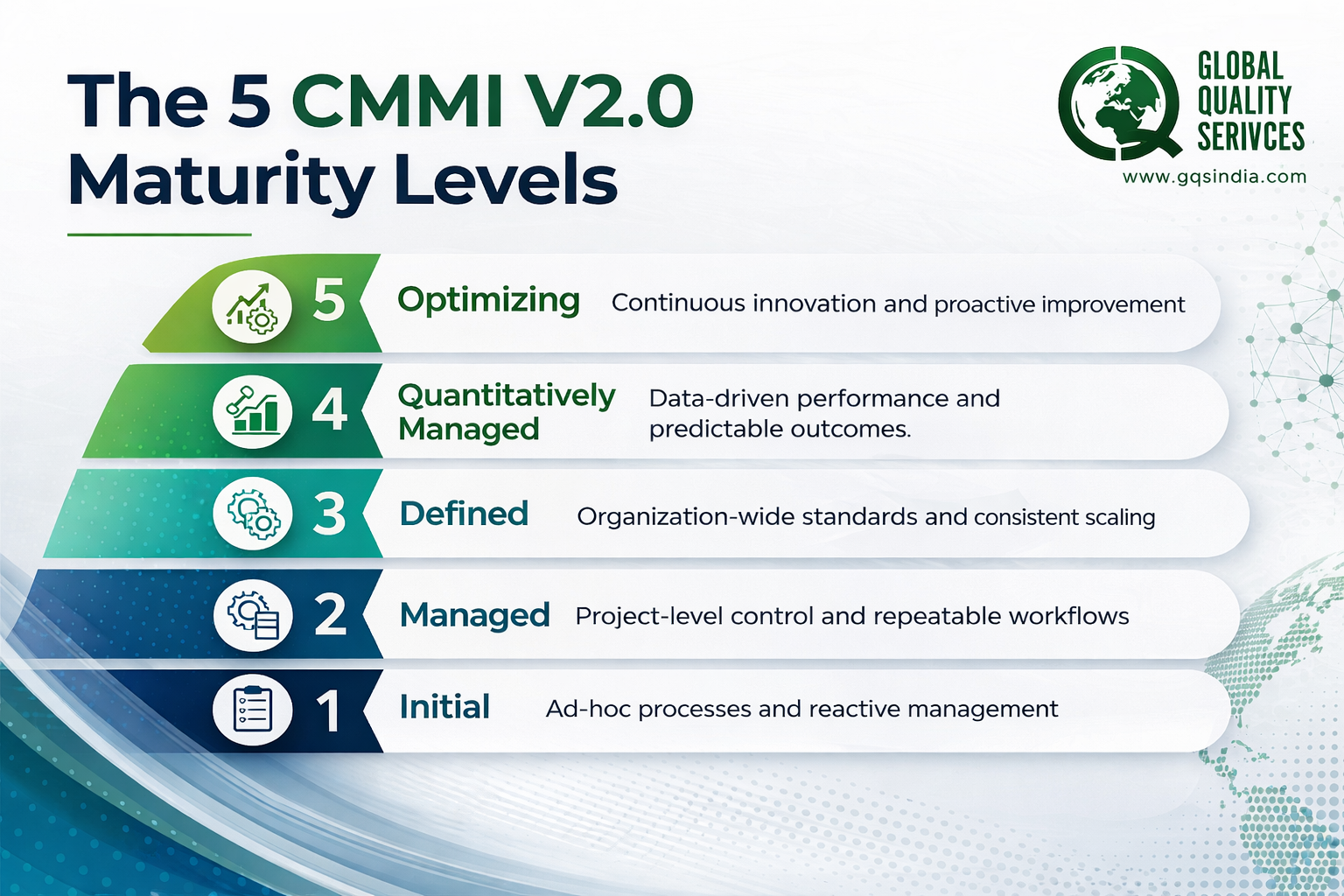
CMMI maturity levels show how structured and predictable an organization’s processes are. Each level reflects a stage of operational discipline and performance improvement. Companies choose levels based on business goals, client expectations, and growth plans.
Level 1 Initial
Processes are mostly informal and depend on individual effort. Outcomes may vary across projects because there is limited standardization or performance measurement.
Level 2 Managed
Organizations establish basic project management practices. Teams begin to follow defined workflows for planning, tracking, and quality control, which improves delivery consistency.
Level 3 Defined
Processes become standardized across the organization. This level helps companies create uniform delivery frameworks that support predictable performance and easier scaling.
Level 4 Quantitatively Managed
Organizations start using data-driven performance metrics to control project outcomes. Decision-making becomes more analytical, and risk management improves significantly.
Level 5 Optimizing
Continuous improvement becomes part of the organizational culture. Companies focus on innovation, efficiency, and proactive process enhancement to maintain long-term competitive advantage.
Why CMMI Certification Matters For Businesses and Startups in Bangalore
Organizations today compete in global technology markets where buyers expect consistent quality and predictable delivery. CMMI V2.0 Certification helps companies demonstrate structured operational discipline and long-term reliability.
Builds stronger confidence during client selection
Global buyers often evaluate vendors based on maturity frameworks before entering long-term engagements. Certification helps organizations show consistent delivery capability, reducing perceived risk for clients who rely on external partners for critical technology projects.
Supports Sustainable Operational Growth
As companies expand, informal processes create inefficiencies and communication gaps. Structured maturity models help standardize execution practices, enabling smoother coordination across teams and departments while maintaining delivery quality.
Improves Project Predictability and Risk Control
Organizations adopting maturity frameworks gain better visibility into project performance metrics. This helps leadership identify potential delivery risks early and implement corrective actions before they impact client relationships.
Strengthens Positioning in Competitive Outsourcing Markets
In outsourcing-driven ecosystems like Bangalore, certification often differentiates vendors with similar technical capabilities. Clients prefer partners who demonstrate structured governance and performance measurement practices.
Which Companies Actually Need CMMI Certification
Not every organization requires certification at the same stage. The decision depends on growth plans, client profile, and operational complexity.
Companies that benefit most
- IT service providers handling global projects
- Software development companies working with enterprise clients
- Product companies planning international expansion
- Engineering and embedded technology firms
- Government project vendors
Startups that focus on rapid experimentation may not need certification immediately. However, as they scale and target larger clients, structured processes become necessary.
How to Choose the Right CMMI Maturity Level for Your Business
Selecting the appropriate maturity level requires a balanced understanding of business objectives, operational readiness, and market expectations. The selection of the appropriate maturity level can strengthen internal processes without adding unnecessary complexity or burdening resources. Here is how to choose the right CMMI maturity level for your business:
Align the Maturity Level with the Business Growth Stage
Early-stage organizations usually benefit from focusing on foundational process control rather than advanced optimization. As operational scale increases, higher maturity levels help introduce performance measurement and continuous improvement mechanisms.
Evaluate Client Expectations and Industry Benchmarks
Certain sectors expect vendors to demonstrate specific maturity levels to qualify for projects. Understanding market expectations helps organizations set realistic certification targets aligned with business development goals.
Consider Internal Readiness and Change Capacity
Certification requires organizational commitment across leadership, project teams, and support functions. Selecting a maturity level that matches internal change capacity ensures smoother adoption and reduces resistance during implementation.
Balance Long-Term Value with Implementation Effort
Higher maturity levels require deeper performance tracking and governance structures. Organizations should assess whether expected business benefits justify the additional investment and operational adjustments.
Step-by-Step Journey to Achieve CMMI V2.0 Certification
Organizations typically follow a structured journey from readiness assessment to final appraisal.
- Initial gap analysis: Consultants evaluate existing processes and identify improvement areas based on maturity requirements.
- Process design and implementation: Organizations define standardized workflows and train teams on consistent execution methods.
- Performance validation: Pilot projects help test new processes and measure operational improvement.
- Final appraisal: Authorized lead appraisers conduct a formal evaluation to determine the maturity level achievement.
How Long Does CMMI Certification Take in Real Business Conditions
Certification timelines vary depending on organizational readiness and resource availability.
- Small organizations: Preparation may take six to nine months if leadership involvement remains strong.
- Medium and large enterprises: Complex project portfolios and distributed teams often extend preparation timelines to twelve or eighteen months.
- Factors affecting duration: Team adoption speed, documentation readiness, and appraisal scheduling significantly influence completion timelines.
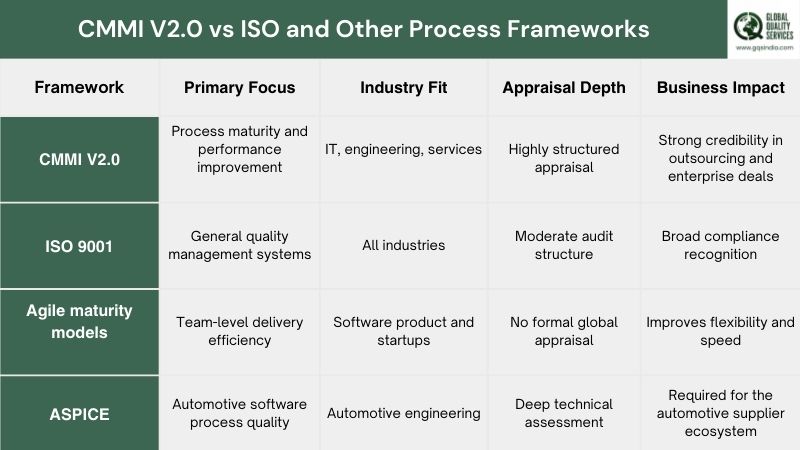
CMMI V2.0 vs ISO and Other Process Frameworks: Which One Is Better
Different frameworks serve different business objectives. Understanding practical differences helps leaders choose the right path:
How to Select the Right CMMI Consultant in Bangalore
Choosing the right consulting partner significantly affects certification success, implementation experience, and long-term value realization.
Important evaluation factors:
- Industry experience relevance: Consultants should demonstrate prior implementation experience in similar domains such as IT services, product engineering, or embedded systems. Domain familiarity improves practical guidance during process transformation.
- Verified certification expertise: Organizations should confirm consultant credentials, appraisal participation history, and maturity level project experience to avoid theoretical or incomplete implementation approaches.
- End-to-end service capability: Strong consulting partners support gap analysis, implementation planning, training, performance monitoring, and appraisal readiness rather than offering fragmented advisory services.
- Reputation and client references: Reviewing client testimonials, case experience, and long-term engagement history helps assess credibility and delivery reliability.
- Practical implementation methodology: Consultants should focus on realistic timelines and business-aligned process adoption instead of documentation-heavy approaches that burden internal teams.
- Post certification support: Sustaining maturity after appraisal requires ongoing monitoring and guidance. Partners who provide continuous improvement support create stronger long-term value.
Start Your CMMI Certification Journey with Global Quality Services
CMMI certification is not just about achieving a maturity level. It is about building systems that support long-term operational stability, predictable delivery, and scalable growth. Organizations that approach certification strategically often see improvements in client confidence, project performance, and internal efficiency.
In Bangalore’s competitive market, process maturity strengthens client trust and business opportunities. With expert guidance and a strong presence across major Indian cities, Global Quality Services supports organizations in achieving CMMI Level 2, Level 3, and Level 5 certification through a structured, results-focused approach.
Frequently Asked Questions
- Can startups apply for CMMI certification?
Yes, startups can pursue certification when they begin scaling operations or targeting enterprise clients. Early adoption helps build structured delivery systems, but timing should align with business maturity and resource readiness.
- How often does CMMI appraisal renewal happen?
CMMI appraisal results generally remain valid for three years. Organizations must maintain process discipline and performance monitoring during this period to prepare effectively for future reappraisal cycles.
- Does CMMI certification guarantee more client projects?
Certification improves shortlist probability, not deal closure. However, project acquisition still depends on technical capability, pricing strategy, market positioning, and relationship management efforts.
- Can Agile teams follow CMMI practices?
Yes. CMMI V2.0 supports Agile and hybrid delivery models. Organizations can maintain flexibility in development while demonstrating structured performance measurement and process maturity during formal appraisal assessments.
- Is CMMI certification mandatory for software companies in India?
No, CMMI certification is not legally mandatory. However, many enterprise clients, global outsourcing buyers, and government projects prefer or require certified vendors to ensure consistent delivery standards and structured quality management practices.