The business landscape in Delhi NCR has transformed into a global powerhouse for IT services and manufacturing. As organizations in Noida, Gurgaon, and Delhi compete for international contracts and Government of India (GoI) tenders, standardized excellence is now a baseline requirement. While many still search for V2.0, the CMMI Institute has officially transitioned to Version 3.0. This update addresses modern needs, including cybersecurity, data management, and remote work.
According to the 2024 CMMI Technical Report by ISACA, organizations implementing these models reported an average 24% improvement in overall productivity and a 31% reduction in defect density. These figures prove that process maturity is a powerful driver of profitability.
This guide provides a roadmap for Delhi-based firms to achieve appraisal status efficiently. By aligning with these global standards, your organization ensures it is prepared to deliver high-value defence and tech projects.
What is CMMI V2.0 Certification?
CMMI V2.0 is a global process improvement model that helps organizations improve performance, quality, and project control. The certification focuses on measurable results rather than only documentation and supports agile methods and modern business needs. It guides companies in building structured systems that reduce dependence on individuals. By following CMMI practices, businesses create predictable delivery, better planning, and stronger customer confidence across projects.
Why CMMI V2.0 Matters For Businesses in Delhi
Today, businesses face tighter deadlines, global competition, and higher client expectations. Companies cannot rely on informal ways of working anymore. This is why CMMI has become more relevant now than ever for stable and predictable growth:
- Agile Integration: Modern CMMI versions work seamlessly with Scrum and Kanban frameworks. This allows Gurgaon tech startups to maintain high speed without sacrificing the rigorous quality standards required by large global clients or complex government contracts.
- Data-Driven Decisions: The framework mandates performance benchmarking across the board. Instead of guessing efficiency, Delhi firms use hard metrics to prove process effectiveness. This leads to more accurate project bidding and highly optimized resource allocation strategies.
- Security and Privacy: With new Indian DPDP laws, CMMI now includes specific domains for data security. This helps local SaaS companies prove they handle sensitive client information with world-class protection and meet strict international regulatory requirements.
- Supply Chain Resilience: For NCR manufacturers, CMMI improves vendor management and procurement cycles. It ensures that localized disruptions do not lead to total project failure through better risk planning and more transparent communication across the entire supply chain.
Key Business Benefits of CMMI V2.0 Certification
Beyond certification value, businesses must understand how CMMI V2.0 directly impacts performance, growth, and credibility. The following benefits explain why structured process maturity delivers measurable business advantages:
Winning Tenders
Many government, defence, and large-enterprise tenders require a minimum CMMI maturity level before shortlisting vendors. Certification improves technical evaluation scores and builds trust in execution capability. This increases eligibility for high-value contracts and opens new revenue channels for growing organizations.
Stronger Global Client Trust
Global clients prefer vendors who follow structured and repeatable delivery systems. CMMI certification signals strong governance, quality control, and predictable outcomes. This reduces perceived project risk, improves confidence during vendor selection, and helps close international deals faster with stronger long-term partnerships.
Improved Profit Margins
Clearly defined processes reduce project uncertainty and prevent avoidable mistakes. Teams spend less time on corrections and crisis handling. This improves schedule discipline, controls operational spending, and increases profitability across projects by reducing rework, waste, and unplanned resource utilization.
Consistent Service and Product Quality
Standard operating practices help teams maintain uniform quality across all projects. Delivery does not depend on individual working styles. This consistency strengthens the customer experience, reduces complaints, increases repeat business, and supports brand positioning as a reliable and professional service provider.
Improved Operational Efficiency
CMMI encourages performance tracking through measurable indicators and process monitoring. Leaders gain clarity on operational gaps and areas for improvement. This helps optimize resource allocation, eliminate inefficiencies, and build a more productive execution environment that supports faster, more predictable delivery outcomes.
Employee Retention
Defined workflows and role clarity reduce confusion in daily operations. Employees better understand their responsibilities, expectations, and escalation paths. This structured environment lowers stress, improves accountability, and builds a stable work culture that supports higher employee satisfaction and long-term retention.
Strong Risk and Compliance Management
CMMI strengthens control mechanisms related to documentation, reviews, and monitoring. Organizations become better prepared to manage operational, security, and regulatory risks. This is important for industries handling sensitive data, where compliance readiness directly impacts client trust and market credibility.
Scalable Business Growth
Organizations with mature, repeatable processes can expand operations without losing control of execution. Standard systems efficiently support the onboarding of new teams, clients, and projects. This structured growth approach reduces expansion risks and enables sustainable scaling into larger and more competitive markets.
Common Challenges Companies Face During the CMMI Journey
While CMMI brings strong business value, the journey is not always smooth. Here are some common challenges companies face during implementation that can affect timelines and overall certification success:
- Cultural Resistance: Teams often view new processes as unnecessary bureaucracy or a lack of trust. Overcoming this requires leadership to demonstrate that standardized workflows actually reduce daily stress and eliminate the need for constant, exhausting firefighting.
- Documentation Overload: Many firms mistakenly create excessive paperwork that nobody actually reads. The challenge lies in finding a lean balance where you provide enough evidence for auditors without slowing down the actual creative and technical development work.
- Misinterpreting the Model: Without expert guidance, companies may apply practices that do not fit their specific business size. This results in a clunky system that feels forced and expensive rather than being a helpful catalyst for organizational growth.
- Evidence Collection Gaps: Firms often realize too late that they lack the artifacts or proof of process execution. Consistent habits must be formed early to ensure a smooth final appraisal without a frantic last-minute scramble for documentation.
Which Companies in Delhi Should Consider CMMI V2.0?
Delhi serves as a diverse economic engine where process maturity is vital for several sectors. Here is a list of companies in Delhi that should consider CMMI V2.0:
- Software Developers (Noida/Gurgaon): Essential for custom app and enterprise solution providers looking to scale.
- Defense Manufacturers: Vital for firms supplying high-precision components to the Ministry of Defence.
- BPO/KPO Centers: Critical for service providers needing to prove consistent delivery benchmarks to global partners.
- Fintech Startups: Necessary for companies handling sensitive financial data and requiring rigorous security audits.
CMMI V2.0 Certification Process Explained
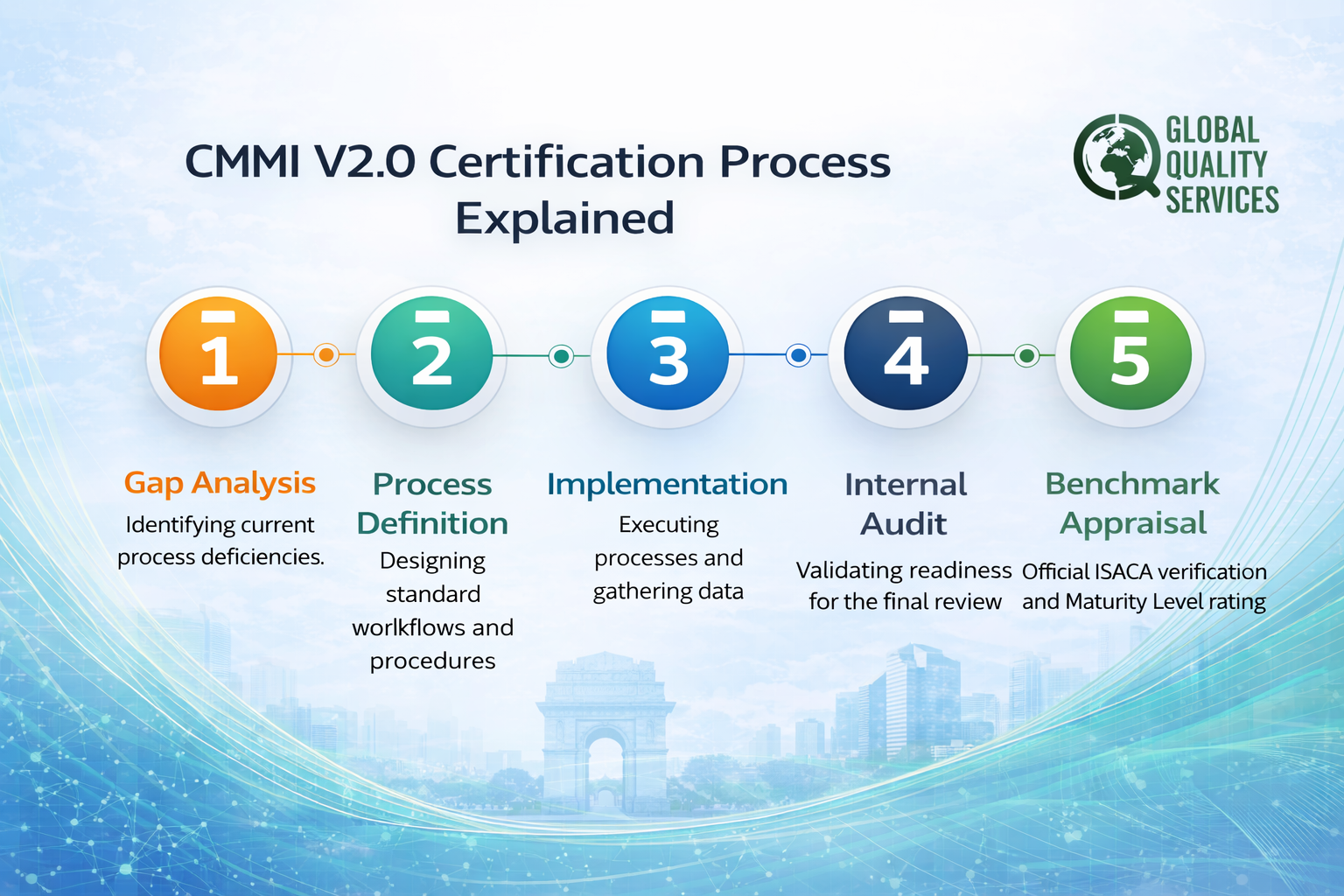
Getting CMMI V2.0 Certification is a structured journey that needs clear planning and consistent execution. Here are the main steps companies usually follow to achieve successful appraisal and certification:
Step 1 Gap Analysis
Consultants review existing workflows against CMMI criteria to identify missing elements. This diagnostic phase lays the foundation for all subsequent process improvements, training sessions, and organizational changes.
Step 2 Process Definition
Based on gap findings, organizations design or refine standard operating procedures that align with business goals. This includes defining project planning methods, quality review processes, risk management practices, and performance-tracking mechanisms.
Step 3 Implementation Period
Teams must actively follow the defined processes across live projects. This phase tests whether new systems work in real execution conditions. Organizations collect evidence such as meeting records, review notes, risk logs, and performance reports.
Step 4 Internal Audit
An internal readiness review simulates the formal appraisal environment. Auditors check process compliance, evidence completeness, and staff awareness. This step helps identify overlooked documentation gaps or weak execution areas.
Step 5 Benchmark Appraisal
An ISACA-certified Lead Appraiser conducts structured interviews and reviews organizational evidence. They interview staff and verify evidence to officially grant the organization its specific and hard-earned CMMI Maturity Level rating. Once verified, the maturity level rating is officially recorded.
CMMI Maturity Levels Explained for Leaders
Before starting the CMMI journey, leaders should know what each maturity level means for the business. Here is a simple breakdown to help understand how process capability grows step by step:
- Level 1 (Initial): Work is unpredictable and reactive. Success depends on individual effort and firefighting rather than a repeatable, reliable system that can be taught to new hires.
- Level 2 (Managed): Projects are planned and documented. Work is managed at the project level, though processes may vary significantly between different teams or departments within the same company.
- Level 3 (Defined): Processes are standardized across the whole organization. Every project follows the same quality foundation, ensuring consistent, predictable delivery and high-quality performance for every client.
- Level 4 (Quantitatively Managed): The organization uses statistical techniques to control performance. Leaders can predict project outcomes with high accuracy using historical data and sophisticated metrics to drive decisions.
- Level 5 (Optimizing): The highest level focuses on continuous innovation. The organization uses data to constantly evolve and improve processes, effectively preventing defects before they ever occur in production.
CMMI Certification Cost in Delhi
Understanding the investment for CMMI certification involves looking at both external fees and internal resource allocation. In the Delhi-NCR market, the total expenditure is generally split into three primary categories:
- Professional Consultancy Fees: This covers the end-to-end guidance provided by experts. It includes the initial gap analysis, mandatory staff training, documentation support, and the final mock audits to ensure readiness.
- Official Appraisal & ISACA Fees: These are fixed costs paid for the formal assessment. They include the professional fees of the Lead Appraiser and the official filing charges required by the CMMI Institute.
- Internal Resource Costs: Organizations must account for the man-hours employees spend on training and process implementation. This is often the most overlooked aspect of the total project budget.
The total cost varies significantly based on the size of your workforce, the number of physical locations in Delhi or Noida, and whether you are aiming for Level 3 or the more complex Level 5.
Why Choose Global Quality Services for CMMI V2.0 Certification in India
Partnering with Global Quality Services ensures that your CMMI journey is a catalyst for business excellence rather than just a compliance checkbox. Our approach is designed to blend global standards with local business realities:
Deep Local Cultural Alignment
Our experts are deeply familiar with the Delhi-NCR work culture and communicate effectively with your local teams. This proximity enables frequent on-site support in Noida or Gurgaon, leading to faster adoption and much higher employee engagement.
Tailored Process Architecture
We strictly avoid one-size-fits-all templates that often lead to audit failures or bureaucratic bloat. We build custom processes that reflect how your specific company operates, ensuring the system is practical, usable, and adds real business value.
Sustainable Skill Transfer
Global Quality Services focuses on mentoring your internal teams rather than just delivering documentation. This ensures your staff gains the skills needed to maintain and improve processes long after the official appraisal has concluded.
Accelerate Your CMMI V2.0 Journey with Global Quality Services
Turn process maturity into a real business advantage with expert guidance from Global Quality Services. We help organizations plan, implement, and prepare for CMMI appraisal through practical consulting and structured execution support. Strengthen delivery confidence, improve operational performance, and qualify for larger opportunities. Start building scalable systems that support consistent quality, stronger client trust, and sustainable long-term business growth.
FAQs
- What is the difference between a Benchmark and a Sustainment appraisal?
A Benchmark appraisal grants the initial rating valid for three years. A Sustainment appraisal is a shorter, more cost-effective audit used to extend that rating for an additional two years.
- Can we skip Level 2 and go directly for Level 3 certification?
Yes, most Delhi firms go directly for Level 3. While Level 2 practices must still be implemented, you can be formally appraised at Level 3 in a single appraisal cycle.
- How does the CMMI V3.0 handle remote or hybrid workforces?
V3.0 is designed for modern work environments. It focuses on the process’s capability regardless of location, using digital evidence and virtual interviews to verify compliance in hybrid setups.
- Is CMMI certification mandatory for all Indian government IT projects?
Not really. It is a standard technical qualification requirement for large-scale Digital India, defense, and smart city tenders. It ensures the vendor can handle complex deliveries and maintain rigorous quality standards.
- What happens if we fail the formal Benchmark Appraisal?
If gaps are found, the Lead Appraiser provides a specific period to resolve them. Once corrected, the appraiser verifies the fixes before finalized results are submitted to the CMMI Institute.