Mumbai continues to strengthen its position as a major technology delivery hub within India’s global export ecosystem. According to Business Line’s latest news, Maharashtra accounts for nearly 20 percent of India’s software exports from STPI-registered units, making it one of the country’s key hubs for global technology services.
With global clients expecting stronger delivery discipline, risk control, and measurable performance standards, technology firms in Mumbai are increasingly investing in structured maturity frameworks.
CMMI V2.0 certification supports this shift by helping organizations build consistent processes, improve project outcomes, and strengthen credibility in competitive international markets. To understand why many companies are prioritizing this certification today, it is important to first examine what the updated CMMI model entails and how it differs from earlier versions.
What is CMMI V2.0, and How is it Different From Earlier Models
CMMI V2.0 certification represents an evolution in how organizations approach process maturity and performance improvement. Instead of focusing mainly on documentation practices, the updated model aligns maturity adoption with measurable business outcomes such as productivity, delivery reliability, and customer satisfaction.
Earlier versions emphasized standardization of workflows, while the new model integrates modern engineering practices and performance measurement systems. It also simplifies appraisal approaches and encourages organizations to connect process improvements directly with strategic business goals.
How Does CMMI Certification Improve Business Performance and Client Trust
Clear and well-managed processes help organizations deliver work in a more reliable way. This section explains how CMMI certification supports better project outcomes, reduces uncertainty in execution, and builds stronger confidence:
1. Drive Predictable Delivery and Execution Consistency
CMMI V2.0 replaces traditional process monitoring with a focus on measurable performance goals. By establishing structured planning and quality assurance benchmarks, organizations reduce project uncertainty, ensuring teams consistently meet deadlines and budget requirements. This predictability is a key differentiator for vendors during strategic client engagements.
2. Strengthen Governance and Operational Risk Oversight
The V2.0 framework introduces specific Practice Areas for Governance to ensure leadership has direct visibility into project health. Through real-time performance dashboards and standardized escalation paths, management can proactively mitigate risks. This structured oversight minimizes operational disruptions and ensures organizational stability across complex portfolios.
3. Build Enterprise Trust and Procurement Credibility
For global clients, CMMI certification is a trusted indicator of disciplined engineering. V2.0 utilizes a more rigorous, statistically-validated appraisal method, providing higher reliability in benchmarking. Demonstrating this level of maturity streamlines the procurement process, lowers the perceived risk for the buyer, and strengthens long-term partnership potential.
4. Maximize Engineering Productivity and Cost Efficiency
Standardized workflows and integrated performance metrics allow organizations to identify and eliminate systemic inefficiencies. By focusing on reducing rework and optimizing resource allocation, V2.0 helps companies drive higher engineering output while effectively managing operational costs, leading to a visible return on investment (ROI).
Why Mumbai-Based IT and Product Companies are Adopting CMMI V2.0
Mumbai’s tech landscape has shifted from basic outsourcing to high-value engineering and fintech. In this market, CMMI V2.0 is the differentiator for securing global contracts. Key adoption drivers include:
- Drive Predictable Delivery and Execution: Establish measurable performance goals and structured QA to ensure projects hit deadlines and budgets consistently.
- Strengthen Governance and Risk Oversight: Implement leadership dashboards and standardized escalation paths to proactively manage risks across complex portfolios.
- Build Enterprise Trust and Procurement Credibility: Leverage a global benchmark to signal disciplined engineering, reducing buyer risk and streamlining the procurement process.
- Maximize Productivity and Cost Efficiency: Use data-driven workflows to identify inefficiencies, reduce rework, and optimize engineering output for better ROI.
What Maturity Level Should Your Organization Target First
Selecting the right CMMI maturity level depends on your current operational goals and client requirements. Here is how to evaluate your baseline to determine the most effective starting point:
Level 2 – Establishing Managed Delivery Discipline
Organizations at this stage develop basic project management systems, including requirement tracking, schedule monitoring, and quality control mechanisms. This level focuses on stabilizing execution patterns and reducing variability across projects. It creates a foundation for scalable delivery capability.
Level 3 – Building Standardized Organizational Processes
Level 3 emphasizes integrating consistent engineering practices across departments. Organizations develop common frameworks, documentation systems, and governance structures. This maturity stage improves coordination between teams and strengthens client confidence in predictable delivery outcomes.
Level 4 – Enabling Data-Driven Performance Management
At Level 4, leadership relies on quantitative metrics to guide operational decisions. Performance indicators help forecast risks, optimize resource allocation, and improve productivity benchmarks. This stage supports measurable improvement in cost efficiency and delivery accuracy.
Level 5 – Driving Continuous Improvement and Innovation
Organizations reaching Level 5 adopt proactive improvement mechanisms such as automation, advanced analytics, and feedback-driven process refinement. This maturity level strengthens long-term competitiveness by enabling organizations to adapt quickly to evolving market demands.
How Does the CMMI V2.0 Certification Process Actually Work Step By Step
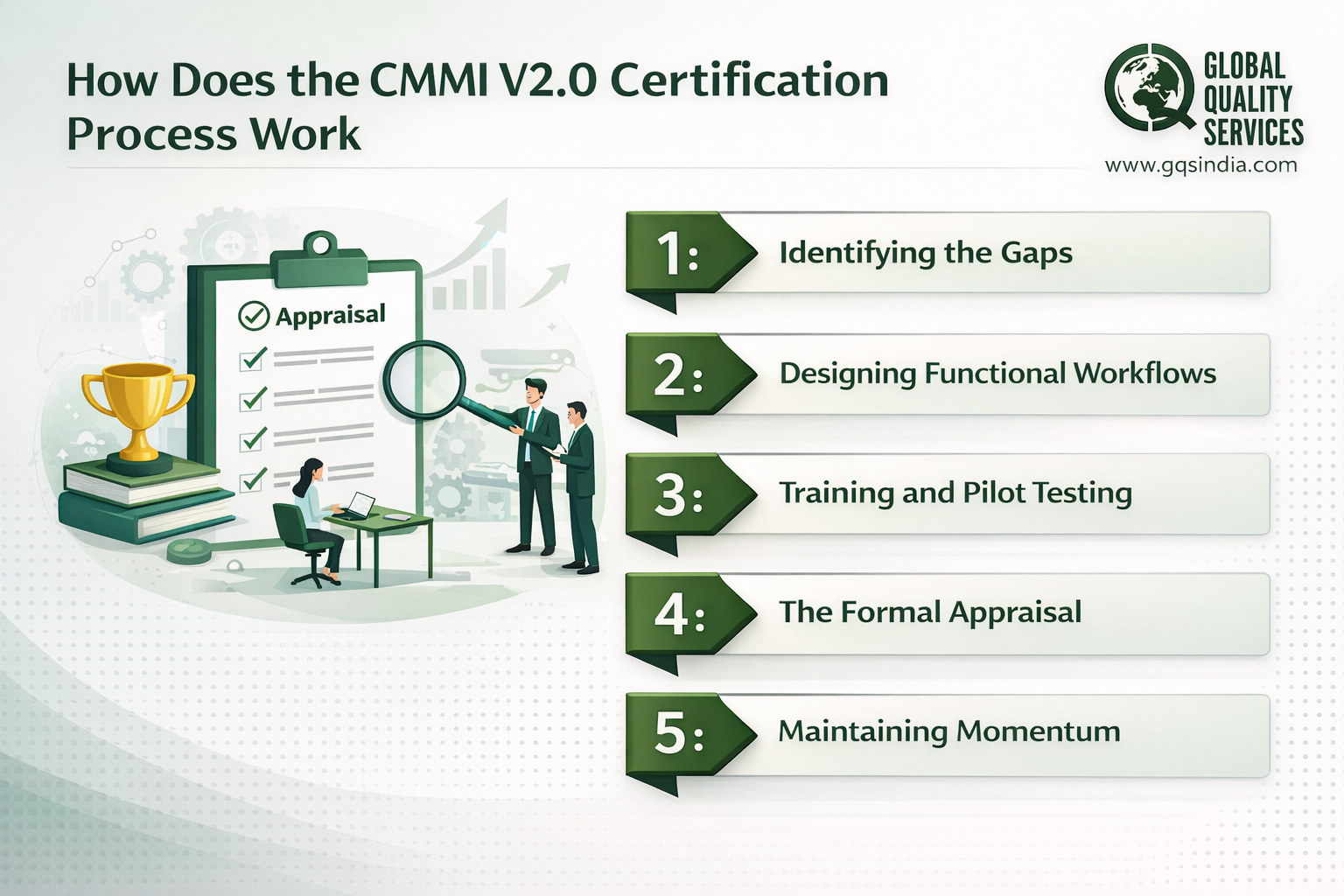
The certification journey involves a structured transformation rather than a simple audit. Organizations must align internal systems, documentation, and governance practices. Here is how the certification process works:
Step 1: Identifying the Gaps
The process starts with an honest look at your current delivery practices. By comparing your existing workflows against CMMI requirements, you can spot inconsistencies in governance and execution. This stage helps leadership build a realistic roadmap that addresses specific business priorities.
Step 2: Designing Functional Workflows
Next, you will refine your processes to ensure they actually work for your teams. The goal is to design reporting systems and performance monitoring that integrate into daily operations. When done correctly, these improvements strengthen your delivery without disrupting ongoing client commitments.
Step 3: Training and Pilot Testing
Before a full-scale rollout, teams must understand the new standards. By testing these practices on pilot projects, you can identify practical challenges and refine the workflows in a controlled environment. This ensures that the processes are proven to work before the whole organization adopts them.
Step 4: The Formal Appraisal
A certified lead appraiser conducts a deep dive into your organization’s performance. This involves reviewing evidence, interviewing stakeholders, and validating that your systems meet the target maturity level. A successful appraisal confirms your organization is operating at a high level of discipline.
Step 5: Maintaining Momentum
Certification is a milestone and not the finish line. Post-appraisal, the focus shifts to sustaining these habits through periodic reviews and continuous refinement. This ensures that the maturity practices continue to drive long-term ROI and operational stability.
How Long Does CMMI Implementation Take in Real-World Scenarios
The time required for CMMI implementation depends on your current operational baseline and the size of your organization. While smaller teams with existing structure can move quickly, larger enterprises naturally require more time to align governance across different business units.
Here is a look at the typical timelines for different organizational scales.
- Early-stage technology startups: 4 to 6 months
- Mid-size IT services organizations: 6 to 10 months
- Large enterprises with complex delivery structures: 10 to 14 months
What is The Cost Structure of CMMI V2.0 Certification in Mumbai
Understanding the cost of CMMI certification requires looking at it as a strategic investment rather than a single fee. In Mumbai, these costs fluctuate based on your company size and the maturity level you are targeting. Here are the primary financial factors to consider:
- Advisory support for process transformation
- Training initiatives to build internal capability
- Appraisal partner evaluation fees
- Temporary productivity adjustments during process transition
How Should Companies Choose The Right CMMI V2.0 Consultant In Mumbai
Selecting a CMMI consultant in Mumbai needs careful review of capability, experience, and approach. Companies should focus on partners who bring structured execution and real business understanding. Consider these important factors before making a decision.
Proven Certification Experience
Choose consultants who have delivered multiple successful CMMI appraisals across different company sizes and maturity levels. Their past execution experience helps reduce risks, solve implementation issues early, and guide teams with practical steps that keep certification timelines predictable and controlled.
Relevant Industry Knowledge
A consultant who understands your industry can design processes that fit real operational needs. This ensures recommended practices improve delivery performance, strengthen quality outcomes, and align with business priorities instead of creating rigid systems that reduce team productivity.
Clear and Practical Roadmap
Strong consultants offer a structured implementation plan with defined phases, responsibilities, and milestones. This roadmap guides organizations through assessment, process design, governance setup, and appraisal readiness, ensuring clarity across teams and preventing confusion during the transformation journey.
Focus on Team Capability
The right consultant prioritizes training and knowledge transfer throughout the engagement. By building internal capability, they help organizations sustain maturity practices independently, reduce long-term consulting dependency, and strengthen ownership of quality and performance improvement initiatives.
Long Term Guidance
CMMI success continues beyond certification. Choose consultants who support ongoing improvement through performance reviews, process refinement, and governance strengthening. This long-term involvement helps organizations maintain maturity, discipline, adapt to business changes, and protect the value gained from certification.
How Does CMMI V2.0 Compare With ISO and Other Quality Frameworks
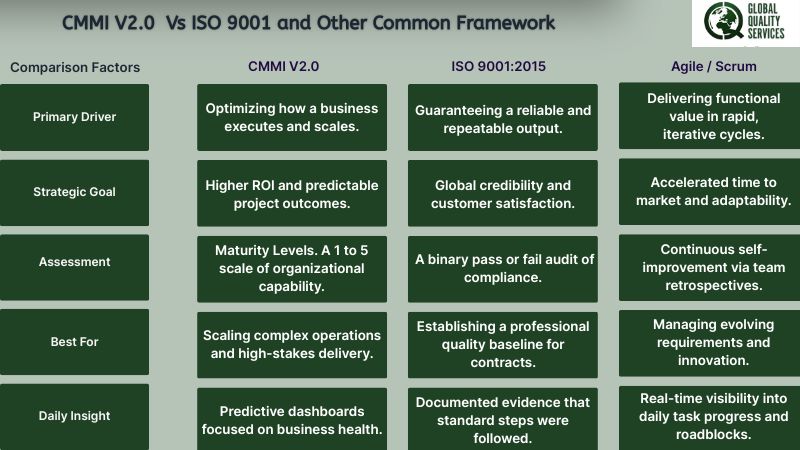
While CMMI and ISO are often mentioned in the same breath, they serve different strategic purposes. CMMI is primarily a performance improvement model designed to build capability and maturity, whereas ISO 9001 is a quality management standard focused on meeting basic requirements and ensuring consistency.
Here is how CMMI V2.0 compares with ISO 9001 and other common frameworks.
Comparison of Global Quality Frameworks:
Achieve Global Benchmarks and Operational Stability
Organizations today are evaluated not only on technical skills but on how consistently they deliver results. Adopting CMMI V2.0 certification helps bring structure to project execution, improves governance clarity, and builds stronger confidence among global clients.
With practical guidance from Global Quality Services, your teams can implement maturity practices in a way that supports real business goals, strengthens delivery stability, and prepares your organization for sustained growth in competitive markets.
Frequently Asked Questions
1. Is CMMI V2.0 certification mandatory for global outsourcing contracts?
Technically, it is not always a legal requirement, but it is often a practical one. Most global enterprise clients use maturity benchmarks to filter vendors during the procurement stage. Having the certification proves you have the systems in place to handle high-stakes projects, which significantly increases your chances of winning long-term contracts.
2. How should an organization prepare before starting the process?
Preparation starts with leadership commitment. You need to evaluate your current delivery methods honestly and appoint a dedicated team to lead the transformation. Building awareness across departments early on ensures that everyone understands the goals, which helps prevent delays once the implementation begins.
3. Can CMMI V2.0 and Agile work together effectively?
Absolutely. The latest version of the model was specifically designed to support modern workflows like Agile and DevOps. It allows you to keep your development cycles flexible while providing the high-level governance needed to ensure that speed does not come at the cost of quality or consistency.
4. Who conducts the CMMI V2.0 appraisal process?
Authorized appraisal partners approved by the CMMI Institute conduct formal evaluations. These experts assess organizational maturity through evidence review, performance validation, and stakeholder interaction.
5. Does certification lead to actual productivity gains?
Yes, when implemented correctly. By standardizing workflows and using data to track performance, organizations typically see better resource management and a sharp decrease in rework. While the exact results vary, the structure naturally leads to more reliable delivery and improved operational efficiency.