

Managing operational costs is a primary concern for manufacturers in the capital. Delhi has seen a significant shift in its industrial landscape, with peak power demand hitting a record 8,442 MW during the 2025 to 2026 period. The city continues to see a sharp rise in electricity requirements across its industrial hubs.
For industrial facilities, this directly impacts electricity bills, equipment efficiency, production stability, and long-term operational costs. An industrial energy audit helps businesses identify where energy is being wasted and how systems can perform more efficiently without affecting production output.
Our audits are focused on identifying practical improvements that help factories, warehouses, and industrial facilities reduce energy losses, improve system performance, and make better use of available power resources.
Why Industrial Energy Audits Matter in Delhi
Operating a factory in industrial hubs such as Okhla, Bawana, or Narela entails high overheads. Beyond the monthly electricity bill, there are various reasons why a professional energy audit for an industrial building is necessary:
- Financial Liquidity: Reducing energy waste directly improves your bottom line. Every rupee saved on electricity is a rupee added to your net profit.
- Equipment Longevity: Many energy issues stem from voltage fluctuations or motor inefficiencies. Fixing these prevents premature equipment failure and costly downtime.
- Regulatory Compliance: The Bureau of Energy Efficiency and the Delhi Pollution Control Committee are increasingly focusing on the carbon footprint of local industries. An audit ensures you stay ahead of environmental mandates.
- Carbon Footprint Reduction: As Delhi faces ongoing air quality challenges, industrial units are under pressure to adopt clean manufacturing practices. Lower energy use equals fewer carbon emissions.
Our Energy Audit Services for Industrial Facilities
Our industrial energy audit services are designed to evaluate major energy-consuming systems across industrial buildings and manufacturing facilities in Delhi NCR. Instead of using a generic checklist approach, we study how each system performs under actual operating conditions.
1. Preliminary Energy Audit
This is a quick diagnostic check. We review your past 12 to 24 months of utility bills and conduct a walk-through of the facility to identify obvious energy drains for quick savings.
2. Detailed Energy Audit
This is a comprehensive technical assessment. We use high-precision instruments to measure the efficiency of every major system in your building. You receive a detailed report with specific recommendations, estimated costs for upgrades, and a clear payback period.
3. Targeted System Analysis
If you feel only a specific part of your plant is underperforming, we offer focused audits for:
- Electrical Systems: Analyzing transformers, capacitors, and power factor correction.
- Thermal Systems: Checking boilers, furnaces, and steam distribution.
- Compressed Air: Identifying leaks and optimizing compressor performance.
Industries We Serve Across Delhi NCR
Our auditors have extensive experience across the diverse industrial landscape of the National Capital Region.
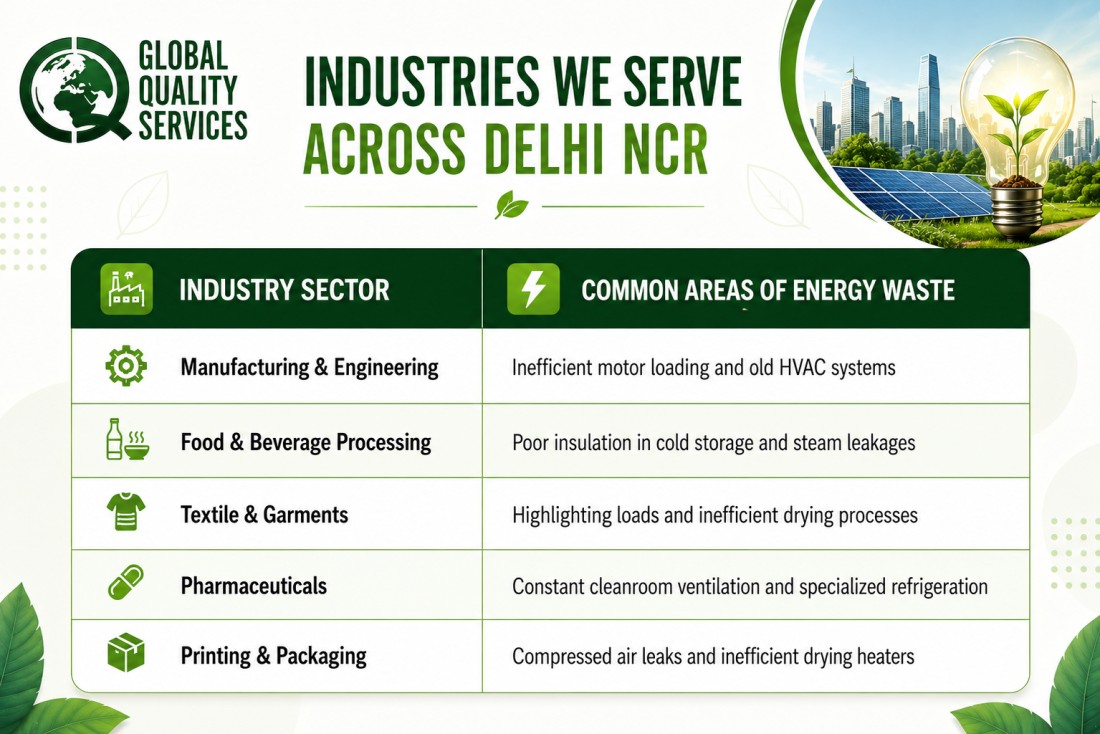
Our Technical Audit Methodology for Delhi Factories
We follow a structured four-phase methodology to ensure that our findings are accurate and our recommendations are actionable.
Phase 1: On-Site Data Gathering
We begin by mapping your energy flow. Our team collects technical specifications of all heavy machinery and reviews your load profile to see when your energy consumption peaks.
Phase 2: Diagnostic Testing & Measurement
Using advanced tools like thermal imagers and power quality analyzers, we measure the real-time performance of your systems. This helps us identify invisible losses, such as heat dissipation from uninsulated pipes or harmonic distortion in your electrical lines.
Phase 3: Data Analysis & Cost-Benefit Modeling
We do not just tell you what is broken. We calculate exactly how much money you are losing. We then model different solutions to show you which upgrades will give you the fastest return on investment.
Phase 4: Implementation Roadmap
We categorize recommendations into no-cost measures, low-cost measures, and high-investment measures.
Why Partner With Our Delhi-Based Audit Team at Global Quality Services?
Choosing an auditor is about trust and technical depth. Global Quality Services stands out in the Delhi market because we understand the local industrial context.
- Certified Expertise: Our auditors hold the necessary certifications to ensure your reports are valid for government and regulatory submissions.
- Local Knowledge: We are familiar with the power supply characteristics of different Delhi distribution companies, allowing us to spot tariff-related saving opportunities.
- No Disruption Guarantee: We conduct our on-site measurements without interrupting your production schedules.
- Data-Driven Accuracy: We rely on calibrated instruments rather than assumptions. Our reports provide a realistic roadmap for savings that actually show up on your next bill.
Secure Your Energy Efficiency Strategy with Global Quality Services
Reducing industrial energy costs starts with understanding where energy is actually being lost. A professional industrial energy audit can help your facility improve operational efficiency, reduce unnecessary electricity consumption, and identify practical opportunities for long-term savings.
Whether your facility operates heavy machinery, thermal systems, HVAC infrastructure, or continuous production lines, a structured energy assessment provides the clarity needed to improve performance and control costs.
Connect with Global Quality Services to schedule an industrial energy audit for your facility in Delhi NCR and take the next step toward smarter energy management.
Frequently Asked Questions
1. How long does a typical industrial energy audit take to complete?
The duration depends on the size of your facility. A preliminary audit may take only 1 to 2 days on-site, while a comprehensive, detailed audit for a large manufacturing unit can take 1 to 2 weeks for data collection and analysis.
2. Is an energy audit a one-time requirement for industries?
No, a single audit provides immediate savings, but energy efficiency is an ongoing process. Most large industrial units find it beneficial to conduct a detailed audit every 2 to 3 years to account for equipment aging and process changes.
3. Will we need to shut down my production during the audit process?
No. Our technical team is trained to conduct measurements and observations while your plant is fully operational. Seeing the machines under load is essential for accurate data collection.
4. What is the average payback period for energy-saving recommendations?
Many operational and low-cost changes pay for themselves within 3 to 6 months. Larger equipment upgrades typically have a payback period of 1 to 3 years, depending on your energy tariff and usage hours.
5. Are these audits mandatory for small-scale industries in Delhi?
No. For small-scale industries in Delhi, energy audits are generally voluntary rather than a legal mandate. While statutory financial audits are mandatory for all private limited companies under the Companies Act 2013, mandatory energy audits currently apply only to Designated Consumers (large energy-intensive units) identified by the Bureau of Energy Efficiency.