India’s defence manufacturing sector is growing rapidly, and quality compliance is becoming a major requirement for companies supplying ballistic protection products. According to the Ministry of Defence, India’s defence exports reached a record ₹38,424 crore in FY 2025–26, showing a 62.66% increase over the previous year. At the same time, Indian defence products are now exported to more than 80 countries, creating greater demand for internationally recognised manufacturing and quality systems.
For body armor manufacturers, BA 9000 certification helps build credibility, improve manufacturing controls, and meet global procurement expectations. It supports organizations in maintaining consistent quality, product traceability, and compliance across the entire production process.
What is BA 9000 Certification?
The BA 9000 certification is a quality management standard created specifically for body armor manufacturers. It builds directly upon the foundation of ISO 9001, adding strict technical requirements designated by the National Institute of Justice (NIJ). The standard focuses on the technical reliability, testing protocols, and manufacturing consistency of ballistic-resistant materials like bulletproof vests, helmets, and tactical plates.
Unlike general manufacturing certifications, this standard ensures that every single batch of body armor produced offers identical protective capabilities. It introduces critical checks on raw materials, construction processes, and environmental testing variables to eliminate structural weak points that could lead to equipment failure in the field.
Why BA 9000 Matters for Body Armor Manufacturers
Body armor products are directly connected to human safety. Even small manufacturing inconsistencies can create serious risks during real-world use. Because of this, buyers and procurement agencies expect strong quality controls from manufacturers. BA 9000 helps organizations maintain:
- Consistent production quality
- Proper raw material traceability
- Controlled manufacturing processes
- Reliable testing procedures
- Better documentation practices
For Indian manufacturers, the standard also improves credibility when supplying products to:
- Defence organizations
- Police departments
- International distributors
- Government procurement agencies
- Export markets
Who Needs BA 9000 Certification in India?
BA 9000 certification is relevant for organizations involved in manufacturing or supplying ballistic protection products, including:
- Bulletproof vest manufacturers
- Ballistic helmet manufacturers
- Tactical gear manufacturers
- Defence equipment suppliers
- Military product exporters
- OEM manufacturers
- Private label body armor companies
- Government defence contractors
Key Requirements of BA 9000 Certification
BA 9000 focuses heavily on manufacturing discipline and process control. The standard requires organizations to establish documented systems that support product consistency and traceability.
- Raw Material Traceability: Manufacturers must maintain clear records showing where materials were sourced and how they were used during production.
- Controlled Manufacturing Processes: Production activities should follow approved procedures with proper monitoring and supervision.
- Product Testing and Inspection: Testing methods must be documented and performed consistently to verify product performance and quality.
- Equipment Calibration: Machines and testing equipment must be calibrated regularly to maintain accurate production and inspection results.
- Supplier Quality Management: Organizations should evaluate and monitor suppliers to ensure material quality remains consistent.
- Documentation and Record Control: Proper records should be maintained for manufacturing, inspections, corrective actions, and audits.
- Corrective Action Procedures: Any nonconformity or production issue must be identified, investigated, and resolved systematically.
BA 9000 Certification Process in India
Transforming your factory floor to meet this military-grade quality standard requires a structured, multi-step journey.
Step 1: Gap Analysis and System Review
Consultants review your existing workflow against the strict baseline criteria of the standard. This step identifies hidden flaws in material tracking, storage conditions, and testing documentation.
Step 2: System Upgrades and Documentation
Your team designs and deploys targeted operational controls. This involves establishing secure material logs, creating specialized standard operating procedures for material cutting, and setting up environmental logs for storage zones.
Step 3: Employee Training and Awareness
Technical staff, line operators, and quality inspectors receive intensive training. Everyone learns the critical role lot numbers and ambient conditions play in maintaining product integrity.
Step 4: Internal Audits and Pre-Assessment
A comprehensive mock audit tests the efficiency of the new management system. This dry run ensures that your tracking records, storage rooms, and test samples are perfectly prepared for official scrutiny.
Step 5: Final Certification Audit
An accredited registrar conducts a thorough site evaluation. The auditor validates production logs, inspects material tracing protocols, and verifies full alignment with the standard. A successful audit results in your formal certification.
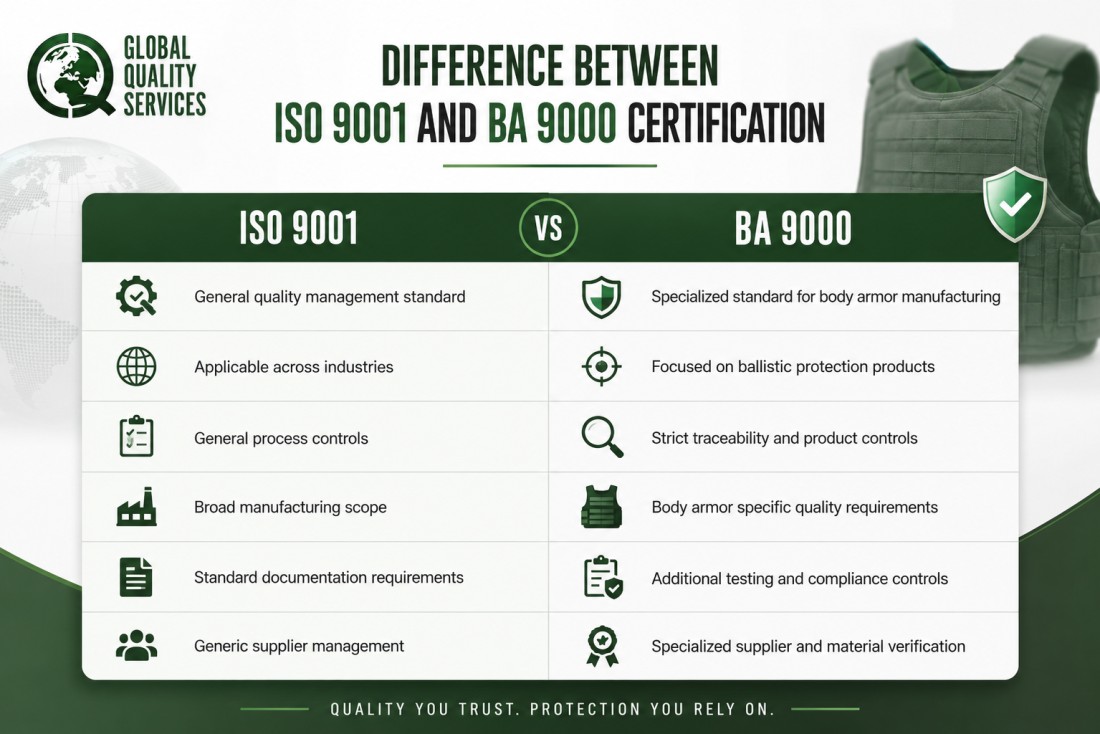
Difference Between ISO 9001 and BA 9000 Certification
While both standards share a common structural backbone, their operational focus and depth vary significantly. Here is the actual difference between the two:
Benefits of BA 9000 Certification
Achieving compliance offers powerful operational and strategic advantages that help your business stand out in a competitive marketplace.
- Access to Premium Global Tenders: Most international defense ministries and elite law enforcement agencies restrict bidding access to fully certified manufacturers.
- Substantial Reduction in Waste: Improved lot control and rigorous processing checks reduce batch errors, material waste, and costly remanufacturing runs.
- Enhanced Commercial Credibility: Displaying this specialization underscores your status as an elite manufacturer, setting your brand apart from generic security gear providers.
- Streamlined Regulatory Audits: Organized documentation and deep traceability make it simple to clear periodic inspections by defense procurement boards.
Why Choose Global Quality Services for BA 9000 Certification Consultancy
Implementing BA 9000 requires both technical understanding and practical manufacturing knowledge. A structured consultancy approach helps organizations avoid delays and implementation gaps. Our consultancy support focuses on:
- Gap assessment and compliance review
- Documentation development
- Process implementation guidance
- Internal audit support
- Employee awareness training
- Certification audit preparation
- Ongoing compliance improvement
BA 9000 Certification Cost in India
The total investment required to secure certification is unique to each organization. It depends entirely on your current operational scale, the maturity of your existing quality management systems, the number of production lines involved, and the specific upgrades required to meet environmental and lot-tracking benchmarks.
A detailed initial assessment of your production facilities helps map out an accurate budget tailored directly to your business requirements.
Get BA 9000 Certification Support in India
Accelerate your entry into elite international defense contracts by building a world-class manufacturing framework. Partner with Global Quality Services to upgrade your operational quality systems, master strict ballistic tracing demands, and secure your compliance smoothly.
Contact our defense compliance specialists today to receive a customized implementation roadmap that transforms your production floor into a certified center of ballistic excellence.
Frequently Asked Questions
1. Can a startup manufacturing body armor apply for this certification immediately?
Yes, any manufacturing setup can apply for this certification, provided they have an active production line where lot tracking, material controls, and manufacturing processes can be audited against the standard.
2. Does this certification replace the need for NIJ ballistic lab testing?
No, it does not replace lab testing. Ballistic lab testing validates the actual protective capability of a specific armor design, while this certification ensures that your manufacturing system consistently reproduces that approved design across every batch.
3. How long does it take to implement this standard on the factory floor?
The timeline usually ranges between three and six months, depending on the size of your facility, your current quality tracking systems, and the speed at which your team implements the required material controls.
4. How often are surveillance audits conducted after getting certified?
Surveillance audits are typically conducted once every year by the certifying registrar to verify that your operations continuously maintain compliance with the lot tracking and environmental rules.
5. What are the most common challenges during the audit process?
The most frequent hurdles involve gaps in lot-to-lot traceability for old batches, poor climate data records in fabric storage areas, and insufficient documentation regarding minor design modifications.