
Bengaluru remains the primary engine of India’s commercial expansion. In the 2025 to 2026 financial year, Karnataka recorded a massive 9.5% growth in total exports, reaching nearly 19.7 lakh crore INR, a milestone driven heavily by the technology, aerospace, and advanced manufacturing sectors of Bengaluru.
Alongside this massive trade volume, the Global Startup Ecosystem Report 2026 ranks Bengaluru 15th globally with an ecosystem valuation of 153 billion USD, confirming its status as a massive hub for deeptech and artificial intelligence, as detailed by The Hindu.
As thousands of businesses scale across this rapid economic landscape, the requirement for operational structure becomes critical. The International Organization for Standardization is rolling out its latest update with the ISO 9001:2026 Quality Management System framework. Securing this modern certification ensures that local enterprises can protect their processes, meet international buyer compliance, and sustain rapid corporate growth without sacrificing quality.
Why Bengaluru Businesses Must Prepare for the 2026 Standard
The upcoming ISO 9001:2026 revision is expected to reflect modern business realities, including evolving customer expectations, digital transformation, organizational resilience, risk management, and performance-driven decision-making.
For Bengaluru businesses, preparation is not simply about compliance. It is about creating systems that support long-term growth and operational excellence. Organizations that begin preparation early can benefit from:
- Stronger process control
- Better customer experience
- Improved operational efficiency
- Reduced quality-related issues
- Better readiness for certification audits
- Increased confidence among clients and stakeholders
- Stronger positioning during supplier evaluations and tenders
Which Industries in Bengaluru Benefit Most from ISO 9001 Certification?
While a Quality Management System improves any business model, specific industrial sectors in Bengaluru require it to maintain market access.
- Information Technology and SaaS Providers: Software firms in Electronic City and Koramangala utilize the framework to control code deployment processes, protect customer data workflows, and secure global vendor compliance.
- Aerospace and Defense Manufacturing: Precision engineering firms located in Peenya and Yelahanka rely on rigid quality protocols to qualify for state tenders and fulfill international aviation supply contracts.
- Biotechnology and Pharmaceuticals: High-tech labs require pristine process validation, equipment calibration management, and strict documentation to clear international regulatory audits.
- Logistics and Supply Chain Operators: Warehousing and distribution centers servicing major e-commerce platforms use standardized workflows to reduce fulfillment errors and optimize turnaround times.
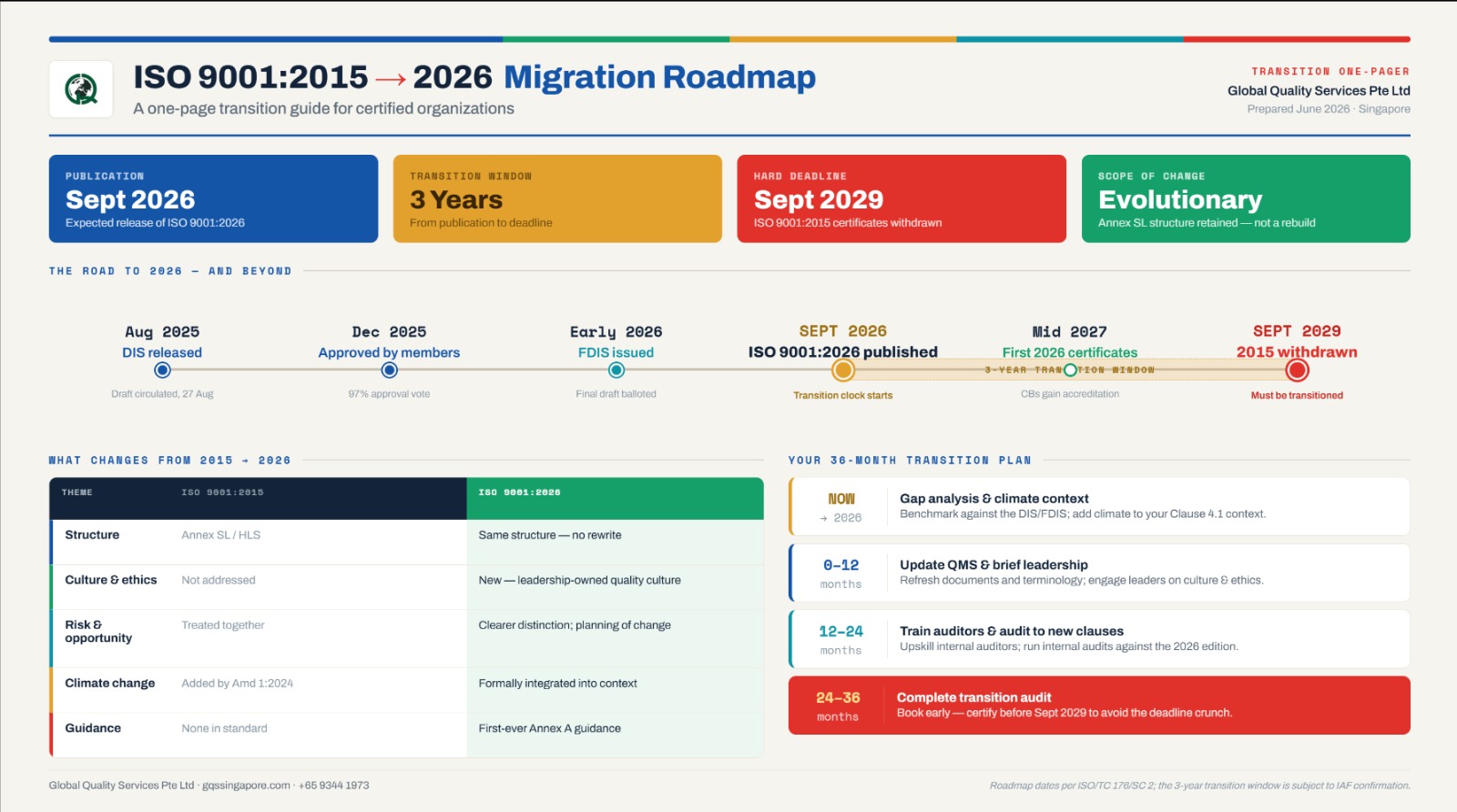
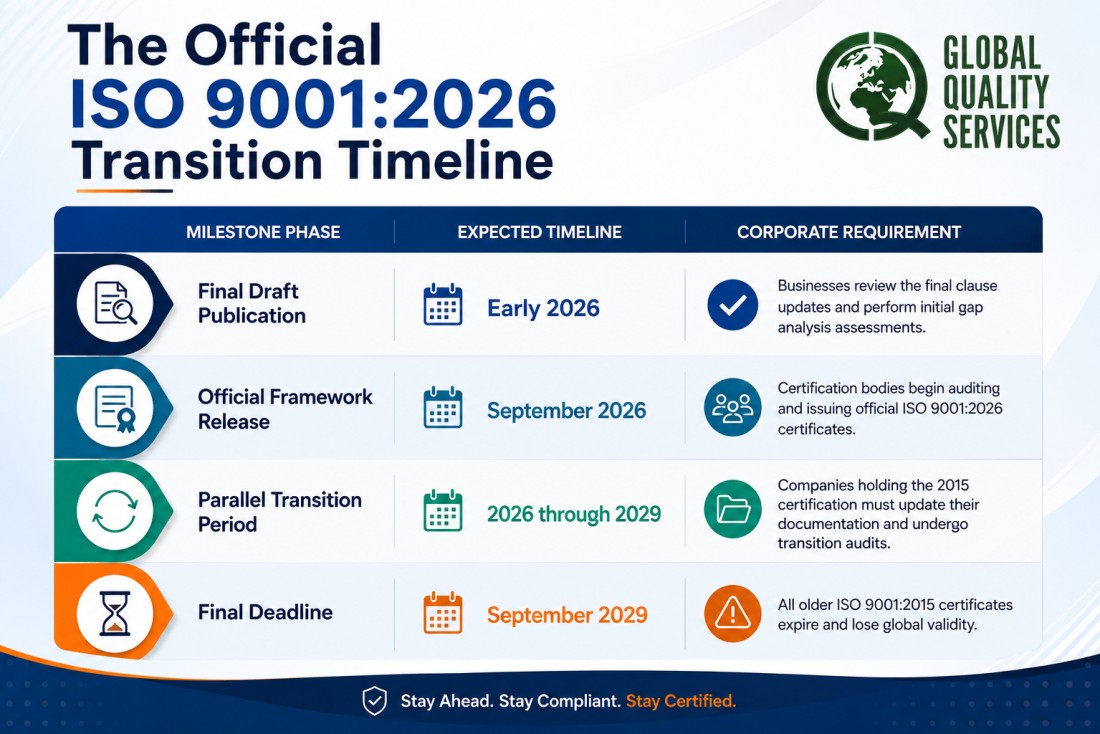
The Official ISO 9001:2026 Transition Timeline
Organizations must keep a close eye on the official rollout milestones to prevent their existing certifications from lapsing. The transition window is structured to allow companies sufficient time to align their Quality Management Systems with the revised clauses.
Our ISO 9001:2026 Certification Process in Bengaluru
Achieving certified status requires a systematic, multi-stage approach that integrates smoothly with your daily business workflows. We design the implementation path to avoid operational disruptions while building a highly sustainable compliance framework.
Step 1: Comprehensive Gap Analysis
Our consultants audit your current operational workflows against the newly published 2026 standards to identify missing compliance elements.
Step 2: Documentation and Process Design
We draft your customized Quality Management System manuals, standard operating procedures, and risk registers tailored directly to your specific business model.
Step 3: Employee Training and Execution
Our team trains your staff on the updated processes and helps your team implement the daily logging systems required for compliance tracking.
Step 4: Internal Audits and Pre-Assessment
We conduct a full-scale mock audit to uncover any hidden process non-conformities and fix them before the external auditors arrive.
Step 5: Final Certification Audit Support
We stand alongside your team during the official review by the accredited registrar, assisting with clarifications until your certificate is successfully issued.
Common ISO 9001 Audit Findings and How to Avoid Them
Many companies face delays during their final certification audit due to simple, recurring oversight issues. Understanding these common pitfalls ahead of time ensures a clean evaluation by the registrar.
- Poor Version Control on Digital Documents: Auditors frequently flag organizations using outdated procedural files. You can avoid this by maintaining a centralized, cloud-based document management hub with strict edit permissions.
- Incomplete Training Logs: If an employee performs a critical quality task without a recorded training certificate, it triggers an immediate non-conformity. Keep an updated digital skills matrix for every active team member.
- Superficial Corrective Actions: When an operational error occurs, businesses often fix the immediate symptom rather than investigate the underlying systemic flaw. Use structured root cause analysis methods like the five whys technique to satisfy auditor expectations.
- Neglected Internal Audit Schedules: Companies occasionally treat internal reviews as an afterthought. Regular, independent internal assessments must be scheduled and thoroughly logged to prove system maintenance.
How does Global Quality Services support ISO 9001:2026 Certification Across Bengaluru?
Whether your company operates from software offices in Manyata Tech Park, corporate hubs in Whitefield, or heavy industrial units in Bommasandra, our consultants deliver tailored strategies that align with your regional operational environment.
Our consulting model rejects generic templates. We focus heavily on building practical documentation that reduces systemic waste, improves your daily delivery speeds, and helps your corporate leadership teams make data-driven operational decisions. Our experienced consultants deliver end-to-end certification support tailored specifically to the unique operational demands of your industry.
- Secure official compliance through fully accredited global certification bodies
- Update your existing documentation to meet the latest 2026 clause requirements without interrupting daily business operations
- Reduce overall process waste and increase your enterprise procurement win rates
Partner with Global Quality Services to streamline your corporate compliance journey and establish a world-class quality infrastructure today.
Frequently Asked Questions
1. Can a startup with fewer than ten employees apply for this certification?
Yes, the framework is fully scalable. The standard focuses on process consistency rather than the total size of your workforce, making it highly beneficial for growing startups looking to establish early operational structure.
2. How long does the entire implementation process take from start to finish?
For most small to medium-sized enterprises in Bengaluru, the complete process from initial gap analysis to final certificate issuance takes approximately six to twelve weeks, depending on system readiness.
3. Is an internal audit team mandatory before the final certification can occur?
Yes, the standard requires that you conduct internal reviews. We train your selected staff members to become competent internal auditors, or our consulting team can perform these mandatory reviews on your behalf.
4. What is the typical validity period of an issued ISO 9001 certificate?
The certificate remains officially valid for a maximum period of three years. During this timeframe, the registrar will conduct brief annual surveillance audits to ensure your system remains fully compliant.
5. How does the 2026 standard handle cloud software and digital records?
The updated framework explicitly accounts for digital documentation, cloud infrastructure security, and remote workplace workflows, replacing old traditional requirements for physical paperwork logs.