Good Manufacturing Practice, referred to as GMP, is the foundation that makes manufacturing possible at companies involved in the production of goods that will either be ingested or used in any treatment. Starting up a company in Bangalore involves stringent implementation of quality control measures and manufacturing standards. No matter what industry your firm belongs to, compliance means maintaining your good standing in the market.
The industrial ecosystem in Karnataka is expanding at a rapid pace. According to an analysis by the Visvesvaraya Trade Promotion Centre (VTPC) published in the Times of India, Karnataka recorded total exports of approximately Rs 19.7 lakh crore in 2025-26. Bengaluru Urban emerged as the largest contributor by generating Rs 10.6 lakh crore in exports, driven by significant growth in software, basic chemicals, pharmaceuticals, and cosmetics. Achieving GMP Certification in Bengaluru ensures your facility satisfies statutory requirements while qualifying your products for domestic distribution and global export markets.
Why GMP Compliance Matters for Bengaluru Businesses
A strong GMP certification does more than just meet basic regulatory requirements. It creates an operationally sound framework that lowers product failures, maximizes batch performance, and enhances brand integrity. This is how GMP is crucial for business operations in Bengaluru:
- Regulatory Compliance: Meets the mandatory requirements enforced by the Central Drugs Standard Control Organization (CDSCO) and the Karnataka State Licensing Authority.
- Enhanced Product Safety: Prevents contamination, cross-contamination, mix-ups, and operational errors during the manufacturing cycle.
- Global Market Expansion: Opens export avenues to strictly regulated international markets that require WHO-GMP or ISO aligned production credentials.
- Operational Efficiency: Streamlines daily processes, minimizes product rejection rates, and reduces costly batch recalls.
- Customer and Investor Trust: Demonstrates a clear commitment to quality, making it easier to secure venture funding, commercial partnerships, and large enterprise contracts.
Industries We Serve in Bengaluru
The GMPs have been customized to meet the particular requirements of the respective industries. Below are listed some of the major industrial sectors of Bengaluru wherein customized GMPs have been developed:
- Pharmaceutical Formulations and APIs: Active pharmaceutical ingredients, solid oral dosages, liquids, and topical formulations.
- Biotechnology and Biosimilars: Fermentation units, recombinant protein production, and cell culture processing facilities.
- Nutraceuticals and Dietary Supplements: Herbal extracts, dietary powders, vitamin tablets, and functional food manufacturing lines.
- Food Processing and Beverages: Packaged food items, dairy processing, commercial bakeries, and beverage bottling plants.
- Cosmetics and Personal Care: Skincare creams, lotions, hair care products, and hygiene formulations under Indian Standard IS 15000 guidelines.
- Medical Devices and In Vitro Diagnostics: Sterile surgical instruments, diagnostic kits, and electronic healthcare monitors.
GMP Certification Process for Businesses in Bengaluru
Compliance with the GMP process requires a methodical journey and not just one submission of the documentation. Below is the process undertaken to ensure that your business reaches GMP certification:
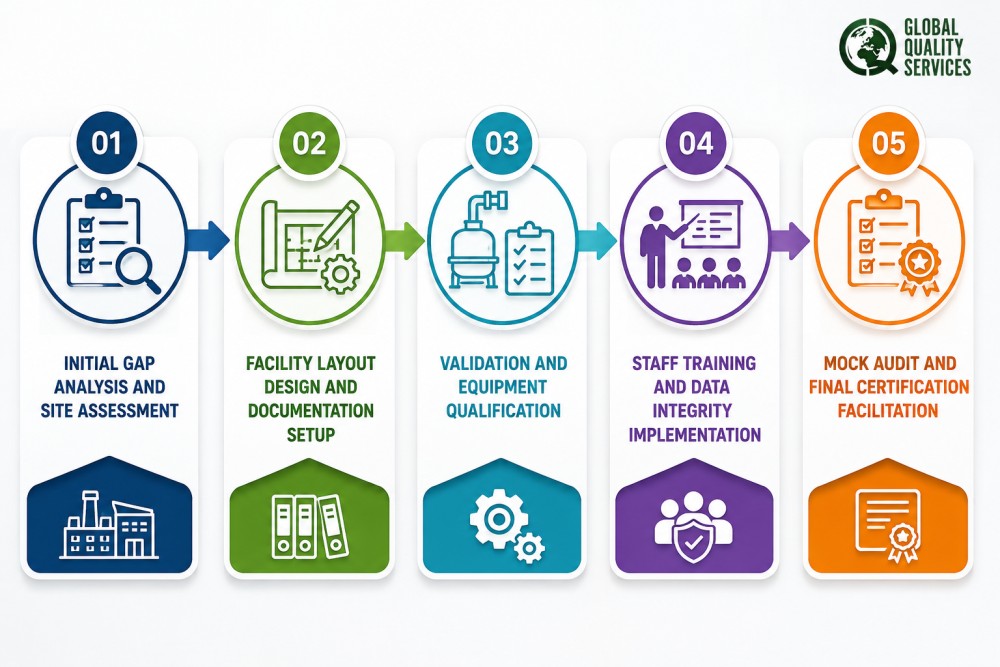
- Initial Gap Analysis and Site Assessment: Experts conduct a complete walk-through of your manufacturing facility. This step identifies structural deficiencies, HVAC airflow gaps, drainage issues, and process bottlenecks against current GMP guidelines.
- Facility Layout Design and Documentation Setup: Adjustments are made to ensure proper material and human traffic flow. Simultaneously, essential documentation is created, including the Site Master File (SMF), Standard Operating Procedures (SOPs), and Validation Master Plans (VMP).
- Validation and Equipment Qualification: Machinery and utilities undergo Installation Qualification (IQ), Operational Qualification (OQ), and Performance Qualification (PQ). Air Handling Units (AHUs) and purified water systems are tested to meet required cleanliness parameters.
- Staff Training and Data Integrity Implementation: Machine operators, quality control teams, and plant supervisors undergo practical training. They learn how to record batch entries in real time and maintain data integrity standards.
- Mock Audit and Final Certification Facilitation: A comprehensive mock inspection replicates an official state or central regulatory review. Once corrective actions are finalized, the facility undergoes its official audit to secure its GMP certificate.
Why Choose Global Quality Services for GMP Certification Support in Bengaluru?
Experience with regulatory guidelines is needed in practice, not through theoretical guidance. Industrial complexes such as Peenya, Bommasandra, Hoskote, Dobbaspet, and Electronic City have different operational considerations, including parameters related to water treatment and available space. With the help of experienced consultants, you can prevent structural renovations and delays in the introduction of products.
- Proven Technical Experience: Over two decades of practical experience guiding manufacturing units through local and international audit standards.
- Local Geographic Presence: Rapid access to key Bengaluru manufacturing hubs allows consultants to provide frequent on-site assessments and hands-on guidance.
- Customized Implementation: Solutions match your specific facility scale, budget, and product vertical instead of using generic templates.
- End-to-End Handholding: Complete support covering initial blueprint reviews, SOP authoring, staff training, equipment validation, and final inspection assistance.
- High Success Rate: A strong track record of helping facilities pass state drug control and central authority audits on their initial attempt.
Accelerate Your Audit Readiness with Global Quality Services
Compliance of your manufacturing facility necessitates technical expertise, documentation, and professional implementation. Working with Global Quality Services enables your organization to benefit from professionals who understand the standards of compliance in Karnataka and the global level of compliance requirements. Our team will ensure that there is no guesswork and save you time on implementation.
- On-Site Gap Analysis: Receive a thorough, objective evaluation of your current plant floor within days.
- Turnkey Documentation: Get fully customized SOPs, Site Master Files, and validation plans tailored to your facility.
- First Time Audit Success: Build long-term quality systems that satisfy inspectors and protect your commercial reputation.
Reach out to our experts today to schedule your initial facility assessment and secure your GMP credentials without operational delays.
Frequently Asked Questions
1. What is the main difference between ISO GMP and statutory WHO GMP in Karnataka?
The statutory WHO GMP is an obligatory regulatory approval provided by state licensing agencies in conjunction with CDSCO. The regulatory approval authorizes pharmaceutical and biologics companies legally to manufacture and export their goods. ISO GMP is a third-party management system certificate that indicates good practices but is not an alternative to statutory government approvals.
2. What is the time span required to do GMP certification for the facility in Bengaluru?
The average period would be from 6 to 12 weeks if we talk about existing facilities where there is only a need to update processes and some minor construction changes. If we have a greenfield facility or one that requires the installation of HVAC and equipment qualification, then the period can be 3 to 6 months.
3. Should food processing plants in Bangalore adhere to Revised Schedule M?
No, because Revised Schedule M is only applicable to pharmaceutical companies. Food, beverages, and nutraceuticals plants operate within the ambit of FSSAI guidelines and have to abide by Schedule 4 rules for GMPs.
4. Can an SME in Peenya get GMPs without making huge investments in capital expenditure?
Yes, it is possible for SMEs to become compliant through efficient space utilization, strict segregation of processing zones, and disciplined documentation. Investments would be made only in necessary utilities such as water purification and air handling systems.
5. How frequently is re-audit or re-licensing required of a GMP licensed facility in Karnataka?
A GMP license normally lasts for 2 to 3 years according to the particular agency that issues it. However, self-inspections are always ongoing, while external audits take place at intervals without any prior notice from the state drug inspectors.