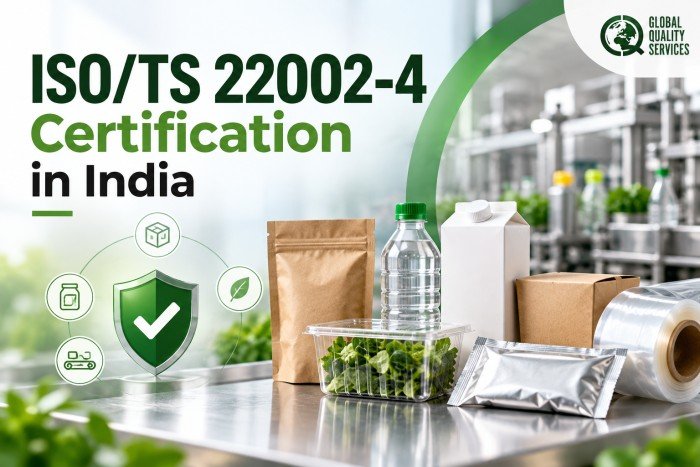
The Indian food processing industry keeps growing, which translates into higher demands for packaging solutions capable of protecting foods through production, storage, and distribution processes. According to a PIB report dated 2026, India’s annual food processing and preservation capacity grew by 34 lakh metric tonnes under the Production Linked Incentive Scheme for Food Processing. The increasing scope of operations raises the stakes in the matter of preventing food safety hazards during packaging production.
ISO/TS 22002-4:2013 was designed as a guidance document setting out prerequisite program (PRP) requirements for food packaging production to facilitate ISO 22000 compliance. However, ISO/TS 22002-4:2013 was withdrawn as of July 29, 2025, and replaced by ISO 22002-4:2025, the most recent version addressing PRPs in food and feed packaging production.
Indian packaging producers need to know about this change while implementing new policies or working towards ISO 22000, FSSC 22000 compliance, or customer audits. Global Quality Services offers consultation services for gap analysis, PRP development, documentation, training, and auditing.
What is ISO/TS 22002-4 Certification
ISO/TS 22002-4:2013 was a technical specification that established prerequisite programme requirements for food packaging manufacturing. Prerequisite programmes are the basic conditions and operating practices needed to maintain a hygienic manufacturing environment and control food safety hazards before they become a problem. For a packaging manufacturer, these controls can involve:
- Facility design and maintenance
- Production area hygiene
- Material and personnel flow
- Utilities
- Equipment
- Cleaning and sanitation
- Pest control
- Supplier management
- Raw material handling
- Storage
- Contamination prevention
- Traceability
- Product withdrawal
- Personnel hygiene
- Food defence
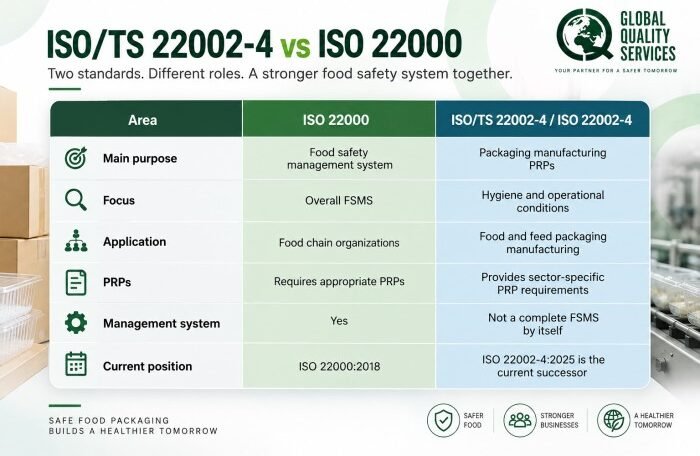
ISO/TS 22002-4 didn’t replace ISO 22000. Where ISO 22000 covers food safety management systems in general, this technical specification specifically focuses on PRPs within packaging manufacturing. It’s just one piece of the puzzle.
Is ISO/TS 22002-4:2013 Still Valid
ISO’s official withdrawn standard page lists the withdrawn date as July 29, 2025, with the replacement standard listed as ISO 22002-4:2025. The evolution looks something like this:
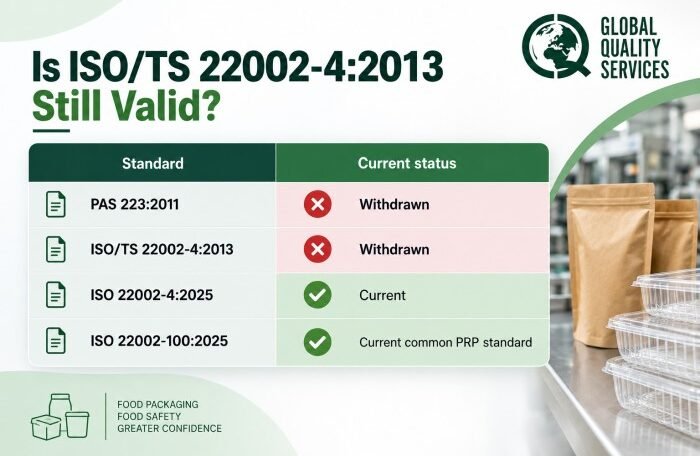
For Indian companies operating with a legacy system built around FSSC 22000, ISO 22000, or bespoke standards that rely on the prior set of PRPs, this update will be crucial to implement successfully. The most important thing is not to assume that existing documentation still covers everything needed to stay compliant. Instead, evaluate your current setup carefully against the new guidelines.
What Replaced ISO/TS 22002-4:2013
The latest edition of this standard, ISO 22002-4:2025, superseded the previous one (ISO/TS 22002-4:2013). Along with ISO 22002-100:2025, it provides specifications for establishing, implementing, and maintaining prerequisite programs for controlling food safety hazards during the manufacture of food and feed packaging.
The structure of the revised ISO 22002 standard includes:
- ISO 22002-100:2025 Common prerequisite program (PRP) requirements applicable to food/feed packaging production in the food, feed and packaging chains
- ISO 22002-4:2025 Specific prerequisite program (PRP) requirements for the manufacture of food/feed packaging products
According to ISO, ISO 22002-100 sets out the generic requirements for PRPs and is designed to complement the appropriate sector-specific document within the ISO 22002 series.
What is ISO 22002-4:2025
ISO 22002-4:2025 is the latest international standard for prerequisite programs in the production of food and feed packaging.
It aims to assist organizations in establishing prerequisites for ensuring safe operations to avoid food safety hazards during the manufacturing of packaging products.
The standard applies to organizations that manufacture food and feed packaging irrespective of their size and complexity. It does not cover other parts of the food chain outside of packaging manufacturing.
In an Indian packaging manufacturing business context, implementing ISO 22002-4 involves applying the standard requirements in the real-world setting of the organization. The company has to assess where food safety risks might occur within the organization and implement necessary control measures accordingly.
Who Needs ISO 22002-4 Requirements
Standard SO 22002-4 applies to organizations involved in producing packaging for foods and feeds and any intermediates used in those products. The precise applicability will depend on your specific operations.
- Plastic food packaging manufacturers
- Flexible packaging manufacturers
- Paper and paperboard packaging manufacturers
- Metal packaging manufacturers
- Glass packaging manufacturers
- Multilayer packaging manufacturers
- Food-contact packaging manufacturers
- Packaging component manufacturers
- Packaging material manufacturers
- Manufacturers of intermediate packaging products
- Suppliers producing packaging for food manufacturers
- Manufacturers producing packaging for feed applications
What Does ISO 22002-4 Cover
ISO 22002-4 includes important prerequisite programs for food and feed packaging manufacturing facilities:
- Facilities and Layout: Facilities need to be hygienic with appropriate materials movement controls.
- Utilities: Access to safe water, air, gases, and other necessary utilities.
- Equipment: Proper equipment should be used and maintained correctly.
- Materials: Proper procurement, examination, and storage procedures are required.
- Contamination Control: Controls are needed to prevent physical, chemical, and biological contaminants.
- Cleaning and Sanitation: There must be proper cleaning procedures and schedules.
- Pest Control: Pest prevention measures need to be in place.
- Personnel Hygiene: Personal hygiene standards must be established, along with appropriate protective clothing requirements.
- Storage and Handling: Appropriate product handling practices are mandatory.
- Traceability: Traceability processes are necessary for materials and packaged products.
- Product Recall: Product withdrawal plans should be developed.
- Food Defense: Food defense plans are needed to protect against intentional contamination and security threats.
ISO/TS 22002-4 vs ISO 22000
ISO/TS 22002-4 and ISO 22000 have different roles:
ISO/TS 22002-4 and FSSC 22000
ISO/TS 22002-4:2013 provided PRP requirements for food packaging manufacturing under the earlier FSSC 22000 framework. Since it is now withdrawn, FSSC 22000 Version 7, released on 1 May 2026, uses the updated ISO 22002-x:2025 series.
For packaging manufacturers, the current framework includes:
ISO 22000 + ISO 22002-100:2025 + ISO 22002-4:2025 + applicable FSSC 22000 additional requirements.
Together, these requirements address the food safety management system, common PRPs, packaging-specific PRPs, and FSSC scheme requirements.
Benefits of Implementing ISO 22002-4 Requirements
Here are the key benefits of implementing ISO 22002-4 requirements:
- More Comprehensive Packaging Safety Controls: The PRP methodology will assist companies in determining any conditions that may influence packaging safety at each stage of production.
- Greater Contamination Prevention: Cleaning procedures, hygienic practices, pest prevention, handling of materials, and environmental controls minimize contamination possibilities.
- Enhanced Supplier Management: The systematic approach to supplier approval and material control improves tracking of ingredients and other externally sourced items.
- Greater Traceability: Identification and documentation help when investigating issues because you can track back to the problematic ingredients or finished goods easily.
- Enhanced Audit Preparation: Procedures and documentation show proof of control, instead of just being on paper.
- Alignment With FSSC 22000 Packaging Certification: Organizations seeking FSSC 22000 packaging certification will find that the relevant ISO 22002-4 standard falls under existing PRPs.
- Building Customer Trust: Food & beverage brands could evaluate their packaging providers based on safety, hygiene, traceability, and material management. The presence of a PRP program indicates that these aspects are systematically handled.
5 Steps to Implement ISO 22002-4 Requirements in India
Here are 5 main steps to achieve ISO 22002-4 requirements in India:
Step 1: Establishing Scope
To begin with, define what products, processes, facilities, and packaging operations are included within scope. In addition, this step will reveal whether ISO 22002-4 certification should be incorporated into ISO 22000/FSSC 22000 implementation.
Step 2: Performing Gap Analysis
Evaluate current facilities, processes, and food safety control measures according to relevant requirements. This reveals existing gaps that require action.
Step 3: Developing and Implementing PRPs
Create or modify procedures concerning cleaning, personal hygiene, pest management, supplier management, storage management, maintenance, and contamination control. Apply these procedures consistently within the premises.
Step 4: Internal Audit
Review compliance with established control measures. Document deviations from established control measures and address these issues appropriately.
Step 5: Get Ready for the Certification Audit
This is where you review everything about the system once more, plug up any outstanding gaps, and prepare staff and documentation for the upcoming audit. If your goal was either FSSC 22000 or ISO 22000 certification, your system moves ahead to its respective certification audit.
Documents and Records for ISO 22002-4 Implementation
- PRP Manual and Procedures
- Cleaning and Sanitation Records
- Pest Control Records
- Supplier and Material Control Records
- Maintenance and Calibration Records
- Traceability and Corrective Action Records
Common Challenges in ISO 22002-4 Implementation
Here are common challenges in ISO 22002-4 implementation:
- Outdated ISO/TS 22002-4 Documentation: There are companies that still rely exclusively on documentation based on the outdated standard published back in 2013. The logical starting point would be to identify changes and relevant requirements.
- Generic Procedures: Cut-and-paste approaches usually include requirements irrelevant to the specific operation. Proper PRPs must reflect real-life operations, including specifics of cleaning, production facilities, inputs, accountability, and verification activities performed by the organization.
- Implementation Issues on the Ground Level: Just signing a procedure is no proof that controls are effective. Audit trail will include documents, observations, corrections, among other aspects.
- Insufficient Supplier Controls: Raw materials, packaging substances, ink, adhesives, and coating agents may affect food safety; hence, supplier approval must reflect the degree of risk involved in the procurement of such products/services.
- Limited Ability to Trace: An inability to easily trace what was put in a certain batch makes food safety investigations unnecessarily challenging.
- Confusion Between ISO Requirements and FSSC Requirements: FSSC 22000 integrates ISO 22000 along with applicable PRPs and additional scheme requirements. Hence, a business preparing itself for FSSC certification needs to understand its entire scope and not merely implement ISO 22002-4.
How Long Does ISO 22002-4 Implementation Take
There is no standard implementation period for every Indian packaging manufacturer. The timeline depends on:
- Facility size
- Number of employees
- Manufacturing processes
- Number of production lines
- Packaging materials produced
- Existing PRPs
- Existing ISO 22000 or FSSC 22000 system
- Facility improvements required
- Documentation gaps
- Training requirements
- Audit readiness
ISO/TS 22002-4 Certification Cost in India
The cost depends on the scope and level of support required. Key cost factors include:
- Number of manufacturing sites
- Facility size
- Employee strength
- Production processes
- Product and packaging categories
- Existing food safety systems
- Documentation status
- Training requirements
- Internal audit support
- Certification audit requirements
- Onsite consultancy requirements
Why Choose Global Quality Services for ISO 22002-4 Consultancy in India
For 26 years, Global Quality Services has been a reputable consulting firm that provides solutions to Indian organizations looking to comply with their certifications through efficient and actionable systems. Our approach centers around providing only what is necessary for your organization without creating any unnecessary documentation.
- Gap Assessment: Gap assessment aims at identifying any gaps and prioritize the necessary improvements to be made.
- Documentation: Customizing the development of PRP documents based on your processes.
- Implementation Assistance: Implementation assistance entails implementing all requirements within your facility.
- Training Employees: Assisting in ensuring your employees understand and implement PRP controls.
- Internal Audit: Identifying gaps and assisting in taking corrective action prior to certification.
- PRP Alignment: Aligning applicable PRPs in line with ISO 22000 and FSSC requirements.
- Certification Audit: Document, record, and personnel readiness preparation for certification audits.
ISO 22002-4 Consultancy Services Across India
Global Quality Services supports food packaging and food-related manufacturing organizations across India. Consultancy support can be provided to organizations in major manufacturing locations including:
- Mumbai
- Pune
- Ahmedabad
- Delhi NCR
- Noida
- Bengaluru
- Chennai
- Hyderabad
Frequently Asked Questions
1. Is ISO/TS 22002-4:2013 current?
Not anymore. ISO/TS 22002-4:2013 became obsolete as of July 29, 2025. The latest version, ISO 22002-4:2025, serves as the replacement document for PRPs in food and feed packaging manufacturing.
2. What replaced ISO/TS 22002-4?
ISO/TS 22002-4 standard has been revised and replaces ISO/TS 22002-4:2013. Application ISO 22002-4:2025 is to be used in conjunction with ISO 22002-100:2025, including the common PRP requirements for the food, feed and packaging supply chain.
3. Can ISO/TS 22002-4:2013 still be applied for a new implementation?
Companies implementing a new system in 2026 need to check the existing ISO 22002-4:2025 standard instead of designing a new system based on the obsolete 2013 ISO 22002-4 specification.
4. Is ISO 22002-4 the same as ISO 22000?
Q2: Is ISO 22000 a food safety management system? A2: Yes. ISO 22000 is a food safety management system standard. ISO 22002-4: Sector-specific prerequisite programme requirements for food and feed packaging manufacturing.
5. Do I Need ISO 22002-4 to Get FSSC 22000 Packaging?
Applicable Packaging Manufacturing PRPs under FSSC 22000 Version 7: ISO 22002-100:2025, ISO 22002-4:2025. The FSSC Version 7 was published on 1 May 2026.