Indian manufacturers supplying cosmetic ingredients to domestic and international brands face growing expectations around quality, consistency, traceability, and manufacturing controls. In August 2026, India’s exports of organic and inorganic chemicals reached US$2.80 billion, up 16.38% year-on-year, according to the Press Information Bureau. For ingredient manufacturers competing in global markets, having a recognised GMP system can help demonstrate that quality controls are built into the manufacturing process.
EFFCI GMP Certification is designed specifically for cosmetic ingredient manufacturers. The standard addresses the quality and manufacturing risks associated with ingredients used in cosmetics and personal care products. It is based on the ISO 9001 structure but adds requirements specific to the cosmetic ingredient supply chain.
Global Quality Services provides EFFCI GMP consultancy in India, covering gap assessment, documentation, implementation, employee training, internal audits, and preparation for the certification audit.
What is EFFCI GMP Certification
EFFCI stands for the European Federation for Cosmetic Ingredients. The organisation developed the EFFCI GMP Standard to provide a certifiable framework for good manufacturing practices specifically for cosmetic ingredients.
Unlike a general quality management standard, EFFCI GMP addresses controls that are relevant to the manufacture and supply of cosmetic ingredients. The framework is built around the ISO 9001 structure and adds requirements related to the specific risks and quality expectations of cosmetic ingredient manufacturing.
The certification is assessed through independent third-party certification bodies recognised by EFFCI. The EFFCI currently lists 20 partner certifying bodies operating across five continents.
Why is EFFCI GMP Certification Important for Indian Manufacturers
Cosmetic ingredient manufacturers need to maintain consistent quality from incoming raw materials through production, testing, storage, and delivery. This becomes even more important when supplying large cosmetic manufacturers or exporting ingredients to overseas markets.
EFFCI GMP helps companies establish controls around these activities and demonstrate that their manufacturing processes follow a recognised industry-specific framework. Key reasons Indian manufacturers pursue certification include:
- Customer requirements: Cosmetic manufacturers may expect suppliers to demonstrate recognised GMP practices.
- Consistent quality: Defined processes and controls help reduce variations between batches.
- Better traceability: Documented records make it easier to track materials, production activities, and finished ingredients.
- Risk control: The standard addresses risks associated with cosmetic ingredient manufacturing.
- Export readiness: Certification can support supplier qualification when approaching international cosmetic companies.
- Stronger quality systems: Companies with ISO 9001 can build on their existing quality management system rather than creating an entirely separate framework.
EFFCI states that its standard is specifically designed for the cosmetic ingredient industry, while SGS notes that it adds cosmetic ingredient-specific requirements to the ISO 9001 structure.
Who Needs EFFCI GMP Certification in India
EFFCI GMP is relevant to organisations involved in manufacturing cosmetic ingredients and raw materials used by cosmetic and personal care manufacturers. It can be considered by:
- Cosmetic ingredient manufacturers
- Natural and botanical ingredient manufacturers
- Synthetic cosmetic ingredient manufacturers
- Essential oil manufacturers
- Fragrance and personal care ingredient manufacturers
- Specialty chemical manufacturers supplying cosmetic ingredients
- Manufacturers of plant-based cosmetic ingredients
- Suppliers producing raw materials for cosmetic formulations
- Export-oriented cosmetic ingredient manufacturers
EFFCI GMP Certification Requirements
EFFCI GMP requirements cover the quality management and operational controls needed to manufacture cosmetic ingredients consistently. Important areas include:
- Quality Management System: The organisation needs a structured quality management system covering responsibilities, procedures, records, monitoring, and improvement activities.
- Management Responsibility: Management must establish appropriate responsibilities, resources, quality objectives, and oversight for the GMP system.
- Personnel and Training: Employees involved in manufacturing and quality-related activities need suitable competence and training for their assigned responsibilities.
- Raw Material and Supplier Controls: Companies need appropriate controls for the selection, approval, receipt, identification, storage, and monitoring of raw materials and suppliers.
- Manufacturing and Process Controls: Production processes should be defined, controlled, monitored, and supported by appropriate records to maintain consistent ingredient quality.
- Quality Control: Testing and quality control activities must support the organisation’s ability to verify that ingredients meet specified requirements.
- Traceability and Records: Records should provide sufficient information to trace materials and production activities through the relevant stages of the manufacturing process.
- Nonconformities and Corrective Action: Companies need a defined method for handling deviations, nonconforming products, complaints, root causes, and corrective actions.
Internal Audits and Management Review
The organisation should regularly evaluate its GMP system through internal audits and management review activities.
The exact implementation requirements depend on the organisation’s scope, manufacturing processes, products, facilities, and existing quality management system.
EFFCI GMP and ISO 9001: What is the Difference
EFFCI GMP is not simply another version of ISO 9001. It uses the ISO 9001 structure while adding requirements that address the specific needs of cosmetic ingredient manufacturing.
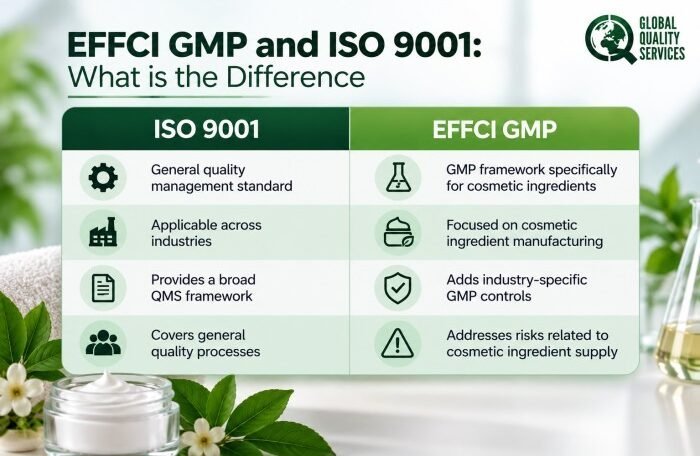
An organisation that already has ISO 9001 certification may therefore have a useful foundation for EFFCI GMP implementation, but it still needs to address the additional EFFCI requirements applicable to its operations.
EFFCI GMP vs ISO 22716
Both standards relate to the cosmetics sector, but their intended application is different. EFFCI GMP focuses on the manufacture of cosmetic ingredients.
ISO 22716 provides GMP guidelines for the manufacture, control, storage, and shipment of cosmetic products.
For example, a company manufacturing an ingredient supplied to cosmetic brands may need to evaluate EFFCI GMP, while a company manufacturing finished creams, lotions, shampoos, or other cosmetic products may need to consider ISO 22716.
The correct certification depends on what the organisation manufactures, its customers, and the requirements applicable to its supply chain.
Benefits of EFFCI GMP Certification
Here are the key benefits of EFFCI GMP certification listed below:
- Demonstrates Controlled Manufacturing: Certification provides independent evidence that the organisation has implemented a GMP framework suited to cosmetic ingredient manufacturing.
- Supports Customer Qualification: A recognised certification can help ingredient manufacturers meet quality expectations during supplier evaluation and qualification.
- Improves Process Consistency: Defined manufacturing and quality controls help organisations maintain greater consistency across production batches.
- Strengthens Traceability: Documented processes and records make it easier to track materials, production activities, testing, and product release.
- Supports International Business: Indian manufacturers supplying overseas cosmetic companies can use certification as part of their quality credentials when dealing with international customers.
- Builds a Stronger Quality System: EFFCI GMP brings together quality management principles and cosmetic ingredient-specific controls, giving manufacturers a structured approach to managing quality risks.
EFFCI GMP Certification Process in India
Global Quality Services can support organisations through the implementation and preparation stages of the certification process.
Step 1: Initial Gap Assessment
We review your existing quality and manufacturing practices against EFFCI GMP requirements and identify areas that need improvement.
Step 2: Documentation Development
Required policies, procedures, work instructions, records, and quality documents are prepared or updated to meet the applicable EFFCI GMP requirements.
Step 3: Implementation & Training
The system is implemented across relevant departments, with employees trained on GMP practices, procedures, responsibilities, and documentation.
Step 4: Internal Audit & Corrective Action
An internal audit checks the effectiveness of the implemented system. Identified gaps and nonconformities are addressed before the certification audit.
Step 5: Certification Audit & Certification
An independent certification body conducts the EFFCI GMP audit. Once applicable requirements are met and findings are closed, the organisation receives its certification.
Documents Required for EFFCI GMP Certification
The documentation required depends on the organisation’s operations and certification scope. Common areas include:
- Quality policies and procedures
- Manufacturing procedures
- Raw material specifications
- Supplier evaluation records
- Production records
- Quality control records
- Testing procedures and results
- Training records
- Equipment maintenance records
- Calibration records
- Cleaning records
- Traceability records
- Product release records
- Complaint handling procedures
- Nonconformity and corrective action records
- Internal audit records
- Management review records
EFFCI GMP Certification Audit
During the certification audit, the certification body evaluates whether the organisation’s documented system and actual operations meet the applicable EFFCI GMP requirements. The audit may include:
- Review of quality documentation
- Assessment of manufacturing areas
- Verification of production controls
- Review of raw material controls
- Examination of quality records
- Employee interviews
- Traceability checks
- Review of corrective actions
- Evaluation of internal audits and management review
How Long Does EFFCI GMP Certification Take in India?
There is no single certification timeline for every organisation. The duration depends on the size of the company, number of manufacturing sites, existing quality system, process complexity, certification scope, documentation status, and audit findings. A typical implementation may include:
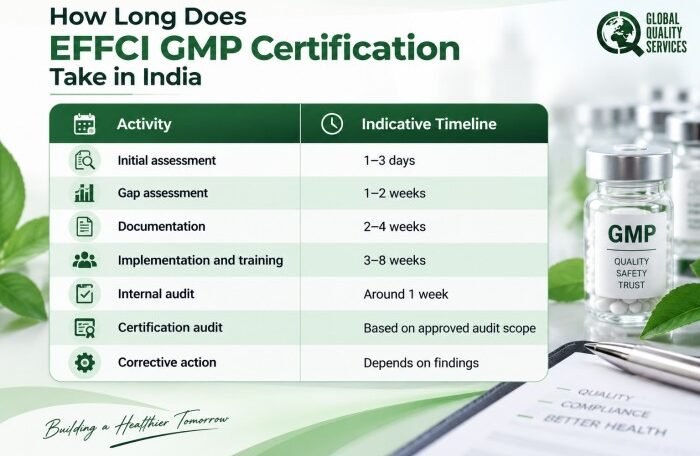
Companies with an established ISO 9001 system may require less preparation in some areas, although the additional EFFCI GMP requirements still need to be addressed.
What Does EFFCI GMP Certification Cost in India?
The cost depends on the organisation’s certification scope and the amount of work required to prepare the system. Factors that influence the total cost include:
- Number of employees
- Number of manufacturing locations
- Manufacturing processes
- Product and ingredient scope
- Existing ISO 9001 system
- Current documentation
- Number and complexity of processes
- Audit duration
- Certification body charges
- Consultancy and implementation requirements
EFFCI GMP Certification for Cosmetic Ingredient Exporters
India has an established chemical manufacturing and export base, with chemical exports continuing to form a significant part of the country’s international trade. The Department of Commerce also identifies CHEMEXCIL as the export promotion council covering areas including cosmetics, toiletries, essential oils, specialty chemicals, and related products.
For manufacturers supplying international cosmetic companies, quality certification can form part of a broader supplier qualification strategy.
EFFCI GMP can help exporters demonstrate that their manufacturing system addresses recognised GMP expectations for cosmetic ingredients. It does not, by itself, replace country-specific regulatory, product safety, registration, labelling, or export requirements.
Why Choose Global Quality Services for EFFCI GMP Certification?
Global Quality Services has 26 years of experience supporting organisations with management system certification, consultancy, documentation, training, and audit preparation. For EFFCI GMP, our support can include:
- Documentation development
- Employee training
- Internal audit
- Management review support
- Certification audit preparation
- Corrective action guidance
- Certification body coordination
Start EFFCI GMP Certification in India
Prepare your cosmetic ingredient manufacturing system for EFFCI GMP certification with structured support from Global Quality Services. Get assistance with gap assessment, documentation, implementation, training, internal audits, and certification audit preparation. Call us to discuss your EFFCI GMP certification requirements in India.