The industrial landscape of Bengaluru is undergoing a massive digital shift. As smart manufacturing, connected supply chains, and Industrial Internet of Things (IIOT) devices integrate into production environments, the vulnerability of operational technology (OT) increases. Recent data highlights the urgency of this transition. According to the 2026 annual compendium report by the Centre of Excellence for Cybersecurity Karnataka (CySecK), Karnataka accounted for nearly 9% of all ransomware cases across India during 2025 and 2026. The report specifically reveals that cyberattacks within Bengaluru skyrocketed to four times the volume recorded in the previous year.
Furthermore, high-profile incidents hitting Indian electronics and automotive manufacturing plants in mid 2026 have shown that attackers heavily target internet-facing operational technology at remote sites. Legacy shop floor systems were never designed to combat modern cyber threats. Achieving compliance with the ISA/IEC 62443 standard is no longer a luxury for industrial facilities. It is a baseline operational requirement to secure infrastructure, protect intellectual property, and guarantee business continuity.
Why Bengaluru Industries Need ISA/IEC 62443 Compliance
Implementing an ISA/IEC 62443 certification is vital for companies operating in India’s primary technological hub. Relying on standard corporate IT security protocols fails to safeguard physical production assets. Industrial facilities require specialized protection due to several critical factors.
- Mitigation of Costly Operational Downtime: Unlike standard IT networks where a breach might compromise emails, an OT cyberattack can completely halt physical assembly lines. For large manufacturing units in Peenya or Electronic City, a single day of production shutdown results in massive revenue losses and supply chain backlogs.
- Protection of Valuable Intellectual Property: Bengaluru houses major global research, development, and engineering design centers. Industrial cyberattacks frequently target proprietary product blueprints, embedded software code, and manufacturing process formulations. Compliance ensures these digital assets remain secure against corporate espionage.
- Establishment of International Market Trust: Global buyers and multinational corporations mandate strict cybersecurity compliance from their supply chain partners. Securing this international certification allows local aerospace, automotive, and electronics manufacturers to qualify for high-ticket global contracts.
- Defense Against Ransomware and Malware Exploits: Modern ransomware groups actively exploit vulnerabilities in interconnected programmable logic controllers (PLCs) and supervisory control and data acquisition (SCADA) systems. This standard provides defensive blueprints to isolate and protect these vulnerable endpoints.
- Clear Separation Between IT and OT Networks: Many legacy factory systems link directly to corporate networks without proper segmentation. This framework introduces clear separation barriers so an administrative email phishing attack cannot cross over and control physical machinery.
Industries That Should Implement ISA/IEC 62443 in Bengaluru
- Automotive and Electric Vehicle Manufacturing Plants
- Aerospace and Defense Component Manufacturers
- Electronics and Semiconductor Fabrication Units
- Pharmaceutical and Chemical Processing Facilities
- Industrial Automation and Control System OEMs
- Power Generation and Renewable Energy Utilities
- Water Treatment and Smart Infrastructure Systems
Our Step-by-Step Certification Roadmap
Achieving full compliance requires a systematic approach that aligns with the specific operational realities of your facility. We utilize a structured four-stage methodology to guide your organization seamlessly from initial evaluation to final audit readiness.
Step 1: Gap Assessment and Asset Discovery
Our consultants conduct an exhaustive inventory of your current operational technology assets. We identify all active network connections, legacy hardware components, software applications, and current access protocols. This stage establishes a baseline by comparing your existing security controls against the precise mandates of the standard.
Step 2: Risk Modeling and Zone Definition
We map out your industrial ecosystem into distinct security zones and conduits. By grouping assets based on their operational criticality, we minimize the risk of lateral threat movement. During this phase, we collaborate with your engineering teams to define realistic Target Security Levels ranging from basic protection to defense against sophisticated, state-sponsored cyber threats.
Step 3: Technical Remediation and Policy Documentation
Our team assists your technical staff in deploying essential security measures. This includes setting up multi-factor authentication, tightening firewall rules, updating system patches, and implementing secure remote access. Concurrently, we draft comprehensive operational policies covering incident response, vendor risk management, and employee security awareness.
Step 4: Mock Audits and Pre-Verification
Before inviting an accredited third-party certification body, we perform a rigorous mock audit. This simulation tests your technical defenses and staff responses under realistic pressure. We identify and resolve any remaining compliance gaps to ensure your formal certification audit proceeds without friction or unexpected delays.
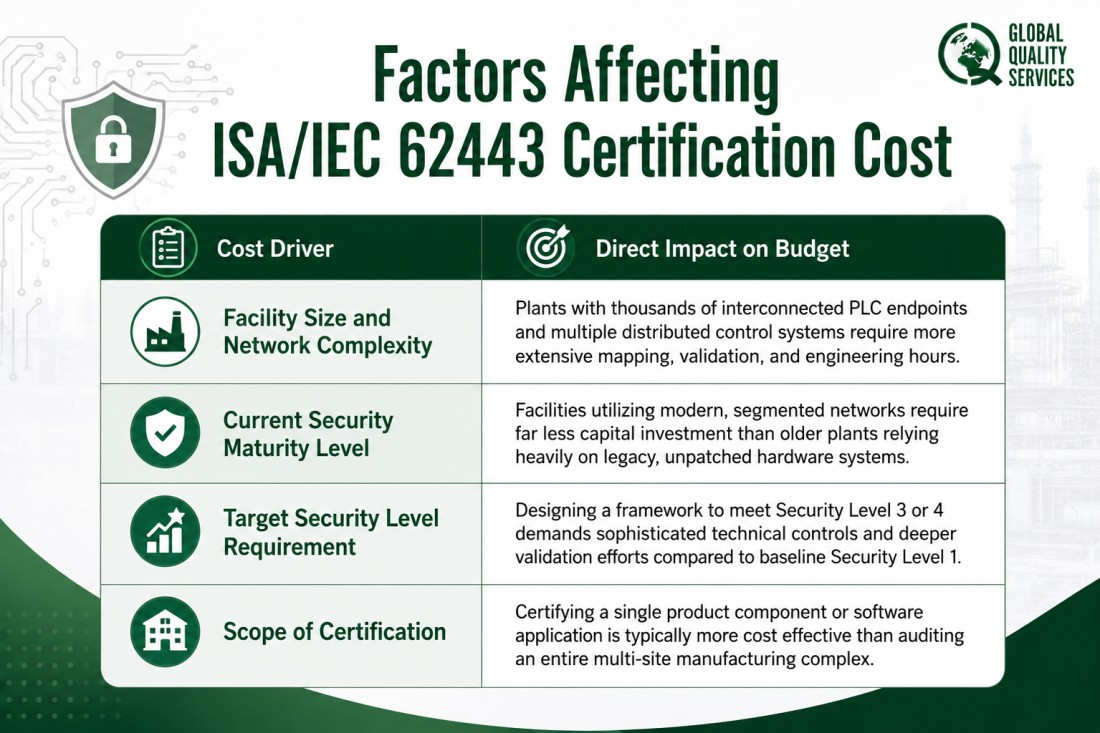
Factors Affecting ISA/IEC 62443 Certification Cost
The financial investment required to achieve certification varies significantly based on several unique organizational variables. Understanding these cost drivers helps businesses budget accurately for their industrial cybersecurity initiatives.
How Does Global Quality Services Support ISA/IEC 62443 Certification Across Bengaluru
Global Quality Services provides end-to-end deployment support that eliminates the complexity of industrial cybersecurity. We understand that your engineering teams need to focus on production throughput, so we manage the heavy administrative and technical lifting of compliance. Our comprehensive support model includes:
- On-site network discovery and physical security assessments across industrial hubs like Peenya, Whitefield, and Bommasandra.
- Customized documentation toolkits including incident response playbooks and vendor risk evaluation matrices that fit your existing corporate workflows.
- Cross-functional alignment sessions that bring your IT security staff and OT engineering teams together under a unified security strategy.
- Detailed technical guidance on selecting and configuring industrial firewalls, intrusion detection systems, and secure endpoint patch managers.
- Liaison support with leading international accredited certification bodies to streamline your final audit scheduling and paperwork submission.
Secure Your Industrial Operations with ISA/IEC 62443 Certification
Securing your automated systems against sophisticated digital threats requires practical, on-site expertise and structured execution. Global Quality Services provides the targeted consulting, comprehensive engineering documentation, and practical deployment support your business needs to protect production continuity and build unshakeable trust with global partners.
Let our local compliance specialists help you transform complex cybersecurity mandates into a clear, strategic business advantage.
- Deploy proven risk mitigation frameworks tailored specifically to your automated factory floor layout.
- Accelerate your path to accredited validation through comprehensive prep audits and mock incident drills.
- Empower your internal engineering teams with practical operational knowledge to sustain ongoing security levels.
Frequently Asked Questions
1. How does ISO 27001 differ from the ISA/IEC 62443 standard?
ISO 27001 focuses on corporate information technology environments to protect data privacy, intellectual property, and business information systems. ISA/IEC 62443 focuses strictly on operational technology environments to ensure the physical safety, reliability, and continuous availability of industrial automation and control systems.
2. Which part of the standard applies to industrial product manufacturers?
Product suppliers and manufacturers must primarily focus on the component and system development lifecycles outlined in parts 4-1 and 4-2. These sections provide specific requirements for embedding secure design practices directly into industrial hardware and software products.
3. Can our internal corporate IT team handle this certification independently?
While corporate IT teams excel at securing databases and corporate networks, they often lack familiarity with physical industrial automation protocols like Modbus or Profibus. Effective deployment requires specialized OT expertise to avoid accidentally disrupting sensitive, real-time machinery during security scans.
4. What is a security zone and conduit in industrial network design?
A security zone is a logical grouping of physical or functional assets that share identical cybersecurity requirements. A conduit is the specific communication path that connects these separate zones, which must be strictly monitored and filtered to prevent unauthorized access from spreading across the facility.
5. How long does the complete consulting and certification lifecycle take?
A typical timeline ranges from eight to fourteen months depending on the initial maturity of your factory network. Smaller component vendors may complete the process faster, while multi-site manufacturing operations require a longer timeframe to systematically execute assessments, remediation steps, and final audits.