Industrial plants and assembly lines across Delhi NCR are connecting their factory floors to digital networks to improve production efficiency. While this shift drives output, it exposes physical machinery, programmable logic controllers (PLCs), and SCADA systems to network security risks. Standard IT frameworks like ISO 27001 protect office computers and company data, but they lack the technical layout required to secure physical engineering operations on a shop floor.
The threat to operational technology (OT) across the region is rising. According to official data from the Press Information Bureau (PIB) India, the Indian Computer Emergency Response Team (CERT-In) tracked 29,44,248 cybersecurity incidents during its latest annual reporting cycle.
For companies operating factories in Delhi, implementing a verified framework through professional consulting partners is now necessary to maintain operational uptime, secure supply chains, and meet strict vendor compliance rules.
Why Businesses in Delhi Need ISA/IEC 62443 Certification
Here are key reasons why businesses in Delhi needISA/IEC 62443 certification:
- Prevents Factory Floor Interruptions: An operational technology breach can freeze an entire production setup. This framework helps plant managers establish distinct security perimeters that prevent vulnerabilities in the office network from reaching manufacturing machinery.
- Secures Proprietary Production Methods: Industrial zones in Okhla, Mayapuri, and surrounding NCR hubs manufacture high-precision products for global firms. Securing industrial controllers prevents the unauthorized modification or theft of proprietary formulas, assembly blueprints, and machinery settings.
- Ensures Compliance with Indian Standards: The Bureau of Indian Standards has formally adopted this framework into national guidelines under the designation IS 16335. Local compliance ensures your factory directly aligns with domestic infrastructure security guidelines.
- Meets International Contract Standards: Global corporations require regional component suppliers to verify their industrial cybersecurity setups. Holding this certification helps local manufacturers qualify for international export bids and high-value supply agreements.
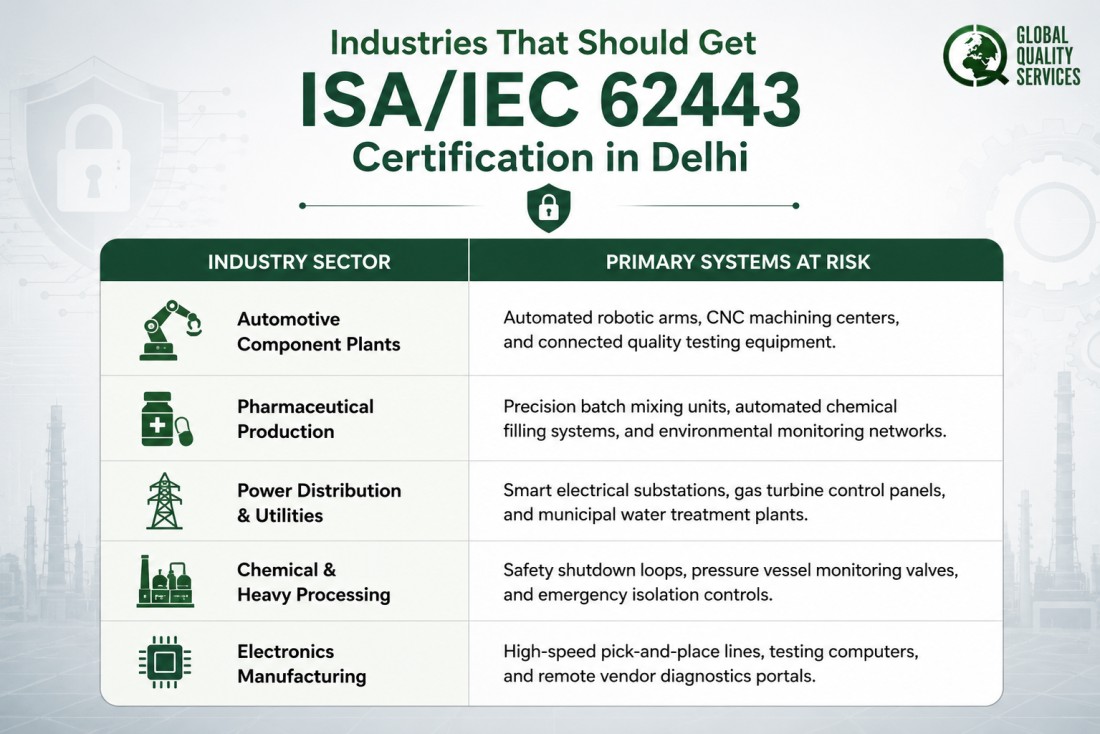
Industries That Should Get ISA/IEC 62443 Certification in Delhi
Our ISA/IEC 62443 Certification Process
Here is a complete process on how we support youthroughout your ISA/IEC 62443 certification process:
Step 1: Network Mapping and Boundary Definition
We start by tracking every industrial asset, communication line, and hardware controller inside your facility. Our team documents every point where your corporate IT network hooks into your machinery networks, ensuring a clear operational boundary for the security audit.
Step 2: Technical Gap Assessment
We inspect your hardware systems, employee login policies, and access controls against the specific clauses of the standard. This step identifies vulnerabilities in your operational setup without pausing your daily production schedules.
Step 3: Risk Zoning and Conduit Design
Our team groups your factory machinery into distinct security zones based on how critical they are to your operations. We then build secure logical pathways between these zones to ensure that a security issue in an auxiliary area cannot spread to stop your main assembly lines.
Step 4: Operational Control Deployment
We guide your plant engineers through the process of updating system security settings. This includes removing default vendor passwords, enforcing access restrictions for maintenance terminals, and setting up clean security logs for your engineering systems.
Step 5: Final Audit Preparation
Before your official third-party audit begins, we run a mock verification check. We test your technical network defenses and review documentation to ensure your staff is fully prepared to clear the compliance check and receive the final certificate.
Common OT Cybersecurity Risks Found During Assessments
Here are common OT cybersecurity risks found during assessments:
- Direct Corporate-to-Machinery Connections: Workstations often sit connected to both the corporate internet and active floor controllers so managers can download fast logs. These unmanaged pathways let standard office threats travel straight down to production lines.
- Unchanged Factory Default Credentials: Industrial switches and programmable controllers frequently run on standard manufacturer login passwords across entire shifts. This makes it impossible to trace system changes to individual personnel during a production error.
- Outdated Hardware Firmware: Critical assembly components often operate on the same factory software code for over a decade. Since these legacy systems cannot run modern antivirus applications, they stay highly vulnerable unless protected by proper network isolation.
- Unmonitored Supplier Access Channels: Third-party maintenance firms regularly use persistent, unmonitored remote connections to check machine health. If a supplier faces an external security breach, their open connection gives unauthorized users a direct entry point to your plant controls.
How Does Global Quality Services Support ISA/IEC 62443 Certification Across Delhi
ISA/IEC 62443 provides a structured framework to secure these systems while supporting safe and reliable operations. Businesses across Delhi benefit from ISA/IEC 62443 certification because it helps them:
- Protect PLCs, SCADA systems, and industrial control networks from cyber attacks.
- Reduce the risk of production downtime caused by ransomware or unauthorized access.
- Build stronger security controls for connected factories and Industrial IoT environments.
- Meet customer requirements for secure manufacturing and supply chain compliance.
- Strengthen business continuity by improving operational resilience.
- Support digital transformation without compromising industrial safety.
- Improve confidence among customers, partners, and stakeholders.
- Establish a systematic approach to managing operational technology cybersecurity risks.
Start Your ISA/IEC 62443 Certification Journey with Global Quality Services
Global Quality Services provides end-to-end consulting, meticulous gap assessments, and structured implementation roadmaps designed to secure your factory systems while preserving continuous manufacturing uptime. Our field-proven engineering approach ensures your operations fulfill global safety requirements, satisfy export vendor qualifications, and withstand operational threats.
- Practical Plant Mapping: We build custom network protection zones tailored around your specific factory floor layout.
- Zero Production Downtime: Our inspection techniques collect necessary infrastructure logs without disrupting your running machinery.
- Verified Local Compliance: We align your operational processes with both domestic IS 16335 and international frameworks.
- Complete Management Support: Our technical experts assist you from the first documentation draft until you clear your final compliance audit.
Partner with our team to secure your facility architecture and establish verified compliance. Contact our technical consulting office today to set up an initial scoping session for your production site.
Frequently Asked Questions
1. What is the difference between ISO 27001 and ISA/IEC 62443?
ISO 27001 targets data privacy and information security for corporate IT networks, covering assets like email servers, business files, and cloud storage. ISA/IEC 62443 focuses exclusively on operational technology (OT), protecting the real-time control networks, physical machinery, and automation systems used on factory floors.
2. How many months does it take to get a factory fully certified?
The complete process typically takes between eight and fourteen months. The exact timeline depends on the scale of your facility, the number of connected automated systems, and how fast your engineering team can apply the required network segmentation updates.
3. Can old manufacturing machinery pass this certification without being replaced?
Yes. The standard does not demand that you purchase new factory machinery. Instead, it allows you to secure older legacy hardware by placing it inside protected network boundaries, restricting access rules, and using dedicated firewalls to shield it from outside networks.
4. Does your firm issue the final compliance certificate directly?
No. Our role is to act as your implementation consultant, which means we handle your gap analysis, design your network zones, and prepare your compliance documents. The final certificate is issued by an independent, accredited third-party certification body after they audit your plant.
5. How frequently does an industrial facility need to renew this certification?
Certified plants undergo yearly tracking audits to ensure that new machine additions or changes to network layouts haven’t compromised security. A full re-certification audit is carried out every three years to maintain the official valid certificate status.