Pune has become a core driver for global technology and manufacturing integration. The Central Government recently earmarked ₹5,000 crore in the Union Budget 2026 to transform Pune into a high-growth economic megahub. This industrial surge runs parallel to rapid smart factory automation.
As plants adopt an interconnected environment, there will be increased risk for OT networks. IACS no longer remains separate from web-exposed IT. It is a necessity for a firm to get the ISA/IEC 62443 certification in order to safeguard their assets and industrial control equipment, as well as to remain eligible as a vendor in other countries.
Why Industries in Pune Need ISA/IEC 62443 Certification
General IT cybersecurity frameworks like ISO 27001 are insufficient for plant floors because they protect data confidentiality. The ISA/IEC 62443 framework explicitly protects physical safety, operational availability, and equipment integrity. Implementing this standard provides direct commercial and operational advantages:
- Securing International Export Contracts: Global automotive OEMs and European aerospace buyers mandate that their tier-one and tier-two supply chain partners prove OT resilience before bidding on new programs.
- Preventing Production Downtime: A single ransomware attack on a factory floor can freeze assembly lines for weeks, causing millions of rupees in daily revenue losses.
- Ensuring Domestic Regulatory Compliance: The Bureau of Indian Standards aligns closely with global safety benchmarks, meaning third-party verified OT security keeps your facility ahead of upcoming national critical infrastructure mandates.
- Protecting Human and Physical Assets: An OT breach can cause boilers to overheat, robotic arms to malfunction, or chemical valves to fail, presenting severe physical risks to plant personnel.
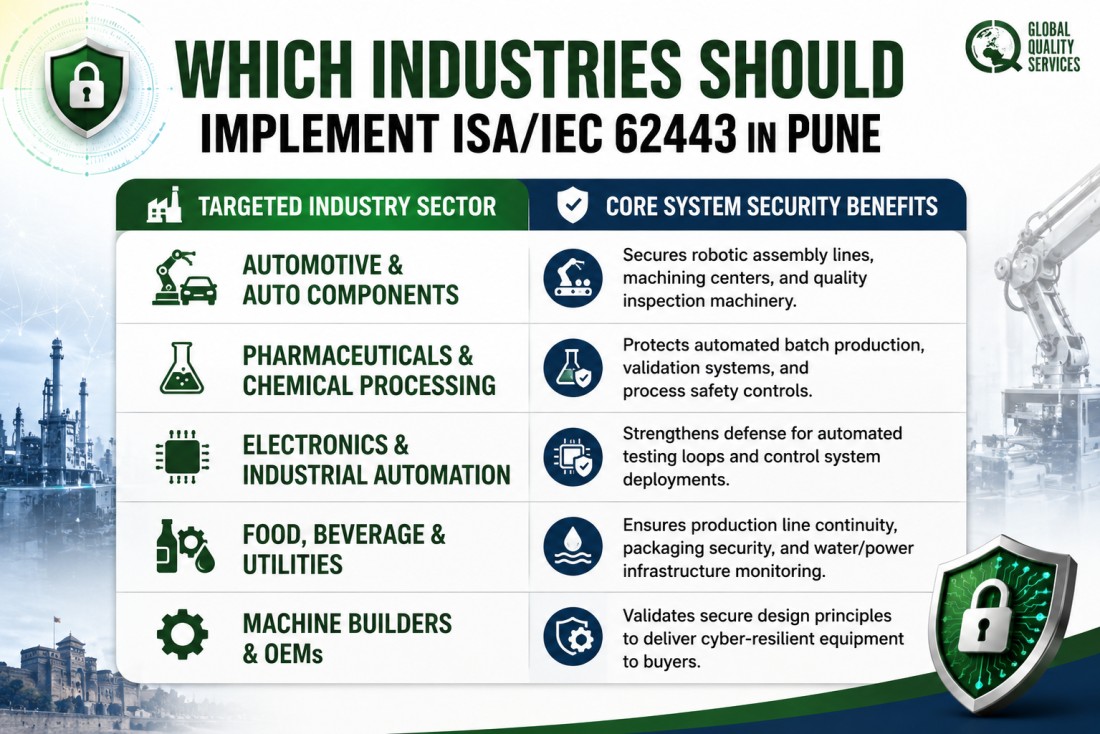
Which Industries Should Implement ISA/IEC 62443 in Pune
Our ISA/IEC 62443 Certification Process in Pune
Achieving compliance requires a structured, phase-based approach that minimizes disruptions to your live manufacturing timelines. Our comprehensive certification roadmap follows five execution steps.
Step 1: Asset Discovery and Gap Analysis
We begin by conducting an on-site evaluation of your facility to map all active OT assets, engineering workstations, and networking devices. We compare your current operational policies against the specific requirements of the standard to pinpoint where security controls are lacking.
Step 2: Defining Zones and Conduits
We logically segment your industrial network into distinct, secure zones based on operational criticality. Communication paths between these zones are established through tightly monitored conduits to contain potential cyber threats and prevent lateral movement across the factory floor.
Step 3: Security Controls Implementation and Remediation
Our team works alongside your plant engineers to deploy practical security modifications. This includes setting up secure remote access protocols for third-party vendors, implementing robust firewall rules, updating legacy patch management policies, and locking down engineering workstations.
Step 4: Pre-Audit Verification and Vulnerability Testing
Before welcoming the external registrar, we conduct a rigorous mock audit. We perform controlled penetration testing on the industrial network and review all policy documentation to confirm that every technical requirement is met.
Step 5: Final Audit and Certification Issuance
We provide full technical support during the final assessment conducted by the accredited certification body. We assist in answering auditor inquiries, addressing minor observations, and finalizing your official compliance status.
Common Industrial Cybersecurity Risks Faced by Pune Manufacturers
Local manufacturers often expose critical factory systems to unnecessary external vectors due to basic architectural oversights:
- Unmonitored Third-Party Vendor Remote Access: External maintenance teams frequently log directly into PLCs via unprotected commercial software, opening clear pathways for supply chain intrusions.
- Shared IT and OT Network Architecture: Allowing office computers and corporate Wi-Fi networks to connect directly to factory SCADA systems exposes plant machinery to standard office phishing or malware campaigns.
- Unpatched Legacy Machinery Operating Systems: Human-Machine Interfaces (HMIs) running unsupported operating systems are highly vulnerable to known exploits because plants fear that updates might interrupt production.
- Inadequate Staff Awareness and Lack of OT Training: Floor operators often connect personal devices to industrial USB ports for charging or basic data transfers, bypassing standard perimeter security firewalls.
Factors Affecting ISA/IEC 62443 Certification Cost
Every manufacturing facility features a unique operational configuration, meaning compliance budgets scale alongside specific architectural realities:
- The Scope and Count of Connected Assets: A single-site component factory running twenty PLCs requires fewer auditing resource hours than a distributed process plant managing thousands of network nodes.
- The Targeted Security Assurance Level: Achieving basic Security Level 1 (protection against casual exposure) is substantially less complex and costly than designing systems for Security Level 3 or 4 (protection against sophisticated, intentional cyber attacks).
- Current State of Network Segregation: If your plant floor is already properly segmented with modern firewalls, the cost of remediation drops compared to a facility running a completely flat network layout.
- The Selection of Certification Tracks: Pursuing component-level product certification (Part 4-2) requires distinct testing laboratory hours compared to securing a plant asset operator framework (Part 3-3).
How Does Global Quality Services Support ISA/IEC 62443 Certification Across Pune
Rather than applying a standard checklist, we focus on understanding your production environment, identifying real risks, and developing a practical implementation roadmap that fits your business. Our support includes:
- Complete ISA/IEC 62443 gap assessments.
- Industrial cybersecurity risk assessments.
- Operational technology security planning.
- Documentation development aligned with certification requirements.
- Security policy and procedure development.
- Internal audit support.
- Certification audit preparation.
- Guidance for continuous improvement after certification.
- Support for organizations of all sizes, from individual facilities to multi-site manufacturing operations.
Get Trusted ISA/IEC 62443 Certification Services in Pune
Being associated with the experienced experts at Global Quality Services will offer you the immediate benefit of possessing knowledge about technology, network segmentation, and audit preparation. The solutions offered by us will help enhance the security of your manufacturing process, overcome compliance problems that lead to hefty fines, and fulfill the requirements of your distinguished international clients.
- Receive a comprehensive roadmap detailing all technical gaps on your plant floor
- Isolate critical manufacturing assets using optimized zone and conduit architectures
- Prepare your operational engineering teams for successful third-party verification
- Establish international credibility to confidently secure premium export contracts
Hasten your compliance process and protect your factory from new operational risks. Contact us at our regional office in Pune for an initial OT security assessment.
Frequently Asked Questions
1. What is the difference between an ISA/IEC 62443 assessment and a penetration test?
An assessment evaluates your entire operational framework, including policies, hardware design, and security lifecycles against standard requirements. A penetration test is a tactical, controlled attempt to breach your active digital perimeters to discover exploitable software vulnerabilities.
2. Can legacy industrial machinery achieve compliance without hardware replacement?
Yes, legacy controllers can be secured by placing them behind dedicated industrial firewalls and secure protocol converters. This approach wraps legacy hardware in a protected network zone, achieving compliance without requiring expensive machinery upgrades.
3. How does the standard apply to outsourced engineering vendors or system integrators?
System integrators must follow Part 2-4 of the standard, which defines strict security program requirements for service providers. This ensures that when external teams design or modify your plant control systems, they maintain secure configuration practices.
4. Does our factory need to halt production during the audit or testing phases?
No, we conduct all network mapping, architecture reviews, and asset discovery passively without disrupting active communications. Any required vulnerability tests are scheduled during planned maintenance windows to avoid production downtime.
5. How often must a certified facility undergo re-auditing to maintain compliance?
Certificates are generally valid for three years, subject to annual surveillance checks. These brief yearly reviews confirm that your plant continues to follow its documented security policies and that new machine additions adhere to established zoning rules.