Bengaluru is one of India’s most influential business hubs, home to global technology companies, advanced manufacturing facilities, aerospace suppliers, biotech firms, and rapidly growing startups. As environmental expectations continue to rise across industries, organizations are under increasing pressure to manage their environmental impact in a structured and measurable way.
This shift is becoming more important as Karnataka strengthens its economic position. According to the Karnataka Economic Survey 2024-25, the state contributes 8.9% of India’s GDP and recorded 7.4% growth during 2024-25, making it one of the country’s strongest industrial economies.
ISO 14001:2026 Certification in Bengaluru provides organizations with a practical framework to improve environmental performance, strengthen compliance, reduce waste, and meet the expectations of customers, regulators, investors, and global supply chains.
Bengaluru’s Push Towards Sustainable Business Growth
Bengaluru’s economy has evolved beyond being a technology center. Today, the city plays a major role in electronics manufacturing, aerospace engineering, healthcare technology, logistics, research, and global capability centers. These industries are increasingly expected to demonstrate responsible environmental practices.
Many organizations are now facing:
- Customer sustainability requirements
- ESG reporting expectations
- Environmental compliance obligations
- Supply chain sustainability assessments
- Resource efficiency targets
ISO 14001:2026 helps businesses establish a structured Environmental Management System (EMS) that allows them to identify environmental risks, control operational impacts, and continually improve performance.
Is Your Organization Ready for ISO 14001:2026?
Your organization may benefit from ISO 14001:2026 if you:
- Hold an existing ISO 14001:2015 certification
- Supply products or services to multinational companies
- Participate in government or private tenders
- Generate industrial waste or emissions
- Operate multiple facilities or sites
- Have sustainability or ESG objectives
- Want to improve resource efficiency and environmental performance
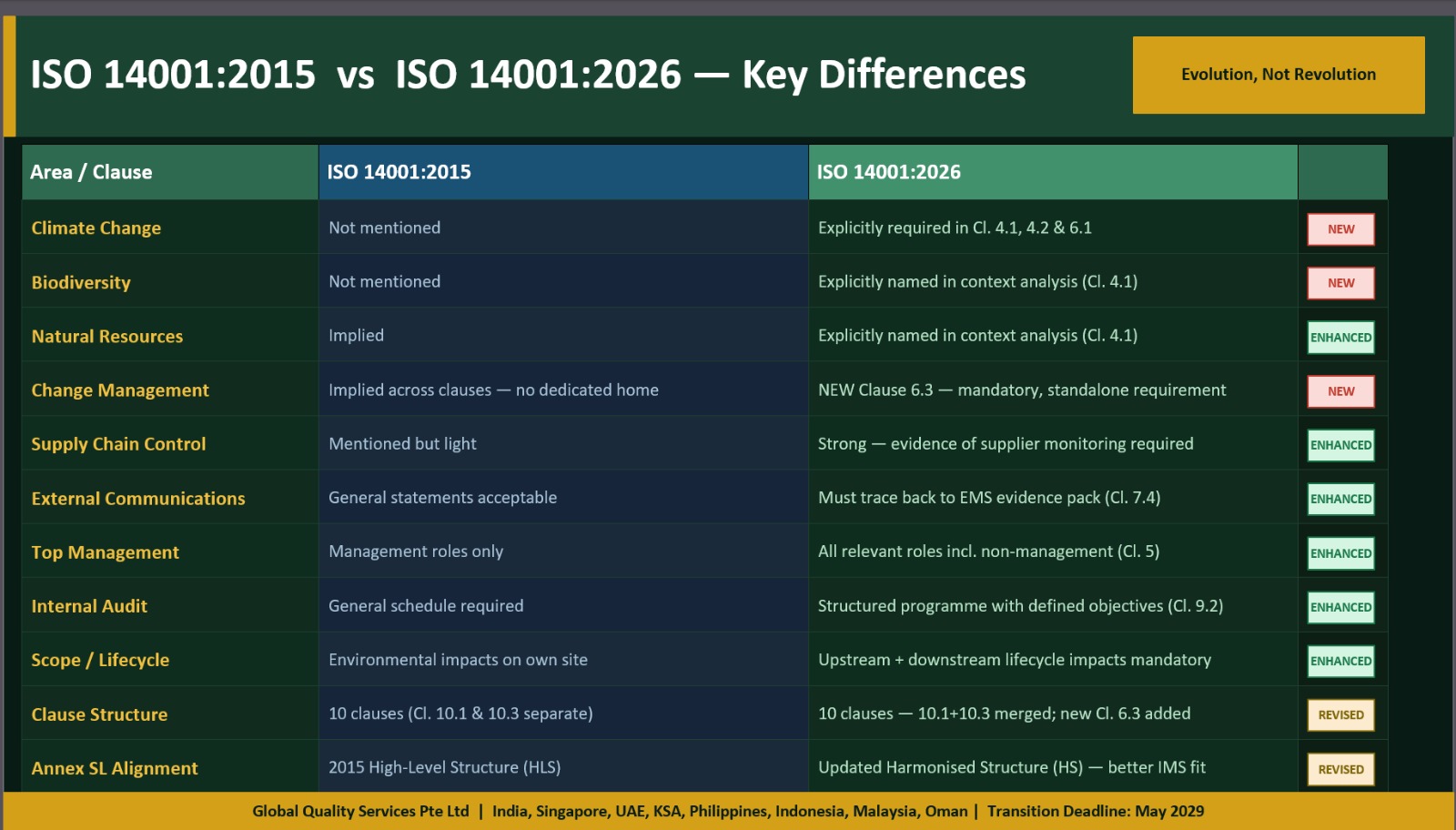
Changes from ISO 14001:2015 to ISO 14001:2026
The revised standard is expected to place greater emphasis on environmental resilience, climate-related considerations, stakeholder expectations, and strategic environmental planning. Some of the key areas organizations should prepare for include:
Where Bengaluru Businesses Are Applying ISO 14001:2026
Environmental management requirements vary by industry. However, the need for structured environmental controls is becoming common across Bengaluru’s business landscape.
- Technology Parks and Corporate Campuses: Large campuses consume significant energy and water resources. ISO 14001 helps organizations manage utilities, waste generation, and sustainability goals more effectively.
- Electronics and Semiconductor Manufacturing: These facilities often deal with chemicals, waste streams, and resource-intensive operations that require robust environmental controls.
- Aerospace and Defense Suppliers: Environmental compliance is increasingly important for organizations operating within global aerospace supply chains.
- Healthcare and Medical Technology: Medical device and healthcare manufacturers are under growing pressure to demonstrate environmental responsibility alongside quality and regulatory compliance.
- Warehousing and Logistics Operations: Environmental management helps logistics companies improve waste handling, energy efficiency, and operational sustainability.
A Practical Roadmap to ISO 14001:2026 Certification
Most organizations move through a few key stages that help them build a system that works in practice and meets certification requirements. Here is a step-by-step process:
Step 1: Review Your Current Setup
Start by looking at your existing environmental practices, policies, and controls. This helps identify what already meets the requirements and where improvements are needed.
Step 2: Put the Right System in Place
Once the gaps are identified, the necessary procedures, records, and environmental objectives are developed or updated. The focus is on creating a system that fits your operations and can be followed consistently.
Step 3: Get Teams Involved
The system is rolled out across the organization, and employees are made aware of their responsibilities. Everyone should understand how their role supports environmental performance.
Step 4: Check What Needs Improvement
Before the certification audit, the system is reviewed internally to make sure it is working as intended. Any issues can be corrected before the external audit takes place.
Step 5: Complete the Certification Audit
An accredited certification body reviews the system and verifies compliance with ISO 14001:2026 requirements. Once certified, the organization continues monitoring and improving its environmental performance.
Common Environmental Challenges Faced by Bengaluru Organizations
While every business is different, several environmental issues are becoming increasingly relevant across Bengaluru.
- Waste Management: The city continues to strengthen waste management initiatives, making proper segregation, handling, and disposal critical for organizations.
- Water Resource Management: Growing demand for water resources is encouraging businesses to focus on conservation, monitoring, and efficient usage.
- Industrial Effluent Management: Industrial areas continue to face challenges related to wastewater management and environmental compliance.
- Energy Consumption: Organizations are under pressure to reduce energy usage and improve operational efficiency.
- Supply Chain Sustainability: Customers increasingly want suppliers to demonstrate environmental responsibility throughout their operations.
How Global Quality Services Supports ISO 14001:2026 Adoption in Bengaluru
Global Quality Services supports organizations throughout the certification journey by helping them build practical environmental management systems that fit their business operations. Support typically includes:
- Initial gap assessments
- EMS documentation development
- Environmental objective planning
- Employee awareness training
- Internal audit support
- Audit readiness assessments
- Multi-site implementation guidance
- Integrated management system support
Smooth Migration to ISO 14001:2026 Starts with the Right Plan
Whether your goal is to upgrade an existing certification or implement a new environmental management system, we at Global Quality Services make your certification process smoother. Here is how an upgrade helps your organization:
- Identify gaps before certification audits
- Update documentation efficiently
- Align environmental objectives with business goals
- Improve audit preparedness
- Reduce transition risks and delays
If your organization is preparing for the next revision, contact us for migration to the 2026 version and receive practical guidance from an experienced ISO 14001:2026 consultant.
We provide ISO 14001:2026 Migration consulting, support for ISO 14001:2026 transfer certification, and tailored ISO 14001:2026 Consultancy services designed around your operational needs and certification objectives.
Frequently Asked Questions
1. How long does ISO 14001:2026 certification take?
The timeline depends on the size, complexity, and readiness of the organization. Most businesses complete implementation and certification within a few months.
2. Will organizations certified to ISO 14001:2015 need to migrate?
Yes. Once transition requirements are formally announced, organizations certified to the previous version will need to migrate within the specified timeframe.
3. Can ISO 14001:2026 be integrated with ISO 9001 and ISO 45001?
Yes. Many organizations implement an integrated management system to simplify compliance and improve operational efficiency.
4. What should organizations review before starting migration?
A gap assessment is usually the best starting point. It helps identify which parts of the existing environmental management system require updates based on revised requirements.