Pune is growing fast as a major manufacturing and technology hub. According to the Press Information Bureau, India’s real Industry Gross Value Added grew by 7% year-on-year in the first half of the financial year 25-26. This massive industrial growth means that local businesses face greater scrutiny regarding their environmental impact.
The International Organization for Standardization released the updated ISO 14001:2026 framework to help companies handle modern climate risks and supply chain challenges. Getting ISO 14001:2026 certification in Pune ensures that your business stays compliant with the Maharashtra Pollution Control Board while building trust with international buyers. It turns environmental management into a clear business advantage.
Why ISO 14001 Certification is Important for Businesses in Pune
As local pollution control authorities tighten rules on industrial discharge and emissions, staying compliant is necessary to prevent costly operational stoppages. Adopting this standard brings clear operational benefits:
- Easier Legal Compliance: It helps businesses track and meet regional environmental laws systematically, saving management from heavy fines.
- Direct Cost Reduction: By reducing energy use, raw material waste, and water consumption, companies notice a direct drop in utility bills.
- Access to Global Tenders: Major international corporations and government bodies require suppliers to hold a valid environmental certificate during the bidding process.
- Smart Risk Management: The system identifies potential environmental emergencies early, reducing the risk of accidental chemical spills or waste leaks.
Which Businesses in Pune Should Implement ISO 14001?
ISO 14001 is suitable for organizations of all sizes. It is particularly valuable for businesses whose operations directly or indirectly affect the environment:
- Automotive Manufacturers and OEM Suppliers: Pune’s automotive ecosystem increasingly faces environmental performance expectations from OEMs and international customers. ISO 14001 helps establish a structured environmental management framework.
- Engineering and Manufacturing Companies: Factories involved in machining, fabrication, assembly, and industrial production can use ISO 14001 to manage waste, emissions, energy consumption, and environmental risks.
- Pharmaceutical and Chemical Companies: Organizations handling chemicals, solvents, or hazardous materials often require stronger environmental controls and compliance processes.
- Logistics and Warehousing Operations: Warehousing facilities and logistics providers can improve fuel management, waste handling, resource efficiency, and sustainability performance.
- Construction and Infrastructure Companies: Construction projects often involve environmental considerations related to waste management, dust control, water usage, and regulatory compliance.
- IT Parks and Corporate Facilities: Large office campuses increasingly adopt ISO 14001 to support sustainability initiatives and improve environmental performance.
Common Environmental Challenges Faced by Businesses in Pune
Many organizations face environmental obligations but struggle with maintaining a structured approach to managing them. Some of the most common challenges include:
|
Environmental Challenge |
Business Impact |
|
Waste generation and disposal |
Increased compliance risk |
|
Energy consumption |
Higher operational costs |
|
Water usage management |
Resource inefficiencies |
|
Air emissions monitoring |
Regulatory concerns |
|
Hazardous material handling |
Safety and environmental risks |
|
Compliance tracking |
Difficulty maintaining records and evidence |
ISO 14001:2026 Certification Process in Pune
Updating your business operations to meet the revised 2026 environmental guidelines requires a clear step-by-step approach. Here is how the process looks:
Step 1 Detailed Gap Analysis
The process starts by comparing your current waste management and resource tracking protocols with the newly released ISO 14001:2026 requirements. This step highlights the exact areas that need updates.
Step 2 System Design and Documentation
Businesses draft clear environmental policies, set measurable goals, and design standard operating procedures. This documentation outlines how the team will handle waste, track energy use, and respond to environmental risks.
Step 3 Staff Training and Execution
Employees across all departments attend simple training sessions to learn their roles in the new system. This step ensures that factory floor workers and office staff follow correct waste segregation and energy-saving rules.
Step 4 Internal Auditing and Refinement
Internal auditors run a mock assessment across the facility to test the practical strength of the environmental policies. This step uncovers small procedural issues, allowing the team to fix them before the final audit.
Step 5 External Certification Auditing
An accredited third-party certification body conducts the official evaluation. The audit happens in two stages, beginning with a document review and finishing with an on-site evaluation of your actual shop floor operations.
Step 6 Annual Surveillance and Maintenance
After receiving the certificate, the business enters a phase of steady improvement. The certification body conducts yearly surveillance audits to ensure the management system adapts to business growth and stays compliant over its three-year cycle.
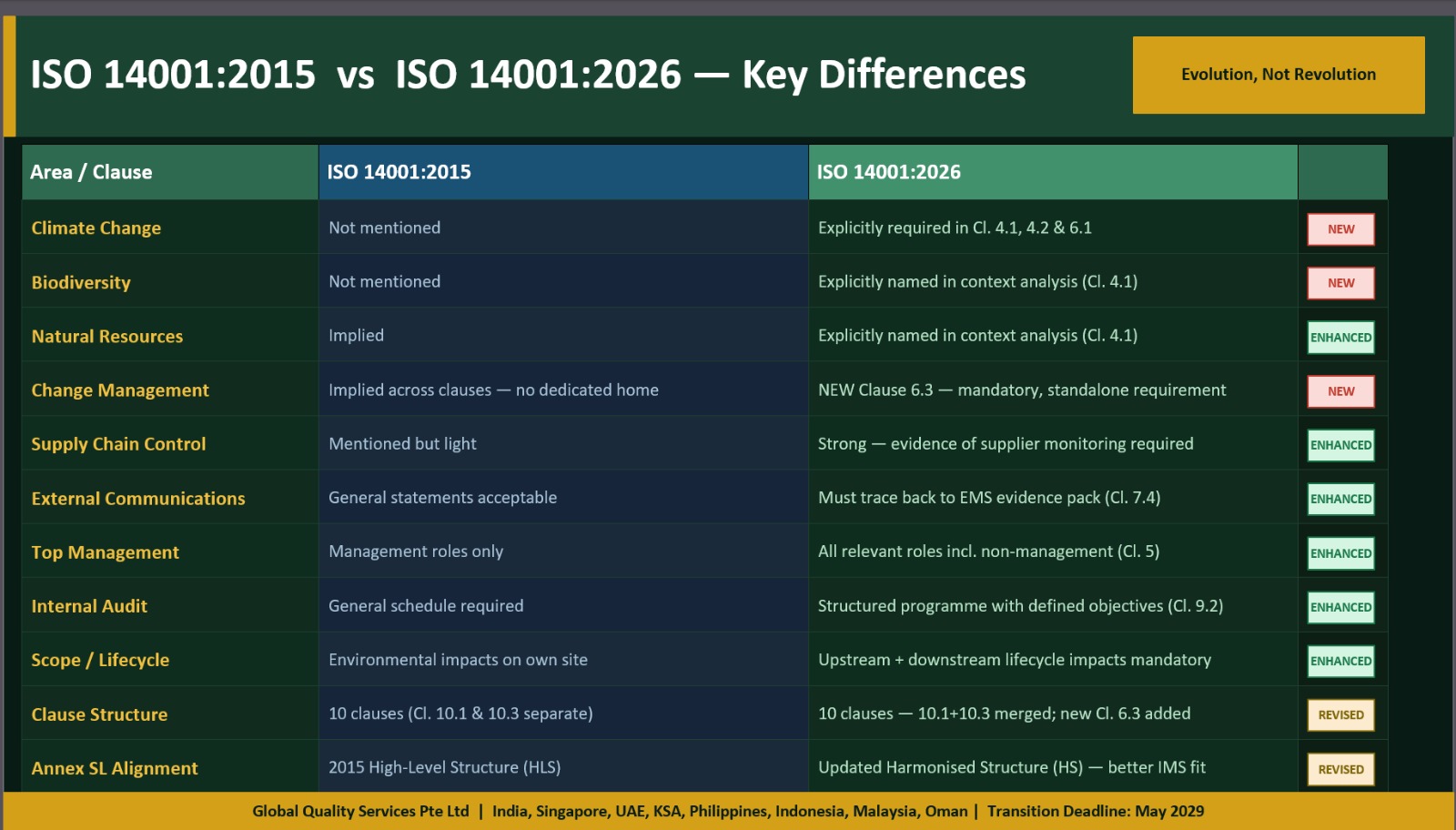
Key Differences Between ISO 14001:2015 and ISO 14001:2026
The 2026 revision is expected to strengthen environmental governance, climate-related considerations, and sustainability integration while maintaining the core EMS framework.
Why Choose Global Quality Services for ISO 14001:2026 Certification in Pune?
Meeting the latest international environmental standards requires a consulting partner who understands global rules and local industrial challenges. The consulting team brings deep experience in building lean environmental management systems that remove unnecessary paperwork.
By aligning international standards with the specific mandates of the Maharashtra Pollution Control Board, the path to compliance becomes clear and cost-effective. The implementation plans focus entirely on practical business benefits, helping your company lower utility bills while winning green-conscious corporate clients.
Migrate to ISO 14001:2026 with Confidence
Businesses in Pune looking to transition to ISO 14001:2026 can benefit from expert guidance to ensure a smooth, timely, and cost-effective upgrade. Whether you require support from an experienced ISO 14001:2026 consultant, need ISO 14001:2026 migration consulting, or are planning an ISO 14001:2026 transfer certification, our team can help you achieve compliance with confidence.
Our ISO 14001:2026 Consultancy Services in Pune Include:
- Migration planning and gap assessment
- Documentation review and system updates
- Internal audit and compliance support
- Employee awareness and auditor training
- ISO 14001:2026 transfer certification assistance
- Certification readiness and implementation support
Contact Global Quality Services today to discuss your ISO 14001:2026 migration requirements in Pune and take the next step toward maintaining a robust and internationally recognized environmental management system.
Frequently Asked Questions
1. How long does ISO 14001 certification take for a business in Pune?
The timeline depends on company size, operational complexity, and existing management systems. Most organizations complete implementation and certification within three to six months.
2. Is ISO 14001 certification mandatory in India?
ISO 14001 certification is voluntary. However, many customers, tenders, and supply chains increasingly expect organizations to demonstrate structured environmental management practices.
3. Can ISO 14001 be integrated with ISO 9001 and ISO 45001?
Yes. ISO 14001 shares a common management system structure with ISO 9001 and ISO 45001, making integration efficient and practical.
4. What documents are typically required for ISO 14001 certification?
Organizations generally need an environmental policy, environmental aspect and impact assessment, compliance obligations register, objectives, operational controls, internal audit records, and management review documentation.
5. How can businesses prepare for an ISO 14001 certification audit?
Preparation typically includes conducting a gap assessment, implementing required controls, training employees, performing internal audits, and addressing identified nonconformities before the certification audit.