India’s focus on industrial energy efficiency continues to grow. In 2025, the Bureau of Energy Efficiency’s Perform, Achieve and Trade program covered 1,333 energy-intensive industries, representing 55% of total industrial energy consumption, with reported energy savings of 25.78 million tonnes of oil equivalent.
ISO 50001:2018 Certification in India helps organizations establish a systematic Energy Management System (EnMS) to improve energy performance, manage energy use and consumption, and support continual improvement.
Organizations across industries can apply the standard, and it is particularly useful for businesses where energy costs, efficiency, operational performance, and sustainability are key priorities. ISO 50001:2018 remains the current edition, confirmed by ISO in 2024.
What Is ISO 50001:2018 Certification?
ISO 50001:2018 is an international standard for establishing, implementing, maintaining, and continually improving an Energy Management System. It provides a structured approach for organizations to understand their energy use, establish energy objectives, monitor performance, and take action to improve energy efficiency and energy performance.
The standard applies to organizations of different sizes and sectors. It can also be integrated with other ISO management systems such as ISO 9001 and ISO 14001.
ISO 50001:2018/Amd 1:2024 and Its Importance
ISO 50001:2018/Amd 1:2024 amends ISO 50001:2018 by adding climate-action considerations to the Energy Management System. Published in February 2024, it requires organizations to consider whether climate change is a relevant issue affecting their energy management system.
Organizations should also consider relevant climate-related requirements and expectations of interested parties. ISO 50001:2018 remains the current edition, with Amendment 1:2024 adding these climate-action considerations rather than replacing the standard.
The amendment helps organizations consider climate-related factors alongside energy performance, energy efficiency, and continual improvement. Organizations implementing or maintaining ISO 50001:2018 should therefore address the applicable requirements of Amendment 1:2024 as part of their Energy Management System.
Key Differences Between ISO 50001:2011 and ISO 50001:2018
| Area | ISO 50001:2011 | ISO 50001:2018 |
|---|---|---|
| Structure | Followed the earlier ISO management-system structure. | Adopted the High-Level Structure (HLS), making integration with standards such as ISO 9001 and ISO 14001 easier. |
| Organizational Context | Less emphasis on understanding the organization’s broader context. | Organizations must consider their context and relevant internal and external issues affecting the EnMS. |
| Leadership | Management responsibilities were defined. | Places stronger emphasis on top management leadership and accountability for energy performance. |
| Energy Performance | Addressed energy performance through the EnMS. | Provides clearer focus on energy performance improvement and how it is evaluated. |
| Energy Performance Indicators (EnPIs) | EnPI requirements were included but had less detailed clarification. | Provides clearer requirements and guidance for establishing and using EnPIs. |
| Energy Baseline (EnB) | Required an energy baseline. | Provides clearer requirements for establishing, maintaining, and adjusting the energy baseline. |
| Energy Data | Required measurement and monitoring of energy use and consumption. | Places greater emphasis on collecting, analyzing, and using energy data to evaluate energy performance. |
| Strategic Integration | Primarily focused on establishing the Energy Management System. | Encourages stronger integration of energy management with the organization’s strategic direction and business processes. |
| Documented Information | Used the concept of documents and records. | Uses the broader ISO concept of documented information, aligned with other modern ISO management standards. |
| Terminology | Earlier terminology and definitions. | Includes updated terms and clearer definitions to improve understanding of energy-management concepts. |
| Integration With Other Systems | Could be aligned with other management systems. | Designed for easier integration with other ISO management systems because of its common structure. |
| Applicability to Organizations | Applicable to organizations of different sizes and sectors. | Maintains broad applicability while providing clearer requirements that can be used by small, medium, and large organizations. |
ISO 50001:2018 Certification Process in India
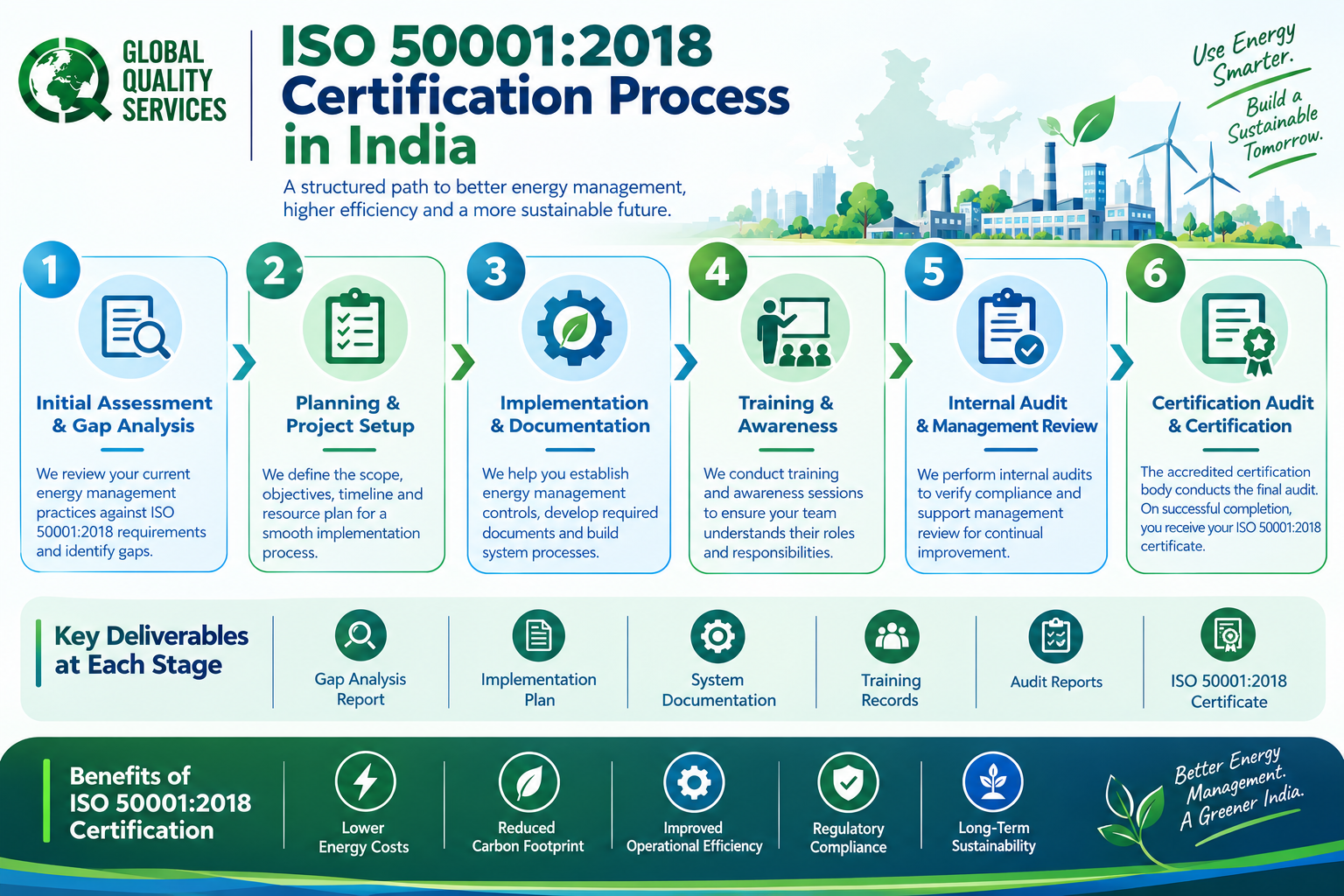
Step 1: Understand ISO 50001 Requirements
The organization reviews the requirements of ISO 50001:2018 and determines how they apply to its operations and energy profile.
Step 2: Conduct a Gap Assessment
The organization reviews existing energy-management practices, records, processes, and controls against the standard’s requirements.
Step 3: Conduct an Energy Review
Evaluate relevant energy sources, consumption patterns, significant energy uses, and opportunities to improve energy performance.
Step 4: Establish the Energy Management System
Develop required policies, objectives, targets, performance indicators, processes, responsibilities, and documentation.
Step 5: Implement the System
The organization implements the Energy Management System across the applicable functions, processes, facilities, and operations.
Step 6: Monitor Energy Performance
The organization monitors energy consumption and relevant performance indicators to evaluate progress against established objectives and targets.
Step 7: Conduct Internal Audit
An internal audit evaluates whether the Energy Management System is effectively implemented and maintained.
Step 8: Conduct Management Review
Top management reviews system performance and identifies opportunities for improvement.
Step 9: Certification Assessment
The organization undergoes an assessment by an applicable certification body.
Step 10: Maintain and Improve the System
After Certification, the organization continues to monitor, audit, review, and improve its Energy Management System.
What Is the 10-Clause Structure of ISO 50001:2018?
ISO 50001:2018 follows the harmonized structure used by modern ISO management system standards. The standard has 10 main clauses, with Clauses 4 to 10 containing the requirements organizations must address for their Energy Management System (EnMS).
Clause 1: Scope
Defines the purpose, intended application, and scope of ISO 50001:2018 for organizations seeking to establish, implement, maintain, and improve an Energy Management System.
Clause 2: Normative References
Identifies the normative references that are essential for applying the standard.
Clause 3: Terms and Definitions
Provides the terminology and definitions used throughout ISO 50001:2018, including terms related to energy performance, energy baselines, Energy Performance Indicators (EnPIs), and the EnMS.
Clause 4: Context of the Organization
Organizations must understand their internal and external context, relevant interested parties, the scope of the EnMS, and the processes required for managing energy performance.
Clause 5: Leadership
Focuses on top management commitment, the energy policy, organizational responsibilities, and accountability for the effective implementation of the EnMS.
Clause 6: Planning
Covers actions to address risks and opportunities, energy objectives, energy targets, energy reviews, energy performance indicators, energy baselines, and planning for achieving energy performance improvements.
Clause 7: Support
Addresses the resources, competence, awareness, communication, and documented information required to support the Energy Management System.
Clause 8: Operation
Focuses on operational planning and control, including the implementation of processes that influence energy performance and the effective control of energy-related operations.
Clause 9: Performance Evaluation
Covers monitoring, measurement, analysis, evaluation of energy performance, compliance evaluation, internal audits, and management review of the EnMS.
Clause 10: Improvement
Addresses nonconformities, corrective actions, and continual improvement of the suitability, adequacy, effectiveness, and energy performance of the EnMS.
Which Organizations Should Consider ISO 50001:2018 Certification in India?
ISO 50001:2018 can be implemented by organizations across different sectors. It is particularly relevant where energy use is significant or where the organization has defined energy-performance objectives.
Manufacturing Companies
Factories often operate energy-intensive machinery, production lines, compressors, boilers, furnaces, HVAC systems, and other equipment. ISO 50001 can help manufacturing organizations establish a structured approach to monitoring and improving energy performance.
Steel and Metal Industries
Steel, aluminum, and other metal-processing industries can have substantial energy requirements across production and processing. An Energy Management System can help these organizations systematically monitor energy use and identify opportunities for improvement.
Cement and Construction Material Companies
Cement and other construction-material manufacturing processes can consume large amounts of energy. ISO 50001 can support better energy planning, monitoring, performance measurement, and continual improvement.
Textile and Garment Industries
Textile operations may consume substantial amounts of electricity and thermal energy across spinning, weaving, dyeing, finishing, and other processes. Energy management can help identify inefficient processes and improve overall energy performance.
Pharmaceutical and Chemical Industries
Pharmaceutical and chemical facilities may have significant energy requirements for HVAC, cleanrooms, production equipment, refrigeration, utilities, and controlled environments. ISO 50001 provides a framework for managing energy-related performance across these activities.
Food and Beverage Industries
Food processing facilities often use refrigeration, boilers, ovens, dryers, compressors, pumps, and other energy-consuming equipment. A structured Energy Management System can help organizations monitor consumption and improve energy efficiency.
Hotels and Commercial Buildings
Hotels, offices, shopping facilities, hospitals, and other commercial buildings can have substantial energy requirements from lighting, HVAC, elevators, refrigeration, and other systems. ISO 50001 can support systematic energy management across these facilities.
Data Centers and IT Facilities
Data centers require continuous power for servers, cooling systems, backup infrastructure, and supporting equipment. Energy management can help operators monitor energy performance and identify opportunities for greater efficiency.
Utilities and Infrastructure Organizations
Organizations operating power, water, transportation, and other infrastructure systems can use ISO 50001 to establish consistent energy-management practices across relevant operations.
Benefits of ISO 50001:2018 Certification in India
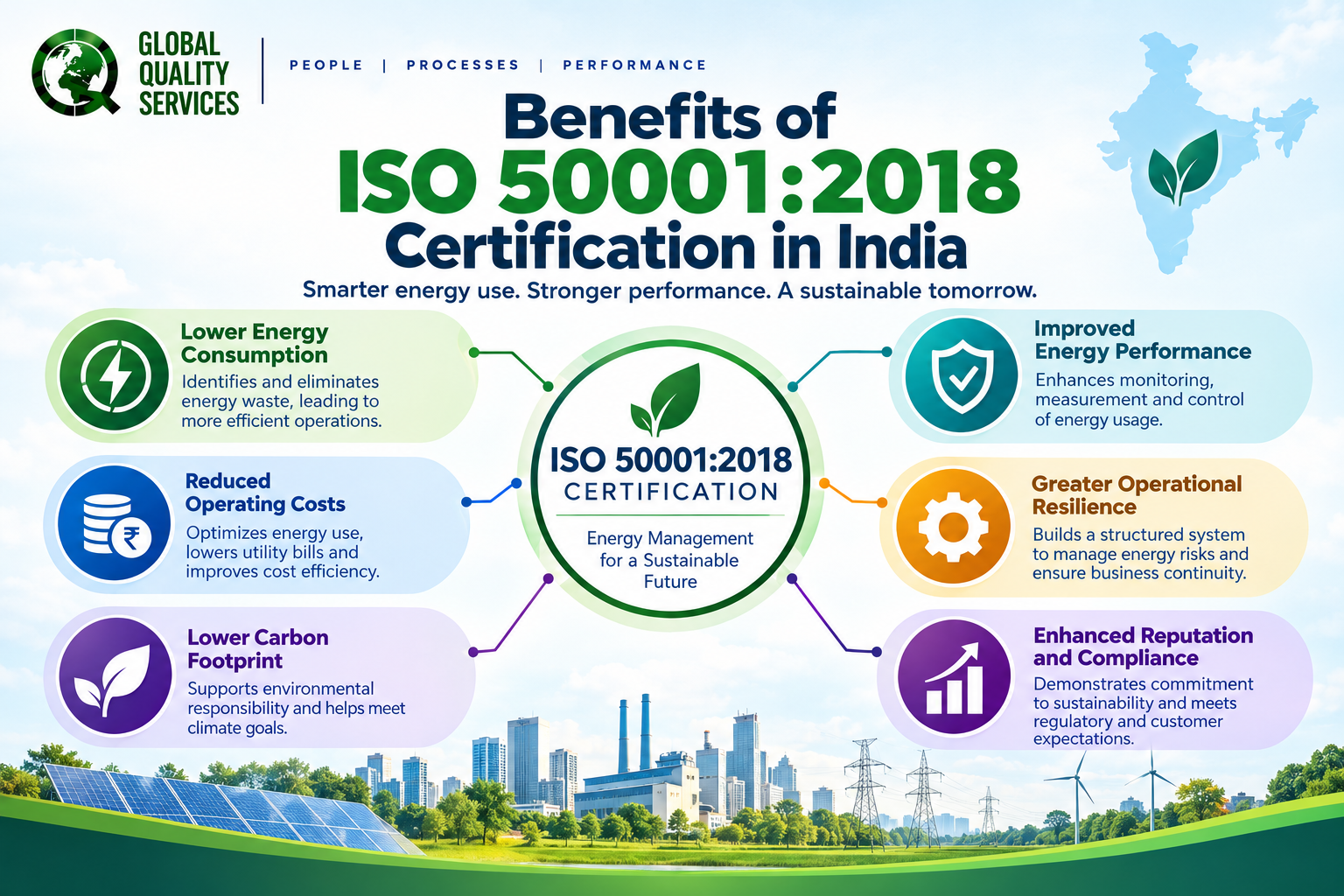
Improved Energy Efficiency
ISO 50001 provides a systematic framework for identifying opportunities to improve energy efficiency and energy performance.
Better Energy Cost Management
Improved visibility into energy consumption can help organizations identify areas where energy use and associated costs can be reduced.
Data-Based Energy Decisions
Energy Performance Indicators and monitoring processes provide organizations with useful information for making informed energy-management decisions.
Reduced Energy Waste
Regular monitoring and evaluation can help organizations identify inefficient processes, equipment, and energy-use patterns.
Improved Operational Performance
Energy management can encourage organizations to examine equipment, processes, maintenance practices, and operational controls that influence energy performance.
Support for Sustainability Goals
Improved energy performance can contribute to organizational sustainability and climate-related objectives.
Stronger Regulatory Awareness
ISO 50001 can help organizations establish structured processes to understand and manage applicable energy-related obligations. It does not, however, replace specific legal or regulatory compliance requirements.
Improved Customer Confidence
Certification can demonstrate to customers, investors, business partners, and other stakeholders that the organization has established a structured approach to energy management.
Integration With Other Management Systems
ISO 50001 follows a management-system approach that can be integrated with other ISO systems where appropriate.
Why Choose Global Quality Services for ISO 50001:2018 Certification?
Global Quality Services offers management-system consultancy and certification preparation support for organizations across different industries.
With experience in management-system standards, GQS can help organizations take a practical approach to ISO 50001 requirements based on their energy profile, operations, facilities, and business objectives.
The objective is to develop an Energy Management System that supports day-to-day operations rather than creating documentation only for certification purposes.
Frequently Asked Questions
What Is ISO 50001:2018 Certification?
ISO 50001:2018 certification shows that an applicable certification body assessed an organization’s Energy Management System against the requirements of ISO 50001:2018.
Is ISO 50001 Mandatory in India?
ISO 50001 certification is generally not mandatory for every organization in India. Certain energy-intensive organizations may have separate obligations under applicable Indian energy-efficiency regulations and programs. Organizations should determine their specific regulatory and contractual requirements before deciding on certification.
Who Can Get ISO 50001:2018 Certification?
Certification for different sizes and sectors can be certified to ISO 50001. It can apply to manufacturing companies, commercial buildings, data centers, hospitals, hotels, logistics organizations, utilities, and many other businesses.
What Is an Energy Management System?
An Energy Management System, or EnMS, is a structured management system used to establish energy policies, objectives, processes, performance measures, and continual improvement practices.
Can ISO 50001 Be Integrated With ISO 9001?
Yes. ISO 50001 uses a management-system structure that can be integrated with ISO 9001, ISO 14001, and other management systems where appropriate.
Is ISO 50001:2018 Still Valid?
Yes. ISO 50001:2018 remains the current edition. ISO reviewed and confirmed the standard in 2024. It also has Amendment 1:2024, which introduces climate-action changes.