

Ahmedabad is growing faster than ever as a global manufacturing and export powerhouse. According to official trade records reported by The Times of India, Ahmedabad crossed the ₹1 lakh crore export milestone for the first time in the financial year 2025 to 2026. The district recorded ₹1.05 lakh crore in exports led by heavy engineering, automobiles, and pharmaceutical shipments. At the same time, commercial real estate data from Cushman & Wakefield confirms that engineering and manufacturing firms accounted for 38% of all commercial leasing activity in Ahmedabad during the first quarter of 2026.
With heavy machinery operating around the clock in industrial hubs like Sanand, Changodar, Vatva, and Naroda, managing physical assets is a top priority for local business owners. Unplanned machine failures directly destroy your profit margins. ISO 55001 certification provides Ahmedabad companies with a proven international system to track equipment, reduce repair costs, and prevent unexpected factory downtime.
Why ISO 55001 Certification Matters for Businesses in Ahmedabad
ISO 55001 Certification helps organizations shift from reactive maintenance to a planned and data-driven approach. Instead of fixing problems after they occur, businesses can identify risks early, improve maintenance planning, and maximize the value of every critical asset. Some of the key reasons businesses in Ahmedabad choose ISO 55001 include:
- Improve the reliability and availability of critical equipment.
- Reduce unexpected breakdowns and production interruptions.
- Increase the lifespan of valuable assets through planned maintenance.
- Make smarter investment decisions using asset performance data.
- Lower maintenance and replacement costs over time.
- Improve compliance with regulatory and contractual requirements.
- Build greater confidence among customers, investors, and stakeholders.
- Support sustainable business growth through efficient asset utilization.
Industries That Should Get ISO 55001 Certification in Ahmedabad
Any business that relies on high-value equipment, utility systems, or physical infrastructure gains a significant financial advantage from structured asset management. In Ahmedabad, five key sectors see immediate financial benefits from certification:
- Automotive and Heavy Engineering: Assembly plants in Sanand use this framework to keep robotic arms, stamping presses, and CNC machines operating with precise accuracy.
- Pharmaceuticals and Chemicals: Drug formulation plants in Changodar and Vatva depend on temperature-controlled vessels and lab instruments that require strict lifecycle logs for regulatory inspection.
- Textiles and Garment Manufacturing: Spinning and weaving mills in Naroda apply asset tracking protocols to stop sudden loom failures and lower energy waste.
- Logistics and Warehousing Operations: Large supply chain hubs along the Sarkhej-Gandhinagar Highway track transport fleets, conveyor systems, and loading dock equipment.
- Infrastructure and Real Estate Developers: Facility managers operating commercial office towers and utility grids in and around GIFT City use the standard to protect structural infrastructure.
ISO 55001 Certification Process in Ahmedabad
Getting certified is a straightforward journey that transforms how your factory floor handles maintenance. Your team will move away from guesswork and adopt clear international standards.
Step 1 Detailed Facility Audit: Operations specialists inspect your current maintenance logs, machinery age, and spare parts inventory to spot hidden risks across the plant floor.
Step 2 Strategic Plan Creation: Leadership writes the Strategic Asset Management Plan. This document connects your factory maintenance schedules directly to your company revenue targets.
Step 3 Preventive Action Setup: Plant engineers set up clear workflows for early equipment checks and establish safe operational limits for every critical machine.
Step 4 Staff Training: Machine operators and floor supervisors learn how to log equipment data correctly and spot early signs of mechanical wear.
Step 5 Internal System Review: Qualified internal auditors walk through your facility to check if technicians are following the new maintenance habits.
Step 6 Final Verification Audit: An independent certification agency visits your Ahmedabad facility to verify your documentation and inspect live plant operations before issuing the official certificate.
Common Asset Management Challenges Businesses Face
Implementing ISO 55001 helps organizations solve these exact issues by replacing guesswork with a step-by-step system to track and maintain assets throughout their entire lifespan. Here are the most common challenges businesses face before organizing their asset management:
1. Unplanned Equipment Downtime
When a critical machine breaks down out of nowhere, everything stops. Production lines freeze, project deadlines get missed, and customers lose trust. Waiting for things to break before fixing them causes massive disruptions that ruin your weekly output numbers.
2. Skyrocketing Repair Costs
Running to fix emergencies always costs more than regular upkeep. Emergency technician fees, rushed spare parts shipping, and last-minute fixes drain your operational budget quickly. Businesses without a clear asset plan end up burning cash on constant damage control rather than planned, cost-effective maintenance.
3. Blind Spots in Machine Performance
If your asset data is scattered across different spreadsheets, paper logs, or isolated departments, you cannot see the big picture. Leadership teams struggle to know which machines are running efficiently and which ones are about to fail.
4. Shorter Equipment Lifespans
Bad maintenance habits destroy expensive machinery long before its time. When equipment wears out prematurely, businesses have to spend massive amounts of capital on early replacements.
5. Reactive Maintenance Habits
Many factories still operate on a reactive basis, meaning repairs only start after an asset stops working completely. This old-fashioned approach maximizes your downtime and stretches your budget thin. Shifting to a planned, preventive routine improves your plant reliability and cuts out surprise business interruptions.
6. Unmanaged Operational Risks
Neglected machinery creates serious hidden dangers. Equipment that does not receive regular safety checks can cause workplace accidents, environmental leaks, or total system failures. Spotting these risks early lets your team fix them quietly before they turn into major liabilities.
7. Guesswork in Financial Budgeting
Without solid data on how your machines are performing, planning next year’s budget feels like throwing darts in the dark. Executive teams struggle to predict exactly when a facility needs major repairs or when an assembly line needs a total replacement.
8. Messy Operations Across Multiple Sites
Companies with more than one factory or branch often deal with completely different maintenance standards at each location. One site might take perfect care of their gear while another site ignores basic checkups.
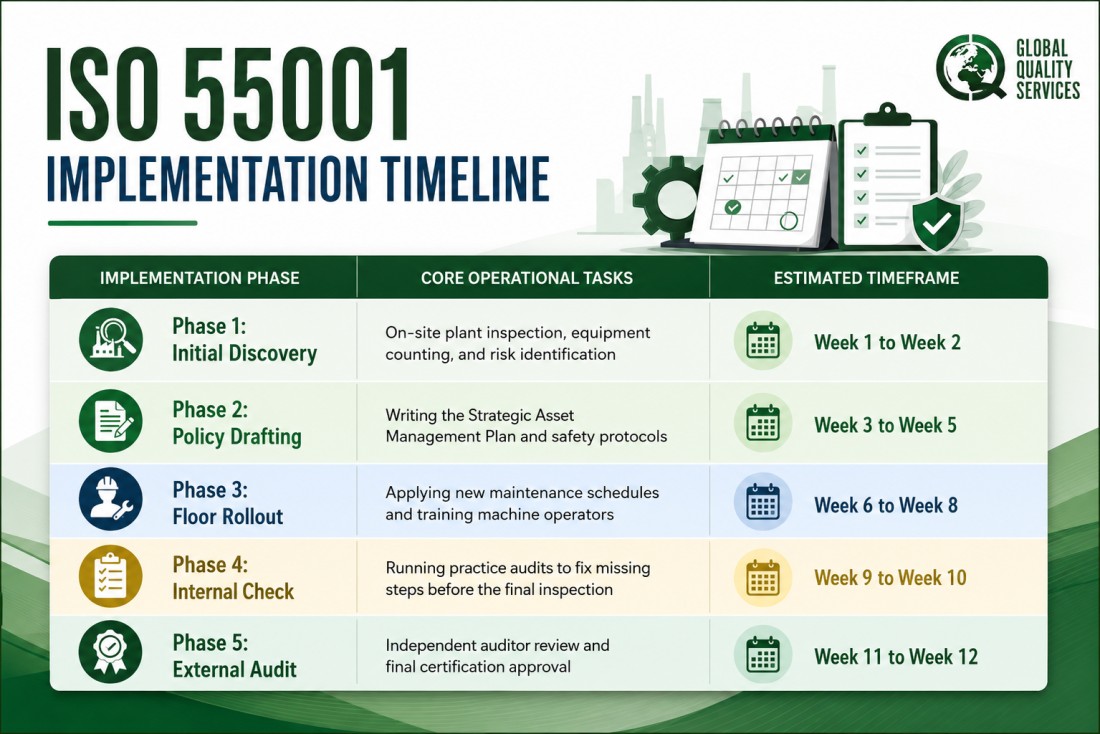
ISO 55001 Implementation Timeline
The time required to achieve full certification depends on the size of your facility and the total number of physical assets you manage. Below is a realistic schedule for an industrial plant operating in Ahmedabad.
How Does Global Quality Services Support ISO 55001 Certification Across Ahmedabad
Setting up an advanced asset management system requires deep knowledge of local industry habits and global quality standards. A standard template copied from the internet will never fit the unique setup of an Ahmedabad manufacturing plant. Experienced consultants help you build practical workflows that fit your factory floor without stopping daily production.
- Localized knowledge of Ahmedabad industrial belts including Sanand, Changodar, Vatva, and Naroda
- Custom documentation written specifically for your machinery and utility systems
- Practical floor training designed for daily machine operators and maintenance engineers
- Complete audit preparation that eliminates compliance errors before the official inspection occurs
- Ongoing annual support to keep your certification active and up to date
Take total control over your factory equipment today to eliminate unexpected mechanical failures and boost your bottom line. Partnering with Global Quality Services gives your business hands-on consulting, custom documentation, and expert floor training tailored specifically for industrial leaders across Gujarat.
Protect Your Factory Machinery with Expert ISO 55001 Consulting
Stop spending your operational budget on expensive emergency repairs and premature equipment replacements. Implementing an ISO 55001 system helps you shift from reactive firefighting to a predictable, cost-saving maintenance routine. Collaborate with Global Quality Services to build a resilient asset management culture that satisfies international quality buyers and keeps your factory running at peak efficiency year after year.
- Step-by-step gap assessments and custom Strategic Asset Management Plans
- Practical strategies designed to lower your total cost of equipment ownership
- Continuous post-certification support during annual ISO 55001 surveillance reviews
Frequently Asked Questions
1. What is the main difference between ISO 9001 and ISO 55001?
ISO 9001 focuses on product quality and consistent customer service. ISO 55001 focuses specifically on managing physical equipment, machinery, and infrastructure to extend asset life and stop mechanical breakdowns.
2. How much does ISO 55001 certification cost for an Ahmedabad factory?
Costs depend on the size of your facility, your total asset count, and the complexity of your equipment. Your investment covers consulting support to build the system and the audit fees paid to the independent certification agency.
3. Can small manufacturing businesses apply for this standard?
Yes. The standard scales easily for small machining workshops and large assembly plants alike. Small businesses use the standard to organize maintenance logs, prevent costly equipment damage, and qualify for bank loans.
4. How long does the ISO 55001 certificate remain valid?
The official certificate stays valid for three years from the date of issue. Your facility must pass a short annual checkup audit every twelve months to confirm that your maintenance system remains active.
5. Do we need to buy expensive software to get certified?
No. The standard does not force you to buy specialized software. You can easily pass the audit using organized digital spreadsheets and clear written repair manuals.