Responsible Business Alliance Certification in Pune helps organisations strengthen labour practices, workplace health and safety, environmental management, business ethics, and responsible supply-chain practices. It is particularly relevant to companies supplying electronics, technology, engineering, manufacturing, automotive, and other global supply chains where customers expect suppliers to demonstrate responsible business practices.
The Responsible Business Alliance (RBA) Code of Conduct provides social, environmental, and ethical standards for organisations and their supply chains. Although the RBA originated in the electronics industry, its Code is now applicable to and used by organisations across multiple industries. The current RBA Code of Conduct Version 8.0 became effective on January 1, 2024.
For companies in Pune, RBA requirements can become particularly important when supplying multinational companies, electronics manufacturers, technology companies, engineering organisations, or customers with responsible sourcing requirements.
Global Quality Services helps organisations understand applicable RBA requirements, identify gaps, strengthen their management practices, prepare evidence, and get ready for customer assessments or applicable RBA audit programmes.
What Is Responsible Business Alliance Certification?
The Responsible Business Alliance is an industry initiative focused on responsible business practices across global supply chains. Its Code of Conduct covers five broad areas: labour, health and safety, environment, ethics, and management systems. The Code draws on recognised international principles and standards, including ILO labour standards, the Universal Declaration of Human Rights, OECD Guidelines, ISO standards, and other international frameworks.
For a Pune-based organisation, preparing for RBA requirements means looking beyond written policies. The organisation needs to demonstrate that responsible practices are actually implemented across its workplace and, where applicable, its supply chain.
This can involve reviewing worker conditions, working hours, wages, health and safety controls, environmental practices, ethical conduct, supplier management, grievance mechanisms, training, records, and corrective actions.
RBA is not an Indian government-issued statutory certification. The applicable requirement may come from an RBA programme, customer, multinational buyer, or supply-chain contract. Organisations must continue to meet all applicable Indian and Maharashtra legal requirements separately.
What Are the Benefits of Responsible Business Alliance Certification in Pune?
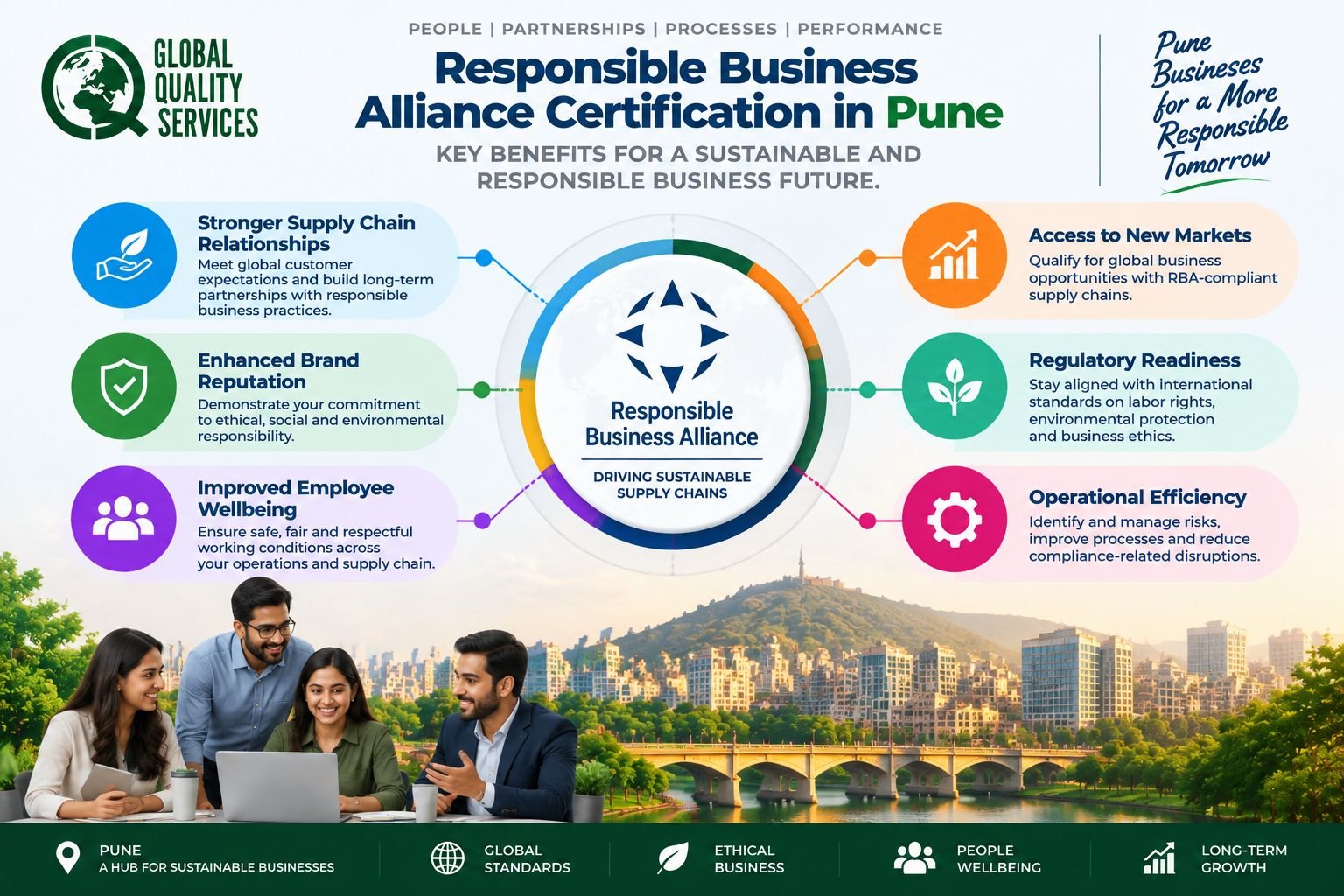
Better Labour and Human Rights Practices
RBA provides a structured way to review employment practices, including working hours, wages and benefits, non-discrimination, freedom of association, worker treatment, and other labour-related requirements.
This helps organisations identify gaps between their written policies and actual workplace practices.
Safer Working Conditions
Health and safety requirements cover the systems organisations use to identify and control workplace hazards.
Depending on the nature of the facility, this can include machine safety, emergency preparedness, fire protection, chemical handling, occupational health, personal protective equipment, and worker training.
Stronger Environmental Practices
RBA includes environmental expectations covering areas such as environmental permits, pollution prevention, resource consumption, waste management, and environmental risks.
For manufacturing organisations in Pune, this can help create more systematic controls around factory-level environmental responsibilities.
Improved Business Ethics
Responsible business also includes ethical conduct. Organisations can review areas such as anti-corruption, conflicts of interest, protection of intellectual property, responsible disclosure, and other ethical risks.
Clear policies combined with implementation and monitoring can provide stronger evidence of ethical business practices.
Better Supply-Chain Management
Responsible business expectations can extend beyond an organisation’s own facility.
Companies may need to understand how suppliers and business partners address labour, environmental, safety, and ethical risks. A structured RBA approach can help establish supplier expectations and improve monitoring.
Greater Customer Readiness
Global customers may request social compliance information, supplier questionnaires, audit reports, corrective-action evidence, or other responsible sourcing information.
Preparing against RBA requirements can help Pune organisations organise their policies, records, responsibilities, and evidence before customer assessments take place.
What Is the RBA Certification and Assessment Process in Pune?
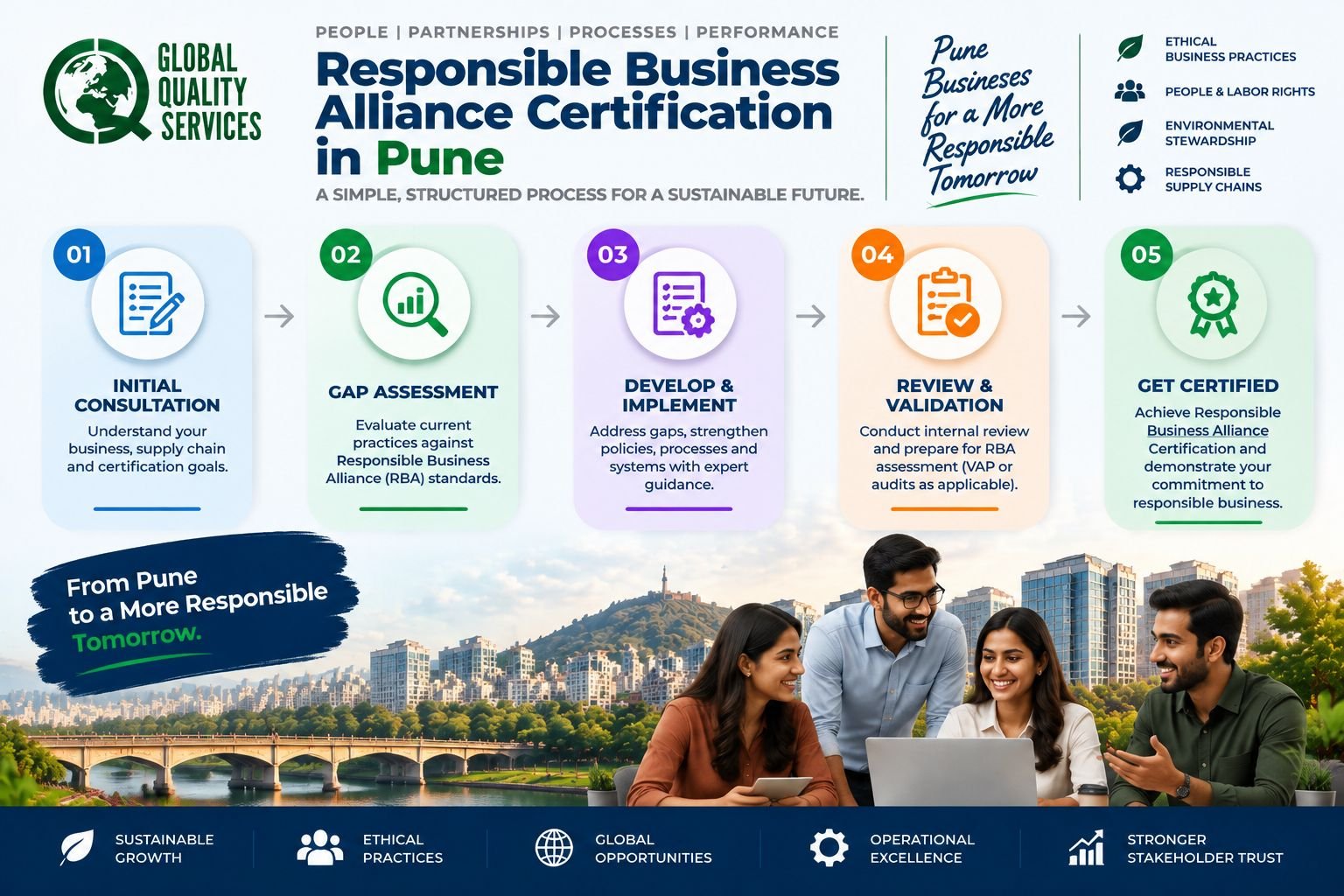
Step 1: Identify Applicable RBA Requirements
The organisation first determines which RBA requirements apply to its operations, workforce, products, customers, suppliers, and business relationships.
Customer-specific requirements should also be identified because a customer may have additional responsible sourcing expectations.
Step 2: Conduct an RBA Gap Assessment
Existing labour, health and safety, environmental, ethics, and management practices are reviewed against the applicable requirements.
The assessment should consider both documentation and actual implementation.
This is important because having a policy on paper does not by itself demonstrate that the organisation is following the required practice.
Step 3: Review Labour Practices
The organisation reviews areas such as employment records, wages, working hours, worker contracts, recruitment practices, discrimination and harassment controls, grievance mechanisms, and worker communication.
Where applicable, special attention should also be given to risks relating to forced labour and child labour.
Step 4: Review Health and Safety Controls
Workplace hazards are identified and existing controls are reviewed.
Depending on the organisation’s activities, this may include fire and emergency preparedness, machine safety, electrical safety, chemical management, occupational health, PPE, incident reporting, and worker training.
Step 5: Review Environmental Controls
The organisation reviews its environmental responsibilities, including applicable permits, waste management, emissions, hazardous substances, resource use, water management, and pollution prevention.
Records should demonstrate that relevant environmental controls are being implemented.
Step 6: Strengthen Ethics and Management Systems
Policies and procedures covering business ethics, risk assessment, accountability, communication, training, supplier management, documentation, and corrective action are reviewed and improved where required.
Step 7: Correct Identified Gaps
Gaps identified during the assessment are assigned to responsible teams and addressed through corrective actions.
The organisation should maintain evidence showing what was identified, what action was taken, who was responsible, and how effectiveness was verified.
Step 8: Prepare for the Applicable Assessment
Once the required controls have been implemented, the organisation can prepare for the applicable customer assessment or RBA audit programme.
The RBA operates different audit programmes, including the Validated Assessment Program (VAP), Customer Managed Audit (CMA), Auditee Managed Audit (AMA), and specialty audits. RBA states that participating audit firms and auditors for its audit programmes are subject to RBA approval requirements.
Areas We Cover in Pune
Global Quality Services provides RBA consultancy and readiness support across major business and industrial areas of Pune and the surrounding region.
This includes Hinjawadi, Baner, Wakad, Aundh, Kharadi, Viman Nagar, Kalyani Nagar, Yerawada, Hadapsar, Magarpatta, Pimpri, Chinchwad, Bhosari, Chakan, Talegaon, Ranjangaon, Talawade, Narhe, Kondhwa, and surrounding industrial areas.
The wider Pune region has an established IT, ITeS, engineering, electronics, automotive, and manufacturing ecosystem. Maharashtra’s IT and ITeS policy identifies Pune Metropolitan Region as a major area within the state’s IT and ITeS framework.
Maharashtra’s government also maintains policy support for electronics, IT, ITeS, emerging technologies, and related manufacturing and technology sectors. The state’s Electronics, Information Technology and Artificial Intelligence Department, established in 2026, has a mandate covering electronics, IT, AI, cybersecurity, data governance, digital infrastructure, and emerging technologies.
What Government Rules or Laws Apply to RBA in Pune?
RBA requirements are separate from Indian statutory compliance. RBA is an industry-led framework and does not replace the laws and regulations that apply to organisations operating in Pune.
Companies must continue to comply with applicable Indian and Maharashtra requirements relating to employment, wages, occupational health and safety, environmental protection, waste management, pollution control, factories and industrial operations, and other sector-specific obligations.
At the same time, a customer may impose RBA-related requirements that go beyond minimum statutory obligations.
Maharashtra has established policy frameworks supporting IT, ITeS, electronics, engineering, and manufacturing. The Maharashtra IT and ITES Policy 2023 aims to strengthen the state’s position as a competitive IT and ITeS destination and includes Pune within its regional framework.
The Maharashtra government also maintains policies for electronics and other industrial sectors, supporting manufacturing, technology development, research, engineering, and related activities.
Organisations should therefore treat RBA as an additional responsible-business and supply-chain requirement, while maintaining full compliance with applicable statutory obligations.
How Can Global Quality Services Help?
Global Quality Services can help Pune organisations prepare for RBA requirements through a practical gap-based approach.
Our support can include RBA gap assessment, labour and human rights review, health and safety review, environmental compliance review, ethics and management-system review, supplier-management support, documentation review, corrective-action planning, worker and management awareness, and assessment readiness.
The objective is not simply to create policies. The organisation needs to demonstrate that its policies are implemented and supported by appropriate records and evidence.
GQS can help identify weaknesses, establish practical controls, assign responsibilities, improve documentation, and prepare the organisation for customer or applicable RBA assessment requirements.
For organisations supplying multinational customers, this approach can also help create a more organised response to responsible sourcing questionnaires, supplier evaluations, social compliance reviews, and corrective-action requests.
FAQs About Responsible Business Alliance Certification in Pune
Is Responsible Business Alliance Certification mandatory in Pune?
No. RBA is not a mandatory government certification in Pune or elsewhere in India. However, a multinational customer, buyer, or supply-chain programme may require a supplier to demonstrate alignment with the RBA Code or participate in an applicable assessment.
What does the RBA Code of Conduct cover?
The RBA Code covers labour, health and safety, environment, ethics, and management systems. Version 8.0 became effective on January 1, 2024.
Is RBA only applicable to electronics companies?
No. While the RBA originated in the electronics industry, the organisation states that its Code is applicable to and used by many industries beyond electronics.
Does RBA certification replace Indian labour or environmental laws?
No. RBA requirements do not replace Indian statutory requirements. Organisations must continue to comply with applicable labour, employment, environmental, safety, waste-management, and other legal obligations.
Can GQS provide RBA consultancy in Pune?
Yes. Global Quality Services can provide RBA consultancy and assessment-readiness support for organisations in Pune. This can include gap assessment, documentation review, implementation guidance, corrective-action support, supplier-management guidance, and preparation for applicable customer or RBA-related assessments.